Saturday, April 30, 2011

Growing Diversity Of The H1N1 Virus


# 5531


When the 2009 H1N1 virus emerged just over two years ago, the assumption was that it would begin to evolve (or mutate) fairly rapidly.


There were real concerns that it might quickly pick up oseltamivir (Tamiflu) resistance, and even some worries it might hook up (reassort) with the H5N1 avian flu and produce some kind of Frankenswine Virus.


Instead, for the first 12 months or so, we received assurances from the CDC and the World Health Organization (WHO) that the virus was unusually stable.


What few variations that were seen were reportedly antigenically very similar to the A/California/7/2009 H1N1 virus that the vaccine was based upon. 


But of course, some changes, and variations, were observed.


There were a handful of oseltamivir resistant cases reported – most (but not all) appeared to have developed spontaneously in a patient actually taking the drug.


During a 14-month period (April 2009-June 2010) 6,740 H1N1 samples were submitted to US surveillance systems for testing, and of those, only 37 (.5%) proved resistant to oseltamivir.


This kind of resistance is usually caused by a mutation (H275Y) where a single amino acid substitution (histidine (H) to tyrosine (Y)) occurs at neuraminidase position 275.


*          *         *          *           *           *


The D225G `Norway’ mutation made headlines in November of 2009, but it was observed in both mild and severe cases, and so it wasn’t at all clear what the clinical significance was (see Eurosurveillance: Debating The D222G/N Mutation In H1N1).


But with millions of infected hosts (people/birds/pigs) replicating trillions of copies of the virus every day, mutations were inevitable, and viral evolution was bound to take hold.


Many were `flashes in the pan’, and due to inferior biological fitness, failed to propagate well.  But by the middle of 2010, we began to see some subclades of the 2009 H1N1 virus that had exhibited some traction. 


Notably the A/Hong Kong/2213/2010 and the A/Christchurch/16/2010 (highlighted by D222N) subgroups.


In September of 2010, the WHO Influenza Centre in London released an analysis of the evolution of the H1N1 and seasonal viruses to be used in deciding the makeup of the Southern Hemisphere 2011 flu vaccine.  


They acknowledged these new subgroups (and others), but stated (bolding mine):


The A(H1N1) pandemic 2009 viruses propagated at NIMR remain antigenically similar to the vaccine virus A/California/7/2009.  Fewer low reactors have been detected in 2010 than was observed in 2009.


New genetic sub-clades have been detected but they do not appear antigenically distinct from the majority of A(H1N1) pandemic 2009 viruses collected since the start of the pandemic.


Not quite the same thing as saying that all of the viruses collected are antigenically close to the vaccine strain.  But we live in an imperfect world.


Herein lies the dilemma for those who must choose which virus strains to include in a vaccine 6 months before it can be deployed.  


The influenza virus is a constantly moving target.


And unlike a school of fish, that all change direction at  at the same time, flu viruses go their own way.   It’s very messy.   And very difficult to predict.


Worse, it is entirely possible that you can have a field of viruses circulating with enough antigenic diversity that not all of them can be covered by the vaccine.  The best you can hope for is to include the most prevalent strains.


Hence the occasional reports of `vaccine escapes’, and `low reactors’.  


Actually we see a similar situation every year when the vaccine committees choose one of the two B viruses (Yamagata or Victoria strain) to include in the vaccine. Some people who take the flu vaccine will be unlucky enough to catch the strain not included that year. 


Flu vaccines, most years, are pretty good.  But they aren’t perfect.  And some years they miss the mark badly.


As I tell people, if you want a guarantee . . . buy a Craftsman.


By late 2010 another subgroup A/England/142/2010 began to spread widely across Europe.  


By the end of the 2010-2011 flu season (week 16), at least in the European theatre – its prevalence had nearly equaled the number of A/California/7/2009-like isolates detected.


image

Chart based on data from Euroflu Report Week 16 : 18/04/2011-24/04/2011


In other parts of the world, the A/Hong Kong and A/Christchurch strains had much larger shares of the influenza pie.


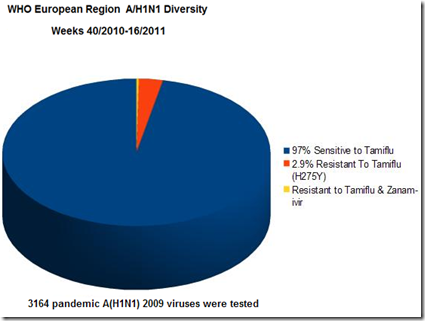
As far as antiviral resistance goes (again from the WHO surveillance of Europe) we find that it is only slowly increasing, with the overwhelming majority of isolates tested still showing sensitivity to Tamiflu. 
 

image


But as we move further downrange from the emergence of the 2009 H1N1 virus, the odds are that we’ll see more diversity in the subgroups, more `low reactors’, and more antiviral resistance.


If a virus – which leaves behind immunity in the host – fails to evolve into a new antigenically different strain, it will eventually die out due to a lack of susceptible hosts.


Survival demands that the virus evolve. 


And in recent months we’ve seen reports – particularly out of Europe – suggesting that may be happening, as the effectiveness of the seasonal flu vaccine over the 2010-2011 flu season had dropped.  


CIDRAP covered this report in late March.


Preliminary studies show lower flu-shot effectiveness in Europe

Robert Roos * News Editor

Mar 21, 2011 (CIDRAP News) – Preliminary studies suggest that this year's trivalent seasonal flu vaccine used in Europe was less effective against the 2009 H1N1 virus than last year's monovalent H1N1 vaccine was, possibly because of some degree of mutation in the virus, according to recent reports in Eurosurveillance.

(Continue . . . )


Which brings us to an interesting report, mentioned by CIDRAP last night in their news roundup, coming from the US Department of Defense (DoD).


It states that recent outbreaks of H1N1 in Venezuela and Mexico's Chihuahua state need to be monitored because they has been linked to severe infections and deaths, including some patients who had received the vaccine.


Initial analysis are suggesting that the Mexico group (inDRE1945) of H1N1 does not fall into previously characterized  A/England/142/2010, A/Christchurch/16/2010 (highlighted by D222N), or A/Hong Kong/2213/2010 subclades.


image

http://airforcemedicine.afms.mil/idc/groups/public/documents/afms/ctb_152827.pdf


These outbreaks have been well monitored for more than a month by the newshounds on the flu forums, including in this thread on FluTrackers, which has more than 250 entries.  


But what to make of all this is less than clear.


Sub clades of circulating influenza viruses emerge all the time.  Some disappear almost immediately, others linger in the background for awhile, sputter and die. 


A very few take off like a rocket.


It is a case of survival of the fittest. The virus that evades acquired immunity the best, replicates well, and transmits the most efficiently usually wins the race.  


At least for a while.


In the world of influenza viruses, nothing is permanent, the status quo never lasts for long, and the only constant is change.


Obviously, anything that increases the virulence, or moves the virus away from our acquired immunity (through prior infection or vaccines), is of concern.


But whether this suspected branch in H1N1’s evolution in Mexico & Latin America proves to have `legs’, remains to be seen.


It is possible that after a relatively mild second year of A/H1N1/2009, we could see a more severe flu season come the fall due to evolution of the virus.  


It’s happened before.


In 1957, the Asian Flu pandemic seemed to disappear completely for more than a year, only to return in 1959 and again after a two year lull during the 1962-63 flu season.  


image

NEJM 2009


With the Northern Hemisphere’s flu season at an end, we’ll be looking to the events south of the equator over the next six months to give us some hint of what may be in store for next fall.


Stay tuned.

Friday, April 29, 2011

Measles: Forgotten, But Not Gone


# 5530


Measles, which was once almost a youth’s `rite of passage’ in the United States, has been all but eliminated in recent years after the introduction of the first measles vaccine in 1963.


The chart below (source: CDC) shows the remarkable effectiveness of the vaccination campaign.


image


While many parents today think of measles as a relatively benign childhood illness, it actually produced significant morbidity and mortality with respiratory, ocular, and neurological complications - sometimes resulting in death.


During the 1950s – before the introduction of the measles vaccine – in the United States the disease infected roughly 4 million, hospitalized nearly 50,000,  and contributed to the deaths of several hundred every year.  


Admittedly, a vast improvement over the mortality rates from earlier in the century, when the disease was far deadlier (for reasons that quite frankly, remain hard to explain – Ian York explored this fascinating mystery in Measles week, part I: Introduction ).


But in recent years lower uptake of the vaccine – its reputation tainted by (disproven) claims of a possible link to autism (popularized by Dr. Andrew Wakefield and promoted by various anti-vaccination groups) – and the continual importation of the disease from countries where it remains endemic - have allowed the virus to keep a toehold in developed nations.


In developing countries, the incidence – and mortality rate – of measles remains high.   These statistics from the World Health Organization:


Measles

Fact sheet N°286

Key facts
  • Measles is one of the leading causes of death among young children even though a safe and cost-effective vaccine is available.
  • In 2008, there were 164 000 measles deaths globally – nearly 450 deaths every day or 18 deaths every hour.
  • More than 95% of measles deaths occur in low-income countries with weak health infrastructures.
  • Measles vaccination resulted in a 78% drop in measles deaths between 2000 and 2008 worldwide.
  • In 2008, about 83% of the world's children received one dose of measles vaccine by their first birthday through routine health services – up from 72% in 2000.


Today news on measles from several fronts. 


First, the WHO’s  WER (Weekly Epidemiological Record) brings us details on an ongoing measles outbreak in Europe, that has infected more than 6,500 people in 33 nations.


Measles outbreaks in Europe

As of 18 April 2011, 33 countries in Europe had reported  6500 measles cases. Epidemiological investigations and genotyping have confirmed transmission of measles virus among several countries in the Region and in the Americas.

<SNIP>

In all these outbreaks, except for the second out-
break in Spain and the outbreak in Turkey, the
D4
genotype
of measles virus has been confirmed.
The B3 genotype of measles virus was isolated
from cases in the second measles outbreak in
Spain, while the D9 genotype, originating from
and common in south-east Asia (e.g. Malaysia and
Indonesia) was confirmed to have caused the out-
break in Istanbul (Turkey) in January 2011.

(Continue . . . )


As you can see, there are a number of different strains or genotypes of measles.  New ones emerge, or are detected, every so often.  As of mid-2010, the World Health Organization (WHO) maintained reference strains representing 23 recognized genotypes.


From Eurosurveillance this week, a report on a novel strain of (an existing genotype:G3) of measles which has spread across Europe over a 2 month period.


Eurosurveillance, Volume 16, Issue 17, 28 April 2011

Rapid communications

Appearance of a novel measles G3 strain in multiple European countries within a two month period, 2010

K E Brown, M N Mulders, F Freymuth, S Santibanez, M M Mosquera, S Cordey, J Beirnes, S Shulga, R Myers, D Featherstone

During late 2010, a previously unrecognised strain of measles genotype G3 virus was identified in five different European countries by the World Health Organization Measles and Rubella Laboratory Network. Apart from one, none had a travel history to south-east Asia, the usual source of G3 viruses, although epidemiological links could be established between some of the cases. This case series illustrates the value of genotyping and sequencing in tracking measles infections, and identifying otherwise unrecognised chains of transmission.

(Continue . . . )


And next, from the Journal of Infectious Diseases a report on the impact of an outbreak of measles in Tucson, Arizona in 2008 that affected two healthcare facilities. 


Health Care–Associated Measles Outbreak in the United States After an Importation: Challenges and Economic Impact


J Infect Dis. (2011) jir115 first published online April 28, 2011 doi:10.1093/infdis/jir115

Sanny Y. Chen,

Shoana Anderson, Preeta K. Kutty, Francelli Lugo, Michelle McDonald, Paul A. Rota, Ismael R. Ortega-Sanchez, Ken Komatsu, Gregory L. Armstrong, Rebecca Sunenshine, and Jane F. Seward


You can follow the above link to read the entire article, or for the short version, you can read the press release from the IDSA.


Infectious Diseases Society of America

Measles outbreak underscores need for continued vigilance in health care settings

[EMBARGOED FOR APRIL 29, 2011] The U.S. measles vaccination program has been successful in eliminating endemic measles in the United States; yet this success has provided challenges that require ongoing vigilance for the rapid identification and response to measles cases in health care settings. In 2008, the largest reported health care-associated measles outbreak in the United States since 1989 occurred in Tucson, Arizona, costing approximately $800,000 in response and containment efforts. In a report published in The Journal of Infectious Diseases and available online, researchers identify preventive measures hospitals and health care facilities can implement to reduce the likelihood and decrease the economic impact of a future measles outbreak in these settings.


Due to a highly effective vaccine and high vaccine coverage, measles was declared eliminated in the United States in 2000; however, the potential for measles infection still exists in this country. Non-adherence to U.S. vaccination recommendations and infection among unvaccinated travelers coming into the United States continue to pose potential threats to the public and to health care personnel. In the 2008 Tucson outbreak, an unvaccinated, infected Swiss traveler visited a hospital emergency department on February 12. The traveler was admitted to the hospital the next day, but a measles diagnosis was not confirmed until February 20. This ignited an intense and lengthy public health investigation and response to persons with suspected and confirmed measles as well as contacts of those persons.

(Continue . . . )


And again from the Journal of Infectious diseases, an editorial comment on the above study by Stephen M. Ostroff.  

The full text of both articles is freely available.


EDITORIAL COMMENTARY:

Stephen M. Ostroff

Measles: Going, Going, But Not Gone

J Infect Dis. (2011) jir125 first published online April 28, 2011 doi:10.1093/infdis/jir125


While not the scourge of the early 20th century in the United States, measles remains a serious public health threat in much of the world, and is only held at bay in developed countries by relatively high vaccination rates.


There is a lot more to the measles story, and I highly recommend reading the entire Mystery Rays blog series on the disease by Ian York from 2010.


Measles week, part I: Introduction

Measles week, part II: Emerging disease

Measles week, Part III: Not the answers

Measles week, part IV: Some of the answers

Measles week, Part V: What about the vaccine?


            Thursday, April 28, 2011

            Hint: Don’t Order The `Possum On the Half Shell’


            # 5529


            Nine-banded Armadillo -wikipedia


            Armadillo and road kill jokes abound in the south (Why did the chicken cross the road?  . . .  To prove to the armadillo it can be done). But apparently some people actually do indulge in that cliché of a southern delicacy – known in finer rural dining establishments as `possum on the half shell’.


            I’ll not bother to debate the culinary merits of armadillo stew, since I’m fully aware that tastes (of people, and presumably armadillos) vary. A lesson learned after I once futilely tried to explain `grits’ to friend from the UK while she countered with vividly told tales of `the haggis’.  


            Neither of us gained much ground with the other.


            Different strokes, I guess.


            But it is worth noting today that an article in the NEJM is reporting that some of the roughly 150 cases of Leprosy in the United States each year may arise from the consumption of, or more likely - contact with - armadillos.


            This is not exactly a new idea, since it has been known since the 1960s that armadillos can carry the etiological agent responsible for leprosy;  Mycobacterium leprae.


            Establishing a link between strains carried by humans, and carried by armadillos, has only recently  been accomplished.


            Below is the link to the NEJM article, but for more details I have the HRSA press release as well.


            Probable Zoonotic Leprosy in the Southern United States

            Richard W. Truman, Ph.D., Pushpendra Singh, Ph.D., Rahul Sharma, Ph.D., Philippe Busso, Jacques Rougemont, Ph.D., Alberto Paniz-Mondolfi, M.D., Adamandia Kapopoulou, M.S., Sylvain Brisse, Ph.D., David M. Scollard, M.D., Ph.D., Thomas P. Gillis, Ph.D., and Stewart T. Cole, Ph.D.

            N Engl J Med 2011; 364:1626-1633April 28, 2011


            FOR IMMEDIATE RELEASE
            Wednesday, April 27, 2011

            Leprosy in U.S. may be transmitted by armadillos, study finds

            A new genetic study on leprosy bacteria reports that armadillos may be a source of infection in the Southern United States. The collaboration between scientists at the Health Resources and Services Administration’s (HRSA) National Hansen’s Disease Program (NHDP) in Baton Rouge, La., the Ecole Polytechnique Federale de Lausanne and Institute Pasteur in Europe, and the Instituto de Biomedicina in Venezuela sheds light on the potential risk of transmission of leprosy bacteria between armadillos and humans. The risk of transmission is extremely low.


            The study, led by Richard W. Truman, Ph.D., Research Scientist at NHDP, and published in the April 28 issue of the New England Journal of Medicine, was partially supported by the National Institute of Allergy and Infectious Diseases (NIAID), part of the National Institutes of Health.


            “Leprosy has been feared throughout human history, and there are still regions in several countries, including in the southern United States, where new cases of this disease continue to occur,” said Dr. Truman.  “The results of this study will help us better understand where some of these infections originate.”


            Caused by the bacterium Mycobacterium leprae, leprosy, also known as Hansen’s disease, primarily affects the skin and peripheral nerves. It is a chronic infection that afflicts more than 2 million persons worldwide with nerve damage, deformity or disability. Today, leprosy is found mostly in tropical regions of the world; at least 250,000 new cases are reported globally every year, with 150-250 cases occurring in the United States. Leprosy is treatable with antibiotics but is easily misdiagnosed, and delays in therapy increase the likelihood of disability and deformity.


            Leprosy was thought to be spread only between humans via respiratory droplets. Armadillos are the only other known natural hosts of leprosy bacteria. These data confirm a long-suspected link between armadillos and the 30 to 40 new cases of leprosy seen each year in U.S.-born Americans who have never traveled abroad to regions where the disease is prevalent.


            The new study, scientists compared the gene sequences of M. leprae samples taken from humans and armadillos in the United States.  They found that 64% of the human samples had a particular genotype that had never been seen before, and 85% of samples from armadillos shared that same genotype.


            “These findings do not change the risk of acquiring leprosy from armadillos, which remains extremely low,” said Dr. James Krahenbuhl, director of NHDP.  “Armadillos have been suspected as a source of human infection in the Gulf Coast area for 40 years.”


            “Genetics and genomics have become important tools for studying how diseases behave in natural settings,” said Christine Sizemore, Ph.D., chief of the Tuberculosis and Other Mycobacterial Diseases Section at NIAID. “The data and methods used in this study can be applied in other areas of the world to monitor leprosy transmission and identify other possible environmental reservoirs.”


            The NHDP is a center of excellence comprising an outpatient clinic and referral center for treatment and rehabilitation, training and research, all focused on leprosy. The NHDP outpatient clinic and 11 contract clinics in the U.S. manages 3000 cases. An additional 600 cases are managed by private sector physicians with services and consultation provided by NHDP physicians.  The NHDP is the only provider of these services in the United States:  Visit the National Hansen's Disease Program or the NIAID Leprosy website for more information about leprosy.


            While the risks of contracting leprosy (Hansen’s Disease) for the discriminating diner are exceedingly low, this is a fascinating bit of medical detective work.

            Study: Urban vs Rural Mortality From Spanish Flu


            # 5528


            The last `Great’ Influenza pandemic occurred in 1918-19, and while estimates vary widely, it may have claimed as many as 100 million lives.  A new strain of H1N1, it was known at the time as `Spanish Flu’.


            The impact of this pandemic, however, varied greatly. In 2006, in a Lancet journal (doi:10.1016/S0140- 6736(06) 69895-4) article cited as much as a 30-fold difference in mortality rates around the world:


            Estimation of potential global pandemic influenza mortality on the basis of vital registry data from the 1918—20 pandemic: a quantitative analysis

            Christopher JL Murray , Alan D Lopez , Brian Chin , Dennis Feehan , Kenneth H Hill

            Excess mortality ranged from 0·2% in Denmark to 4·4% in India. Since there was some under-registration of mortality in India, total pandemic mortality could have been even higher.


            Indeed, in some the more remote regions of the world – such as among the Maori of New Zealand or the Eskimos of Alaska – the mortality rates were even higher.


            The following account comes from Alaska’s pandemic history on http://1918.pandemicflu.gov/


            In some areas, influenza decimated whole villages. A schoolteacher reported that in her immediate area “three [villages were] wiped out entirely, others average 85% deaths...Total number of deaths reported 750, probably 25% [of] this number froze to death before help arrived.”


            One of the other striking features of the 1918 pandemic – aside from the high death toll – was the sparing of those over the age of 65 in the United States.


            image

            The infamous `W shaped curve’ of the 1918 pandemic clearly shows that the death rates among those in their teens, 20s, and 30s was much higher than was normally seen in previous influenza years.


            This wide disparity in mortality rates – much of it based on anecdotal accounts – has long intrigued researchers.  Today we’ve a new study from the Norwegian Institute of Public Health that attempts to answer some of these questions.


            What they found was that the mortality rate varied nearly 100 fold between remote, rural regions and urban populations, and that in the more remote areas, older persons were just as susceptible to the virus as those who were younger.


            First excerpts from the Press release, then a link to the study.   I’ll return with some comments.


            Large differences in mortality between urban and isolated rural areas

            Published 27.04.2011 , updated: 27.04.2011, 12:30
            Stikkord:


            In urban communities, less than 1 in 100 inhabitants died from Spanish flu in 1918, but in isolated communities up to 9 out of 10 died. An important explanation for the differences is due to different exposure to influenza in the decades before the Spanish flu came. Those living in urban communities probably had a higher degree of pre-existing immunity that protected against illness and death in 1918 than those living in very isolated rural areas. This is shown in a new study from the Norwegian Institute of Public Health.


            Previous studies have suggested that an important reason for the large regional differences in mortality must be that people living in cities were more frequently exposed to similar viruses to the one that caused the Spanish flu earlier in life than those living in rural and extremely isolated areas.


            “It is not inconceivable that there was a different geographical spread of the virus in the 1800s and early 1900s, at a time when intercontinental communication networks were less developed" said Svenn-Erik Mamelund, a senior adviser in the Division of Infectious Disease Control at the Norwegian Institute of Public Health.


            “No one knows exactly which influenza viruses circulated before 1918. But a leading theory is that there were H1-like viruses circulating in the period before the last major pandemic, the Russian pandemic of 1889-90. Some viruses circulating prior to 1889 may therefore have been related to the virus that caused the Spanish flu in 1918, A (H1N1). This would mean that some people who were older than 28-30 years in 1918 may have had some protection against severe infection and death from Spanish flu because of previous exposure to similar viruses," he said.

            (Continue . . . )


            This study appears in the Journal Epidemics.


            Geography May Explain Adult Mortality from the 1918–20 Influenza Pandemic

            Original Research Article
            Pages 46-60
            Svenn-Erik Mamelund


            The theory that a similar H1 virus circulated prior to 1890 – and that provided some immunity to those over the age of 30 – is bolstered by this study.


            Young people, and those older people living in isolation during the 1880s had not been exposed, and were therefore more vulnerable to the 1918 virus.


            But as the author points out, that alone is not likely to have accounted for the huge difference in mortality.  From the abstract, the author writes:


            Low exposure to H1-like viruses in adults could not alone explain the high total mortality in remote populations (up to 90%). A high concurrent disease load, crowding, low genetic variability, a lack of basic care, and infrequent exposure to other forms of influenza virus 1890–1917 may have played a role as well.


            This form of immunological cross-protection from previous exposure to A-type influenza viruses other than H1N1 can only be explained as a consequence of cellular immunity against internal proteins that show less inter-strain variation than the surface proteins.


            Our most recent pandemic experience, once again at the hands of the H1N1 virus, proved milder than feared probably for the same reasons.


            As populations intermingle - we trade more viruses - and over time build up a certain level of immunity.  And part of that immunity may be generic cellular immunity, as opposed to antibodies to specific pathogens.


            And in this highly mobile world, that may bode well for the next pandemic – assuming it comes from a relative of a virus that we’ve seen in the recent past; an H1, H2, or H3 strain.


            There are no guarantees, of course.


            Should a less familiar strain emerge, however, no one knows how severe an impact it might have.


            The H5N1 virus has – thus far – killed about 50% of its known victims.  Far worse than the Spanish flu of 1918.  The H7 and H9 avian strains, however, have produced generally mild illness and few fatalities in humans.


            So there is obviously more to the influenza mortality and morbidity story than just being immunologically naive to a virus. 


            While today’s paper may not provide definitive answers to the questions surrounding the 1918 pandemic, it does give us more data to ponder and a plausible explanation for its divergent impact around the world.

            USGS: Central U.S. Earthquake Preparedness Handbook


            # 5527


            With the Great Central U.S. Shakeout drill scheduled for later this morning, today is a good day to promote the new and revised Central U.S. Earthquake Handbook provided by the USGS.


            Here is the press release, followed by a link to the (large & graphic intensive) PDF file.


            NOTE: I experienced some difficulties viewing this PDF in my (firefox/Foxit reader) browser, and had to save it to my desktop before viewing.


            Preparing for the Great ShakeOut Drill: Handbook Offers Vital Earthquake History and Preparedness Information to Central U.S. Residents


            Released: 4/27/2011 5:48:44 PM

            Contact Information:
            U.S. Department of the Interior, U.S. Geological Survey
            Office of Communication
            119 National Center
            Reston, VA 20192

            The U.S. Geological Survey (USGS) encourages people to join the millions in 11 states who have signed up to participate in the April 28, 2011, Great Central U.S. ShakeOut drill. The upcoming 200th anniversary of the New Madrid earthquakes is an opportune time to consider earthquake preparedness and learn about the region’s earthquake history. Go to the ShakeOut website to sign up for the drill, learn preparedness tips and learn how to “Drop, Cover and Hold On” during an earthquake.


            A newly released handbook from the USGS can assist with preparing for earthquakes in the central United States. “Putting Down Roots in Earthquake Country – Your Handbook for Earthquakes in the Central United States” provides detailed information about the threat of earthquakes in this part of the country, particularly along the New Madrid and Wabash Valley seismic zones.


            "Everyone has an individual responsibility for earthquake safety, but you're also part of a bigger community," said USGS Director Marcia McNutt. "In addition to saving lives, the goal of this drill is to help develop resilient communities that can recover more quickly after natural disasters.  I encourage you to learn what steps you can take to help the places you live and work ride out the next earthquake with minimal impact."

            (Continue . . . )


            Putting Down Roots in Earthquake Country—Your Handbook for Earthquakes in the Central United States

            U.S. Geological Survey contributors: Richard Dart, Jill McCarthy, Natasha McCallister, and Robert A. Williams

            Thumbnail of and link to GIP 119 PDF (112 MB)


            This handbook provides information to residents of the Central United States about the threat of earthquakes in that area, particularly along the New Madrid seismic zone, and explains how to prepare for, survive, and recover from such events. It explains the need for concern about earthquakes for those residents and describes what one can expect during and after an earthquake.


            Much is known about the threat of earthquakes in the Central United States, including where they are likely to occur and what can be done to reduce losses from future earthquakes, but not enough has been done to prepare for future earthquakes. The handbook describes such preparations that can be taken by individual residents before an earthquake to be safe and protect property.


            For more on the seismic threat in the central United States, and today’s Shakeout drill, you may wish to revisit:


            NEPEC: New Madrid Earthquake Hazard Review
            The Great Central U.S. Shakeout
            The World Upside Down

            Safety Issues After The Storm Passes


            # 5526


            Yesterday’s tornado and severe weather outbreak across the Mississippi Valley and Southland may well go into the record books, but as of now the full extent of the losses (human and property) haven’t been surveyed.


            But what we do know is that it was – as predictedvery bad; scores are dead, hundreds injured, and hundreds of thousands affected by power outages.


            image


            The Storm Prediction Center in Norman, Oklahoma lists nearly 160 tornado reports, almost 300 wind reports, and 178 hail reports for yesterday. These are preliminary numbers, and each must be verified.  


            The record was set on April 3rd, 1974 when over a 16 hour period 138 tornadoes swept across the Midwest killing more than 300 people.


            April, 2011 – with more than 600 tornado sightings (preliminary) though Monday the 25th, is stacking up to be one of the worst months on record. 


            The previous (confirmed) highest number was 267 confirmed – again during the infamous 1974 Super Outbreak.


            But today is a day for cleanup and recovery, amid large scale power outages.  This is a dangerous time, during which additional deaths and injuries may occur.


            So today, a review of some safety information for after the storm passes. 


            Perhaps not something that people in the tornado damage zone will be reading today, but hopefully of use for those who may be hit tomorrow, or next month, or later in Hurricane season.


            The Peachtree City, Georgia NOAA weather page has some useful information on after-storm cleanup, including dealing with repair contractors. 


            This is just an excerpt, follow the link for a lot more:


            Safety After the Storm

            Here are just a few safety tips...

            • Be aware of hazards from exposed nails and broken glass.
            • Do not touch downed power lines or objects in contact with downed lines. Report electrical hazards to the police and the utility company.
            • If it is dark when you are inspecting your home, use a flashlight rather than a candle or torch to avoid the risk of fire or explosion in a damaged home.
            • If you see frayed wiring or sparks, or if there is an odor of something burning, you should immediately shut off the electrical system at the main circuit breaker if you have not done so already.
            • If you smell gas or suspect a leak, turn off the main gas valve, open all windows, and leave the house immediately. Notify the gas company, the police or fire departments, or State Fire Marshal's office, and do not turn on the lights, light matches, smoke, or do anything that could cause a spark. Do not return to your house until you are told it is safe to do so.
            • For more information, visit the Centers for Disease and Prevention. They have a wealth of information about what to do in the aftermath of all sorts of events - like tornadoes, floods, hurricanes, and many more.


            The use of generators, and improvised cooking or heating indoors, often results in (preventable) Carbon Monoxide poisonings.  Each year hundreds of Americans are killed, and thousands affected, by CO poisoning.


            In Carbon Monoxide: A Stealthy Killer I wrote in depth on the issue, but a few tips from the CDC include:


            Prevention Guidelines
            You Can Prevent Carbon Monoxide Exposure
            • Do have your heating system, water heater and any other gas, oil, or coal burning appliances serviced by a qualified technician every year.
            • Do install a battery-operated CO detector in your home and check or replace the battery when you change the time on your clocks each spring and fall. If the detector sounds leave your home immediately and call 911.
            • Do seek prompt medical attention if you suspect CO poisoning and are feeling dizzy, light-headed, or nauseous.
            • Don't use a generator, charcoal grill, camp stove, or other gasoline or charcoal-burning device inside your home, basement, or garage or near a window.
            • Don't run a car or truck inside a garage attached to your house, even if you leave the door open.
            • Don't burn anything in a stove or fireplace that isn't vented.
            • Don't heat your house with a gas oven.


            You’ll also find this useful CDC TV also has an excellent 3 minute video on CO poisoning from CDC TV , which you can watch here (dbl click image to view on Youtube).


            Food safety after a power outage is another concern after the storm, something I covered last year in  USDA: Food Safety When The Power Goes Out.  


            A few excerpts include:


            The USDA maintains a Food Safety and Inspection website with a great deal of consumer information about how to protect your food supplies during an emergency, and how to tell when to discard food that may no longer be safe to consume.


            First, an audio podcast (5 minutes).


            hurricaine


            Surviving a Power Outage: Don't Be in the Dark When it Comes to Food Safety (Jun 2, 2010; 4:45) | Script
            FSIS Food Safety staff discusses tips on how to be food safe during a power outage.


            The USDA also maintains a large repository of food safety information available to be read online, or downloaded as a pdf.


            A Consumer's Guide to Food Safety: Severe Storms and Hurricanes

            Note: This text-only version of the Guide has been optimized for accessibility. The illustrated PDF version (2.1MB) is recommended for printing.


            Chainsaw accidents figure prominently after many weather-related disasters.  The CDC maintains a chainsaw safety webpage.  Excerpts follow:


            Preventing Chain Saw Injuries During Tree Removal After a Disaster

             image

            Be aware of the risk of chain saw injury during tree removal

            Each year, approximately 36,000 people are treated in hospital emergency departments for injuries from using chain saws. The potential risk of injury increases after hurricanes and other natural disasters, when chain saws are widely used to remove fallen or partially fallen trees and tree branches.


            May and June are the peak months for Tornadoes in this country, and September is the peak of the Hurricane season.   Spring floods are sweeping downstream right now, affecting many communities.  


            While it may seem as if the danger has passed once the clouds part, and the sun comes out, the truth is quite the opposite.


            Now is a good time to follow these links and print out the information you may need - before the next big storm hits.

            Wednesday, April 27, 2011

            Reminder: Central U.S. Shakeout Tomorrow - April 28th


            # 5525


            image


            A brief reminder, tomorrow at 10:15am CDT millions of residents in 8 central U.S. states will take part in their first annual Central U.S. Shakeout Drill.


            You’ll find earlier coverage of this event at:


            NEPEC: New Madrid Earthquake Hazard Review
            The Great Central U.S. Shakeout
            The World Upside Down


            So far more than 2.9 million individuals, businesses, organizations, and entities have registered to participate in this year’s Shakeout. 

            To learn how to join in, click on the image below:

            image

            And to learn what to do in an earthquake, watch this 4 minute video from Shakeout.org


            image

            http://www.dropcoverholdon.org/

            National Take Back Initiative


            image


            # 5524


            Every year millions of pills are dispensed in the United States that – for a variety of reasons – never get taken by the person for whom they were intended.


            Sometimes a doctor changes a prescription, or a patient simply doesn’t take their meds.  Often a patient dies with a medicine cabinet full of pills.  


            Whatever the reason, these drugs pose a serious threat, both to people, and to the environment. 


            Too often, they end up flushed down the drain, or tossed into the trash, only to end up in rivers and streams.


            Sometimes they end up in the hands of the wrong persons, and are used recreationally – particularly by teenagers.


            For many, the dilemma is how to properly dispose of these pills.   To this end, the National Take Back Initiative was created by the DEA, in conjunction local law enforcement agencies, to provide a safe place to take these drugs.


            This from the DEA division of the DOJ.


            You’ll find handy links for a search engine that will provide you with local drop off locations around the country.


            NATIONAL TAKE BACK INITIATIVE

            APRIL 30, 2011
            10:00 AM - 2:00 PM
            Find a collection site near you

            This initiative addresses a vital public safety and public health issue.  More than seven million Americans currently abuse prescription drugs, according to the 2009 Substance Abuse and Mental Health Administration’s National Survey on Drug Use and Health.  Each day, approximately, 2,500 teens use prescription drugs to get high for the first time according to the Partnership for a Drug Free America.  Studies show that a majority of abused prescription drugs are obtained from family and friends, including the home medicine cabinet.


            In an effort to address this problem, DEA, in conjunction with state and local law enforcement agencies throughout the United States, conducted the first ever National Prescription Drug Take Back Day on Saturday, September 25, 2010.  The purpose of this National Take Back Day was to provide a venue for persons who wanted to dispose of unwanted and unused prescription drugs.  This effort was a huge success in removing potentially dangerous prescription drugs, particularly controlled substances, from our nation’s medicine cabinets.  There were approximately 3,000 state and local law enforcement agencies throughout the nation that participated in the event.  All told, the American Public turned in more than 121 tons of pills on this first National Take Back Day.


            Due to the overwhelming success of the first event, DEA has scheduled the second National Prescription Drug Take Back Day which will take place on Saturday, April 30, 2011, from 10:00 am - 2:00 pm.  This is a great opportunity for those who missed the first event or who have subsequently accumulated unwanted, unused prescription drugs, to safely dispose of them.

            Find a collection site near you


            As a final note, for anyone thinking about hanging on to these medications for `a rainy day’, many lose potency over timeand worsea few can become toxic with age.


            Better to turn them in, and let the experts deal with their disposal, than to risk using them or having them fall into the wrong hands.


            Today is a good day to go through your medicine cabinet in anticipation of Saturday’s event. 

            Is There A House In The Doctor?


            # 5523


            The May 2011 edition of the CDC’s  EID Journal is now available online, and it chock full of the stuff that makes the writer’s of TV’s favorite diagnostician - House M.D. - salivate with anticipation.


            image


            The May edition contains literally dozens of articles, dispatches, and letters concerning emerging vector-borne illnesses - many of which are showing up in regions of the world where they’ve rarely (if ever) been seen before – making their diagnosis difficult.


            Some, like Human Intraocular Filariasis Caused by Pelecitus sp. Nematode, Brazil involve rare, even exotic, pathogens.  While others - like Chikungunya Virus, Southeastern France - provide new information or perspectives on more familiar infections.


            Although I’ve already profiled a few of these articles already (see An Epidemiologist’s Delight and EID Journal:Vector-Borne Infections), I plan to select a few more over the next couple of weeks to highlight.


            In the meantime, check out:


            http://www.cdc.gov/ncidod/EID/index.htm

            Tuesday, April 26, 2011

            SPC Upgrades Today’s Severe Storm Forecast


            # 5522


            image


            The Storm Prediction Center in Norman, Oklahoma has raised their risk assessment for severe storm to HIGH for later today across Northeast Texas, far Southeast Oklahoma, a slice of Northwest Louisiana, and the Southern half of Arkansas.


            WOUS40 KWNS 261153
            ARZ000-LAZ000-OKZ000-TXZ000-261800-
             

            PUBLIC SEVERE WEATHER OUTLOOK  
            NWS STORM PREDICTION CENTER NORMAN OK
            0653 AM CDT TUE APR 26 2011

            ...OUTBREAK OF SEVERE STORMS AND TORNADOES EXPECTED OVER PARTS OF THE SOUTHERN PLAINS AND LOWER MISSISSIPPI VALLEY THIS EVENING AND
            OVERNIGHT...

            THE NWS STORM PREDICTION CENTER IN NORMAN OK IS FORECASTING THE DEVELOPMENT OF A FEW STRONG LONG TRACK TORNADOES AND WIDESPREAD
            DAMAGING WIND OVER PARTS OF THE SOUTHERN PLAINS AND LOWER    MISSISSIPPI VALLEY THIS EVENING AND OVERNIGHT.


            THE AREAS MOST LIKELY TO EXPERIENCE THIS ACTIVITY INCLUDE

                      SOUTHERN ARKANSAS
                      EXTREME NORTHWESTERN LOUISIANA
                      SOUTHEASTERN OKLAHOMA
                      NORTHEASTERN TEXAS

            ELSEWHERE...SEVERE STORMS ARE ALSO POSSIBLE FROM...THE OHIO AND TENNESSEE VALLEYS THROUGH THE LOWER MISSISSIPPI VALLEY AND EASTERN  PORTIONS OF THE SOUTHERN PLAINS.


            Tomorrow’s forecast has this area of severe weather shifting east.

            image


            This comes on the heels of yesterday’s tornado outbreak that left at least 7 dead in Arkansas and leaving the little town of Vilonia, Arkansas nearly destroyed.


            There were 38 tornados reported yesterday, along with 97 reports of hail and nearly 400 reports of high winds.


            image


            To keep abreast of severe storm forecasts, you can visit NOAA’s Storm Prediction Center online.  There you’ll find interactive maps showing current and anticipated severe weather threats all across the nation.


            image

            image

            Another resource is NOAA WEATHER RADIO.


            Once thought of as mainly a source of local weather information, it has now become an `All-Hazards' alert system as well.


            In order to receive these broadcasts, you need a special receiver.  Many of these radios have a special `Tone Alert', and will begin playing once they receive a special alert signal from the broadcaster.


            Like having an emergency kit, a first aid kit, and a portable AM/FM radio - having a weather radio is an important part of being prepared. 


            If you haven’t done so recently, now would be a good time to review your family or business emergency plan. 


            Most Americans are woefully unprepared to deal with emergencies.  This despite dozens of major disasters (often weather related) that occur every year in this country.


            Agencies like FEMA, READY.GOV and the HHS are constantly trying to get the preparedness message out, so that when (not `if') a disaster does occur, human losses can be minimized.


            For more information on how to prepare for emergencies, including tornadoes, the following sites should be of assistance.


            FEMA http://www.fema.gov/index.shtm

            READY.GOV http://www.ready.gov/

            AMERICAN RED CROSS http://www.redcross.org/


            Meanwhile, keep a weather eye out, and monitor the situation in your area either through your battery operated NOAA radio or from your local broadcasters. 


            If severe weather threatens, get to a place of safety.


            Oklahoma City has had more than their share of tornadoes, and they offer advice on what to do on their Tornado Safety webpage.

            India Looks For (And Finds) NDM-1


            # 5521


             image

            Inoculated MacConkey agar culture plate cultivated colonial growth of Gram-negative, small rod-shaped and facultatively anaerobic Klebsiella pneumoniae bacteria. – CDC PHIL.

            NDM-1, or New Delhi metallo-ß-lactamase-1, is an  enzyme that can confer resistance to certain gram negative bacteria like E.coli and Klebsiella against a class of antibiotics called carbapenems.


            Of particular concern, this enzyme is carried by a plasmid – a snippet of portable DNA  - that can be transferred to other types of bacteria (see Study: Adaptation Of Plasmids To New Bacterial Species).


            Last August a Lancet Infectious Diseases article was published on its growing prevalence on the Indian sub-continent and its recent importation into the UK, US, and other countries.


            The Lancet Infectious Diseases, Early Online Publication, 11 August 2010

            doi:10.1016/S1473-3099(10)70143-2Cite or Link Using DOI

            Emergence of a new antibiotic resistance mechanism in India, Pakistan, and the UK: a molecular, biological, and epidemiological study


            The reaction from officials out of India was both immediate and disappointing. Rather than taking action against a growing public health threat, they took umbrage instead.


            They condemned of the use of `New Delhi’ in the naming of this resistance gene, called the paper a `conspiracy theory’, and issued broad denials of its prevalence in India or that medical tourism to their nation was responsible for its spread.


            It is worth noting that the naming convention for pathogens that invoked so much ire traditionally incorporates its place of discovery or emergence.


            In 2001 a similar gene was discovered in Brazil and was dubbed SPM-1 (Sao Paulo metallo-beta-lactamase). Another, discovered in 1999 in Italy, is called VIM (Verona integron-encoded metallo-β-lactamase), while SIM stands for Seoul imipenemase found in Korea.


            Six months later (April, 2011), the same researchers published a new study, again in The Lancet, that found the NDM-1 enzyme in 4% of New Delhi’s sampled drinking water sources, and 30 per cent of the sewage tested.


            The Lancet Infectious Diseases, Early Online Publication, 7 April 2011

            doi:10.1016/S1473-3099(11)70059-7

            Dissemination of NDM-1 positive bacteria in the New Delhi environment and its implications for human health: an environmental point prevalence study

            Prof Timothy R Walsh PhD , Janis Weeks BS, David M Livermore PhD , Mark A Toleman PhD


            And as feared, the researchers also identified 11 new species of bacteria carrying the NDM-1 gene, including strains which cause cholera and dysentery.


            Once again the reaction out of India was one of swift denial (see Hopefully, It’s Just A Stage They Are Going Through)


            Indian newspapers, however, have continued to question the government’s response - putting pressure on officials to begin testing for the enzyme.


            Over the past couple of days Indian media has carried reports out of Pune - a city of about 3.5 million (8th largest in India) located about 1400 kilometers from New Delhi – regarding the detection of 20 NDM-1 cases at Sassoon hospital.


            Pune is less than 200 kilometers from Mumbai (formerly Bombay), which is the largest city in India (12.5 million people) and the 5th largest metropolitan area in the world.


            Microbiologists tested samples of blood, urine and puss from 3,172 patients at the hospital and found that 885 had gram negative bacterial infections. 


            Of those, 181 (20%) were resistant to the carbapenem family of drugs .


            And twenty of those tested positive for the NDM-1 gene.


            Some of the media coverage follows. From the Indian Express we get:


            NDM-1 in Pune: Researchers

            Posted: Sat Apr 23 2011, 01:11 hrs Pune:

            ‘Superbug gene detected in 20 patients’

            The controversial multi-drug-resistant superbug, the origin of which has been a matter of debate with the Centre taking strong exception to it being named after New Delhi, researchers from the government-run B J Medical College (BJMC) and the National Centre for Cell Science (NCCS), in preliminary findings of a study to find the New Delhi metallobeta lactamase-1 (NDM-1) incidence in Pune, reported the strain in the city.

            (Continue . . . )


            And from Mid-Day News:


            NDM-1 superbug has arrived in the city

            By: Alifiya Khan
            Date:  2011-04-25
            Place: Pune

            20 of 885 patients tested by Sassoon hospital found infected by antibiotic-resistant bug controversially named after Indian capital, says dean of govt healthcare facility


            THE NDM-1 superbug has reached the city. So far 20 patients from Sassoon General Hospital have shown the presence of the multi-drug-resistant superbug. Shocking as it may sound, the presence of the New Delhi metallobeta lactamase-1 (NDM-1) superbug in the city is a fact that has been confirmed by the seniormost authority at the hospital.

            (Continue . . . )


            Absent from these media dispatches are details on the exact types of resistant bacteria that were detected.   


            While 20 NDM-1 cases may not sound like a lot, these are the results from only 1 hospital over a 2-month period of time.  


            It undoubtedly only represents the tip of the iceberg.


            And as I described in my blog Carbapenemases Rising, the rising rate of regular carbapenem resistance is alarming as well.  Carbapenems are often used as the drug of last resort for treating difficult bacterial infections, including Escherichia coli (E. coli) and Klebsiella pneumoniae.


            India, of course, isn’t the only country with NDM-1 cases or growing carbapenem resistance - although the Indian sub-continent does appear to be a focal point – a situation often blamed on their longstanding lax controls on the use of antibiotics.


            Given the results of these studies published in the Lancet, and these latest findings from Pune’s Sassoon hospital - increased surveillance, openness, and international cooperation  – not indignation – are the responses needed today if a major public health crisis is to be averted.


            One that has the potential to spread far beyond India, and that could – over time – greatly diminish our ability to fight bacterial infections with our dwindling arsenal of antibiotics.


            For more on NDM-1 and antimicrobial resistance, you may wish to check out:


            And perhaps the single best place to learn about the dangers and impact of antimicrobial resistance is from our favorite `scary disease girl’ Maryn McKenna’s SUPERBUG BLOG  and her terrific book on the subject  SUPERBUG: The Fatal Menace Of MRSA.