
Note: This is the 5th day of National Preparedness Month. Follow this year’s campaign on Twitter by searching for the #NatlPrep #BeReady or #PrepMonth hashtags.
This month, as part of NPM26, I’ll be rerunning some updated preparedness essays, along with some new ones.
#19,324
Two years ago I was forced to evacuate (for the 3rd time in 10 years) from my west-central Florida home due to the approach of hurricane Milton, which passed 50-60 miles to my south.
While I live roughly 40 miles inland, and at a high (for Florida) elevation, we saw prolonged hurricane force winds, massive tree damage, and - thanks to 14" of rain in a few hours - a 500 year-flood.
It took 4 days for the water to recede enough for me to return home. Luckily I had a `disaster buddy' who took me and my cat in for the duration. I was lucky, my home wasn't flooded, although some only a hundred yards away were.
It took 4 days to get power back on, and a week to get internet (see Signs of Life). While my home took substantial wind damage, it was inland flooding that caused the worst damage to my community.
Now, imagine that sort of rain dump happening - perhaps repeatedly - this winter in California. That's the growing concern for state officials (see ABC-7 News 'Super El Niño' strengthens, triggering preparations for possible flooding in LA County).
Depending on the intensity, duration, and frequency of such storms, it could even lead to an ARkStorm event, which we first looked at 15 years ago in ARkStorm: California’s other "Big One".While it sounds like the plot from a bad made-for-cable Sci Fi film, this actually comes from the USGS Multi Hazards Demonstration Project (MHDP) analysis of a winter storm scenario with historical precedence.
From the USGS website:
Experts have designed a large, scientifically realistic meteorological event followed by an examination of the secondary hazards (for example, landslides and flooding), physical damages to the built environment, and social and economic consequences. The hypothetical storm depicted here would strike the U.S. West Coast and be similar to the intense California winter storms of 1861 and 1862 that left the central valley of California impassible. The storm is estimated to produce precipitation that in many places exceeds levels only experienced on average once every 500 to 1,000 years.
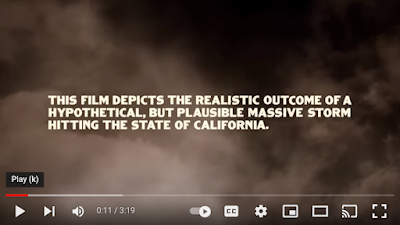
We returned to this topic in 2022's California's ARkStorm Scenario Revisited, after the USGS released an updated assessment; one that suggested that as the climate grows hotter and dryer, it increases the odds of seeing another catastrophic ARkStorm event.
Climate change is increasing the risk of a California megaflood
XINGYING HUANG AND DANIEL L. SWAIN
SCIENCE ADVANCES
12 Aug 2022
Vol 8, Issue 32
DOI: 10.1126/sciadv.abq0995
Abstract
Despite the recent prevalence of severe drought, California faces a broadly underappreciated risk of severe floods. Here, we investigate the physical characteristics of “plausible worst case scenario” extreme storm sequences capable of giving rise to “megaflood” conditions using a combination of climate model data and high-resolution weather modeling.
Using the data from the Community Earth System Model Large Ensemble, we find that climate change has already doubled the likelihood of an event capable of producing catastrophic flooding, but larger future increases are likely due to continued warming. We further find that runoff in the future extreme storm scenario is 200 to 400% greater than historical values in the Sierra Nevada because of increased precipitation rates and decreased snow fraction. These findings have direct implications for flood and emergency management, as well as broader implications for hazard mitigation and climate adaptation activities.
This is an extreme scenario - and remains a low probability event despite this winter's El Niño - but even something less severe could cause considerable damage, and potentially loss of life.
So, the question is, how ready are you and your family for severe weather this winter? The LA County website advises:
LA County is preparing its flood control and emergency response systems now. Crews are inspecting and maintaining dams, debris basins, channels, storm drains, and pump stations; monitoring burn areas, hillsides, and other areas at risk of flooding and debris flows; and preparing for evacuations, emergency shelter, and other storm response. County teams are also preparing to assist people experiencing homelessness, older adults, and others who may need additional help during severe weather.
Here’s what residents can do now:
- Sign up for emergency alerts: Go to alert.lacounty.gov to receive emergency notifications, including evacuation warnings and orders.
- Know the risks where you live: If you are near a hillside, canyon, recent burn area, or area that can flood, learn your flood and mudflow risk before a storm.
- Make an evacuation plan: Know where you will go and how you will get there if you need to leave quickly.
- Have supplies ready: Keep enough food, water, medications, and other essentials for up to 10 days.
- Prepare your home: Clear gutters, downspouts, and storm drains, fix roof leaks, and get sandbags before heavy rain is in the forecast.
- Consider flood insurance: Standard homeowners insurance does not cover flood damage. Flood insurance is separate and can take at least 30 days to go into effect.
- Need help with mud or debris flow risk? Call LA County Public Works at 1-800-933-0930 to speak with an engineer.
- Know someone experiencing homelessness who needs help? Visit homeless.lacounty.gov/get-help/
But it isn't just California that could be impacted by a strong El Niño.
Here in Florida - where we are enjoying the quietest Atlantic Hurricane Season in recent memory - we've a history of seeing strong winter storms during El Niño years, including the tornado outbreak of 1998 which killed 42 people.
Predicting exactly where unusual or severe weather will occur this winter due to El Niño is impossible, but generally, the jet stream across the United States shifts storm tracks to the southern tier of states.

Exactly where that may happen is unknowable, but five years ago (Feb 2021) 3 successive winter storms swept across Texas, Louisiana, and Oklahoma, causing the worst collapse of the Texas energy grid on record (see Texas: The Latest - But Not The Last - Grid Down Crisis).
At least 4.5 million homes were without power during a week of bitter winter temperatures, resulting in hundreds of deaths and tens of billions of dollars of damage (see City of Austin & Travis County 2021 WINTER STORM URI AFTER-ACTION REVIEW).

While I can't tell you where the next natural disaster will strike, or how bad it will be, being prepared for whatever comes is your best defense. So, if the grid goes down, or flood waters rise, or the ground begins to shake . . . do you already have?
- A battery operated NWS Emergency Radio to find out what was going on, and to get vital instructions from emergency officials
- A decent first-aid kit, so that you can treat injuries
- Enough non-perishable food and water on hand to feed and hydrate your family (including pets) for the duration
- A way to provide light when the grid is down.
- A way to cook safely without electricity
- A way to purify or filter water
- A way to handle basic sanitation and waste disposal.
- A way to stay cool (fans) or warm when the power is out.
- A small supply of cash to use in case credit/debit machines are not working
- An emergency plan, including meeting places, emergency out-of-state contact numbers, a disaster buddy, and in case you must evacuate, a bug-out bag
- Spare supply of essential prescription medicines that you or your family may need
- A way to entertain yourself, or your kids, during a prolonged blackout