#19,180
For a variety of economic, political, and societal reasons most of the world's nations have moved towards `normalizing' COVID infection; treating it more as if it were the `flu' or the common `cold'.Testing outside of the hospital environment is now uncommon, and ICU admissions and deaths are no longer published by 90% of the world's nations.Although COVID deaths have dropped, the evidence continues to show that COVID infections - and particularly repeated infections - can still take a considerable toll on human health.
While `Long COVID' and PASC (Postacute Sequelae of COVID) are now officially recognized conditions, its presentation is often `messy'; with multiple diffuse - and sometimes conflicting - symptoms.
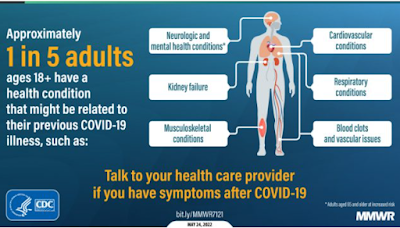
While we've seen estimates of up to 1 in 5 adults experiencing some form of PASC, other studies have shown a much lower incidence; sometimes in the single digits. We've also seen studies that suggest - since the arrival of Omicron in late 2021 - the incidence and/or severity of `Long COVID' has dropped.
But nearly all of these reports rely heavily on the medical coding systems, which adopted a `Post-COVID syndrome' ICD-10 code (U09.9) in late 2021, but which is only used at the discretion of the treating physician.
Some clinicians may avoid coding for PASC because it is largely a diagnosis of exclusion, and they may want to rule out other causes first. Others may consider it too broad, and prefer to code specific complaints like fatigue, dyspnea, or cognition problems.
As a result, when studies are based on EHR (Electronic Health Records) coding, they may miss many probable PASC cases.
In order to try to remove - or at least narrow - this blind spot, researchers created an AI tool that searched electronic health records for patterns of symptoms and diagnoses consistent with PASC, even though their chart may not have been coded as such.
There are limitations to this type of approach, as it relies heavily on the quality and quantity of the EHR documentation, and so it may have missed some PASC cases. At the same time, temporal association does not establish causation, and so these numbers should be taken with a grain of salt.
Still, it strongly suggests that the actual burden of PASC is considerably higher than the EHR coding reflects, and that the incidence of Long COVID was still increasing in 2024, two years after the shift to Omicron.
The full study is well worth reading in its entirety. I've posted the Abstract and summary below.
Original Investigation
Infectious Diseases
Long COVID Persistence and Surveillance Gaps Across 58 US Hospitals
Jiazi Tian, MSc1; Alaleh Azhir, MD, MSc1,2; Matthew Decaro, MSc3 et al
JAMA Netw Open
Published Online: May 27, 2026
2026;9;(5):e2614909. doi:10.1001/jamanetworkopen.2026.14909
Key Points
Question What is the true burden of chronic disease following COVID-19, and why does current surveillance fail to capture it?
Findings In this cohort study of 457 950 patients with COVID-19 across 58 hospitals, validated computable phenotyping identified postacute sequelae of SARS-CoV-2 infection in 16.28% of cases, 2-fold higher than diagnostic code–based surveillance. Of identified manifestations, 89.31% represented chronic conditions, with prevalence increasing through mid-2024.
Meaning These findings suggest that approximately 1 in 6 patients with COVID-19 develops postacute sequelae, predominantly chronic conditions currently invisible to surveillance systems, representing an accumulating rather than resolving health care burden.

Abstract
Importance Surveillance of postacute sequelae of SARS-CoV-2 infection (PASC) depends on diagnostic coding systems that capture fewer than one-half of affected individuals, rendering millions invisible to health systems and policymakers.
Objective To quantify the gap between true PASC burden and diagnostic code–based estimates, determine the proportion representing chronic disease, and characterize organ system heterogeneity and temporal trends across diverse populations.
Design, Setting, and Participants This retrospective cohort study used electronic health record data from 58 hospitals and affiliated clinics in 4 US regions, from 2017 to 2025. Adults (aged ≥18 years) with laboratory-confirmed SARS-CoV-2 infection or a COVID-19 diagnosis code were included. A custom artificial intelligence algorithm, the Precision Phenotyping for Research Cohorts (P2RC), was implemented using federated infrastructure.
Exposure Laboratory-confirmed SARS-CoV-2 infection or COVID-19 diagnosis code.
Main Outcomes and Measures The primary outcomes were PASC prevalence, the proportion classified as chronic conditions, organ system distribution, and temporal trends from 2020 to 2024. χ2 Tests were used to assess organ system heterogeneity across regions, and negative binomial regression was used to model quarterly temporal trends, yielding incidence rate ratios (IRRs) with 95% CIs.
Results In this cohort study of 457 950 COVID-19 cases (mean age, 52.05 years; 275 107 [60.07%] female), the P2RC algorithm identified 74 560 PASC cases (16.28% overall; 28 585 [18.58%] in New England, 978 [19.55%] in Southeast Texas, 10 534 [22.69%] in Southern California, and 34 463 [13.64%] in Western Pennsylvania), more than 2-fold higher than the proportion identified by code-based surveillance (<7%). Of 883 International Statistical Classification of Diseases, Tenth Revision, Clinical Modification codes associated with PASC, 594 (67.27%) represented chronic or potentially chronic conditions. Of 74 560 patients with PASC, 66 587 (89.31%) developed chronic conditions requiring ongoing clinical management; this represents 14.54% of the total number of 457 950 patients with COVID-19. Substantial organ system heterogeneity was observed (χ2 = 2504.73; P < .001): New England demonstrated thyroid-predominant endocrine patterns, while Southeast Texas, Southern California, and Western Pennsylvania showed metabolic-predominant profiles. Negative binomial regression revealed increasing PASC prevalence through mid-2024 (IRR per quarter, 1.01 [95% CI, 1.00-1.01; P < .001] in New England; 1.00 [95% CI, 1.00-1.01; P < .001] in Southern California; and 1.02 [95% CI, 1.01-1.02; P < .001] in Western Pennsylvania), indicating an accumulating rather than resolving burden.
Conclusions and Relevance In this cohort study, approximately 1 in 6 patients with COVID-19 developed PASC, and 89.31% of these patients had at least 1 chronic condition. Current diagnostic coding captured fewer than one-half of the cases, obscuring a substantial chronic disease burden. The persistently increasing prevalence through 2024 indicated an accumulating health care burden requiring investment in surveillance infrastructure and integrated care pathways.