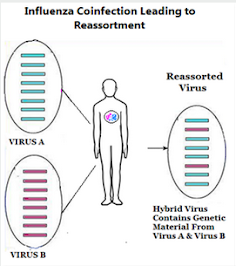
Last week, in When Flu Viruses Collide, we looked at the concerns over rare - but documented - instances of seasonal flu reassorting with a novel flu virus, and producing a biologically `fit' hybrid.
At least 2 pandemics in the last century (1957 and 1968) are believed the product of such an interaction. This is the reason why yearly flu vaccination has long been recommended for people who raise pigs or work with poultry and the CDC now urges vaccination in dairy workers.
In 2024, Chinese scientists looked at the reassortment potential of H5N1 and H3N2 (see Preprint: Intelligent Prediction & Biological Validation of the High Reassortment Potential of Avian H5N1 and Human H3N2 Influenza Viruses) and predicted the risks to be relatively high.
Another, older (2010) study (see PNAS: H3N2 And H5N1 Reassortment) found that Reassortment between avian H5N1 and human H3N2 influenza viruses creates hybrid viruses with substantial virulence.
While viewed as possible, it isn't clear how compatible contemporary seasonal viruses are for reassorting with currently circulating HPAI H5Nx viruses.
Complicating matters, since there is great diversity among all of these viruses - and they continually evolve - only partial answers are obtainable.
To that end, we have a brief report published yesterday in PNAS, which describes (partially successful) attempts to create reassortants using `weakened' (live attenuated NS1-truncated) clade 2.3.4.4b H5N1 HPAIVs of the B3.13 and D1.1 genotypes, and older (circa 2009 and 1968) human-adapted pdmH1N1 and H3N2 IAVs in MDCK II cells.
Today's panoply of seasonal flu viruses have evolved considerably since those lineages emerged. But these are well characterized lab strains, with reverse genetic clones widely available, and their use likely makes comparisons with earlier studies easier.
The authors acknowledge these (and other) limitations, but despite those constraints, they were able to generate 20 reassortants (0.74%). They report:
Polymerase assays identified human IAV subunits, particularly H1N1 PA or H3N2 PB2, that increased H5N1 polymerase activity. Thus, contemporary clade 2.3.4.4b H5N1 viruses can reassort with human IAVs, but factors beyond polymerase compatibility may limit their recovery.
This study did not test these reassortants' fitness, transmissibility or disease severity, so it cannot predict real-world risk. It does, however, suggest that contemporary clade 2.3.4.4b H5N1 viruses can reassort with human IAVs.
Although it is not a particularly long report, I've only posted some excerpts. Follow the link to read it in its entirety.
Jakob Ankerhold, Susanne Kessler https://orcid.org/0000-0002-9720-8291, Philipp P. Petric, +4 , and Kevin Ciminski https://orcid.org/0000-0001-5397-7497 kevin.ciminski@uniklinik-freiburg.deAuthors Info & Affiliations
Edited by Peter M. Palese, Icahn School of Medicine at Mount Sinai, New York, NY; received September 8, 2026; accepted October 12, 2026
November 9, 2026
123 (46) e2631654123
https://doi.org/10.1073/pnas.2631654123
Abstract
Influenza A virus (IAV) pandemics can arise when animal-derived and human-adapted IAVs exchange genome segments; however, whether contemporary clade 2.3.4.4b H5N1 viruses can generate viable reassortants with human IAVs is unclear. Here, we tested the reassortment potential of two clade 2.3.4.4b H5N1 viruses with human-adapted H1N1 and H3N2 IAVs using a biosafe reassortment system. Across multiple coinfection conditions, we genotyped 2,698 plaque-purified viral clones and recovered 20 reassortants (0.74%). Polymerase assays identified human IAV subunits, particularly H1N1 PA or H3N2 PB2, that increased H5N1 polymerase activity. Thus, contemporary clade 2.3.4.4b H5N1 viruses can reassort with human IAVs, but factors beyond polymerase compatibility may limit their recovery.
Zoonotic influenza A viruses (IAVs) pose a constant pandemic threat, with previous pandemics often associated with reassortment between animal-derived and human-adapted IAVs (1). Reassortment requires coinfection of a cell and compatibility between viral genome segments from different host-adapted lineages (2). Highly pathogenic avian influenza viruses (HPAIVs) of the H5 clade 2.3.4.4b have created an unusually broad ecological interface for such events. Since 2020, these viruses have spread globally among wild birds and mammals and entered U.S. dairy cattle, resulting in human exposure and zoonotic infections (3–6). Although sustained human transmission has not been documented, cocirculation with seasonal human IAVs creates opportunities for coinfection and reassortment.
Previous studies showed that prepanzootic H5N1 HPAIVs can reassort with human IAVs (7–10). However, the reassortment potential of contemporary clade 2.3.4.4b H5N1 HPAIVs remains unknown. Here, we tested two clade 2.3.4.4b H5N1 HPAIVs, representing different viral genotypes associated with U.S. dairy cattle outbreaks (3, 5) in combination with human-adapted H1N1 and H3N2 IAVs. We show that contemporary clade 2.3.4.4b H5N1 viruses can form viable reassortants with human IAVs in vitro and identify distinct vRNP compatibility patterns.
(SNIP)
Discussion
In this study, we show that contemporary clade 2.3.4.4b H5N1 HPAIVs can reassort with human-adapted H1N1 and H3N2 IAVs, but reassortants represented only 0 to 2.3% of plaque-purified clones under the in vitro conditions tested. This finding is consistent with the absence of documented reassortment events involving human IAV segments in clade 2.3.4.4b H5N1 HPAIVs to date.
However, the low observed recovery frequency of reassortants does not indicate complete genetic incompatibility, as recovered reassortants carried human IAV polymerase segments and selected human IAV subunits increased H5N1 polymerase activity in human cells. Thus, our data separate reassortant recovery under the tested conditions from the functional properties of the resulting polymerase constellations.
As clade 2.3.4.4b H5 HPAIVs undergo frequent and complex reassortment with avian IAVs (4, 6), the factors potentially limiting reassortment with human-adapted IAVs remain unclear (2). Several limitations should be considered: MDCK II cells do not recapitulate natural infection dynamics or selective pressures, and the observed H5N1 replication advantage and viral progeny composition may differ in relevant hosts. Additionally, using NS1-truncated viruses and early pandemic representatives rather than contemporary seasonal isolates limits generalizability, while the absence of reassortant characterization limits conclusions about replication fitness, transmissibility, and pathogenicity.
Because no standardized benchmark for IAV reassortment exists, observed recovery frequencies cannot be directly compared across IAV combinations. Despite these limitations, our study provides a functional framework for interpreting reassortment risk during the ongoing clade 2.3.4.4b H5 panzootic.