Monday, March 30, 2009

Food Insecurity And The Control Of Bird Flu


# 2953


Around the world, about 1 person in 6 lives with daily food insecurity – in other words – hunger.  


The FAO (Food & Agriculture Organization) estimates  that over 1 Billion people will go hungry this year, and that about 2/3rds of them live in the Asia/Pacific region.


Over the past two years more than 100 million more people, according to the FAO, have fallen to the ranks of the daily food insecure.


The reasons for this include higher food prices, the global economic recession, along with crop losses due to changing climate patterns and diseases.


Reuters has a report on this growing food insecurity this morning.  First the article, then some discussion about how this might affect bird flu control measures – particularly in the Asia-Pacific regions.


Food security still a problem as hunger rises: FAO

Mon Mar 30, 2009 7:20am EDT

BANGKOK (Reuters) - A fall in grain prices has led to the impression that food security is no longer a concern, but the number of people without enough to eat is still rising in a world facing recession, the United Nations said Monday.


"The level of prices is still 19 percent above the average of 2006 ... so we're still in a period of high prices," Jacques Diouf, director-general of the U.N.'s Food and Agricultural Organization (FAO), told reporters at a conference in Bangkok.


In addition, recent FAO studies showed that even though prices had fallen in international markets, retail prices in most developing countries had not.


"Not only is the crisis here, but it's been worsened by the financial and economic crisis," Diouf said.


Stocks for cereals were at a 30-year low, and he described the situation as "very fragile."


(Continue . . . )


Against this backdrop of increasing food insecurity, rising food costs, and recession we also have a serious zoonotic disease – bird flu – becoming endemic in many regions of the Asia-Pacific region.


Poultry - whether factory-farm produced or from backyard flocks - is a major source of income, and food, for hundreds of millions of people living around the world.   


China, which produces more poultry than anyplace else on earth, reportedly raises about 15 Billion birds each year.  


Anything that seriously threatens their poultry industry also raises the specter of mass hunger in the world’s most populous nation.


China, like Indonesia and Egypt, has adopted poultry vaccination as their primary method of controlling the H5N1 bird flu virus.   They have, for years, conducted mass poultry vaccination drives several times each year.


Recently, however, we’ve seen growing evidence that these vaccines may not be preventing the disease – but that they are only hiding the symptoms.    


Asymptomatic, but infected birds, have become the new concern.


(see The Winter Of Our Disbelief for more details)


Leading scientists such as Zhong Nanshan of China, have stated,"The existing vaccines can only reduce the amount of virus, rather than totally inactivating it.”

Dr. C.A. Nidom, whose name has appeared often in this blog, was quoted earlier this month in Poultry Indonesia as saying:


Poultry Indonesia Printing Edition, March 2009

(excerpts)

Chairul Anwar Nidom, a virologist with the Tropical Disease Centre at Airlangga University in Surabaya, said a common policy on bird flu was lacking among government agencies, making controlling the disease more difficult.


Nidom criticized the government’s policy of vaccinating poultry rather than culling, believing that it masks the virus, and ultimately contributes to its mutation.


The OIE (World Organization For Animal Health) recently reaffirmed their long-standing position that vaccination of poultry cannot be considered a long-term solution to combating the avian flu virus.


In Avian influenza and vaccination: what is the scientific recommendation?, the OIE reiterates their strong recommendation that humane culling be employed to control avian influenza, and advising that vaccines should only be used as a temporary measure.


While the OIE concedes that some nations may require the use of vaccines for `several years', they strongly urge that countries move away from that program and towards the more conventional culling policy. 


They call this shift away from vaccines an `Exit Strategy’, something which China has shown no move towards.


For now, at least, most of the nations currently utilizing poultry vaccines don’t appear to be moving towards any `exit strategy’.   


Despite growing concerns over asymptomatic poultry, and the danger that might pose to humans, the need to preserve their poultry industry is great – particularly in times of increasing food insecurity.


The Agriculture Ministries of many nations are caught in the middle. 


A move towards culling, and away from vaccines, would involve the loss of huge quantities of badly needed food.  Something that could become politically destabilizing in some regions.


Culling is also far more problematic when you are dealing with millions of small holdings – backyard chicken coops – instead of more centralized factory farms.  


And the greatest impact would be in the areas currently most affected by hunger today.


The Asia-Pacific region.


Despite the downsides to using vaccines, the pressures of food insecurity today make it very difficult for nations like China, Vietnam, and Indonesia to move away from their use.  


The choice in many of these countries literally boils down to increasing hunger today in order to decrease the possibility of a pandemic someday in the future.


All of which goes to show just how complex and difficult the decisions are when trying to eradicate H5N1 around the world.  

Laos: Phongsaly Province Still At Risk Of Additional Outbreaks


# 2953


image

Phongsaly province


While we don’t often get reports from this area, over the past several months we’ve heard of several localized outbreaks of bird flu in poultry in Northern Laos.


On March 9th (see One Month Later, Laos Still Dealing With Bird Flu) we learned of the ongoing attempts to quell outbreaks in Luang Namtha Province. 


Today’s report tells of neighboring Phongsaly province's recent bout with avian flu (see Laos: H5N1 outbreak in Phongsaly province on Crofsblog Feb 19th), and the difficulties they have in controlling the virus.


This report from Xinhua News.


Lao province at risk of bird flu outbreak

www.chinaview.cn 2009-03-30 16:27:52

    HANOI, March 30 (Xinhua) -- Many areas of Phongsaly province of Laos are at risk of infection from the H5N1 bird flu virus as local people are continuing to bring in poultry and eggs illegally from neighboring countries, the Lao newspaper Vientiane Times reported Monday.


Provincial authorities find it hard to identify when and where there's a virus outbreak as people can walk or drive across and engage in casual trade of poultry easily at border areas without checkpoints, said provincial Livestock and Fisheries Deputy Head Somnith Keoboun-ngune.


Last month there was an outbreak of the virus in Khua district, Phongsaly province. Now the outbreak is over and the district was declared bird-flu free today, said Somnith.


To prevent the spread of the virus to other districts, the provincial avian influenza control committee together with district and village committees culled about 2,600 poultry in 11 villages and set up checkpoints, said Somnith.


The provincial livestock and fisheries sector will work with the sectors concerned in leading a public campaign about bird flu, said Somnith.

Sunday, March 29, 2009

UK: NHS Booklet On Pandemic Flu For Businesses


# 2952


image


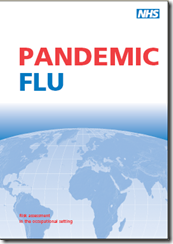
The NHS is the National Health Service, and they’ve just released a new, simple, and fairly generic booklet on pandemic influenza geared for businesses.   


The booklet is available as a 27-page  PDF File.


Old hands at pandemic preparedness won’t find much new here, but for businesses that have yet to seriously prepare, this makes a good primer.


While this is released by, and for the UK, it could certainly be used as an introduction to pandemic flu for businesses in any country.


Pandemic flu guidance for businesses: risk assessment in the occupational setting

  • Document type: Guidance

  • Author: Department of Health and Health Protection agency in collaboration with the Health and Safety Executive, Department for Business, Enterprise and Regulatory Reform and Cabinet Office.

  • Published date: 27 March 2009

  • Publication format: A4

  • Gateway reference: Not required

  • Pages: 27

  • Copyright holder: Crown


As the introduction explains, preparing for a pandemic is everyone’s business:


Everyone will be involved in the fight against pandemic influenza (flu) in terms of managing the impact it will have on society and preventing further spread of the infection.


This booklet explains how businesses can help reduce the spread of flu. it provides information to allow businesses to assess the types of measures that may be used in their particular occupational setting.


Introduction

The Health Protection agency and the department of Health have worked closely with the healthcare sector and certain non-healthcare services, such as the police and fire and rescue services, to develop pandemic influenza infection control guidance for specific occupational settings (available Here)

However, it is not possible to outline detailed pandemic influenza infection control guidance for every occupation or to cover every conceivable scenario where a person might be exposed to the risk of infection from flu.


With this in mind, this simple and generic guidance has been developed to raise awareness of the measures that may be employed to reduce the spread of the flu virus at work. it aims to:


●● allow businesses to evaluate potential situations where there may be possible exposure to the flu virus


●● describe the steps that can be taken to moderate any potential exposure to the flu virus in the workplace

●● set out the measures that might be used to reduce the spread of the flu virus in the workplace

●● provide a matrix that can be used to consider the best ways of reducing the spread of flu in a work environment

●● put into context the relative value of personal protective equipment, including the wearing of face masks,1 when compared with other environmental and organisational approaches.


Information on pandemic flu specific to businesses can be found on the UK resilience website   


A hat tip to UK-Bird on the Flu Wiki for  posting this link.

Watching Egypt (Again)


# 2951


March has been a busy  month for Human H5N1 infections in Egypt, with their 9th case of the year confirmed last Thursday.  Egypt has seen more cases in the first 90 days of this year than they saw in all of 2008 (8 cases, with 4 fatalities). 


The good news is, so far at least, all of the confirmed cases have recovered.


We continue to see new news reports of suspect cases being tested.  Nothing unusual about that, of course.  Over the past three years thousands of people have been tested for the virus in that country.


Despite all of this testing, however, only 60 people have tested positive for the virus.


For that reason, I tend not to mention `suspect’ cases in Egypt until we get something more definitive.


Nevertheless, we watch these reports with interest.  


One report, yesterday, indicated a possible bird flu fatality – that of a 45 day old infant. 


This case appears unconfirmed as yet.  I mention it because it has been posted on a number of the flu forums.


Tests are pending.  If positive, we should hear in the next couple of days.  This is just one of several news reports on suspect cases this weekend.


When we know more, I’ll post on it.


The H5N1 bird flu virus is endemic in Egypt, with well over 1,000 outbreaks reported in poultry since the virus was first detected there in 2006.


Unlike most other countries battling bird flu, Egypt does not have a compensation program for farmers who lose birds due to culling. As a result, many people are reluctant cooperate and notify authorities if their birds sicken or die.


An interactive map, showing human cases and poultry outbreaks for 2008-2009 can be viewed by clicking the image below.


image


One of the best web resources for information regarding Egypt’s bird flu situation is the SAIDR home page: Strengthening Avian Influenza Detection and Response in Egypt

Hawaii Looking For Public Input On Vaccine Priority In A Pandemic


# 2950


Last July, we received the long-awaited guidance from the HHS (Dept. of Health and Human Services) on pandemic vaccine allocation called Guidance on Allocating and Targeting Pandemic Influenza Vaccine.


Pandemic vaccines are almost certainly to be in very short supply during the first year of a pandemic, with little or none available until 5 months into a crisis.  After that, vaccine should begin to come off production lines, but even then, only in limited quantities.


Accordingly, since there won’t be enough vaccine to inoculate everyone at the same time, priority groups needed to be established.


image

(Click to Enlarge)


There are variations to these tiers at different pandemic levels (Cat 1-5).


The one's listed here assume a CAT 4 or CAT 5 pandemic. Tier 1 priorities remain the same at all pandemic intensities, but adjustments may be made to lower tiers depending on the virulence of a pandemic.


 clip_image002


As you may have noted, these recommendations are packaged in what the HHS calls `Guidance’.   Individual states, ultimately, still have a large say in how they will dispense vaccines during a pandemic.  


Each state will receive an allocation of vaccines as it becomes available in proportion to the State’s population.  They are encouraged to use the Federal guidelines, but it is not mandated. 


Hawaii will begin a public education campaign next month, and open up a dialog with their residents, on who should receive priority for scarce vaccines during a pandemic.


What follows is a rather long, and detailed, story from the Honolulu Advertiser.   I’ve only posted excerpts.  It is well worth reading in its entirety.


Hawaii working on list of who gets shots first in flu pandemic

Public's input wanted on who'll be vaccinated first if outbreak strikes

By Dan Nakaso
Advertiser Staff Writer

State health officials want the public's views on deciding who should get vaccinated — and who should not — against the next flu pandemic that reaches the Islands.So far, a wide-ranging advisory group of about a dozen community members representing religious groups, the chamber of commerce and even an expert in mediation have been working to set up a system that will help determine who will be inoculated first and who will have to face the pandemic unarmed, at least until more vaccine can be manufactured and shipped to Hawai'i.


The final determination will rest with Gov. Linda Lingle.


"The decision is with the governor," said Lingle spokesman Russell Pang.


There is no way to stockpile vaccine for an unknown virus that has yet to arrive. And no way to calculate how much vaccine will be needed, how many people will be infected and how many could die, according to Bill Gallo, senior management official with the Centers for Disease Control and Prevention in Honolulu.


So it could take months before federal officials isolate the virus, create a vaccine for it and send it to Hawai'i.


By then, untold lives could be lost.


"It is a very sobering scenario to be thinking about," said Jim Tollefson, president and CEO of the Chamber of Commerce of Hawai'i who sits on the advisory committee. "But it's best to be prepared and educated."


<snip>


public campaign


To that end, the Health Department plans a public education campaign that will begin next month to explain the project and get community opinions.


"We're responsible for making science-based decisions all the time," said Dr. Sarah Y. Park, state epidemiologist and chief of the Disease Outbreak Control Division. "Without neglecting the scientific basis for our state's pandemic planning, this project gives us a unique opportunity to focus on the values-based aspects of some of our decision-making. We encourage everyone to participate in the public activities and let their voice be heard."


Park is the principal investigator for Hawai'i's pandemic priorities grant.


Hawai'i's position as a gateway to and from Asia makes any potential pandemic of particular concern since air travel could quickly spread the disease. To guard against such problems, a disease surveillance and quarantine system was begun at Honolulu International Airport in 2005. It was the nation's first such system, and it screens sick passengers as they arrive for signs of serious illness.


Hawai'i and five other states have been chosen to participate in a federal program to carry out further pandemic planning.


<snip>

  • Three live one-hour broadcasts on KHNL in April. A panel of speakers will discuss who should get vaccinations during a pandemic and solicit viewer opinions on air and via e-mail. The shows are tentatively scheduled from 8 to 9 p.m. April 15, 22 and 29.
  • An "Alternate Reality Game" will be available in late April or early May. Details are still being worked out, but the game is aimed at Island residents. People on the Mainland probably will be able to access the game as potential tourists.
  • Community-based meetings around O'ahu from April through May 30, still to be scheduled.
  • Reach Dan Nakaso at dnakaso@honoluluadvertiser.com.

  • Saturday, March 28, 2009

    Study: (H5N1): Effects Of Physico-Chemical Factors On Its Survival


    # 2949


    Actually, the full name of the study which just appeared in the Virology Journal is:


    Avian influenza virus (H5N1); effects of physico-chemical factors on its survival

    Muhammad Akbar Shahid, Muhammad Abubakar1, Sajid Hameed2 and Shamsul Hassan


    And before you turn away, this study is actually more interesting than it sounds.


    The authors wanted to find out how long, and under what conditions, the H5N1 virus can survive intact in the environment, and the best ways to kill it.    


    Answers to which are of interest to just about all of us.


    Even if the virus never obtains pandemic capability, it still remains an environmental hazard (to poultry, and to people) in areas where it has become endemic.  


    Right now, that includes countries like Egypt, Indonesia, China, India, Pakistan, and Vietnam . . . but someday it could also include the United States, Canada, and Europe.  


    And the threat isn’t limited to just the H5 viruses, there are H7 and H9 viruses in circulation that are of concern as well.


    Vaccination of poultry is considered, at best, to be a stopgap measure.  Eradication of infected birds and the disinfecting of contaminated environments is the preferred method of control.


    Researchers in Pakistan isolated the H5N1 virus during an outbreak in 2006 and cultivated it in embryonated chicken eggs. 


    They then harvested the allanto-amniotic (AAF) fluid containing the virus, and used it in a variety of environmental and chemical tests to see how long the virus remained viable.


    The results are illuminating.


    Some excerpts from the study follow, with the first regarding viability at various temperatures, and the effects of UV light:


    Avian influenza virus H5N1 retained its infectivity at 4°C for more than 100 days although HA activity was decreased.


    Virus lost its infectivity after 24 h  when kept at room temperature (28°C).


    Virus tolerated 15 min exposure to 56°C however it was inactivated at 56°C after 30 min of exposure.


    Ultraviolet light had no deleterious effect on the virus replicating ability even after 60 minutes of exposure (Table 1).


    Virus samples were exposed to Acid (pH < 7) and Basic  (pH > 7) solutions to determine at what level of acidity or alkalinity were viruses inactivated.


    It was observed that H5N1 subtype lost its viability when exposed to pH 1, 3, 11 and 13 after 6 h while it remained viable at pH 7 for all contact times (6, 12, 18 and 24 h).


    It retained its virulence at pH 5 for 18 h but got inactivated after 24 h.


    Virus retained its infectivity at pH 9 for more than 24 h (Table 2).


    To give the lay person some idea of the relative acidity and alkalinity of various common substances, I’ve reproduced a chart from the Wikipedia.


    image


    The prolonged contact time required to inactivate the virus even at relatively high and low pH levels tends to makes their use problematic to control the virus.


    With regards to commonly used disinfecting agents in laboratories and hospitals, better results were achieved:


    H5N1 was inactivated with formalin (0.2, 0.4 and 0.6% after 15 minutes)


    Iodine crystals (0.4 and 0.6% after 15 minutes)


    Phenol crystals (0.4 and 0.6% after 15 minutes)


    CID 20 (0.5% after 60 minutes and 1.0% after 15 minutes)

    Virkon®-S (0.2% after 45 minutes, 0.5 and 1.0% after 15 minutes)


    Zeptin10% (0.5% after 45 minutes, 1% after 30 minutes and 2% after 15 minutes)


    KEPCIDE300 (0.5% after 30 minutes and 1% after 15 minutes) and KEPCIDE 400 (0.5 and 1.0% after 15 minutes) at 28°C.


    And finally, soap and detergents were tested:


    Lifebuoy, Surf Excel and Caustic soda inactivated the virus at 0.1, 0.2 and 0.3% concentration after 5 minutes contact time while a concentration of 0.05% was not enough to kill virus (Table 4).


    The authors make it clear that:  Each commercial preparation is the result of careful formulation and any modification can reduce the efficacy.

    In other words, use according to directions!


    While the virus is relatively easily inactivated by commonly used disinfecting methods, left unchallenged, at low temperatures and in a suitable medium, the virus can remain viable for days, weeks, or even months.


    All of this, right now, is mostly of concern to those charged with maintaining bio-security measures at farms and hatcheries in the wake of avian influenza virus outbreaks, it could someday have broader implications.


    This study is another step along the path of understanding how avian flu viruses survive (or not) in the environment, and how to eradicate them.