Friday, May 05, 2017

FAO H7N9 Update - May 4th


#12,432

Released yesterday, we have the latest FAO update on H7N9 activity in China, which bring us to 1461 confirmed human cases since the virus first emerged in the spring of 2013.  This latest weekly update added 17 cases, which we first saw reported a week ago today.
While the number of new cases being reported is running well below what we were seeing in January and February, significant activity continues. This despite the closure of many live markets in affected areas, steps that in the past have greatly reduced disease transmission. 
The trend towards seeing more H7N9 in China's northern provinces continues, with Beijing's cluster increasing by 2 this week. Some excerpts from yesterday's report follow.  Items in red indicate new information since the last report.

Follow the link below to read the full report:


H7N9 situation update
4 May 2017, 11:00 hours; Rome

The next update will be issued on 10 May 2017

Overview

Situation: Influenza A(H7N9) virus with pandemic potential.
Country: China; three human cases originated in China and were reported in Malaysia (1) and Canada (2).
Number of human cases: 1461 confirmed; 551 deaths (since February 2013).

Number of new findings in birds or the environment since last update (26 April 2017): 37.
Number of new human cases since last update (26 April 2017): 17.
Provinces/municipalities: Beijing, Chongqing, Shanghai and Tianjin Municipalities; Anhui, Fujian, Gansu, Guangdong, Guizhou, Hebei, Henan, Hubei, Hunan, Jiangsu, Jiangxi, Jilin, Liaoning, Qinghai, Shaanxi, Shandong, Sichuan, Taiwan, Yunnan and Zhejiang Provinces; Hong Kong SAR; Macao SAR, Guangxi, Ningxia Hui, Tibet and Xinjiang Uyghur Autonomous Regions; Sabah (Malaysia); British Columbia (Canada).
Animal/environmental findings: around 2,500 virological samples from the environment, chickens, pigeons, ducks and a tree sparrow tested positive; positives mainly from live bird markets, vendors and some commercial or breeding farms.

Highly pathogenic virus findings: Out of the 1461 confirmed human cases, H7N9 virus isolates from three cases (two from Guangdong and one from Taiwan Provinces) were found to be highly pathogenic for chickens. The H7N9 highly pathogenic avian influenza virus was detected in a total of 41 poultry or environmental samples (30 chickens, 1 duck and 10 environmental samples) from 23 live bird markets (LBMs) in: Fujian (Longyan City), Guangdong (Dongguan, Guangzhou, Huizhou, Lufeng, Meijiang, Meizhou, Zhongshan Cities and Haifeng County), Guangxi (Guilin City) and Hunan (Chenzhou City) Provinces; and from 3 farms in: Guangxi (Guilin City) and Hunan (backyard in Chenzhou City and a large farm in Yongzhou City [reference]) Provinces.

FAO actions: liaise with China and partners, monitor situation, monitor virus evolution, conduct market chain analysis, risk assessment, surveillance guidance and communication.
Map 1. Human cases and positive findings in birds or the environment

Human cases and positive findings in birds or the environment
 Click to enlarge - Note: Human cases are depicted in the geographic location where they were reported; for some cases, exposure may have occurred in a different geographic location. Precise location of 23 human cases in Anhui (2), Beijing (2), Guangdong (1), Guangxi (1), Hebei (2), Hunan (1), Hubei (2), Jiangsu (1), Jiangxi (6), Sichuan (2) and Zhejiang (3) Provinces are currently not known, these cases are therefore not shown on the map.

Situation update
Animals

    3 May, Shaanxi Province: While no virological positive samples from animals have ever been reported, a first H7N9 human case occurred in Qindu District, Xianyang City, with onset on 23 April. A specimen of the male patient tested positive for H7N9 virus nucleic acid on 30 April and he died on 1 May due to multiple organ failure [reference].

    2 May, the Chinese Ministry of Agriculture issued the monthly surveillance report for March including a part of the results from the H7N9 intensified surveillance conducted from 25 January to 28 February. 453,951 samples were collected from 21,978 sites. 1533 out of 290,836 serological samples tested positive for H7 subtype and 55 out of 163,115 virological samples were H7N9 positive [reference].
(Continue . . . )


DEFRA: HPAI H5N8 Detected In Small Lancashire Flock


#12,431


While the UK hasn't been hit nearly as hard with avian flu this winter as has France or Germany, since December they have detected the H5N8 virus on a small number of farms in Northumberland, Suffolk, Lancashire and Lincolnshire, and in backyard flocks in North Yorkshire and Carmarthenshire.
Lancashire, with three outbreaks in January, has been particularly active (see UK: 3rd H5N8 Outbreak In Lancashire Confimed - DEFRA).

With no new farm outbreaks reported since early March, and the last wild bird detection more than a month ago,  last week DEFRA announced Avian Flu measures would be relaxed in England from 15 May.

With summer around the corner the risks of seeing avian flu outbreaks in the UK - and the rest of Europe - is undoubtedly decreasing, but as the following announcement overnight from DEFRA confirms, it is not zero.


Avian flu confirmed at a farm near Thornton, Wyre, Lancashire

From:         Department for Environment, Food & Rural Affairs, Food Standards Agency, Public Health England, and Animal and Plant Health Agency
Part of:       Animal and plant health
Published:  4 May 2017

H5N8 avian flu has been confirmed at a farm near Thornton, Wyre, Lancashire.
placeholder

The UK’s Chief Veterinary Officer has confirmed H5N8 avian flu in a small backyard flock of chickens at a farm near Thornton, Wyre, Lancashire.

A 3 km Protection Zone and a 10 km Surveillance Zone have been put in place around the infected premises to limit the risk of the disease spreading. We have published full details of the controls in place.

The flock is estimated to contain around 30 birds. A number have died and the remaining live birds at the premises are being humanely culled. A full investigation is under way to determine the source of the infection.

Public Health England advises that the risk to public health from the virus is very low and the Food Standards Agency is clear that bird flu does not pose a food safety risk for UK consumers.

Read the latest advice and information on avian flu in the UK, including actions to reduce the risk of the disease spreading, advice for anyone who keeps poultry or captive birds and details of previous cases. Journalists with queries should contact Defra press office.

The latest advice, mentioned above, still reads:
A ban on poultry gatherings remains in place across the UK until 15 May 2017. This applies to birds including chickens, turkeys, ducks and geese, and restricts events such as livestock fairs, auctions and bird shows. We also expect this ban to be lifted on 15 May and gatherings can resume from that date, subject to some additional identity and health checks and biosecurity measures.
So, unless additional outbreaks are reported, it doesn't appear that this small detection will impact announced plans to relax avian flu restrictions across the rest of England. 

After North America's 2015 H5N8 epizootic, the virus all but vanished in the wild (see PNAS: The Enigma Of Disappearing HPAI H5 In North American Migratory Waterfowl) and in the last two years has only been detected a handful of times. 
This past winter's H5N8 epizootic in Europe has differed from earlier outbreaks of this subtype, in that wild bird detections (and die offs) have been far greater than ever before, and the size and scope of farm outbreaks (1000+) has far exceeded anything previously reported in Europe.
This behavioral change has been attributed to multiple reassortments that took place in China and/or Russia last summer.  A reminder that all of these avian viruses are constantly evolving, and moving, targets.

The $64 question is: Will this HPAI H5N8 reassortant slowly disappear from wild birds and the environment, as it did in 2015?   Or is H5N8 now capable of sustained circulation - even at low levels - in the wild and migratory bird population?

The answer to which will likely determine what kind of avian flu activity Europe will see over the summer - and more importantly - what returns next fall.

Stay tuned.


Thursday, May 04, 2017

Hong Kong CHP Reports A Late Season Flu Surge

Credit HK CHP Flu Express


#12,430


Hong Kong often sees a biphasic or `double peaked’  flu season, with their heaviest activity usually from February–April and (a less severe) season in June through August, as was described in the 2008 PLoS One research paper Seasonality of Influenza A(H3N2) Virus: A Hong Kong Perspective (1997–2006).
This winter's flu HK season began earlier than usual (see last December's Hong Kong: Early Flu Surge Puts Pressure On Local Hospitals), and appeared to have run its course by the middle of April with their Flu Express Week 15 reporting a `low level' of flu activity.
Today, somewhat unexpectedly, Hong Kong's CHP is reporting a recent surge in influenza activity, and is reinstating their enhanced surveillance for severe seasonal influenza.

A letter has been sent to local physicians alerting them, a public notice has been posted, and today's Flu Express provides additional details

FLU EXPRESS
 
Flu Express is a weekly report produced by the Respiratory Disease Office of the Centre for Health Protection. It monitors and summarizes the latest local and global influenza activities.
Local Situation of Influenza Activity (as of May 3, 2017)

Reporting period: Apr 23 – 29, 2017 (Week 17)

  • According to the latest surveillance data, the local influenza activity has increased in the past few weeks.
  • From May 5, 2017 onwards, the Centre for Health Protection (CHP) will collaborate with the Hospital Authority (HA) and private hospitals to reactivate the enhanced surveillance for severe seasonal influenza cases (i.e. influenza-associated admissions to intensive care unit or deaths) among patients aged 18 or above in order to monitor the severity of influenza infection. Besides, the CHP continues to routinely monitor severe paediatric influenza-associated complications or deaths among people aged below 18 years.
  • Apart from adopting personal, hand and environmental hygiene practices against respiratory illnesses, those members of the public who have not received influenza vaccine are urged to get vaccinated as soon as possible for personal protection.
  • Influenza can cause serious illnesses in high-risk individuals and even healthy persons. Given that seasonal influenza vaccines are safe and effective, all persons aged 6 months or above except those with known contraindications are recommended to receive influenza vaccine for personal protection.
  • The Vaccination Subsidy Scheme (VSS) 2016/17 was launched on Oct 20, 2016. Subsidised vaccination has been provided for children aged 6 months to under 12 years, elderly aged 65 years or above, pregnant women, persons with intellectual disabilities and persons receiving Disability Allowance (DA). In addition, starting from Nov 3, 2016, the eligibility of free vaccination under the Government Vaccination Programme has been expanded to include children aged 6 years to under 12 years from families receiving Comprehensive Social Security Assistance or holding valid Medical Waiver Certificates as well as persons receiving DA who are existing clients of public clinics and hospitals. Please refer to the webpages (http://www.chp.gov.hk/en/view_content/46107.htm
                 (Continue. . . .)


From the public notice, we also learn that while this year has been predominantly an H3N2 season, the number of H1N1 cases is increasing. Schools are instructed to conduct daily temperature checks of all students, and are required to notify the CHP of any unusual number of respiratory illnesses and/or absenteeism.


     The Centre for Health Protection (CHP) of the Department of Health today (May 4) urged the public, particularly young children, the elderly and chronic disease patients, to observe strict hand, personal and environmental hygiene against influenza amid the increased activity of local seasonal influenza in the past two weeks.
 
     According to the latest surveillance data of the CHP, the positive percentage of seasonal influenza viruses among respiratory specimens received increased from 8.44 per cent to 10.08 per cent from the week of April 16 to that of April 23. While most detections were influenza A(H3) (5.65 per cent in the week of April 23), the percentage of influenza A(H1) detections had increased from 1.70 per cent in the week of April 16 to 3.19 per cent in that of April 23.
 
     In the same period, the number of institutional outbreaks of influenza-like illness (ILI) increased from one (affecting four persons) to four (21 persons). The average ILI consultation rate among sentinel private doctors rose from 31.6 to 49.9 cases per 1 000 consultations in the same period, while that of General Out-patient Clinics increased from 3.6 to 4.0.
 
     "Our data show that the local seasonal influenza activity has increased. Starting from tomorrow (May 5), we will collaborate with the Hospital Authority and private hospitals to reactivate the enhanced surveillance for severe seasonal influenza, i.e. influenza-associated admission to the Intensive Care Unit or death in adults aged 18 or above, to better monitor the severity of illness," a spokesman for the CHP said.
 
     In children aged under 18, routine surveillance of severe influenza-associated complications or deaths is ongoing.
 
     The CHP has issued letters to doctors, hospitals, institutions and schools to appeal for heightened vigilance.
 
     Schools should check the body temperature of all students every day when they arrive at school to identify those with fever. To prevent outbreaks, those with fever (oral temperature over 37.5 degrees Celsius or ear temperature over 38 degrees C), with or without respiratory symptoms, should not be allowed to attend school. Schools should advise them to seek medical advice and avoid school till two days after fever subsides.
 
     In addition, staff should check their temperature before work every day and those with fever or respiratory illnesses should refrain from work.
 
     "Schools should promptly report to the CHP in case of an increase in respiratory illnesses or absentees for immediate epidemiological investigations and outbreak control. We will issue letters to kindergartens and child care centres as well as primary and secondary schools on the above measure," the spokesman said.

(SNIP)
Ends/Thursday, May 4, 2017

Issued at HKT 19:08

While all of this may seem like much to do about nothing, Hong Kong - as both an international city, and sitting adjacent to the `flu factory' that is Mainland China -  is uniquely positioned to be the first see any changes to the seasonal flu virus.
Having experienced the first human outbreak of H5N1 in 1997, followed six years later by the devastating SARS epidemic (see SARS And Remembrance), Hong Kong's CHP takes their vulnerability to infectious disease outbreaks very seriously. 
This surge in flu activity in Hong Kong may be a short-lived blip of little consequence. But should it prove otherwise, we couldn't ask for a more proactive or better equipped health department to deal with it.

Krasnodar: Searching For Avian Flu Contaminated Products In Food Chain


#12,429


On Tuesday, in Rosselkhoznadzor: Avian Flu Infected Poultry Products Discovered In Krasnodar, we looked a cryptic report from Russia's  Federal Service for Veterinary and Phytosanitary Surveillance that potentially avian flu contaminated poultry products had been shipped from neighboring Rostov to Krasnodar. 
Two weeks ago (see Russia: Rosselkhoznadzor Reports Bird Flu Outbreak In Rostov Region), we learned of a large avian flu outbreak at the nation's largest turkey producer.  
While there have been some Russian language media reports on this event, very little else has appeared on official government websites.  Today, however, we've a (translated) press release from the State Administration of Veterinary Krasnodar Region that fills in some of the missing details from Tuesday's report. 
  • First we learn, as previously suspected, that the Rostov Outbreak was HPAI H5.
  • Second, we now know that products were shipped from this poultry plant to wholesale and retail entities across the Krasnodar Region
  • And third, we learn that samples tested from these shipped products have tested positive for the avian flu virus.
Reportedly, as many as 30 tons of product are suspected of contamination, and local officials are attempting to identify and remove them from the food chain.  It appears that some of these products have already been resold, and their current whereabouts are unknown.  

In other words, it's a mess. 

Measures have been taken!

May 2, 2017

The State Veterinary Administration of the Krasnodar Territory informs that on 21 April 2017 a poultry house located in the Oktyabrsky district of the Rostov Region revealed a highly pathogenic avian influenza (subtype H5, class A).

In order to prevent the occurrence of avian influenza in the territory of the Kuban, the veterinary service of the Krai has carried out work to identify cases of receipt of poultry products obtained from the slaughter of poultry grown at the enterprise.

As a result, the products were identified at a number of retail wholesale and retail enterprises in the cities of Krasnodar, Novorossiysk and Sochi, as well as in the Kurganinsky, Tikhoretsk and Tuapse districts.

Based on the results of laboratory tests of samples taken from the detected lots, the products infected with highly pathogenic avian influenza were identified. According to preliminary information, the total number of infected products was about 30 tons.

In spite of the promptly taken actions, from a number of enterprises the contaminated products have left in an unknown direction. As a result, the State Veterinary Department of the Krai prepared and sent materials to the Ministry of Internal Affairs of Russia for the Krasnodar Territory on the need to conduct measures to establish the location of these products, and sent materials to the prosecutor's office to agree on the conduct of unscheduled field inspections of these enterprises.

In addition, economic entities were issued requirements for the withdrawal of hazardous products from circulation.

At present, experts of the veterinary service have already destroyed 611 kg of dangerous products.

It should be noted that all measures are taken by the veterinary service of the province in accordance with the veterinary legislation of the Russian Federation
 

© Press service of public administration of the Krasnodar Territory Veterinary

While the public health risks from these contaminated products is likely very low, it is not zero, and these loose contaminated products have the potential to spread the virus (assuming it is still viable) to other poultry farms in the region.

If nothing else, this incident should remind us of the importance of stringent farm biosecurity, and the need to test and track products, as we learn to deal with these emerging viral threats to our global food production systems.

Wednesday, May 03, 2017

COCA Call Tomorrow: Zika Update

Credit CDC


#12,428


With summer rapidly approaching and the mosquito borne threat of Zika expected to return, the CDC will hold a COCA (Clinicians Outreach and Communication Activity) call tomorrow afternoon with their latest  information and recommendations. 
Primarily of interest to clinicians and healthcare providers, COCA (Clinician Outreach Communication Activity) calls are designed to ensure that practitioners have up-to-date information for their practices.
Follow the link below to review the different ways you can access this webinar.  If you haven't already received it, you can also download the full May 1, 2017, COCA Email Update.

Zika Update: Findings from the U.S. Zika Pregnancy Registry and Updated Clinical Guidance 
 
Free Continuing Education

Date:Thursday, May 4, 2017

Time: 2:00-3:00 pm (Eastern Time)

Please join the COCA Call webinar from a PC, Mac, iPad, iPhone, or Android device: https://cdc.zoom.us/j/445639884

If you cannot join through digital audio, you may join by phone in listen-only mode: +1 408 638 0968 or +1 646 558 8656


Passcode: 445 639 884


International numbers are available: https://cdc.zoom.us/zoomconference?m=CqA0lsuOx1-A-2DyDfmtSQIpZlwB6X8G

You can also join through an H.323/SIP room system::
Dial: 162.255.37.11 (US West) or 162.255.36.11 (US East)
Webinar ID: 445 639 884

Overview

CDC recently released its latest findings from the U.S. Zika Pregnancy Registry (USZPR) on Zika virus infection in pregnant women and infants, which highlight the importance of prevention and early care. Additionally, CDC has released additional considerations for evaluating and managing infants with possible congenital Zika virus infection. Zika virus infection during pregnancy is a cause of microcephaly and other serious brain defects; however, the full range of potential health problems that Zika virus infection during pregnancy may cause is not yet known. Healthcare providers need information to appropriately evaluate and manage patients with possible Zika virus infection. During this COCA Call, clinicians will learn about the latest findings from the USZPR and updated CDC clinical guidance to assist in caring for these patients based on currently available data.

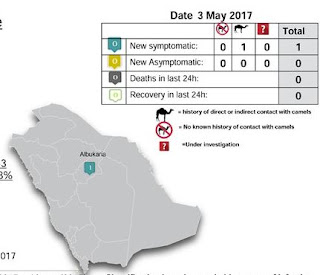
Saudi MOH Reports 1 Primary MERS Case


#12,427

While MERS reports out of Saudi Arabia have been fairly subdued this spring, we continue to see sporadic, widely scattered primary (community acquired) cases pop up around the Kingdom.  
Many are linked (as is today's case) to either direct - or less commonly, indirect - camel exposure, while others have no apparent risk exposure.

`Direct camel exposure' is fairly self explanatory.  The EID Journal's Risk Factors For Primary MERS-CoV Infection, defined indirect camel exposure as: Having visited settings where animals were kept but without having direct contact; or exposure to household members who themselves had direct animal exposure.


We'll likely have to wait for a WHO update to learn how today's case fits that definition. 

 
While limited, these primary cases take on increased importance as the Holy month of Ramadan (this year, May 26th-June 25th) is less than a month away.

All able bodied Muslims are required to make at least one major pilgrimage to Mecca during their lifetime, at the time of the hajj. This is known as the fifth pillar of Islam, and is one of the duties incumbent upon all Muslims.
The faithful may also make `lesser pilgrimages’, called  omra (or Umrah), at other times of the year. These minor pilgrimages don’t absolve the faithful of making the hajj journey unless they take place during the holy month of Ramadan.
The Hajj, which is a much bigger mass gathering event and will see several million international  visitors, takes place this year in late August - early September.