
#19,013
While reporting of flu activity is probably still lagging due to the holidays, later today we should get the latest CDC FluView report on what - by all accounts - is shaping up to be a brutal seasonal flu season (see map above).
The subclade K H3N2 virus we began tracking more than 2 months ago (see Increasing Concerns Over A `Drifted' H3N2 Virus This Flu Season) continues to plague Australia long after their flu season should have ended, and has now become dominant in the Northern Hemisphere.
Still, some protection is better than no protection, and so I gladly rolled up my sleeve.
While they report reduced antibody titers compared to the vaccine strain, they found the vaccine was likely `somewhat effective' against subclade K, and still worth getting.After vaccination, about 70% had antibody levels usually associated with protection against the vaccine strain (J.2), while nearly 40% reached that level for the subclade K virus.
- Only 1 vaccine formulation (standard dose egg-based 2025-2026 Flulaval Trivalent influenza vaccine) was tested
- Challenge was limited to 1 strain of the subclade K virus (A/New York/GKISBBBG87773/2025)
- Follow-up sera collection was 27-30 days post-vaccination, telling us relatively little about the duration of protection.
Antibodies elicited by the 2025-2026 influenza vaccine in humans
Jiaojiao Liu, Shuk Hang Li, Naiqing Ye, Tachianna Griffiths, Elizabeth M Drapeau, Reilly K. Atkinson, Ronald G. Collman, Scott E. Hensleydoi: https://doi.org/10.64898/2026.01.05.26343449
This article is a preprint and has not been certified by peer review
Abstract
A new H3N2 variant (named subclade K) possesses several key hemagglutinin substitutions and is circulating widely during the 2025-2026 influenza season. In this report, we completed experiments to determine if the 2025-2026 seasonal influenza vaccine elicits antibodies in humans that recognize this variant.
We find that H3N2 subclade K viruses are antigenically advanced; however, the 2025-2026 seasonal influenza vaccine elicited antibodies in many individuals that efficiently recognized these viruses.
Thus, the current seasonal influenza vaccine will likely be somewhat effective at preventing H3N2 subclade K virus infections.
(SNIP)
Conclusions
Collectively, our data suggest that H3N2 subclade K viruses are antigenically advanced compared to the 2025-2026 H3N2 vaccine strain; however, the antigenic differences that we observed in sera from some humans are not as large as previously reported in ferrets2 .
While we find that human antibodies elicited by vaccination react more efficiently to the H3N2 vaccine strain relative to subclade K H3N2 viruses, we found that many individuals produced antibodies that efficiently recognized subclade K H3N2 viruses after vaccination.
Our study highlights the benefits of receiving influenza vaccinations, even in seasons that include circulation of variant viruses.
There are other good reasons to get this year's flu shot, if you haven't done so already
- It is always possible we could see an extended flu season, much like Australia has reported; one that lingers on into April or May.
- Even if H3N2 begins to wane in the weeks ahead, we could see a late season surge in H1N1 or Influenza B.
- And with increasing levels of HPAI H5 in the environment, there is (a likely small) potential for a co-infection with H5 and seasonal flu to produce a pandemic strain (see Preprint: Intelligent Prediction & Biological Validation of the High Reassortment Potential of Avian H5N1 and Human H3N2 Influenza Viruses).
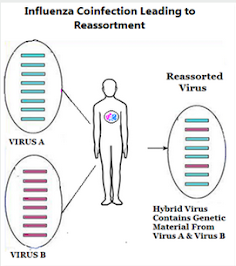
While rare, this isn't just a theoretical concern; twice in my lifetime (1957 & 1968) avian flu viruses did precisely that; reassorted with a seasonal flu virus and launched a human pandemic.
- The first (1957) was H2N2, which according to the CDC `. . . was comprised of three different genes from an H2N2 virus that originated from an avian influenza A virus, including the H2 hemagglutinin and the N2 neuraminidase genes.'
- In 1968 an avian H3N2 virus emerged (a reassortment of 2 genes from a low path avian influenza H3 virus, and 6 genes from H2N2) which supplanted H2N2 - killed more than a million people during its first year - and continues to spark yearly epidemics more than 50 years later.
As would taking other steps to prevent infection; such as wearing masks in crowded indoor areas, using hand sanitizer, and staying home when you are sick.
