
#19,084
A little over 3 weeks ago, in When You're in the Market For Bird Flu, we looked the USDA's reports of 9 HPAI H5 outbreaks in live bird markets around the country (5 in NYC, 4 in PA) since late December 2025.
Since then, the pace has increased, with 9 more outbreaks (8 in NYC, 1 in Fl) reported over the past 16 days (see USDA chart above).
Less than halfway through the month, and already March 2026 is tied for the 2nd highest number (n=8) of outbreaks (see below), only exceeded by the March 2025 total of 15 outbreaks.

As the following graphic illustrates, New York leads the nation with lion's share of of live market outbreaks (44 of 73, or just over 60%), followed by Florida (18%), and Pennsylvania and New Jersey each at 9.6%.

Health Alerts
Highly Pathogenic Avian Influenza
Detections in New York
March 12, 2026 - To date, 78 flocks in New York State have tested positive for HPAI since February 2022. The Department is working closely with the United States Department of Agriculture (USDA) Animal and Plant Health Inspection Service (APHIS) on a joint incident response and is also collaborating with partners at the Department of Health and Department of Environmental Conservation.
According to the U.S. Centers for Disease Control and Prevention, the public health risk associated with these avian influenza detections remains low. As a reminder, the proper handling and cooking of poultry and eggs to an internal temperature of 165 ˚F kills bacteria and viruses. Birds from the affected flocks have not entered the food system.
Biosecurity
The detections of HPAI in New York prompt reminders for commercial and hobby poultry farmers to increase their biosecurity measures to help prevent the spread of the disease. The Department encourages all poultry producers, from small backyard to large commercial operations, should review their biosecurity plans and take precautions to protect their birds. Poultry biosecurity materials and checklists can be found on the USDA’s “Defend the Flock” website. Best practices include:
- Discourage unnecessary visitors and use biosecurity signs to warn people not to enter buildings without permission.
- Ask all visitors if they have had any contact with any birds in the past five days.
- Forbid entry to employees and visitors who own any kind of fowl.
- Require all visitors to cover and disinfect all footwear.
- Lock all entrances to chicken houses after hours.
- Avoid non-essential vehicular traffic on-farm.
- After hauling birds to processors, clean and disinfect poultry transport coops and vehicles before they return to the farm.
- Report anything unusual, especially sick or dead birds, to AGM.
In addition to practicing good biosecurity, poultry owners should keep their birds away from wild ducks and geese and their droppings. Outdoor access for poultry should be limited at this time.
To report sick birds, unexplained high number of deaths, or sudden drop in egg production, please contact the Department’s Division of Animal Industry at (518) 457-3502 or the USDA at (866) 536-7593.
While government agencies are quick to reassure the public that the risk of contracting avian influenza remains low in the United States, exposure to live birds is a known risk factor (see CDC graphic below).
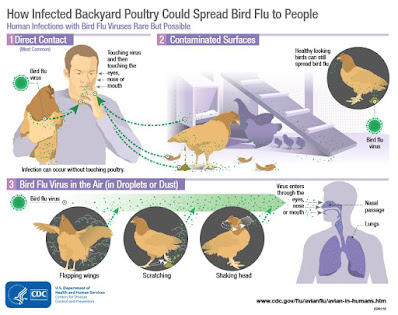
It was just over a year ago that the United States reported its first human H5N1 fatality in a Louisiana Man who kept live poultry in his backyard.
Baton Rouge, Louisiana, Jn 06, 2025 - The Louisiana Department of Health reports the patient who had been hospitalized with the first human case of highly pathogenic avian influenza (HPAI), or H5N1, in Louisiana and the U.S. has died. The patient was over the age of 65 and was reported to have underlying medical conditions. The patient contracted H5N1 after exposure to a combination of a non-commercial backyard flock and wild birds.
As we've discussed previously (see Mixed Messaging On HPAI Food Safety), there is some degree of risk in the slaughtering of live birds and preparation of raw poultry; especially from birds raised at home or purchased from live markets.
And in 2024 the WHO published Interim Guidance to Reduce the Risk of Infection in People Exposed to Avian Influenza Viruses, which lists a number of `risk factors', including:
- keep live poultry in their backyards or homes, or who purchase live birds at markets;
- slaughter, de-feather and/or butcher poultry or other animals at home;
- handle and prepare raw poultry for further cooking and consumption;
These risks go far beyond just human exposure, of course, as live markets also bring together different types of birds which may also silently carry LPAI viruses like H3N2 and H6N2, which could reassort with HPAI H5.
As we discussed last year in J. Virology: Zoonotic Disease Risk at Traditional Food Markets (Minireview), live animal markets present special risks.
