#19,204
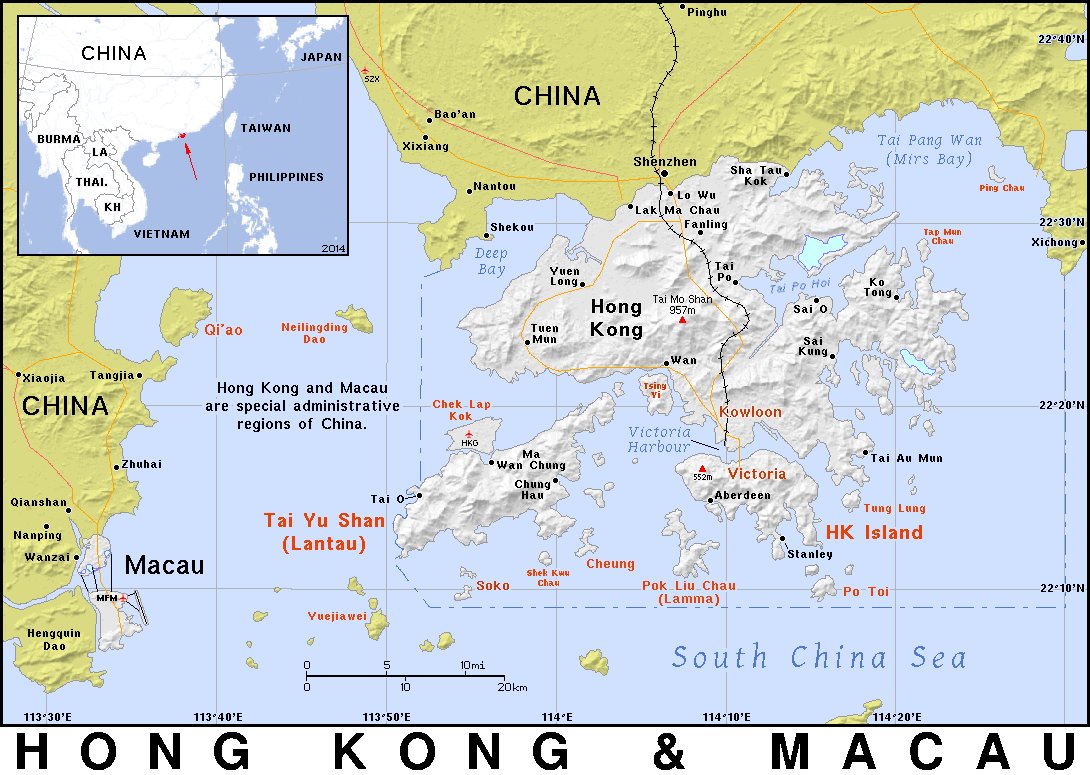
Three days ago (June 13th) we looked at a report (Hong Kong CHP: Locally Acquired Case of H9 Infection - Notification Letter For Doctors) on the first locally acquired case of H9 infection in Hong Kong in more than 6 years.
While not the most dangerous novel flu virus on the CDC's short list of zoonotic influenza viruses (see CDC IRAT SCORE), the CDC does rank two H9N2 lineages has having some pandemic potential.
And in terms of likelihood of sparking a pandemic, the H9N2 Y280 lineage is ranked higher than H5N1, while the G1 lineage is ranked only slightly lower.

Although additional genetic analysis is ongoing, the CHP reports `no significant genetic variations were detected.'
While the toddler's exact exposure is unknown, the CHP believes the boy was most likely exposed by touching a contaminated surface at a local live market. A not uncommon scenario, as the following past blogs attest:
B&E: Assessing The Airborne Spread Of Avian Influenza From LPMs
J. Virol: H9N2 Virus Isolated From Air Samples In LPMs In Jiangxi, China
J. Infection: Aerosolized H5N6 At A Chinese LBM (Live Bird Market)
Detection Of Airborne H9 Nucleic Acid In Chinese Live Poultry MarketWhile this appears to be a one-off infection, Hong Kong's CHP is obviously taking this case seriously. I've reproduced a large portion of their update below. Follow the link to read it in its entirety.
CHP continues to actively follow up on a case of low-pathogenic avian influenza A (H9) infection and reminds the public of the possibility of "twin-peaks" for seasonal influenza and COVID-19 during summer
The Centre for Health Protection (CHP) of the Department of Health (DH) today (June 15) continued to actively follow up on a case of human infection with influenza A (H9) in collaboration with the relevant government departments. Following whole genome sequencing and analysis of the patient's clinical specimens, the virus strain was confirmed to be a low-pathogenic avian influenza A (H9N2) virus. All of the virus genes were avian in origin and no significant genetic variations were detected. The patient is currently in stable condition and all six of his household contacts have remained asymptomatic. As the H9N2 avian influenza virus has long been present in local poultry with low mortality rate for birds, and that the H9N2 avian influenza virus involved in this case has not shown evidence of human-to-human transmission or significant genetic variation, the CHP currently assessed the risk of a local avian influenza pandemic as low. Nevertheless, the CHP once again strongly urged the public to maintain good personal and environmental hygiene at all times, avoid contact with live poultry, birds or their droppings, thoroughly cook poultry meat and eggs before consumption, and wash hands thoroughly after visiting places where live poultry is sold, so as to reduce the risk of avian influenza infection.
In addition, with the recent rise in the activity of seasonal influenza and COVID-19, the CHP does not rule out the possibility that the activity of these two respiratory diseases will continue to rise in the coming months, leading to a "twin-peaks" phenomenon. Members of the public, particularly high-risk individuals, are advised to receive vaccination in a timely manner to reduce the risk of severe disease and death.
Human infection with influenza A (H9) virus
In relation to the recent influenza A (H9) infection in a two-year-old boy, the Public Health Laboratory Services Branch of the CHP conducted whole genome sequencing and analysis of the virus, confirming that the virus strain is a low-pathogenic H9N2 avian influenza virus and that no significant genetic variations were detected.
The CHP has collected 17 environmental samples from the residence of the patient, the fresh provision shop at Wo Che Market he had visited, as well as a park in Fung Wo Estate. One sample collected from a metal tray placed at the bottom of a live chicken cage inside the shop that was used to collect chicken droppings was tested positive for the H9 avian influenza virus. The remaining 16 samples tested negative.
The CHP will conduct further analysis on the positive environmental sample. The CHP believed that it is more likely for the boy to have contracted H9 avian influenza by touching a contaminated surface at the fresh food shop selling live poultry in Wo Che Market. Thorough disinfection and cleaning will be conducted at the fresh food shop in question.
The patient remains hospitalised in stable condition. His symptoms remain mild. Neither his family members nor the staff at the fresh provision shop concerned have developed any symptoms. The CHP has provided them with preventive medication and will continue to put them under medical surveillance.
Based on the above epidemiological and virological evidence, the CHP assessed that the recent local case of infection has not changed the current risk level. The risk of an influenza pandemic due to local avian influenza remains low. The Government's response level under the "Preparedness Plan for Influenza Pandemic" remains at "Alert" level.
Avian influenza viruses are generally classified as highly pathogenic or low pathogenic, and they mainly affect birds and poultry. Birds are also natural hosts for avian influenza viruses. In occasional circumstances, cross-species transmission may occur when human come into close contact with infected poultry or contaminated environments. However, there is currently no scientific evidence to suggest that the existing avian influenza viruses are capable of sustained and efficient human-to-human transmission. No novel influenza virus arising from genetic reassortment between human seasonal influenza viruses and animal influenza viruses has been found either.
Since 1999, a total of 11 cases of human influenza A (H9N2) have been recorded in Hong Kong, including five local cases and six imported cases. No fatal case has been recorded so far.
According to data published by the World Health Organization (WHO), more than 160 cases of human infection with influenza A (H9) have been recorded globally in the past decade. The vast majority of patients presented with mild symptoms. As poultry is a natural host of the virus in many regions, sporadic human infections caused by contact with infected poultry or contaminated environments are expected to continue occurring worldwide.
The CHP will continue to strengthen public education and publicity efforts to reduce the risk of avian influenza infection among the general public. A letter has been issued to all doctors in Hong Kong to update them on the latest situation regarding influenza A (H9), urging them to heighten vigilance and report any suspected cases.
Seasonal influenza and COVID-19
Influenza activity in Hong Kong has increased in recent weeks but remains below the baseline level. Based on past experience, Hong Kong may experience two influenza seasons each year. The onset of summer influenza season began at a later time than usual last year, and sustained a longer period, extending from early September last year to early January this year, resulting in the absence of the winter influenza season that traditionally occurs in the first quarter of each year. Since the summer influenza season typically occurs between July and August, it cannot be ruled out that it may begin earlier than usual this year.
