
#19,304
Nine days ago, in Kent County MI Health Department Bulletin on Swine Flu (in pigs) at Local Fair, we learned of the death (and several illnesses) of pigs at a local county fair due to swine flu, and a health alert issued for possible human cases.
Two days later, on Aug. 15th, we learned of one confirmed human infection with H1N2v from the Michigan Department of Health and Human Services (see Michigan DOH Confirms H1N2v (swine flu) in Fair Exhibitor).
While there were rumors of more than one `flu-like illness' among attendees to the county fair, until now we've heard of no other cases. Today, the CDC announced a total of two confirmed H1N1v swine flu infections linked to this county fair.
Novel Influenza A Virus Infections
Two human infections with influenza A(H1N2) variant (A(H1N2)v) virus were reported by the Michigan Department of Health and Human Services.
The patients, who are <18 years of age, initially developed illness and sought healthcare during the week ending August 15, 2026 (Week 32). The patients were not hospitalized, one patient received influenza antiviral treatment, and both are recovering from their illnesses.
Investigation by local and state public health officials identified that both patients, who have not had contact with one another, had attended the same agricultural fair where ill swine were present prior to their illness onset. No additional cases of human infection with A(H1N2)v virus associated with these cases or the fair have been identified.
These are the third and fourth human infections with a variant influenza virus reported in the 2025-2026 season; all four have been influenza A(H1N2)v viruses.
When an influenza virus that normally circulates in swine (but not people) is detected in a person, it is called a “variant” influenza virus. Most human infections with variant influenza viruses occur following exposure to swine, but human-to-human transmission can occur. It is important to note that in most cases, variant influenza viruses have not shown the ability to spread easily and sustainably from person to person.
No additional notification to WHO of this case is required per International Health Regulations (IHR). More information regarding IHR can be found at http://www.who.int/topics/international_health_regulations/en/.
Although it is possible there were other infections linked to this fair, most people who experience minor or even moderate flu-like symptoms never see a doctor, or are tested, for novel flu viruses.

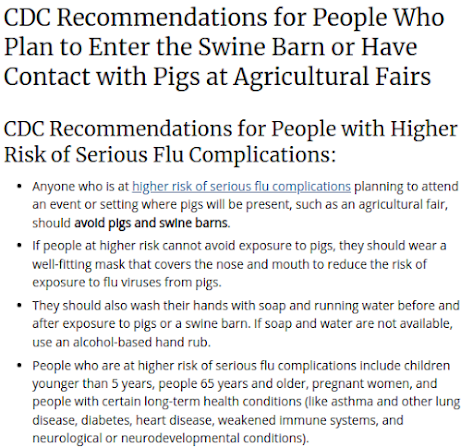
The CDC regularly advises people who are at higher risk of serious flu complications (including children under 5, adults over 65, pregnant women, and those with certain chronic medical conditions), to avoid pigs and the swine barn altogether.
Although the pandemic risk from swine variant viruses is currently regarded as low, the H1N1 pandemic of 2009 demonstrated just how quickly the status quo can change.
