
Note: This is the 4th day of National Preparedness Month. Follow this year’s campaign on Twitter by searching for the #NatlPrep #BeReady or #PrepMonth hashtags.
This month, as part of NPM26, I’ll be rerunning some updated preparedness essays, along with some new ones.
#19,323
Over the past 3 months, in addition to hundreds of mild-to-moderate earthquakes, the world has seen 3 devastating seismic events:
- In early June, the Philippines was struck by a 7.8 quake offshore of Mindanao, killing more than 100 people, and damaging more than 100 thousand homes.
- Two weeks later Venezuela was struck by twin quakes (7.2 and 7.5) - 39 seconds apart - killing more than 6500 people, and destroying tens of thousands of buildings.
- Three weeks after that (August 10th) Colombia was hit by a 7.4 quake, killing > 330 people, and causing massive infrastructure collapse.
While we like to think that these sorts of events can't happen here in the United States, Canada, or Europe, the truth is more sobering.
In January of 2024 the USGS unveiled a new seismic risk map (see top of blog), which increased the percentage of the population at risk of experiencing a damaging earthquake to nearly 75% (roughly 240 million people).
While most people immediately think of California and the `big one', the New Madrid Seismic Zone (NMSZ), the Pacific Northwest (Cascadia fault), coastal South Carolina, Alaska and Hawaii, and even New York City and parts of New England are at risk of seeing significant seismic activity.
Additionally, there are nearly a dozen `very high risk' volcanoes in the continental US (4 in Washington, 4 in Oregon & 3 in California), along dozens of `lesser' threats. While earthquake damage is generally localized, volcanic eruptions can affect property and populations thousands of miles away.

Over the past 100+ years the United States (excluding Alaska & Hawaii) has experienced a `seismic drought', with relatively few big quakes or volcanic eruptions. As a result, most people assume the next `big one' won't happen in their lifetimes.
But all droughts end eventually.
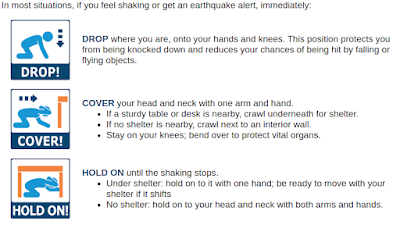
Every year since 2009 I've promoted Shakeout.org's safety campaign, and I strongly urge anyone who lives in any seismically active region to take part.

After the shaking stops, you'll have to find ways to cope with the aftermath.
While the government will send help, you could find yourself pretty much on your own for several days (or longer) and living in less than comfortable conditions for weeks (assuming your home is still habitable).
For starters - and as a bare minimum - every household should have a disaster plan, a good first aid kit (and the knowledge to use it), an emergency battery operated NWS weather radio, and emergency supplies to last a minimum of 72 hours during a disaster.

While 72 hours is an admirable start, having previously lived very near the New Madrid fault, and now living in hurricane country, I wouldn't feel comfortable stopping there.
Many agencies and organizations in the U.S. recommend that households work towards having a 10-to-14 day supply of food, water, and emergency supplies on hand, which I consider far more prudent.
Other steps to consider include setting up emergency meeting places, out-of-state contacts, and creating individual wallet information cards (see #NatlPrep : Create A Family Communications Plan).
For more on earthquake preparedness, both here in the United States, and around the world, you may wish to revisit:
California Quakes : Concrete Concerns
