
#19,048
The world has been watching HPAI H5N1 for nearly 3 decades, but today's HPAI H5 viruses are a far cry from the A/Goose/Guangdong/1/1996 strain that emerged in Southern China 30 years ago.
All that changed in May of 2005 when a large outbreak of HPAI H5 occurred in Qinghai Lake, China, causing the deaths of thousands of bar-headed geese, great black-headed gulls, and brown-headed gulls (see H5N1 Influenza Continues To Circulate and Change 2006 by Webster et. al.).Between 1996 and early 2005, HPAI H5N1 was considered primarily a disease of poultry (ducks, geese, and chickens), and was only sporadically detected in wild or migratory birds.
A new clade (2.2) had emerged - one which was particularly pathogenic in some species - while some migratory birds were better able to transport it over long distances.
But the HPAI H5 virus continued to evolve, generating new subclades (H5N8, H5N5, H5N9, etc.), and new subclades (e.g. 2.3.2.1a, 2.3.2.1c, 2.3.4.4b, etc.), and hundreds of genotypes.
For a while, it appeared that aquatic migratory birds (ducks & geese) were the primary drivers of international spread. Other species - particularly resident birds - were thought either immune or dead-end hosts.
Following North America's first H5 epizootic (2015) researchers were unable to detect HPAI in wild or migratory birds, leading them to surmise that they were not an efficient long-term reservoir for H5 viruses (see PNAS: The Enigma Of Disappearing HPAI H5 In North American Migratory Waterfowl).
But avian flu continued to evolve, and in the fall of 2016 a new reassortant arrived in Europe that caused unusual mortality in a wide range of avian species (see Europe: Unusual Mortality Among Wild Birds From H5N8).
After a series of H5N8 epizootics, that virus was eventually supplanted by a new & improved H5N1 virus, which further expanded its host range (see 2022's DEFRA: The Unprecedented `Order Shift' In Wild Bird H5N1 Positives In Europe & The UK).
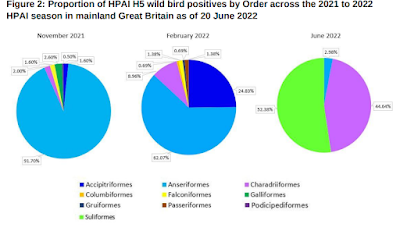
Increasingly, shore birds, passerines, and even raptors were being affected by the virus. The spread to resident birds increased, allowing the virus to persist over the summer, turning HPAI into a year-round threat.
At the same time, HPAI H5 viruses have become better adapted to mammalian species, including livestock, cats, foxes, marine mammals, and even humans.
All of which brings us to a remarkably detailed (albeit U.S. centric) analysis of the spread of HPAI H5N1 via wild (resident & migratory) birds across the 4 North American flyways between Jan 2022 and Apr 2025.

R0 is an estimate of a virus's transmissibility in a naive and susceptible population. In the simplest of terms; anything < 1.0 and a virus (as an outbreak) begins to sputter and die out. Above 1.0, and an outbreak can have `legs’.
This is a lengthy and detailed report, with a lot to unpack. But among its many findings, they report:
- The greatest viral genotype diversity was detected in 2022, with multiple genotypes in circulation.
- By spring of 2025 genotype D1.1 (which only emerged the previous fall) had become the absolute dominant genotype, with its transmission mainly concentrated in Accipitriformes (birds of prey).
- The Mississippi Flyway had the highest R0 in resident birds (6.4); higher than any other bird group or flyway in the analysis.
- While the Atlantic flyways' overall R0 i was just under 1, Georgia and Florida provided persistent, multi‑season resident hotspots for HPAI.
- Quite unexpectedly, Strigiformes (owls) had the strongest transmission capacity, with an R0 of 3.164. Previously owls (and raptors in general) had been thought highly susceptible, but likely to succumb before spreading the virus.
- Anseriformes (waterfowl), surprisingly, had the weakest transmission capacity, with an R0 of 0.992.
- Moderate (not extremely wet or dry) drought conditions (Palmer Index of about −3.3) corresponded to the highest numbers of infections.
The traditional transmission concept centred on Anseriformes is being challenged by the reality of highly efficient transmission and high pathogenicity of the virus in nontraditional hosts such as raptors and mammals. It is essential to quantify the transmission risk of avian influenza in different categories of birds and analyse their roles in the transmission chain.
I've only reproduced the abstract below. Follow the link to read it in its entirety. I'll have a brief postscript after the break.
Nature Communications , Article number: (2026)
We are providing an unedited version of this manuscript to give early access to its findings. Before final publication, the manuscript will undergo further editing. Please note there may be errors present which affect the content, and all legal disclaimers apply.
Abstract
As natural hosts of avian influenza viruses, wild birds pose an increasing threat to public health. Here, using surveillance data from wild bird infections across the United States (2022-2025), we show that HPAI-H5 transmission exhibits strong interspecific variation, seasonality, and spatial heterogeneity linked to migratory flyways.
Phylogeographic analysis reveals that viral genotypes evolve from early, limited transmission along single migratory routes to a nationwide dispersal pattern spanning multiple migratory flyways.
Anseriformes exhibits the highest number of infections but the lowest transmission risk, whereas Strigiformes demonstrates the greatest transmission risk. The HPAI-H5 transmission in wild birds along migratory flyways exhibits significant spatial heterogeneity and is associated with bird migration. Meteorological conditions are correlated with outbreak timing and may inform early warning efforts; however, these relationships are nonlinear. These findings provide a foundation for risk assessment, early warning systems, and integrated management of avian influenza in wild bird populations.
Despite overachieving at almost every turn (see Avian Flu's New Normal: When the Extraordinary Becomes Ordinary), the world continues to treat HPAI H5 as if it were the same virus that threatened - and failed - to produce a pandemic 20 years ago.
While we might get lucky, and find that there is some (as yet, unknown) species barrier that prevents HPAI H5 from becoming a human pandemic, that bit of luck is by no means assured.
Meanwhile the virus continues along an evolutionary path that remains, to a large extent, hidden from our view.
Unfortunately, in the event things take a bad turn, hope isn't much of a plan.
