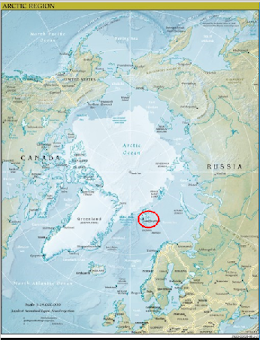
Location of Svalbard in the Arctic Ocean
#19,343
The Svalbard Archipelago, located well above the Arctic Circle - roughly midway between the northern coast of Norway and the North Pole - is about the size of West Virginia and is home to fewer than 3,000 people.
Since 2022, Svalbard has also become a frequent center of HPAI H5 activity, reporting a mixture of H5N1 and H5N5 (see Norwegian Veterinary Institute : HPAI Detected In Arctic (Svalbard) For the First Time).
This becomes all the more important because Svalbard - like many high-latitude avian nesting regions - is the summer home for millions of migratory seabirds, waterfowl, waders, and other birds. As we saw in 2016's Sci Repts.: Southward Autumn Migration Of Waterfowl Facilitates Transmission Of HPAI H5N1, it is thought that these breeding areas may contribute to viral evolution and global spread of new reassortants.
As we discussed in 2025's H5Nx: Reassort & Repeat, each fall we watch for the introduction of new genotypes and/or subtypes with the autumn arrival of migratory birds.

We revisited the Svalbard story again in 2024's HPAI H5N5: A Variation On A Theme, and over the past few months, we've also seen extensive reporting on the detection of H5N5 in polar bears in the region.
Norwegian Veterinary Institute Reports Another HPAI H5N5 Infected Polar Bear on Svalbard Island
Preprint: HPAI H5N5 in a Polar Bear and Atlantic Walrus, Svalbard, 2026, with Widespread Seroconversion in Polar Bears
Norway Veterinary Institute Reports HPAI H5N5 In Polar Bears on Svalbard Island
While most of the world continues to deal primarily with clade 2.3.4.4b HPAI H5N1, since 2023 we've been following a relatively small - but persistent - presence of H5N5 in Northern Europe, Iceland, Eastern Canada, and even the Pacific Northwest.

While these infections often prove fatal, we've also seen growing serological evidence of non-lethal infection.
In August of 2025, the Norwegian Veterinary Institute reported the first detection of H5N5 in Arctic Foxes on Svalbard Island. Their press release stated:
Arctic foxes can become infected with avian influenza through direct contact with sick or dead animals. Foxes are scavengers that are exposed to high infection pressure when they eat infected birds. Studies of red foxes on the mainland indicate that foxes do not have the ability to infect each other. Whole-genome sequencing of the viruses from arctic fox pups will be carried out to investigate whether there are signs of mammalian adaptation in the viruses.This week researchers from the Norwegian Veterinary Institute have published a follow-up, in the form of a 26-page preprint, documenting serological evidence of widespread H5 exposure among Svalbard's population of Arctic foxes.
Due to its length I've only posted some excerpts (reformatted for readability), so you'll want to follow the link to read it in its entirety. I'll have a bit more after you return.
Serological Evidence of Widespread Exposure to H5 Avian Influenza Virus in Arctic Foxes in Svalbard, Norway
Johanna Hol H Fosse, Eva Fuglei, Francesco Bonfante, Line Olsen, Luca Bordes, Rebecca K. Davidson, Torill Mork, Ida Kristin Myhrvold, Lone Thiel Engerdahl, Sandra Venema, Kjersti Sturod, Johan Akerstedt, Olav Hungnes, Monika Z. Ballmann, Lineke Begeman, Ingebjorg Helena Nymo, Ragnhild Tonnessen, Bjornar Ytrehus
doi: https://doi.org/10.64898/2026.09.17.752278
This article is a preprint and has not been certified by peer review [what does this mean?].
Preview PDF
Abstract
The continued circulation of H5 clade 2.3.4.4b highly pathogenic avian influenza virus (HPAIV) has caused extensive mortality in wild bird populations worldwide with increasing spillover to mammals. In 2022, H5 HPAIV emerged in Svalbard, Norway, with subsequent detections in wild birds, walruses, polar bears, and arctic foxes.To understand the population-level exposure among Svalbard arctic foxes, we analysed body fluids from carcasses trapped in 2006-2015 (n = 56), 2023-2024 (n = 112), and 2024-2025 (n = 94) for antibodies to H5 avian influenza (anti-H5), influenza A nucleoprotein (anti-NP), and neuraminidase subtypes using ELISAs, haemagglutination inhibition (HI), and a multiplex assay.
- Only three samples from 2006-2015 tested positive for anti-H5 and were interpreted as false positives.
- In 2023-2024, seropositivity for anti-H5 was high (95%), supported by a lower anti-NP seropositivity (85%) and antibody profiles consistent with mixed H5N1 (42%) and H5N5 (52%) exposure.
- In 2024-2025, anti-H5 and anti-NP seroprevalences remained high (83% and 57%), with H5N5 (87%) exposure predominating over H5N1 (3%).
A subset of anti-H5-positive samples tested positive by HI (2023-2024: 30%; 2024-2025: 14%). Juveniles with exposure limited to the previous season had higher odds of anti-H5 seropositivity in 2023-2024 than in 2024-2025 (OR 5.5). Analysis of paired lung extracts from a subset of individuals (n = 63) yielded results concordant with body fluids, using an indirect anti-H5 ELISA adapted for carnivores. Our findings demonstrate widespread H5 virus exposure.
Together with occasional reports of progression to fatal HPAI, this highlights the need for continued population monitoring to evaluate ecological consequences.
(SNIP)
Discussion
Our study reveals widespread exposure to H5 avian influenza in Svalbard arctic foxes trapped during the winters 2023-2024 and 2024-2025, with no evidence of H5 exposure during the preemergence period (2006-2015), as the few anti-H5-positive results detected in that period were interpreted as likely false positives.Antibody profiles changed over time, suggesting a transition from mixed H5N1 and H5N5 exposure in 2023-2024 to predominantly H5N5 exposure in 2024-2025.
Our findings demonstrate that many arctic foxes survive exposure to H5 avian influenza viruses and develop a detectable humoral response. However, recent detections of fatal HPAI in arctic fox pups suggest that the virus may have profound effects in some individuals, although its potential effects on population dynamics remain unknown. The temporal changes in antibody profiles should be viewed in the context of HPAIV detections in Svalbard wildlife. Both H5N1 and H5N5 viruses were detected in birds and marine mammals in 2023, whereas no detections were reported in 2024. However, H5N5 was subsequently detected in arctic foxes in 2025 and in a polar bear and an Atlantic walrus in 2026 [13,18].
(SNIP)
(Continue . . . )In conclusion, our findings demonstrate widespread exposure of Svalbard arctic foxes to H5 avian influenza virus following the emergence of clade 2.3.4.4b viruses in the High Arctic, with unknown consequences for the population. The exceptionally high seroprevalence, combined with temporal changes in antibody profiles, indicates substantial and evolving exposure within the Svalbard ecosystem. Arctic foxes may represent a useful sentinel species for monitoring HPAIV circulation in remote regions where conventional surveillance is challenging.Continued integrated surveillance of wildlife hosts, predators, and scavengers will be important for understanding the long-term ecological consequences of HPAIV circulation and for detecting future changes in virus distribution, subtype composition, and transmission dynamics [18].
Interestingly, while H5N1 remains the dominant HPAI across the rest of the world, in Svalbard (and potentially other poorly-monitored high-latitude regions); H5N5 appears to have - at least temporarily - gained the upper hand.
It’s not yet clear whether H5N5’s apparent success in Svalbard reflects some inherent viral advantage, favorable local environments or hosts, or simply chance.
But it's an outlier, which makes it well worth our continued attention.
