#19,400
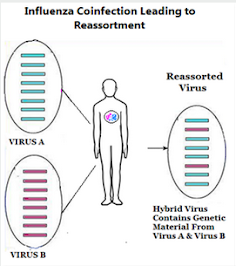
Influenza co-infections in humans - or in any other susceptible host (birds, pigs, cattle, sheep, etc.) - are a public health concern because they can allow two (or more) influenza viruses to swap genetic material (reassort) and produce a hybrid virus.It's more than just a theoretical concern, as twice in my lifetime (1957 & 1968) a reassortment between seasonal flu and an avian flu virus - possibly in a human host - produced a pandemic virus.
- The first (1957) was pandemic H2N2, which According to the CDC emerged after three different genes from an H2N2 avian influenza A virus combined with 5 genes from the existing H1N1 virus.
- In 1968 a novel H3N2 virus emerged (a reassortment consisting of 2 genes from a low path avian influenza H3 virus, and 6 genes from seasonal H2N2) which continues to spark yearly epidemics more than 58 years later.
Coinfection is rare, but not unheard of, and as any virologist will tell you; Shift happens.
With three recent dairy-linked H5N1 cases (1 fatal) reported in Washington state - and previous evidence suggesting mild and/or asymptomatic cases may go unreported (see MMWR: Serologic Evidence of Recent Infection with HPAI A(H5) Virus Among Dairy Workers), the arrival of the fall flu season raises concerns over the possibility of seeing a rare coinfection.
In addition to vaccination, the CDC also promotes (see Reducing Exposure for Workers to Avian Influenza A Viruses) the use of PPEs, but it isn't clear how many are following this advice.

Since 2009, with increased surveillance and better tools, we've seen a growing number of reports of human co-infection with influenza A:
EID Journal: Nosocomial Co-Transmission Of H7N9 & H1N1pdm09
EID Journal: Human Co-Infection with Avian and Seasonal Influenza Viruses, China
But evidence of the generation of `biologically fit' reassortant viruses from a human co-infection remain rare.
- In 2025's Eurosurveillance: Novel influenza A(H1N2) Seasonal Reassortant Virus Identified in a Patient, Sweden, April 2025 we saw a rare reassortment between seasonal H1N1 and seasonal H3N2.
- In April of 2020, during the opening of the COVID pandemic, we saw an MMWR Report on a Seasonal H3N2 & H1N1pdm09 Reassortant Infection - Idaho, 2019), involving a 13 year-old boy.
- In 2015's J Clin Virol: Influenza Co-Infection Leading To A Reassortant Virus, we looked at co-infection in a Cambodian patient with both seasonal H3N2 and H1N1pdm09 which led to a new, reassortant H3N2 virus.
- And in 2011 we saw a similar co-infection in a 16 month old boy in Canada that led to the creation of a unique hybrid reassorted virus (see Webinar: pH1N1 – H3N2 A Novel Influenza Reassortment).
Another, older (2010) study (see PNAS: H3N2 And H5N1 Reassortment) found that Reassortment between avian H5N1 and human H3N2 influenza viruses creates hybrid viruses with substantial virulence.
Of course, reassortment with seasonal flu doesn't have to happen in a human. Swine, cattle, and other species can be susceptible to both human and avian flu.

Simple things; like getting the seasonal flu vaccine, wearing PPEs when in high-risk contact with dairy cattle and poultry, and not consuming raw milk could go a long way in reducing those risks.
Of course, whether we can be bothered to take these types of proactive steps, remains to be seen.
