Showing posts with label APHA. Show all posts

Wednesday, February 11, 2015

APHA: Valentines Preparedness E-Cards For 2015

image

Follow @GetReady on Twitter


# 9697


The United States sees – on average – 60 to 80 major disasters each year (see FEMA list), and yet most Americans remain woefully unprepared to fend for themselves for even the first 72 hours. 


And three days is a minimum goal, as some disasters (think Superstorm Sandy, Hurricane Katrina, or a major earthquake) could cause interruptions lasting a week or longer, and federal state and local help could be spread very thin in the opening days.


Three years ago, in APHA: Some Clever Valentines Day Preparedness Messages, I highlighted some free e-cards from the APHA (American Public Health Association) that incorporated preparedness advice into the traditional Valentine’s Day message.


Every year since then, the APHA has added new cards (along with keeping many from past years), which you can use to remind your loved ones of the importance of being prepared.  This year, once again, the list has grown.


Get ready with one of our free e-cards!

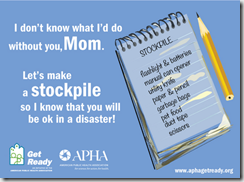
If you're a fan of APHA's Get Ready campaign, we know you love to be prepared as much as we do. To help you spread the message, we created some Get Ready e-cards so that you can share the importance of preparedness with your loved ones.

Browse our cards below. When you find one you'd like to send, click on the image. From there, you can share the card with friends and family!

image


image

image

image

image

image


This is just a sampling as this year there are now 36 cards to choose from. 


For more on what you can do to prepare for the next disaster, visit the FEMA, or Ready.gov website, and feel free to re-visit some of my earlier preparedness blogs (below).

Preparing For An Unpredictable New Year
GridEx 2013 Preparedness Drill

NPM13: Everyday Preppers

Pandemic Preparedness: Taking Our Cue From The Experts


And lastly, in NPM13: The Greatest Prep Of All,  I wrote about what I consider to be the most important preparedness step you can take – having, and being, a disaster buddy.  Cultivating a network of family and friends to whom you can turn for help in a disaster, to who can turn to you for aid,  if they need it.


Because no matter where you live, its just a matter of time before the next disaster strikes.

Saturday, March 08, 2014

Spring Forward Into Preparedness


image

Credit APHA 

# 8360


Each year in the U.S. most of the country switches to Daylight Savings Time (DST) in the Spring, and back to Standard Time in the Fall.   Tonight (well, 2am tomorrow morning to be precise),  we `spring forward’  into DST, which is used as a handy reminder by FEMA , READY.GOV,  the APHA and others for the public to the check batteries in smoke alarms, and to check their emergency supplies.

image


I also use this twice-a-year time change as a reminder to go through and check my stash of emergency food storage, discarding any foods that are out of date (and either using - or donating to the needy - those that are still good, but will expire in the next 6 months).


For some quick and easy advice on how to stock up and prepare,  American Public Health Association has a set of free guides available at:

     Get Ready: Set Your Clocks, Check Your Stocks


Agencies like FEMA, READY.GOV and the HHS are constantly trying to get the preparedness message out, so that when (not `if') a disaster does occur, human losses can be minimized. At a bare minimum, every household should have a disaster plan, a good first aid kit (and the knowledge to use it), and emergency supplies to last a minimum of 72 hours during a disaster. 


For more information on how to prepare for emergencies, up to and including a pandemic, the following sites should be of assistance.

FEMA http://www.fema.gov/index.shtm

READY.GOV http://www.ready.gov/

AMERICAN RED CROSS http://www.redcross.org/

APHA Get Ready : http://getreadyforflu.org/newsite.htm


A few of my (many) blogs on this subject include:

  • In An Emergency, Who Has Your Back?
  • When 72 Hours Isn’t Enough
  • When Evacuation Is The Better Part Of Valor
  • While it takes more than a few minutes to become prepared, once you’ve laid that foundation, a few minutes twice-a-year may be all it takes to maintain it.

    Tuesday, February 11, 2014

    APHA: More Preparedness Valentine’s Day Cards

    image 


    # 8287


    Each year the American Public Health Association’s Get Ready Campaign adds some clever preparedness and public health-related e-cards to their library that you can send to your special someone on this Valentine’s Day.


    As in years past, today I’m highlighting some of the new entries, and a couple of old favorites.


    I’ve included a few screen shots of the cards here, but follow the link below to view them all, and select the ones you like to send.


    Get ready with one of our free e-cards!

    If you're a fan of APHA's Get Ready campaign, we know you love to be prepared as much as we do. To help you spread the message, we created some Get Ready e-cards so that you can share the importance of preparedness with your loved ones.

    Browse our cards below. When you find one you'd like to send, click on the image. From there, you can:

    1. Right-click, save the image, and attach it to your email, upload to Facebook or distribute how you'd like.
    2. Use the page link to tweet, Facebook or email your message.
    3. Have fun!


    image

    image

    image

    image


    image


    This is just a sampling as this year there are 15 cards to choose from.


    For more on what you can do to prepare for the next disaster, visit the FEMA, or Ready.gov website, and feel free to re-visit some of my earlier preparedness blogs (below).


    Preparing For An Unpredictable New Year
    HSPH Video: The Next Pandemic: Are We Ready?
    GridEx 2013 Preparedness Drill
    Pandemic Preparedness: Taking Our Cue From The Experts


    And lastly, in NPM13: The Greatest Prep Of All,  I wrote about what I consider to be the most important preparedness step you can take – having, and being, a disaster buddy.  Cultivating a network of family and friends to whom you can turn for help in a disaster, to who can turn to you for aid,  if they need it.


    Because no matter where you live, its just a matter of time before the next disaster strikes.

    Monday, December 24, 2012

    A Flu Near You Snapshot


    # 6802


    Yesterday I highlighted the latest CDC FluView report – for the week of December 9th-15th – that indicated continued increases in flu activity around the country.


    These reports are essentially a snapshot of flu activity as it was being reported a week or 10 days ago.

    image

    Week 50 ILI activity – Source CDC FluView


    Doctors, epidemiologists, and other public health officials would prefer a more current status report, but collecting, collating, and analyzing data takes time. 


    So these reports are always a week or so behind.


    One recent attempt to use the internet to track influenza activity is the Flu Near You project, which I’ve written about in the past. Run by Healthmap of Children’s Hospital Boston in partnership with the American Public Health Association and the Skoll Global Threats Fund, this project maps self-reported influenza-like-illness from its volunteers.


    While self-reported flu symptom surveys cannot replace traditional influenza testing and surveillance methods, they can hopefully give us a more up-to-date idea of respiratory illness trends.


    And judging by the latest Flu Near You map (current as of 9:15am EST Dec 24th), ILI’s are showing no sign of slowing across the nation.


    image


    As the number of participants grows, it is hoped that this project will become a more reliable indicator of current ILI activity around the nation.


    For more on this project, and information on how you can participate, see Do You Have It In You?


    Meanwhile, now is the time to take those extra steps to try to protect yourself (and others) against the flu, and other viral diseases. 


    • Washing your hands often
    • Covering coughs and sneezes
    • Staying home if you are sick.


    And finally, to all of my friends and  readers around the world, I wish you a happy, healthy, and joyous holiday season.

    Sunday, March 18, 2012

    APHA Get Ready Podcasts


    image


    # 6231


    Last month in APHA: Some Clever Valentines Day Preparedness Messages I highlighted some preparedness e-cards available from the American Public Health Association’s Get Ready Campaign.


    Today I’ve a couple of dozen preparedness podcasts available through APHA, on a wide variety of topics.


    The latest one is on what you ought to have in your first aid kit (you do have a kit at home, at work, and another in your car, don’t you?).  


    Get Ready Report Podcast, episode 25: “Tips for creating a useful first-aid kit”

    Released: March 7, 2012. Running time: 21:14


    Description: What should you put in your first-aid kit? Richard Bradley, MD, a member of the American Red Cross Scientific Advisory Council and an associate professor of emergency medicine at the University of Texas Health Science Center at Houston, provides tips on what you need to have on hand for an emergency.

    • Play podcast
    • Read transcript
    • Download a Healthy You tipsheet from The Nation's Health (PDF)


    You’ll find 24 podcasts available (and growing), along with transcripts, and other toolkits, on this page. A few of the topics covered include:


    • Get Ready Report Podcast, episode 24: “Preparing for disasters: Information for people with disabilities."
       
    • Get Ready Report Podcast, episode 22: “Workplace preparedness: Protecting your employees — and your bottom line — during emergencies"
       
    • Get Ready Report Podcast, episode 19: “It takes more than duct tape to prepare for emergencies: Preparedness tips from the Maine Public Health Association"
       
    • Get Ready Report Podcast, episode 15: “Sheltering in place during an emergency"


    • Get Ready Report Podcast, episode 6: “Healthy stockpiling tips"


    Despite the popular depiction on cable TV shows like Doomsday Preppers, most preppers are not road-kill eating, tomahawk wielding, hardcore survivalists with plans to bug out to a homemade bunker in the foothills of Idaho, expecting to survive some feared future asteroid impact, global thermonuclear war, or a zombie apocalypse. 


    The average prepper is simply someone who recognizes that just about every year hundreds of thousands of Americans are thrust into a difficult emergency situation due to a natural or man-made disaster.


    And millions more are faced with dealing with smaller emergencies, like household accidents, heart attacks, car wrecks, and house fires.


    Being prepared – having a good first aid kit (and knowing how to use it), a family emergency plan, some emergency supplies, and a bug-out bag -  can make a huge difference in how well you, and your family, will come through an emergency.


    While cable shows focusing on folks preparing for a massive solar flares or a the eruption of the Yellowstone super caldera have a certain degree of entertainment value, real preparedness comes from being ready to deal with a wide variety of likely emergencies.


    • Floods
    • Tornadoes
    • Hurricanes
    • Wildfires
    • Blizzards & Ice storms
    • Earthquakes
    • Household accidents
    • and yes . . . even Pandemics


    A mainstream enough concern that the folks at APHA, READY.GOV , FEMA, the American Red Cross, and many other agencies continue to urge you to become better prepared today.

    Tuesday, February 14, 2012

    APHA: Some Clever Valentines Day Preparedness Messages


    # 6145


    The American Public Health Association’s Get Ready Campaign has some clever preparedness and public health-related e-cards you can send to your special someone on this Valentine’s Day.


    I’ve included a few screen shots of the cards here, but follow the link below to view them all, and select the ones you like to send.


    Get Ready for Valentine's Day with us!

    If you're a fan of APHA's Get Ready campaign, we know you love to be prepared as much as we do. To help you spread the love this year, we created some very special Get Ready e-cards so that you can share the message of preparedness with your loved ones.

    Browse our cards below. When you find one you'd like to send, click on the image. From there, you can:

    1. Right-click, save the image, and attach it to your email, upload to Facebook or distribute how you'd like.
    2. Use the page link to tweet, Facebook or email your message.
    3. Have fun!


    image

    image

    image


    image


    image


    For pure sentiment, I’d vote for #4.

    Tuesday, April 06, 2010

    National Public Health Week


    # 4472


    The first week of April has been designated National Public Health Week (NPHW) ever since former President Bill Clinton signed a proclamation to that effect in 1995. 


    Since then, the American Public Health Association (APHA) has served as the lead organizer of this yearly event. 


    Unlike most government programs and agencies, public health’s success is best defined by what doesn’t happen.  


    The fact that developed nations have beaten back many infectious diseases, and have reduced preventable mortality and morbidity to the extent that they have, is due to the considerable efforts of public health agencies.     


    You can follow the events this week on Twitter by following @NPHW, and you can learn more about NPHW, and how to help promote it,  by visiting the NPHW website.


    image

    Imagine other countries looking to the U.S. as a model of health. A place where everyone has access to health care and services, where we’re celebrated for embracing healthy lifestyles, and our communities and neighborhoods make it easy for us to make healthy choices. We can make a difference.


    If every one of us commits to promoting good health in our communities, we can create a ripple effect from coast to coast. Through just one neighborhood that makes its public parks accessible, one municipality that launches a bike-helmet safety program, one group of people who join together to bring fresh foods to school, or one health center that offers a vaccination program, we can create a collage of public health successes across the country.


    Block by block, let’s find these small changes and make them today in our communities. The only way to become a healthier nation is to create healthier communities. Join APHA during National Public Health Week 2010 as we work together to create “A Healthier America: One Community at a Time.”