Showing posts with label Cyclospora. Show all posts

Friday, November 01, 2013

MMWR: Cyclosporiasis Outbreak Summer 2013

image

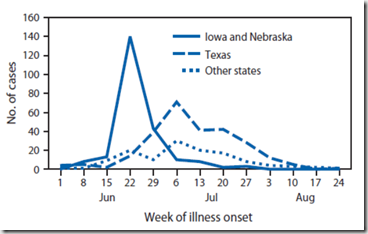
Laboratory-confirmed cyclosporiasis cases by week of onset — United States, June 1–September 10, 2013 – CDC MMWR

# 7928


While  fairly common in developing tropical, or sub-tropical countries, Cyclosporiasis – an infection usually acquired through consuming food or water contaminated with Cyclospora cayetanensis - is relatively rare in the United States.


Unlike the more common cryptosporidium, which can be easily be passed from human-to-human, Cyclospora is rarely transmitted directly from an infected host. Hosts infected with Cyclospora shed unsporulated (non-infective) cysts in their stool which require days or even weeks to mature into infectious agents.


Over the summer, we witnessed a multi-state outbreak of Cyclosporiasis, which I blogged about several times (see here, here, and here). Infection with this parasite is characterized by prolonged bouts of watery diarrhea, which may persist or reoccur over a period of weeks. According to the CDC, Trimethoprim/sulfamethoxazole (TMP/SMX), is the recommended treatment, although they state:


Most people who have healthy immune systems will recover without treatment. If not treated, the illness may last for a few days to a month or longer. Symptoms may seem to go away and then return one or more times (relapse).

Anti-diarrheal medicine may help reduce diarrhea, but a health care provider should be consulted before such medicine is taken. People who are in poor health or who have weakened immune systems may be at higher risk for severe or prolonged illness.


This outbreak slowed, and finally ended, by the end of  August.  Yesterday, the CDC’s MMWR carried a brief post-mortem on the outbreak, which identified not one – but at least two separate outbreaks – and that `the food item associated with illness in Texas was different from that implicated in restaurant-associated cases in Iowa and Nebraska’.


Notes from the Field: Outbreaks of Cyclosporiasis — United States, June–August 2013

Weekly

November 1, 2013 / 62(43);862-862

During June–August 2013, CDC, state and local public health officials, and the Food and Drug Administration (FDA) investigated an unusually large number of reports of cyclosporiasis (compared with annual reports to the National Notifiable Disease Surveillance System [e.g., 123 cases in 2012]), an intestinal infection caused by the parasite Cyclospora cayetanensis (1). By September 20, CDC had been notified of 643 cases from 25 states, primarily Texas (278 cases), Iowa (153), and Nebraska (86). Investigations in Iowa and Nebraska showed that restaurant-associated cases in these two states were linked to a salad mix that contained iceberg lettuce, romaine lettuce, red cabbage, and carrots (2). Most patients in Iowa and Nebraska became ill during June 15–29; cases reported during July and August were primarily from Texas (Figure).

CDC collaborated with state and local public health officials in Texas and the FDA to investigate a cluster of illnesses among patrons of a Mexican-style restaurant in Fort Bend County, Texas (restaurant A). A case of restaurant A–associated gastroenteritis was defined as gastrointestinal illness in a person who had eaten at restaurant A after June 1, 2013. Of 30 persons who ate at restaurant A, 22 had laboratory-confirmed C. cayetanensis infections, and eight had no laboratory confirmation. To identify the source or sources of the infections, a case-control study using 21 case-patients (15 laboratory-confirmed and six probable) with known meal dates and 65 controls matched by restaurant A meal date was conducted.

Case-patients and controls were asked about the meals they ate at restaurant A, using the menu. Ingredient-level analyses were conducted using meal consumption data and restaurant A recipes to identify four fresh produce ingredients with a statistically significant association with illness: fresh cilantro (matched odds ratio [mOR] = 19.8; 95% confidence interval [CI] = 4.0–>999), whole onions (mOR = 15.3; CI = 2.1–697.7), garlic (mOR = 10.7; CI = 1.5–475.4), and tomatoes (mOR = 5.5; CI = 1.1–54.1). Only fresh cilantro was consumed by all case-patients included in the study. In addition, of the four restaurant-produced salsas served at restaurant A, three containing fresh, uncooked cilantro were associated with illness: hot salsa (mOR 8.0; CI = 2.3–31.4), side salsa (mOR 5.7; CI = 1.6–23.7), and fire salsa (mOR 3.5, CI = 1.1–12.7). Case-patients also more commonly than controls reported eating salsa ranchera, which contained fresh cooked cilantro, but the association was not statistically significant: (mOR = 6.0; CI = 0.7–75.2).

Traceback information indicated that Puebla, Mexico, was a source of fresh cilantro served to ill persons at restaurant A. Lettuce served at restaurant A was neither sourced from the same producer implicated in the outbreak investigation in Iowa and Nebraska nor was it associated with illness. Additionally, restaurant A did not use red cabbage or carrots. Taken together, data from tracebacks and epidemiologic investigations in Texas, Iowa, and Nebraska indicate that more than one outbreak of cyclosporiasis occurred during summer 2013 in the United States, and that the food item associated with illness in Texas was different from that implicated in restaurant-associated cases in Iowa and Nebraska.

Friday, July 26, 2013

CDC: Updating The Cyclosporiasis Outbreak


image


# 7517


In early July (see Iowa & Nebraska Report Cyclospora Outbreak) we began to see reports of a relatively rare (at least in the United States) outbreak of Cyclosporiasis – due to infection with a (usually food or water borne) protozoan called Cyclospora cayetanensis.

Since then, this outbreak investigation has grown to include more than 280 cases across 11 states (although some of these cases may have been acquired via international travel).


Thus far, no source of this outbreak has been identified.


Infection with this parasite is characterized by prolonged bouts of watery diarrhea, which may persist or reoccur over a period of weeks. According to the CDC, Trimethoprim/sulfamethoxazole (TMP/SMX), is the recommended treatment, although they state:


Most people who have healthy immune systems will recover without treatment. If not treated, the illness may last for a few days to a month or longer. Symptoms may seem to go away and then return one or more times (relapse).


Anti-diarrheal medicine may help reduce diarrhea, but a health care provider should be consulted before such medicine is taken. People who are in poor health or who have weakened immune systems may be at higher risk for severe or prolonged illness.


The CDC updated their epidemiological investigation webpage yesterday (July 25th), with the following information:


Investigation of an Outbreak of Cyclosporiasis in the United States

Updated: 7/25/13

On June 28, 2013, CDC was notified of 2 laboratory-confirmed cases of Cyclospora infection in Iowa residents who had become ill in June and did not have a history of international travel during the 14 days before the onset of illness. Since that date, CDC has been collaborating with public health officials in multiple states and the US Food and Drug Administration (FDA) to investigate an outbreak of cyclosporiasis. Preliminary details of the ongoing investigation are highlighted below.

Highlights
Epidemiologic Investigation
  • As of July 24, 2013 (5pm EDT), CDC has been notified of 285 cases of Cyclospora infection in residents of multiple states, including IowaExternal Web Site Icon, NebraskaExternal Web Site Icon, TexasExternal Web Site Icon, WisconsinExternal Web Site Icon, Georgia, Connecticut, New Jersey, Minnesota, and Ohio. Illinois and Kansas have also notified CDC of one case each that may have been acquired out of state but in the United States.
  • Most of the illness onset dates have ranged from mid-June through early July.
  • At least 18 persons reportedly have been hospitalized in three states.
  • No food items have been implicated to date, but public health authorities are pursuing all leads. Previous outbreak investigations have implicated various types of fresh produce.
  • It is not yet clear whether the cases from all of the states are part of the same outbreak.
  • No common events (e.g., social gatherings) have been identified among the case patients.
  • Additional cases are currently under investigation and will be included on this page as states confirm them.
Laboratory Investigation
  • To date, CDC has confirmed 5 cases of Cyclospora infection in CDC laboratories. One of those cases was confirmed via telediagnosis.
  • CDC encourages laboratories to obtain confirmation of cases using telediagnosis. Telediagnosis allows for rapid laboratory confirmation. State health laboratories may submit images showing suspected Cyclospora oocysts to CDC. Images may be captured from modified acid-fast stained smears or from wet mounts examined by UV fluorescence microscopy. Both techniques require concentrated stool specimens. Instructions for submitting images for telediagnosis are found on the DPDx site.


Prevention and control is problematic, as the CDC explains below:


Prevention & Control

On the basis of the currently available information, avoiding food or water that may have been contaminated with feces is the best way to prevent cyclosporiasis. Treatment with chlorine or iodine is unlikely to kill Cyclospora oocysts. No vaccine for cyclosporiasis is available.


The U.S. Food and Drug Administration's (FDA) Center for Food Safety and Applied Nutrition (CFSAN) publishes detailed food safety recommendations for growers and suppliers. In its Guide to Minimize Microbial Food Safety Hazards for Fresh Fruits and Vegetables, CFSAN describes good agricultural practices (GAPs) and good manufacturing practices (GMPs) for fresh fruits and vegetables. The guidelines address the growing, harvesting, sorting, packaging, and storage processes; following the guidelines can help reduce the overall risk for microbial contamination during these processes. The precise ways that food and water become contaminated with Cyclospora oocysts are not fully understood.

Monday, July 15, 2013

Iowa: Updating The Cyclospora Outbreak


image

Credit CDC


# 7483


Last week in Iowa & Nebraska Report Cyclospora Outbreak I wrote about an outbreak of a relatively rare (at least in the United States) intestinal illness due to the microscopic parasite Cyclospora cayetanensis.


A week ago (July 8th) Iowa had reported 22 laboratory confirmed cases. Today, that number has more than tripled, with 71 cases now confirmed.


First, two updates from the Iowa Department of Public Health, and then I’ll return with a little bit more.


IDPH Cyclospora Case Count Update

The Iowa Department of Public Health, CDC and local public health agencies are investigating an outbreak of an intestinal illness caused by Cyclospora (a rare parasite). As of today, July 15, 71 cases of Cyclospora infections have been reported to IDPH; almost all have been identified through testing at the State Hygienic Lab (SHL), including:

  • Linn County - 30 cases
  • Polk County - 5 cases
  • Fayette County - 3 cases
  • O’Brien County - 3 cases
  • Dallas County - 3 cases
  • Buchanan - 3 cases
  • Black Hawk County - 3 cases
  • Webster County - 3 cases
  • Mills County - 2 cases
  • Des Moines County - 2 cases
  • Boone County - 3 cases
  • Benton County - 1 case
  • Keokuk - 1 case
  • Monona - 1 case
  • Butler - 1 case
  • Winneshiek - 1 case
  • Johnson County - 1 case
  • Pottawattamie County - 1 case
  • Van Buren County - 1 case
  • Story County - 1 case
  • Cedar County - 1 case
  • Woodbury County - 1 case

Total - 71 cases


Iowa Cyclospora Outbreak 2013
Outbreak Update 7.15.13
(new information is highlighted)

  • IDPH, CDC, the State Hygienic Laboratory and local public health agencies are investigating an
    outbreak caused by Cyclospora.
    • As of today, 71 cases of Cyclospora infections have been reported to IDPH. Case counts are updated at approximately 10 a.m. each day.
    • Cyclospora is a rare parasite.
    • Previous outbreaks have been associated with fresh produce (fresh fruits and
      vegetables)
    • People become infected with Cyclospora by consuming food or water contaminated
      with the parasite.
  • The source of this outbreak is unknown at this time, however progress is being made.
    • Cyclospora illness is typically traced to consumption of fresh fruits and vegetables
      contaminated with the parasite; this investigation currently indicates fresh vegetables, not fruit, may be the source of illness.
    • IDPH is working with local public health agencies to interview individuals who are ill to determine if there is a common food exposure that would indicate the source of illness.
    • Cluster investigations continue, which ask questions of both the ill person and their
      family and friends who are not ill, to determine what the well people did not eat. 
  • Cylospora infection causes a watery diarrhea that lasts an average of 57 days, if untreated.
    • Most of the illnesses in this outbreak began in mid to late June. Many people report still
      being ill and some have had relapses.
    • There is treatment (medicine) available to treat Cyclospora infection.
    • Specific laboratory testing (not commonly ordered) must be done to detect Cyclospora.
    • Specific treatment (not typically used to treat more common diarrheal illnesses) can be prescribed.
  • If you are experiencing diarrhea, or have recently had a long bout with diarrhea, you should
    contact your health care provider and see if you should be tested for Cyclospora infection.
    • Additional symptoms of cyclosporiasis (the infection caused by Cyclospora) include: 
      Watery diarrhea 
      Fatigue (severe tiredness) 
      Loss of appetite 
      Weight loss 
      Bloating 
      Increased gas 
      Stomach cramps 
      Nausea 
      Vomiting 
      Muscle aches 
      Low-grade fever


Unlike cryptosporidium and the infamous norovirus, which can be easily be passed from human-to-human, Cyclospora is rarely transmitted directly from an infected host.


Hosts infected with Cyclospora shed unsporulated (non-infective) cysts in their stool which require days or even weeks to mature into infectious agents.


Neighboring Nebraska has reported more than a dozen cases of Cyclospora over the past two weeks as well, although Iowa appears to be taking the brunt of the outbreak.


The CDC maintains an extensive site on Parasites - Cyclosporiasis (Cyclospora Infection) where you can learn more about this water and food borne illness.


I’ll update this story when (or if) we learn the source.

Tuesday, July 09, 2013

Iowa & Nebraska Report Cyclospora Outbreak


image

Credit CDC 


# 7462


Although fairly common in developing tropical, or sub-tropical countries, Cyclosporiasis – an infection generally acquired through consuming food or water contaminated with Cyclospora cayetanensis - is relatively rare in the United States.


According to the CDC’s Epidemiology & Risk Factors:


In the United States, foodborne outbreaks of cyclosporiasis since the mid-1990s have been linked to various types of imported fresh produce, including raspberries, basil, snow peas, and mesclun lettuce; no commercially frozen or canned produce has been implicated.


U.S. cases of infection also have occurred in persons who traveled to Cyclospora-endemic areas. To reduce the risk for infection, travelers should take precautions, such as those recommended in CDC's Health Information for International Travel (Yellow Book). Travelers also should be aware that treatment of water or food with chlorine or iodine is unlikely to kill Cyclospora oocysts.


Unlike cryptosporidium, which can be easily be passed from human-to-human, Cyclospora is rarely transmitted directly from an infected host. Hosts infected with Cyclospora shed unsporulated (non-infective) cysts in their stool which require days or even weeks to mature into infectious agents.


So far, the source of this outbreak remains a mystery, but at least 3 dozen people in Iowa and Nebraska have been identified as infected – all apparently since mid-June.  Public Health departments in Iowa and Nebraska are urging lab testing for patients with prolonged diarrhea  accompanied by anorexia and fatigue.


This from the Iowa Department of Public Health.


IDPH Investigates Intestinal Illness

The Iowa Department of Public Health, CDC and local public health agencies are investigating an outbreak of an intestinal illness caused by Cyclospora (a rare parasite). As of today, July 8, 22 cases of Cyclospora infections have been reported to IDPH; almost all have been identified through testing at the State Hygienic Lab (SHL), including:

  • Linn County - 10 cases
  • Fayette County - 3 cases
  • O’Brien County - 2 cases
  • Webster County - 2 cases
  • Benton County - 1 case
  • Des Moines County - 1 case
  • Mills County - 1 case
  • Polk County - 1 case
  • Van Buren County - 1 case

Most people’s illness began in mid to late June, and at least one person has been hospitalized. Many people report still being ill with diarrhea and some have had relapses.


Specific treatment is available (but it is not typically used for more common diarrheal illnesses). Also, very specific laboratory testing (not commonly ordered) must be done to detect Cyclospora.


Additional cases have been identified in Nebraska and other Midwestern states. IDPH is coordinating the investigation with public health officials in those states. The investigation is ongoing; no specific source of exposure has been identified. Fresh produce (fresh fruits and vegetables) have been implicated in previous outbreaks. Washing fresh produce is recommended; however, it can be very difficult to wash Cyclospora off all types of produce.


People become infected with cyclospora by consuming food or water contaminated with the parasite, which causes a watery diarrhea that lasts an average of 57 days if untreated.

Symptoms of cyclosporiasis include:

  • Watery diarrhea
  • Fatigue (severe tiredness)
  • Loss of appetite
  • Weight loss
  • Bloating
  • Increased gas
  • Stomach cramps
  • Nausea
  • Vomiting
  • Muscle aches
  • Low-grade fever