Showing posts with label Flu Buddies. Show all posts

Sunday, November 09, 2014

Home Alone . . . With The Flu

flu box 2

My `under-the-bed’ flu kit


# 9301


Although you can never really know what kind of flu season lies ahead, early indications are that the H3N2 virus is leading the pack and that a new strain – not covered in this year’s vaccine – may have an impact (see A `Drift’ In A Sea Of Influenza Viruses). 


Years in which H3 viruses dominate often produce more severe flu seasons – particularly among those over the age of 65.


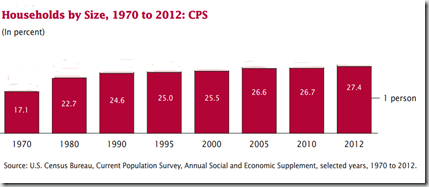
Like many Americans, I live alone.  It is a demographic trend that has been increasing for decades. A couple of years ago the Census bureau reported that 1 in 4 households had just a single occupant - greater than at any time in the past century.


Currently, more than 32 million Americans live alone (see chart below), and while many of those are younger people who are waiting later to get married, a side effect of our longer lifespan and high divorce rate is that many of these single households are held by those over the age of 65.
image


Whether we live alone by choice or by happenstance, we all share a common vulnerability.  If we get sick, or injured, there may be no one around to notice, or to help. 


As a paramedic I saw a significant number of people who lived alone who either died, or spend miserable hours or even days incapacitated and unable to call for help, due to an illness or accident.


Another vulnerable group are households with only 1 adult, and minor children.  This too is a growing demographic, with more than 5 million households falling into that category.  If the adult falls seriously ill, then even more are potentially at risk.


In 2007, I suffered my last serious bout with the flu that laid me up, delirious and unable to move, for about 24 hours. I described the experience HERE, and since I live alone, it inspired me to take steps in case it ever happens again.


First, and perhaps most important, I’ve moved my cell phone charger to my beside table.  My phone now goes with me when I retire at night, that way I can call for help if ever the need arises.

A sensible precaution for anyone of my years.


Second, I made a simple under-the-bed flu kit (see photo at top of blog). In a small plastic box, I keep:


    • A couple of pouch Sports drinks (rehydration)
    • A bottle of acetaminophen
    • A bottle of expectorant pills
    • Imodium pills
    • A thermometer
    • Throat lozenges
    • Surgical masks for me to wear in case I have to call for help or have visitors.


As a result of this little `flu-life adventure’, I also began to promote the idea of having – and being – a `flu buddy’ in this blog. Particularly for those who either live alone, or are the sole adult caregiver in a household.


A `Flu buddy’ is simply someone you can call if you get sick, who will then check on you every day, make sure you have the medicines you need (including fetching Tamiflu if appropriate), help care for you if needed, and who can call for medical help if your condition deteriorates.


While various governments floated the idea of having a `flu friend’ or buddy during the 2009 H1N1 pandemic, the truth is, influenza kills tends of thousands each year – and so this should be a yearly reciprocal arrangement – not just something you arrange for during a  pandemic.


About 5 years ago, I reworked this `flu buddy’ idea into a more generic `Disaster buddy’ concept (see In An Emergency, Who Has Your Back? ). The idea of setting up a `mutual aid’ agreement with a friend, relative, or trusted neighbor is the same – just expanded to cover more than just an illness. 


We live in uncertain times, and frankly, I can’t imagine not having a disaster buddy or two.  No one likes to impose on a friend, of course. But if you’ve already established a `disaster buddy’ relationship  – one that is fair and reciprocal – it shouldn’t be considered an imposition.


Now - before a disaster occurs - is the time to sit down and talk to your friends, family, and neighbors about how you will help one another during a personal or community wide crisis.


For more on increasing your level of preparedness, a partial list of some of my preparedness blogs include:


The Gift Of Preparedness – 2014 Edition

When 72 Hours Isn’t Enough

An Appropriate Level Of Preparedness

Monday, July 19, 2010

In An Emergency, Who Has Your Back?


# 4735


Few people ever expect to be caught up in a disaster or even a serious personal emergency, and fewer still plan for it.  Yet it happens to hundreds of thousands of Americans every year.  


Globally, we’re talking millions of people.


Some disasters are personal – like a house fire or a car accident. While others are of a much larger scale – like a hurricane, a flood, or an earthquake.


But both types of disasters can leave you, and your family, homeless or in desperate need of assistance. 


Yes, FEMA is there to help you in a declared disaster, and there are a number of other emergency assistance organizations and agencies like the Red Cross for disasters large and small.  


The work these groups do is important, and invaluable.  But there are limits as to what they can do for you and your family in an emergency.  


For several years I’ve promoted the idea of Flu Buddies – one or more persons you establish a mutual-aid agreement with if either of you get incapacitated by the flu.


It’s an idea that has value far beyond just flu, however. Although I go in greater detail in Pandemic Solutions: Flu Buddies, the idea is pretty simple.  


Nearly 1 person in 10 in the United States lives alone.   That’s roughly 27 million adults.


Add to that the number of households with one adult caring for one or more minor children or caring for elderly, disabled, or otherwise unable to fend-for-themselves individuals, and the number goes up dramatically.


So people who live alone, or who are the sole responsible adult in a household, have a pressing need to establish a pandemic (or even seasonal flu) `safety net’ with friends, relatives, or neighbors by arranging to have (and to be) a `Flu Buddy’.


A `Flu Buddy’ is simply someone you can call if you get sick, who will then check on you every day, make sure you have the medicines you need (including fetching Tamiflu if appropriate), help care for you if needed, and who can call for medical help if your condition deteriorates.


Those people who care for others, like single parents, also need to consider who will take care of their dependents if they are sick.


I am already a `Flu Buddy’ to several relatives and close friends. I know that in return, should I be stricken with the flu, that I have several people who will be willing to look out for me as well.


This concept isn’t new of course.   It is what friends, neighbors, and families have done for each other for thousands of years.  


But in recent years, with our increasingly mobile and transient society, many people find themselves isolated, alone, and without a built-in safety net.  


Late last year my sister and father were involved in a serious car wreck. Both were hospitalized (then in rehab) for 5 weeks, and both needed considerable support during their hospital stay, and assistance after they came home.


They were lucky enough to have family, friends, and neighbors who took on those extra duties.   


And if you’ve got that kind of support system, consider yourself lucky.  Many do not.


Which is why everyone should be thinking about the idea of becoming a `Disaster buddy’.  Someone who prearranges to help a friend, relative, or neighbor during a personal or local emergency. 


In return, you could rely on them to help you if you needed it.    It only works if it is reciprocal.


Frankly, having (and being) a `Disaster Buddy’ to friends, neighbors, and relatives should be part of everyone’s family disaster plan.


The National Hurricane Survival Initiative survey, conducted earlier this year by Mason-Dixon, polled residents from Virginia to Texas who live within 30 miles of the coast.  


One of the questions I found of particular interest was:


QUESTION: If you needed to evacuate, where would you go?


  23% - To a local shelter
  18% – To a local hotel/motel out of harms way 
  26% - To the house of a nearby friend
  25% - As far as possible – trying to outrun the
path of the storm
   7% - You would not leave under any circumstances
   1% - Not Sure (NOT READ)


For many reasons, the `best’ answer for most people is probably the third one - To the house of a nearby friend.


  • Trying to find a hotel/motel room during a major hurricane evacuation may prove impossible
  • Attempting to get in your car to try to `outrun the storm’  –  amid the traffic snarls that often come with these evacuations – is a recipe for disaster.
  • The fact that nearly a quarter of respondents consider their local hurricane shelters to be their first choice to evacuate to has to be of concern to emergency planners. 


Few communities have the capacity to take in a quarter of their vulnerable residents during a storm. 


Public hurricane shelters should be a `shelter of last resort’.  Reserved for those who have no other place to go. 


No one likes to impose on a friend, of course. 


But if you’ve already established a `disaster buddy’ relationship  – one that is fair and reciprocal – it shouldn’t be considered an imposition.


In the parlance of paramedics, cops, firefighters and the military . . .   “you have their back, and in return, they have yours.”


There has also never been a better time to volunteer to help with the American Red Cross, The Medical Reserve Corps, CERT, or your Neighborhood watch.


We are truly only prepared as our friends, families, and surrounding community are.  There are roles to play for everyone, including civic organizations, schools, and church. 


Now - before a disaster occurs - is the time to sit down and talk to your friends, family, and neighbors about how you will help one another during a personal or community wide crisis.


For more, you might want to revisit:


NPM10 And Building A Culture Of Preparedness

An Appropriate Level Of Preparedness

The Gift Of Preparedness


For more potentially life saving preparedness information, go to:


FEMA http://www.fema.gov/index.shtm

READY.GOV http://www.ready.gov/

AMERICAN RED CROSS http://www.redcross.org/

Tuesday, September 08, 2009

Canada Pushes `Flu Buddies’


# 3707


Taking a page out of the pandemic preparedness advice that’s been offered for several years on the flu forums and in this very blog, Canada is pushing the idea of personal preparedness for this flu season and the acquisition of `Flu Buddies’.


In addition to indentifying (and becoming) flu buddies, according to this morning’s article from the Vancouver Sun, officials plan to launch the next phase of their:


"Citizen Readiness Campaign" this fall with a major public information campaign that will focus on family preparedness plans, immunization and keeping stockpiles of prescription medication, non-perishable food and water.


First the article, then a few flu resources that are pertinent to the subject.


Finding a 'flu buddy' a key part of the plan to prepare Canadians

Major H1N1 information blitz scheduled for fall

By Sharon Kirkey, Canwest News ServiceAugust 8, 2009

Canada's public health agency is urging Canadians to identify a "flu buddy" willing to help care for them should they get sick with human swine flu this fall.


The Public Health Agency of Canada told Canwest News Service that Canadians should "talk with family, friends and neighbours and figure out how you might help each other during the H1N1 pandemic."


"Identify elderly or vulnerable relatives, friends and neighbours who may need your help," the agency said in a statement to Canwest.


"During a pandemic outbreak, keep an eye on these people, especially those living alone and phone them if you suspect they might be ill."

(Continue . . .)


The `Flu Buddy’ concept is one that I’ve personally been pushing since about 2007,  and you can find my latest scribe on the subject in my sidebar:


Karen, aka Readymom who founded the Readymoms Organization has taken that essay and massaged it a bit (and improved it, I think) and has posted it on her SCRIBD account, where anyone can download it for free.


image

Thank you, Karen.


She also has a document, and a powerpoint presentation on Pandemic Parenting also available for free downloading.


Get Pandemic Ready

Get Pandemic Ready

GetPandemicReady.org is a terrific web resource (I am a minor contributor) created by volunteers, and hosted by Nez Perce County, Idaho.


Here you’ll find simple, easy to follow advice on dozens of preparedness subjects including how to stockpile food, build a first aid kit, or staying warm or cool when the power goes out.


And lastly, this is National Preparedness Month in the United States, and Ready.gov, along with FEMA, and a host of other agencies remind us, we all need to be prepared for emergencies.


image

image


Last, but not least, Flu.gov provides some of the best, and most authoritative information on pandemic influenza.  Their individual and family preparedness guides are a bit hard to find, so simply follow THIS LINK.


2009 Flu Info