Showing posts with label Lassa. Show all posts

Tuesday, May 26, 2015

CDC Statement On Imported (Fatal) Case Of Lassa Fever – New Jersey

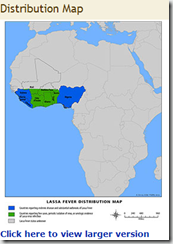
image

Credit CDC’s Lassa Information Page


# 10,091


A recurring theme in public health is just how easily that `exotic’ diseases can cross vast oceans or borders, propelled by our modern air travel industry and our penchant for international travel (see The Global Reach Of Infectious Disease). 


Every week scores of viremic travelers arrive on our shores, carrying everything from measles to dengue to Chikungunya. For some of these diseases – like measles - the risk of them spreading here is quite real. 


For others, while plausible, the risks of their spreading are far lower. 


Last night it was announced that a traveler – recently returned from Liberia – had died after being isolated last week when suspected of having a hemorrhagic fever.  While he tested negative for Ebola, yesterday his tests confirmed Lassa fever.  


The CDC believes that the risk to others is extremely low.


Lassa is endemic in Western Africa and  is commonly found in local rodents that often like to enter human dwellings. Exposure is typically through their urine or dried feces.  Roughly 80% who are infected only experience mild symptoms.  The overall mortality rate is believed to be in the 1%-2% range, although it runs much higher (15%-20%) among those sick enough to be hospitalized.


You may recall a similar importation last year (see Minnesota: Rare Imported Case Of Lassa Fever), along with a couple of earlier cases (2004 in New Jersey (MMWR) & 2010 in Pennsylvania (EID Journal)) – none of which resulted in a secondary transmission of the virus.


While the risks are considered quite low, contact tracing and monitoring will be conducted by health authorities to ensure that any possible spread is quickly detected and contained.   


This from the CDC’s media center:


Lassa Fever Confirmed in Death of U.S. Traveler Returning from Liberia

Risk to others considered extremely low


Press Release

For Immediate Release: Monday, May 25, 2015
Contact:
Media Relations
(404) 639-3286

The CDC and the New Jersey Department of Health have confirmed a death from Lassa fever which was diagnosed earlier today in a person returning to the United States from Liberia. The patient traveled from Liberia to Morocco to JFK International Airport on May 17th. The patient did not have a fever on departure from Liberia, did not report symptoms such as diarrhea, vomiting, or bleeding during the flight, and his temperature was taken on arrival in the U.S. and he did not have a fever at that time. On May 18th, the patient went to a hospital in New Jersey with symptoms of a sore throat, fever and tiredness. According to the hospital, he was asked on the 18th about his travel history and he did not indicate travel to West Africa. The patient was sent home the same day and on May 21st returned to the hospital when symptoms worsened. The patient was transferred to a treatment center prepared to treat viral hemorrhagic fevers. Samples submitted to CDC tested positive for Lassa fever early this morning. Tests for Ebola and other viral hemorrhagic fevers were negative. The patient was in appropriate isolation when he died there this evening.

Lassa fever is a viral disease common in West Africa but rarely seen in the United States. There has never been person-to-person transmission of Lassa fever documented in the United States. The New Jersey case is the sixth known occurrence of Lassa fever in travelers returning to the United States since 1969, not including convalescent patients. The last case was reported in Minnesota in 2014. Although Lassa fever can produce hemorrhagic symptoms in infected people, the disease is different from Ebola, which is responsible for the current outbreak in West Africa. In general, Lassa fever is less likely to be fatal than Ebola (approximately 1% case fatality rate for Lassa vs approximately 70% case fatality rate for Ebola without treatment) and less likely to be spread from person to person. However, some Lassa patients develop severe disease, as the patient in New Jersey did.

In West Africa, Lassa virus is carried by rodents and transmitted to humans through contact with urine or droppings of infected rodents. In rare cases it can be transmitted from person to person through direct contact with a sick person's blood or bodily fluids, through mucous membrane, or through sexual contact. The virus is not transmitted through casual contact, and patients are not believed to be infectious before the onset of symptoms. About 100,000 to 300,000 cases of Lassa fever, and 5,000 deaths related to Lassa fever, occur in West Africa each year.

CDC is working with public health officials to generate a list of people who had contact with the patient. Those identified as close contacts of the patient will be monitored for 21 days to see if symptoms occur.

Updates will be provided as the investigation continues.

Friday, April 04, 2014

Minnesota: Rare Imported Case Of Lassa Fever

image

Credit CDC’s Lassa Information Page


# 8433


Although its lethality is nowhere in the same league as Ebola Zaire, Lassa fever is another Viral Hemorrhagic Fever (VHF) which is endemic in Western Africa. The Lassa virus is commonly found in multimammate rats, a local rodent that often likes to enter human dwellings.


Exposure is typically through the urine or dried feces of infected rodents, and roughly 80% who are infected only experience mild symptoms.  The overall mortality rate is believed to be in the 1%-2% range, although it runs much higher (15%-20%) among those sick enough to be hospitalized.


Like many other hemorrhagic fevers, person-to-person transmission may occur with exposure to the blood, tissue, secretions, or excretions of an individual. The CDC is quick to assure, however, that the risk to fellow travelers who may have had contact with this patient is extremely low:


Casual contact (including skin-to-skin contact without exchange of body fluids) does not spread Lassa virus. 


This is the 7th known imported case of Lassa fever into the US, although most of the early cases were diagnosed abroad and the patients were then airlifted to the US for treatment.  Two previous cases (2004 in New Jersey (MMWR) & 2010 in Pennsylvania (EID Journal)) involved travelers who arrived in the US without knowing they had been infected.


Here is the CDC’s press release, after which I’ll return with a bit more:


Press Release

For Immediate Release: Friday, April 4, 2014
Contact:
CDC Media Relations
(404) 639-3286

Lassa Fever Reported in U.S. Traveler Returning from West Africa

Contact investigation under way; risk to other travelers considered extremely low

The CDC and the Minnesota Department of Health (MDH) have confirmed a diagnosis of Lassa fever in a person returning to the United States from West Africa. The patient was admitted to a hospital in Minnesota on March 31 with symptoms of fever and confusion. Blood samples submitted to CDC tested positive for Lassa fever on April 3. The patient is recovering and is in stable condition.

“This imported case is a reminder that we are all connected by international travel. A disease anywhere can appear anywhere else in the world within hours,” said CDC Director Tom Frieden, M.D., M.P.H.

Lassa fever is a severe viral disease that is common in West Africa but rarely seen in the United States.  Seven other Lassa fever cases, all travel related, have been identified in the United States, with the last one reported in Pennsylvania in 2010. Although Lassa fever can produce hemorrhagic symptoms in infected persons, the disease is not related to Ebola hemorrhagic fever, which is responsible for the current outbreak in West Africa. 

In West Africa, Lassa virus is carried by rodents and transmitted to humans through contact with urine or droppings of infected rodents. In rare cases it can be transmitted from person to person through direct contact with a sick person’s blood or bodily fluids, through mucous membrane, or through sexual contact. The virus is not transmitted through casual contact. About 100,000 to 300,000 cases of Lassa fever, and 5,000 deaths related to Lassa fever, occur in West Africa each year.

CDC is working with public health officials and airlines to determine the patient’s travel route from West Africa and identify any passengers or others who may have had close contact with the infected person. Preliminary information indicates that the patient flew from West Africa to New York City and caught another flight to Minneapolis.

“Given what we know about how Lassa virus is spread to people, the risk to other travelers and members of the public is extremely low,” said Martin Cetron, M.D., M.P.H., director of CDC’s Division of Global Migration and Quarantine. 

“Casual contact is not a risk factor for getting Lassa fever,” said Barbara Knust, D.V.M., M.P.H., an epidemiologist in CDC’s Division of High-Consequence Pathogens and Pathology, which performed the laboratory testing.  “People will not get this infection just because they were on the same airplane or in the same airport.”

As part of its investigation, CDC is working with the airlines to gather contact information for passengers and crew who were seated near the infected individual. CDC will provide passenger contact information to state and local health departments where the passengers live to notify them about their possible exposure.

For additional information about Lassa fever see the CDC website at http://www.cdc.gov/vhf/lassa/.

For more information about airline contact investigations see http://www.cdc.gov/quarantine/contact-investigation.html.

(Continue . . .)


While Lassa fever is a rarity, imported diseases such as measles, polio, dengue, malaria (and many others) remain a constant threat – even in places where they have been officially `eliminated’.  And emerging diseases, like Chikungunya, H5N1, H7N9, or MERS-CoV can easily expand to new geographic regions due to enhanced global travel and trade.

image

Photo Credit- CDC


As both the CDC and the World Health Organization reminded us a few weeks ago (see The Global Reach Of Infectious Disease), pathogens are excellent international travelers. A few recent blogs on other `imported’ disease threats includes:

Chikungunya Update & CDC Webinar Online
CDC Statement On 1st H5N1 Case In North America
Pathogens At the Gate