Showing posts with label Missouri. Show all posts

Monday, March 09, 2015

Missouri Dept. Ag. Statement On Avian Flu At Missouri Turkey Farm

image


# 9796


Just four days after we saw  HPAI H5N2 In A Minnesota Turkey Farm, we’ve news overnight of another facility in Asbury, Mo. (very near the intersection of Missouri, Kansas & Oklahoma) hit by avian flu. Confirmatory testing is also underway at another facility in Fortuna, Mo. which is roughly 150 miles to the Northeast.


While the exact strain is not mentioned, from the context of the statement it appears to be one of the recently arrived (and reassorted) HPAI H5 viruses that has now turned up in 8 states. 


First, this from the Missouri Department of Agriculture, after which I’ll be back with a bit more.


March 8, 2015

MDA implementing response to contain, eliminate virus following detection of avian influenza in Missouri

JEFFERSON CITY, Mo. -- The Missouri Department of Agriculture announced today that it is implementing its plan for a coordinated response with the USDA, state health officials and industry partners following confirmation that turkeys at a grower facility in Asbury, near Carthage, had been infected with a strain of avian influenza.   Outbreaks of a strain of avian flu have occurred in Minnesota, Oregon, Washington and Idaho and are not considered to be a threat to public health or the food supply. Preliminary tests also came back positive for the virus at another facility in Fortuna in Moniteau County.


MDA is following its strict protocols to contain and eliminate the disease.  The facilities were immediately quarantined and the remaining turkeys in the involved flocks will be depopulated and will not enter the food system.  Following USDA protocols, surveillance and testing procedures are underway at properties near the affected facilities to ensure the virus has not spread. 


As a precaution, the Missouri Department of Health and Senior Services (DHSS) is reaching out to monitor workers who may have been exposed to the virus.  MDA has also been working with the USDA, which is sending an incident management team to Missouri to assist MDA in its response.


While lethal to birds, the strain of virus detected is not known to have caused disease in humans and is not expected to pose a risk to public health.  


The specimens from Carthage were tested by the state animal health diagnostic lab in Springfield and the APHIS National Veterinary Services Laboratories in Ames, Iowa confirmed the finding.  MDA is awaiting confirmation on an additional specimen from Fortuna. 
###

Although currently not considered a human health threat, the CDC remains cautious, and has issued specific guidance documents for dealing with those who may have been exposed (see CDC Interim Guidance For Testing For Novel Flu  & CDC Interim Guidance On Antiviral Chemoprophylaxis For Persons With Exposure To Avian Flu).


For now, the primary concern is over the negative impact the arrival and proliferation of these highly pathogenic avian flu viruses will have on North America’s poultry industry. 


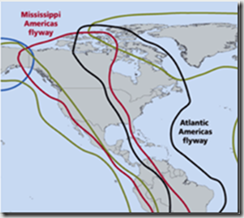
Since November we’ve seen H5N8 and/or H5N2/H5N1 turn up in six western states as well as in British Columbia – all of which lie either beneath, or adjacent to, the Pacific Flyway.   Over the past week we’ve now seen these viruses turn up in two additional states in the Mississippi Americas Flyway, which covers 2/3rds of the United States.
image

Credit FAO 


While these flyways are predominately north-south corridors, their overlapping allows for a lateral (east-west) movement of avian viruses as well – often via shared nesting areas and ponds – something we’ve looked at recently in The North Atlantic Flyway Revisited & FAO On The Potential Threat Of HPAI Spread Via Migratory Birds.

image

Credit Poultry Production Federation


The arrival of HPAI to Missouri is particularly troubling as that state, and several adjacent states (most notably Arkansas), are among the biggest producers of poultry in the nation. 


Where HPAI H5 turns up next is anyone’s guess, but it has proven its ability to spread rapidly and effectively via migratory birds across the nation and around the globe. Poultry producers in states not yet affected are being advised to take extra biosecurity measures to protect their flocks.


Although the future threat from these viruses is unknown, serious outbreaks of H5N1 in Egypt and the rapid emergence and spread of new HPAI H5 reassortants around the globe over the past year recently prompted the World Health Organization to issue a pointed warning (see WHO: H5 Currently The Most Obvious Avian Flu Threat).

Monday, September 01, 2014

Missouri Health Alert On Enterovirus 68

image


  See Update Sept 6th:  Enterovirus D-68 (HEV-D68) Update


# 9024


On Friday morning, in Kansas City Outbreak Identified As HEV 68, I wrote at some length about an outbreak of respiratory illness among children in Kansas City, Missouri that had been identified as  Enterovirus 68, and about the recent increases in its detection around the globe.


While EV 68 was first identified in the early 1960s, it has only rarely been detected in the United States, although several small clusters were reported (see  MMWR: Clusters Of HEV68 Respiratory Infections 2008-2010) in Arizona, Georgia, and Pennsylvania starting about 5 years ago.


Unlike many of the other non-polio enteroviruses, EV 68 is considered primarily a respiratory virus, although the full spectrum of illness it may produce isn’t well understood. Symptoms are generally like those from a `cold’ or rhinovirus, but severe illness can sometimes result, particularly among children with asthma or other respiratory problems.


Over the weekend I began seeing reports that similar cases were showing up in St. Louis, 250 miles to the east.  On Saturday, the Missouri Department of Health and Senior Services issued  the following Health Alert to the medical community:


Missouri Department of Health & Senior Services
Health Alert


August 29, 2014
FROM: GAIL VASTERLING DIRECTOR


SUBJECT: Respiratory Illnesses Due to Enterovirus D68 (EV-D68) in Missouri


Current Situation


Recently, a pediatric hospital in Kansas City, Missouri has experienced over 300 cases of respiratory illnesses in their facility. Approximately 15% of those illnesses have resulted in childen being placed in an intensive care unit. Testing of specimens from several cases at a specialized laboratory at the Centers for Disease Control and Prevention (CDC) indicated that 19 of the 22 specimens were positive for Enterovirus D68 (EV-D68). The St. Louis area is also experiencing a recent increase in pediatric respiratory illnesses. Many specimens from those cases have tested positive for enterovirus, and further testing for specific virus type is pending. To date, no deaths have been reported due to EV-68 in Missouri.


Background


Enteroviruses are very common viruses. There are more than 100 types of enteroviruses. It is estimated that 10 to 15 million enterovirus infections occur in the United States each year. Most people infected with enteroviruses have no symptoms or only mild symptoms, but some infections can be serious. Most enterovirus infections in the U.S. occur seasonally during the summer and fall, and outbreaks of tend to occur in several-year cycles.


EV-D68 infections occur less commonly than those with other enteroviruses. EV-D68, like other enteroviruses, appears to spread through close contact with infected people. This virus was first isolated in California in 1962 from four children with bronchiolitis and pneumonia, and has been reported rarely since that time. Unlike the majority of enteroviruses that cause a clinical disease manifesting as a mild upper respiratory illness, febrile rash illness, or neurologic illness (such as aseptic meningitis and encephalitis), EV-D68 has been associated almost exclusively with respiratory disease. EV-D68 usually causes mild to severe respiratory illness; however, the full spectrum of EV-D68 illness is not well-defined.


Clusters of respiratory illness associated with EV-D68 in Asia, Europe, and the U.S. during 2008-2010 have been described previously. EV-D68 infection was associated with respiratory illness ranging from relatively mild illness to severe illness requiring intensive care and mechanical ventilation. These clusters confirmed that EV-D68 is associated with outbreaks of respiratory illness severe enough to require hospitalization, and in some cases, might contribute to patient death. New-onset wheezing or asthma exacerbation were notable symptoms. However, in each cluster, respiratory specimens typically were collected from persons who had sought medical care or were hospitalized, which would have biased these reports toward more severe disease. No data is currently available regarding the overall burden of morbidity or mortality from EV-D68 in the U.S. approved by the Food and Drug Administration for use in clinical settings ( Luminex xTAG RVP, Idaho Technologies FilmArray Respiratory Panel). But, these systems use broadly reactive primers that amplify RNA from either human rhinoviruses (HRVs) or enteroviruses, and results are reported as "entero-rhinovirus" or "human rhinovirus/enterovirus". Most hospitals are not able to perform enterovirus typing to identify specific enterovirus. The gold standard test for EV-D68 detection is partial sequencing of the structural protein genes, VP4-VP2 or VP1.


There is no specific treatment for EV-D68 infections; specifically there are no anti-viral medications currently available for this purpose. Many infections will be mild and self-limited, requiring only symptomatic treatment. Some people with severe respiratory illness caused by EV-D68 may need to be hospitalized and receive intensive supportive therapy.

Vaccines for preventing EV-D68 infections currently are not available.


Guidance for Healthcare Professionals

Clinicians should be aware of EV-D68 as one of many causes of viral respiratory disease, and should report clusters of unexplained respiratory illness to the local public health agency, or to the Missouri Department of Health and Senior Services (DHSS) at 573/751-6113 or 800/392-0272 (24/7).

To help reduce the risk of infection with EV-D68, healthcare professionals should recommend the following:

• Wash hands often with soap and water for 20 seconds, especially after changing diapers;
• Avoid touching eyes, nose, and mouth with unwashed hands;
• Avoid kissing, hugging, and sharing cups or eating utensils with people who are sick;
• Disinfect frequently touched surfaces, such as toys and doorknobs, especially if someone is sick;
• Stay home when feeling sick, and obtain consultation from your health care provider.