Showing posts with label NYC. Show all posts

Saturday, October 25, 2014

NYC Health: Ebola Patient Timeline

image


# 9249


Although the evidence strongly suggests that those infected with the Ebola virus are unlikely to transmit the virus in the early-symptomatic phase of their illness - the risks of transmission, while low, are probably not zero.  


While reassuring, much of our evidence for this is anecdotal, and the question of the variability of viral shedding that might occur among patients early in their illness probably deserves more scrutiny.


So the New York City public Health Department – while stressing that it is unlikely anyone was infected by this patient prior to his going into isolation - is making public a timeline of their index case’s public movements since his arrival on the 17th. 


Health Department Releases Ebola Patient Timeline

  • Patient is a 33-year-old male Medecins Sans Frontieres (Doctor Without Borders) medical doctor who last worked in Guinea on 10/12. While treating patients in Guinea, he always wore personal protective equipment (PPE), and there were no known breaches in protocol.
  • 10/14, the patient departed Guinea on a flight to Brussels. Patient reported no symptoms.
  • On 10/17, the patient boarded a flight to the U.S. on Brussels Airlines Flight SN0501. Patient reported no symptoms.
  • On 10/17, the patient arrived at JFK. The patient was screened at JFK and had no symptoms upon arrival.
  • On 10/21 at 7 AM, the patient reported fatigue and exhaustion. No fever, vomiting, diarrhea.


Ebola Patient Timeline

  • 10/14  Patient departed Guinea. Patient reported no symptoms.
  • 10/17 Patient boarded a flight to JFK on Brussels Airlines Flight SN0501. Patient reported no symptoms.
  • 10/21 Patient reported fatigue and exhaustion. Patient visited High Line and The Meatball Shop.
  • 10/22 Patient went running on Riverside Drive and Westside Highway and also visited The Gutter.
  • 10/23 Patient first reported a fever. He was immediately taken to Bellevue by FDNY EMS for testing.
    • Fatigue is a symptom of Ebola, but it is very unlikely that people he came into close contact with on 10/21 are at risk. Out of an abundance of caution, we are actively monitoring the health of these close contacts.
  • On 10/21, around 3:00 PM, the patient visited The Meatball Shop. The Meatball Shop is located at 64 Greenwich Avenue.
  • Spent 40 minutes at The Meatball Shop.
  • On 10/21, around 4:30 PM, the patient visited the High Line.
  • Walked on High Line and stopped at the Blue Bottle Coffee stand (10th Ave & W 16th St)
  • On 10/21, around 5:30 PM, the patient got off the High Line at 34th Street and took the 1 train to the 145th Street station.
  • On 10/22, around 1:00 PM, the patient went running along Riverside Drive and Westside Highway
  • On 10/22, around 2:00 PM, the patient went to pick up Community Supported Agriculture (CSA) farm share at 143rd St and Amsterdam Avenue (Corbin Hill Farm)
    • Patient picked up box and brought back to apartment
  • On 10/22, around 5:30 PM, the patient left for The Gutter bowling alley in Williamsburg, Brooklyn with two friends. For his arrival at Gutter, the patient took the A train at 145th Street and transferred at 14th Street and took the L train to Bedford Avenue.
  • On 10/22, around 8:30 PM, the patient left The Gutter. For his return trip, the patient used Uber as his means of transportation.
  • On 10/23, around 10:15AM, the patient first reported a fever. At this point, the patient called Medecins Sans Frontieres and the New York City Health Department. He was immediately taken to Bellevue by FDNY EMS.
  • The patient was tested for Ebola at the Health Department’s Public Health Lab. Test results are presumptive positive for Ebola. A confirmatory test will be conducted by the CDC; results will be available within the next 24 hours.

Additional Notes:

  • The patient’s three contacts are healthy and are being quarantined.
  • There is a difference between “quarantine” and “isolation.”

Quarantine separates and restricts the movement of people who were exposed to a contagious disease to see if they become sick.

Isolation separates sick people with a contagious disease from people who are not sick.

Friday, October 24, 2014

CDC Statement: Ebola Case Tests Positive In NYC

image
Credit CDC PHIL


# 9242


A not altogether unexpected statement this evening, given the media reports of this Healthcare Workers symptoms and recent work in Ebola stricken Guinea, but this evening the CDC has announced that local testing indicates he has been infected with the Ebola virus.


Confirmatory testing should come from the CDC in the coming hours, but there seems little doubt in the matter.


The epidemiological investigation is already underway, and potential contacts of this patient will be identified, notified, and monitored for up to 21 days. The good news is, Ebola patients are believed to be less infectious during the early hours and days of showing symptoms.


While many were hopeful as we approached the end of the 21 day incubation period in Dallas without any more cases, this is a reminder that as long as the virus is spreading in West Africa, the rest of the world is at risk from new importations of the virus.


I expect we will get a good many more details in the coming hours.  In the meantime we have the following statement from the CDC’s press room.


New York City Reports Positive Test for Ebola in Volunteer International Aid Work

A hospitalized medical aid worker who volunteered in Guinea, one of the three West African nations experiencing an Ebola epidemic, and since returned to the United States has tested positive for Ebola according to the New York City Health Department laboratory, which is part of the Laboratory Response Network overseen by the Centers for Disease Control and Prevention.

The patient has been notified of the test results and remains in isolation. The patient is currently at Bellevue Hospital in New York City. Bellevue Hospital is one of eight New York State hospitals that Governor Cuomo has designated to treat Ebola patients. A specially trained CDC team determined earlier this week that the hospital has been trained in proper protocols and is well prepared to treat Ebola patients.

Confirmation testing at the Centers for Disease Control and Prevention's laboratory will be done. The healthcare worker had returned through JFK Airport on Oct. 17 and participated in the enhanced screening for all returning travelers from these countries. He went through multiple layers of screening and did not have a fever or other symptoms of illness. The patient reported a fever to local health officials for the first time today. The patient was transported by a specially trained HAZ TAC unit wearing Personal Protective Equipment (PPE) to Bellevue. The New York City Health Department has interviewed the patient regarding close contacts and activities.

CDC is in close communications with the New York City Health Department and Bellevue Hospital, and is providing technical assistance and resources. Three members of CDC's Ebola Response Team will arrive in New York City tonight. This team is deployed when an Ebola case is identified in the United States, or when health officials have a very strong suspicion that a patient has Ebola pending lab results.

In addition, CDC already had a team of Ebola experts in New York City who can offer immediate additional support. The CDC experts were in New York City this week assessing hospital readiness to receive Ebola patients, including Bellevue hospital. CDC's Ebola hospital assessment teams are designed to make sure that hospitals that have volunteered to take Ebola patients are Ebola ready.

These teams assess a facility's infection control readiness and to determine if there are gaps in infection control readiness. They support a facility in developing a comprehensive infection control plan. The principle is to be ready for the patient coming in the front door and everything that happens through the patient's stay in the hospital. CDC's team is a multidisciplinary team of experts. It includes infection control practice specialists, personal protective equipment specialists, worker safety experts, clinical care and diagnostics experts, and laboratory processes experts. New York City and New York State have designated Bellevue as an Ebola treatment hospital. The CDC team, which had completed its assessment of Bellevue, found the facility to be well prepared to care for a patient with Ebola.

Ebola is spread through direct contact with bodily fluids of a sick person or exposure to objects such as needles that have been contaminated. The illness has an average 8-10 day incubation period (although it could be from 2 to 21 days). CDC recommends monitoring exposed people for symptoms a complete 21 days.

Confirmatory CDC laboratory tests will be shared when these tests are done, following appropriate patient notification.

Thursday, October 23, 2014

NYC Health Dept Statement On Symptomatic HCW From Guinea

image


UPDATED:  Added a statement from Doctors without Borders (MSF).  16:50 hrs EDT


# 9240


Normally I don’t report on suspected cases of Ebola since most will turn out to be false alarms, but since it is already all over the media, and the New York City Department of Health has issued a statement, I’ve reproduced it here.


Statement on Patient at Bellevue Hospital

October 23rd, 3:05 pm

Today, EMS HAZ TAC Units transferred to Bellevue Hospital a patient who presented a fever and gastrointestinal symptoms.  

The patient is a health care worker who returned to the U.S. within the past 21 days from one of the three countries currently facing the outbreak of this virus.

The patient was transported by a specially trained HAZ TAC unit wearing Personal Protective Equipment (PPE).  After consulting with the hospital and the CDC, DOHMH has decided to conduct a test for the Ebola virus because of this patient’s recent travel history, pattern of symptoms, and past work. DOHMH and HHC are also evaluating the patient for other causes of illness, as these symptoms can also be consistent with salmonella, malaria, or the stomach flu.

Preliminary test results are expected in the next 12 hours.

Bellevue Hospital is designated for the isolation, identification and treatment of potential Ebola patients by the City and State.  New York City is taking all necessary precautions to ensure the health and safety of all New Yorkers.

As a further precaution, beginning today, the Health Department’s team of disease detectives immediately began to actively trace all of the patient’s contacts to identify anyone who may be at potential risk. The Health Department staff has established protocols to identify, notify, and, if necessary, quarantine any contacts of Ebola cases.

The Health Department is also working closely with HHC leadership, Bellevue's clinical team and the New York State Department of Health to ensure that all staff caring for the patient do so while following the utmost safety guidelines and protocols.

The chances of the average New Yorker contracting Ebola are extremely slim. Ebola is spread by directly touching the bodily fluids of an infected person. You cannot be infected simply by being near someone who has Ebola.


Via Pathfinder on FluTrackers, we have the following brief statement from Doctors without Borders regarding this case:


Statement on Returned Field Worker

October 23, 2014

Doctors Without Borders/Médecins Sans Frontières (MSF) statement:

A person in New York City, who recently worked with Doctors Without Borders in one of the Ebola affected countries in West Africa, notified our office this morning to report having developed a fever.  As per the specific guidelines that Doctors Without Borders provides its staff on their return from Ebola assignments, the individual engaged in regular health monitoring and reported this development immediately.  While at this stage there is no confirmation that the individual has contracted Ebola, Doctors Without Borders, in the interest of public safety and in accordance with its protocols, immediately notified the New York City Department of Health & Mental Hygiene, which is directly managing the individual’s care. 

At this stage Doctors Without Borders will not be providing any further details about its colleague.


You’ll find that FluTrackers is maintaining an extensive thread on media reports here.

Saturday, March 08, 2014

NYC Health Department Investigating Measles Outbreak

image 

Photo Credit CDC


# 8359


Measles are back in the news again this week (see Thursday’s ECDC: Risk Assessment On Measles Outbreak Aboard Cruise Ship), with a CDC travel Notice issued for an outbreak in the Philippines, and reports of cluster of cases in New York City.


Our first stop, a press release from the New York City Department of Health:


Health Department Investigating Measles Outbreak in Northern Manhattan and the Bronx

Department urges all New Yorkers to make sure they are vaccinated against measles

infants should be vaccinated at 12 months of age 

March 7, 2014 – The Health Department announced today that it has identified 16 cases of measles in northern Manhattan and the Bronx. Seven adult cases and 9 pediatric cases have been identified to date. New Yorkers are urged to make sure all household members, including young children, are vaccinated. To date, there have been four hospitalizations as a result of this outbreak.

Measles is a highly contagious viral infection characterized by a generalized rash and high fever, accompanied by cough, red eyes, and runny nose, lasting five to six days. The illness typically begins with a rash on the face and then moves down the body, and may include the palms of the hands and soles of the feet.  People who contract the measles virus can spread the infection for four days before developing a rash, and for four days after the rash sets in. Measles can spread easily through the air to unprotected individuals. If you suspect you have measles, call and explain your symptoms to your doctor or medical provider BEFORE leaving to avoid exposing others to the measles virus.

The Health Department is working with New York City hospitals to prevent additional exposure to the virus in emergency departments. The Health Department is also asking pediatric-care facilities in Manhattan and the Bronx to identify and vaccinate children who have not received the MMR vaccine and to give the second dose of MMR vaccine to children at the next medical visit. Adults who are unsure of their vaccination history can be revaccinated or obtain a blood test to see if they are immune. Several adults who are included in this outbreak thought they had been vaccinated in the past, but lacked documentation.

As many as one in three people with measles develop complications. These complications from measles can be very serious and include pneumonia, miscarriage, brain inflammation, hospitalization and even death. Infants under one year of age, people who have a weakened immune system and non-immune pregnant women are at highest risk of severe illness and complications.

(Continue . . . )


Maggie Fox with NBC News has more on this story:


New York City Investigates Measles Outbreak

By Maggie Fox

New York City health officials said Friday they are investigating an outbreak of measles that’s made at least 16 people sick.

It might be part of a bigger national outbreak linked to the Philippines.

Health officials are quick to declare concern when they see someone with measles, which is one of the most contagious human diseases. Although it was once seen as a normal childhood infection, it’s easily prevented with a vaccine. And it should be, because fully a third of patients develop complications from the virus, including pneumonia, miscarriage and brain inflammation that can put patients into the hospital or even kill them.

(Continue . . .)


The outbreak in the Philippines, mentioned in Maggie’s article, is the subject of the following travel notice from the CDC.

image

  • Updated Measles in the Philippines Updated March 06, 2014 According to the Department of Health of the Philippines, 1,163 cases of measles and a number of measles deaths were reported in the country from January 1 through January 11, 2014. CDC recommends that travelers to the Philippines protect themselves by making sure they are properly vaccinated against measles. Clinicians should keep measles in mind when treating patients with fever and rash, especially if the patient has recently traveled internationally. Read More >>
  •  

    The measles vaccine – which was introduced in the United States in the mid-1960s - quickly reduced the incidence of the disease by more than 90%.  In the decades that followed, improved vaccination protocols were established and implemented, and in the year 2000 the United States achieved its long sought goal of  `measles elimination’.


    `Elimination’ refers to a local or regional victory over a disease, while `eradication’   indicates global success.


    Thus far, only two infectious diseases – smallpox and rinderpest – have been considered successfully eradicated, although considerable progress has been made on many others (ie. polio, yaws, Dracunculiasis).


    While the number of measles cases in the United States had dropped from nearly a million each year in the 1950s - to roughly 60 each year in the first decade of the 21st century – the virus continued to flourish elsewhere in the world, providing the opportunity for the virus to `reseed’ itself in the US.


    image


    In 2010, we began to see an uptick in the number of `imported’ measles cases.  This from the  MMWR report  Measles — United States, 2011

    During 2011, a total of 222 measles cases (incidence rate: 0.7 per 1 million population) and 17 measles outbreaks (defined as three or more cases linked in time or place) were reported to CDC, compared with a median of 60 (range: 37–140) cases and four (range: 2–10) outbreaks reported annually during 2001–2010.

    This report updates an earlier report on measles in the United States during the first 5 months of 2011 (2). Of the 222 cases, 112 (50%) were associated with 17 outbreaks, and 200 (90%) were associated with importations from other countries, including 52 (26%) cases in U.S. residents returning from abroad and 20 (10%) cases in foreign visitors. Other cases associated with importations included 67 (34%) linked epidemiologically to importations, 39 (20%) with virologic evidence suggesting recent importation, and 22 (11%) linked to cases with virologic evidence of recent importation.

    Most patients (86%) were unvaccinated or had unknown vaccination status. The increased numbers of outbreaks and measles importations into the United States underscore the ongoing risk for measles among unvaccinated persons and the importance of vaccination against measles (3).


    Imported diseases such as measles, polio, dengue, malaria (and many others) remain an ongoing threat – even in places where they have been officially `eliminated’.  Likewise, emerging diseases, like Chikungunya, H5N1, or MERS-CoV can easily expand to new geographic regions due to enhanced global travel and trade.

    image

    Photo Credit- CDC


    As both the CDC and the World Health Organization reminded us last month (see The Global Reach Of Infectious Disease), pathogens are excellent international travelers. A few recent blogs on other `imported’ disease threats includes:


    Chikungunya Update & CDC Webinar Online
    CDC Statement On 1st H5N1 Case In North America
    Pathogens At the Gate

    Thursday, March 07, 2013

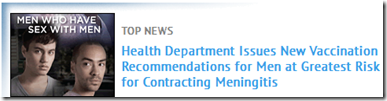
    NYC Updates MSM Meningitis Warning

    image

    Credit NYC Department of Health


    # 6989


    Last October, in NYC: The Other Meningitis Outbreak, we looked at an early warning issued by the NYC health department to Men who are HIV-infected and who have had intimate contact with another man met through a website, digital application (“app”), or at a bar or party since September 1, 2012 – who may have been exposed to meningitis.


    At the time, the New York City Department of Health and Mental Hygiene provided the following recommendation.


    Health Department Reccomends Vaccination for HIV-Positive Men at High Risk of Meningitis

    The Health Department issued recommendations today for vaccinating against invasive meningococcal disease – commonly known as meningitis – after a spike of cases reported over the past five weeks.


    In January we saw an MMWR report (see MMWR: Invasive Meningococcal Disease Among MSM In New York City) and an expansion of vaccination recommendations to include:


    . . .  for men, regardless of HIV status, who have had intimate contact with another man that he met through a website, digital application (“App”), or at a bar or party since September 1, 2012 AND live in the following neighborhoods: Bedford-Stuyvesant, Brownsville, Bushwick, Clinton Hill, Crown Heights, Downtown Brooklyn, Dumbo, East New York, Prospect Heights and Williamsburg.


    Yesterday, after recording four new cases since the first of the year, NYC issued a new Physician Health Alert (HAN) (PDF) and press release expanding their vaccination recommendations.


    First from the HAN notice.


    2012 ALERT # 5


    UPDATE: Invasive Meningococcal Disease in Men Who Have Sex with Men,Four New Cases Reported in 2013, Expanded Vaccine Recommendations


    Please Share this Alert with All Emergency Medicine, Family Medicine, Primary Care Physicians, HIV Specialists, Infectious Disease, and Internal Medicine Staff in Your Facility

    • Four new cases of invasive meningococcal disease have occurred in men who have sex with
      men (MSM) in 2013, bringing the total number of cases to 22.
    • Providers must immediately notify the Department of Health and Mental Hygiene (DOHMH)
      of suspect cases. Do not wait for culture confirmation to report a suspected case.
    • DOHMH has simplified and expanded its vaccine recommendations. Meningococcal vaccine
      should now be offered to:
      • (a) All HIV-infected MSM
      • (b) MSM, regardless of HIV status, who regularly have close or intimate contact with men met through an online website, digital application (“app”), or at a bar or party.


    Excerpts from the public press release:


    Recent Meningitis Outbreak


    March 6, 2013 – The Health Department issued new recommendations today for vaccinating against invasive meningococcal disease – commonly known as meningitis – after an increase in cases.


    Vaccinations are now advised for men, regardless of HIV status, who regularly have intimate contact with other men met through a website, digital application (“App”), or at a bar or party. The Health Department also continues to recommend vaccinations for all HIV-positive men who have sex with men. Individuals who are not sure if they meet the criteria are advised to discuss their need for vaccination with their health care providers.


    “Meningitis symptoms usually come on quickly, and the disease can be fatal if not treated right away,” said Health Commissioner Dr. Thomas Farley. “Vaccination is the best defense. I urge all men who meet these criteria – regardless of whether they identify as gay – to get vaccinated now and protect themselves from this disease before it is too late.”


    Individuals who meet some, but not all, of the criteria are advised to discuss their need for vaccination with their health care provider.


    - Read the most recent press release


    For more on Meningococcal Meningitis, The New York City Department of Health and Mental Hygiene maintains a FAQ page.


    Meningococcal Meningitis


    What is invasive meningococcal disease?
    Invasive meningococcal disease is a severe infection caused by the bacteria Neisseria meningitidis (meningococcus) that includes both meningitis (infection of the meninges - a thin lining covering the brain and spinal cord) or meningococcemia (infection of the blood). The infection can also occur as pneumonia (an infection of the lungs) or in joints, such as the knees. In 2009, there were 17 cases of invasive meningococcal disease reported among New York City residents (rate of 0.21 cases per 100,000 persons).

    Who gets invasive meningococcal disease?
    Anyone can get invasive meningococcal disease. Infants < 12 months of age have the highest rates of disease. Clusters of cases and outbreaks do occur but are rare in the United States.
    How is invasive meningococcal disease spread?
    The meningococcus is spread by direct close contact with nose or throat discharges of an infected person. About eight percent of healthy people carry this particular bacterium in their nose and throat without any signs of illness. Why certain people become ill upon acquiring the organism is not fully understood. Close living quarters, such as in military barracks and dormitories, favor transmission of the organism.
    What are the symptoms of invasive meningococcal disease?

    Although most people exposed to the meningococcus bacteria do not become seriously ill, some may develop fever, headache, vomiting, stiff neck and a rash. Sometimes the disease can be fatal.

    (Continue . . . )


    image

    The CDC’s webpage on Meningococcal Disease.

    Friday, October 12, 2012

    NYC: The Other Meningitis Outbreak

    image


    # 6628


    While the media is understandably focused on the growing fungal meningitis outbreak linked to potentially contaminated steroid injections (see CDC Update: Multi State Meningitis Outbreak – Oct 11th), another outbreak of bacterial meningitis has been reported in New York City over the past several weeks among HIV positive men.


    The following notice comes from the New York City Department of Health and Mental Hygiene.

    Health Department Recommends Vaccination for HIV-Positive Men at High Risk of Meningitis

    The Health Department issued recommendations today for vaccinating against invasive meningococcal disease – commonly known as meningitis – after a spike of cases reported over the past five weeks.


    The Department is advising vaccinations for any man who is HIV positive and has had intimate contact with another man that he met through a website, digital application (“App”), or at a bar or party since September 1, 2012.


    Vaccines will be available starting Friday at medical facilities throughout the city for men who meet these criteria but who cannot obtain it from their HIV care providers.

     
    Read the Press Release


    Find a Nearby Clinic with the Meningitis Vaccine


    Read the Fact Sheet on the Outbreak


    Learn More About Invasive Meningococcal Disease


    See Information for Healthcare Providers


    From the Fact Sheet on this outbreak:


    Meningococcal Outbreak Patient Fact Sheet


    An outbreak of invasive meningococcal disease has recently been identified among HIV-infected men who have sex with men. The New York City Department of Health and Mental Hygiene recommends meningococcal vaccination for the following persons: 


    Men who are HIV-infected and who have had intimate contact with another man met through a website, digital application (“app”), or at a bar or party since September 1, 2012.


    If you think you may be at risk, please read the answers to some important questions below.


    What is invasive meningococcal disease?

    Invasive meningococcal disease is a serious infection that can cause a high fever, headache, stiff neck, and rash. Some people die from the infection. If you develop these symptoms, you should immediately seek medical care.

     
    Does having HIV put me at greater risk of invasive meningococcal disease?


    People living with HIV are at greater risk than the general population of acquiring the infection
    that causes invasive meningococcal disease. Approximately 20% of people who develop the
    disease die of it. 


    How is invasive meningococcal disease spread?

    The disease is spread by prolonged close contact with an infected person. Examples of prolonged close contact include kissing and having sex. In addition, sharing eating utensils, a drinking glass, or a cigarette with an infected person may spread the disease. It is NOT spread by simply breathing the air where a person with the disease has been.


    How can I protect myself?

    There are several vaccines licensed for use in adults that can help protect people against invasive meningococcal disease. Meningococcal vaccine may provide protection 7 to 10 days after vaccination, but not everyone will develop protective levels of antibodies. If you are HIV-infected and you do receive the meningococcal conjugate vaccine, you should return to your health care provider eight weeks later for a second dose. 


    If you are HIV-infected and need a health care provider, call 311 to find one.


    If you do not know your current HIV status, get tested. NYC residents can receive a free HIV test at one of the Health Department’s Sexually Transmitted Disease (STD) or Tuberculosis (TB) clinics, regardless of insurance or immigration status. Call 311 to find a location near you.


    Should I get vaccinated with the meningococcal vaccine?

     
    If you meet all the criteria listed above, then the Health Department recommends that you receive
    meningococcal vaccine.


    For more, we go to the CDC’s Bacterial Meningitis Information page:


    Bacterial Meningitis

    Bacterial meningitis is usually severe. While most people with meningitis recover, it can cause serious complications, such as brain damage, hearing loss, or learning disabilities.


    There are several pathogens (types of germs) that can cause bacterial meningitis. Some of the leading causes of bacterial meningitis in the United States include Haemophilus influenzae (most often caused by type b, Hib), Streptococcus pneumoniae, group B Streptococcus, Listeria monocytogenes, and Neisseria meningitidis.


    In the United States, about 4,100 cases of bacterial meningitis, including 500 deaths, occurred each year between 2003–2007.


    Signs & Symptoms

    Meningitis infection may show up in a person by a sudden onset of fever, headache, and stiff neck. It will often have other symptoms, such as

    • Nausea
    • Vomiting
    • Increased sensitivity to light (photophobia)
    • Altered mental status (confusion)

    The symptoms of bacterial meningitis can appear quickly or over several days. Typically they develop within 3-7 days after exposure.


    (Continue . . . )