
Showing posts with label Pre-pandemic. Show all posts

Wednesday, July 11, 2012

Pre-Pandemic Vaccinations Revisited


image

Photo Credit PHIL


# 6428


In the wake of the publication of the Fouchier & Kawaoka studies (see here & here) - which suggest that the H5N1 virus may be only a few mutations away from being able to transmit among mammals – once again concerns over the possibility of a bird flu pandemic have taken center stage.


Despite its relative mildness, the 2009 H1N1 pandemic demonstrated the difficulty (read: impossibility) of creating, manufacturing, and rapidly deploying an emergency pandemic vaccine to billions of people in the face of a fast spreading influenza virus.


Were an H5N1 pandemic to break out today, even with small quantities of a vaccine already stockpiled, the vast majority of people around the world would not see a vaccine in anything less than six to twelve months.


And while the true CFR (Case Fatality Ratio) of the H5N1 virus remains disputed (see Revisiting The H5N1 CFR Debate), many researchers still believe it has the potential to be as deadly – or deadlier – than the 1918 Spanish Flu.


All of which as recently led to the resurfacing of a controversial, but potentially life-saving idea: the creation and distribution of a pre-pandemic vaccine.


While we’ve discussed this idea before, it was recently aired in the journal Science in an article called:


Influenza: Options to Improve Pandemic Preparation

Rino Rappuoli, Philip R. Dormitzer


While other solutions, including development of a `universal vaccine’, and improvements in our capacity to quickly produce and distribute vaccines were on their list, number one on their hit parade was the creation and distribution of a pre-pandemic H5 vaccine.


A pre-pandemic dose of an adjuvanted H5N1 vaccine – even if it were not an exact match to an emerging pandemic strain – is expected would blunt the impact of the H5N1 virus while the population waits for the arrival of a booster shot.


This idea is explored today in a Reuter’s story:


ANALYSIS-Bird flu vaccine now? More than a shot in the dark


As this article points out, an effective pre-pandemic vaccination program could take 3 to 5 years to conduct, and would cost billions of currently hard-to-find healthcare dollars. 


One of the biggest obstacles would be the public’s reaction to accepting a vaccination against a virus that – as yet – does not routinely infect humans.   


And no doubt, the anti-vaccine and internet conspiratorialists would have a field day with such a program.


This proposal, however, isn’t new.


We looked at this option in May of 2010 (see The Prime Of Our Lives), when the Journal Nature ran an opinion piece by Dr. Klaus Stohr, former head of the World Health Organization's global influenza program, supporting the idea of global pre-pandemic vaccination.


The problem is (aside from the not-insignificant costs, logistics, and difficulties gaining public acceptance) is predicting which influenza strain is likely to emerge next.  


Few would have pegged the H1N1 virus – a cousin to one that had been circulating for decades – to show up as a pandemic virus in 2009.


Which means we could spend billions priming against an H5 pandemic, only to get blindsided by an H7 or H9 virus.


It’s a calculated risk, though many scientists would point out that an H5 pandemic – at least right now – seems to pose a greater risk simply due to its record of lethality in humans.


And in fact, this strategy was employed in Japan back in 2008, when their limited stockpile of H5N1 bird flu vaccine was about to expire. 


They decided to `store it’ in the arms of healthcare and public safety workers, rather than pour it down the drain (see Japan Begins Pre-Pandemic Inoculation Of Health Care Workers). A similar program was launched in 2010 (see Taiwan Offers Public Bird Flu Vaccinations.)


Of course, we won’t know how well this little experiment works until an H5N1 pandemic breaks out, and recipients of this vaccine are shown to have fared better than those who weren’t `primed’.


But the idea is rooted in science.


In the summer of 2008 we saw a study, published in the of The Journal of Infectious Diseases, which showed that people who received an experimental H5N1 vaccine in Hong Kong 8 years before developed a strong immune response after receiving a single booster shot of a clade 1 H5N1 vaccine.


Influenza vaccines have an exceptionally good safety record, yet when millions of shots are given a small number of adverse reactions – some of them serious – are expected to occur.


When a clear and immediate viral threat is at hand, it is fairly easy to accept the risk-benefit equation presented by accepting a vaccine. But when no threat currently exists, one’s tolerance for risk – no matter how slight – tends to diminish.


Making a pre-pandemic jab a tough sell to an increasingly dubious public.


While the science makes sense (and yes, I’d probably avail myself of a shot were it made available), when you add up the costs, public relation concerns, and the sheer logistics of delivering a pre-pandemic shot to hundreds of millions (or even billions) of people, you have a formidable task.


One that, despite the potential benefits, governments don’t appear to be inclined to undertake right now.

Wednesday, March 09, 2011

Nature: A Preemptive H2N2 Vaccine Strike?


# 5363


That’s the idea behind an article that appears (alas, behind a pay wall) in today’s Nature, where authors Gary J. Nabel,Chih-Jen Wei & Julie E. Ledgerwood  discuss the idea of possibly heading off the next pandemic by launching a preemptive strike  . .  .


. . .  against the H2N2 virus.


The article is called:


Vaccinate for the next H2N2 pandemic now


  • Gary J. Nabel, Chih-Jen Wei & Julie E. Ledgerwood

Nature Volume: 471, Pages: 157–158

Date published: (10 March 2011)

DOI: doi:10.1038/471157a
 
An old influenza strain still circulating in birds and swine could easily jump back to humans now that immunity to it has dropped, warn Gary J. Nabel and his colleagues.


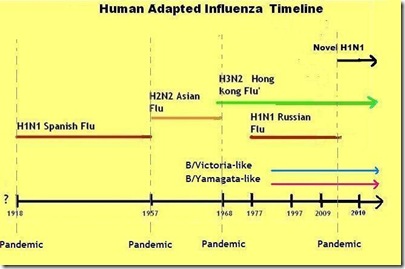
While it hasn’t circulated in humans since it was supplanted by H3N2 in 1968, for eleven years – between 1957 and 1968 – the H2N2 Asian Flu virus was the king of the viral mountain (see below).


Flu Timeline 2010


H2N2 still circulates at low levels in birds, and swine.


But immunity in humans is pretty much non-existent for those under the age of 50, which some scientists fear leaves the world vulnerable to a new H2N2 pandemic.


We get more details from the BBC, after which I will return with more.


Call to vaccinate against possible H2N2 flu pandemic

By Dominic Hughes


H2N2 isn’t the only viable pandemic contender out there, of course. The H5N1 virus, along with the H7s, H9s and even H11s are all considered to have some degree of pandemic potential. 


What H2N2 has, that these others have not, is a recent track record of actually producing a pandemic. 


But whether that makes it any less of a long shot to spark the next pandemic is impossible to tell.


Last May (see The Prime Of Our Lives), the Journal Nature ran an opinion piece by Dr. Klaus Stohr, former head of the World Health Organization's global influenza program, supporting the idea of global pre-pandemic vaccination.


The problem is (aside from the not-insignificant costs, logistics, and difficulties gaining public acceptance for a jab against a flu which isn’t currently a threat) is predicting which influenza strain is likely to emerge next.  


Few would have pegged the H1N1 virus – a cousin to one that had been circulating for decades – to show up as a pandemic virus in 2009.


Quite interestingly, friend and fellow flu blogger Scott McPherson broached the subject of H2N2 returning as a pandemic virus way back in 2007 in the following blog:


Will H2N3 reassortant prove Maurice Hilleman correct?

Posted on Wednesday, December 19, 2007


So the idea of H2N2 returning someday isn’t exactly new.


In just about every book, movie, or TV show about a deadly virus, valiant scientists cobble together some last-minute vaccine, produce it in quantity, and distribute it in the nick of time to save the world.


It is a grand idea, and a handy resolution for any disaster movie, but it suffers from one fatal flaw: 


We’ve neither the technology, manufacturing capacity, or the public health infrastructure to be able to produce and dispense a vaccine to billions of people in a matter of months.


Hardening the immune systems of billions of people against the next emerging pandemic strain could conceivably save millions of lives, and billions of dollars.


So the idea of deploying a vaccine to forestall the next pandemic years before it arrives is certainly intriguing  . . .   assuming the right strain can be selected.


But whether it is possible to sell that idea right now to a world where global economies are in recession, healthcare budgets are tight, and public trust in governments and science continues to ebb remains to be seen.


The hard truth is another pandemic is inevitable, and the next one may have a far greater impact than the last.  


And so solutions, even the difficult ones - like rolling out a pre-pandemic vaccine to billions of people - deserve public airing and consideration.

Tuesday, February 15, 2011

Promising Practices & Pandemic Toolkits


# 5316


While the pandemic of 2009 has receded, many government agencies, public and private organizations, and individuals continue to work to prepare for the next global disease outbreak. 


There are hundreds of toolkits available for free, online, to help communities and organizations prepare.  Every few months I endeavor to highlight them.


One of the best resources available is undoubtedly CIDRAP’s Promising Practices Website. 


If you are interested in starting a community preparedness or response program - or one for a college or university - rather than re-inventing the wheel, a visit to this website could save you and your organization  a lot of time, money, and aggravation.


image

The website welcome describes the site this way:


Promising Practices offers you more than 330 tools, practices, and strategies that have been used by public health and others to prepare or respond to an influenza pandemic. Materials represent work from 45 US states, including more than 65 cities and counties and now, colleges and universities.


The Promising Practices collection has just expanded to include higher education, in cooperation with the universities that compose the Big 10+2, and with support from the Association of State and Territorial Health Officials (ASTHO). The "Higher Ed" category already has more than 30 practices for colleges and universities to use, and collection is ongoing from all colleges and universities (see press release).


Created before the novel H1N1 influenza pandemic to enhance preparedness, Promising Practices now also features useful response activities. State and local health departments, as well as colleges and universities, are sharing their successes. By highlighting this quality work, Promising Practices aims to help conserve resources and strengthen preparedness and response activities.


A small sampling of some recently posted resources includes:


New Approach to Translation Helps Minnesota Respond to H1N1 (MN)

The 2009 H1N1 influenza pandemic prompted the Minnesota Department of Health (MDH) to design an innovative process to help planners determine which languages to translate and how many...   >> More

Evaluation of H1N1 Vaccination Clinics Highlights Leadership Role of School Nurses (ME)

As part of Maine's efforts to evaluate H1N1 response, the University of Southern Maine (USM) Muskie School of Public Service and the Centers for Disease Control and Prevention (CDC)...   >> More

Antiviral Distribution for the Control of H1N1 (TX)

Building new partnerships, including with large retail chains, helped Texas dramatically expand its options for distributing antiviral medications during the 2009 H1N1 influenza...   >> More

H1N1 Strategic Outreach Campaign (CA)

The Kern County Public Health Services (KCPHS) launched a prevention campaign in June 2009 to "minimize confusion, misinformation and potential hysteria" about H1N1 pandemic flu. The...   >> More

Elementary and Middle Schools Collaborate with Public Health to Evaluate Vaccination and Absenteeism (ME)

Two state organizations in Maine worked with the Centers for Disease Control and Prevention (CDC) to evaluate the effects of 2009 pandemic influenza A (H1N1) monovalent (2009 H1N1)...   >> More

New Guidelines and On-Campus Resources Lead to Provision of Alcohol-Free Hand Sanitizer on Campus (MI)

During the H1N1 pandemic, the University of Michigan developed policies and practices around provision of alcohol-free hand sanitizer. In April 2009, the University of Michigan was...   >> More

Stockpiling Protective Equipment Allows Campus to Supply University Hospital with Masks during H1N1 (MI)

The University of Michigan began planning for an influenza pandemic 3 to 4 years ago. At the time, planners noticed that there was a lack of clear guidelines about the storage and use...   >> More

Healthcare Systems and Public Health Collaborate on Free Vaccine Clinics (SD)

Competing healthcare systems in South Dakota worked together for several months to offer free H1N1 vaccine to the public. Avera Health and Sanford Health are two large healthcare...   >> More


In 2008, after nearly a year of consultation with community leaders, the HHS released a series of pandemic preparedness toolkits which I highlighted in Pandemic Toolkits: You Don't Have To Start From Scratch.

image


You’ll find You can download all of the HHS toolkits from the Take The Lead webpage.


You’ll find factsheets, checklists, sample emails, and other resources already designed, and ready for use.


As you will see, the HHS wants, and is encouraging, community involvement and community action.


The King County-Seattle Health Department has produced a remarkable teaching aid, a 12-page comic book available in 8  languages, on pandemic influenza.


You may download and print out this resource, or you can order copies (outside of Washington State, order from National Association of County and City Health Officials (NACCHO)).

Preparedness comic book in multiple languages

Screenshot of preparedness comic book, "No Ordinary Flu"

Public Health - Seattle & King County has developed a 12-page comic book on pandemic flu in multiple languages. Targeting readers of all ages, this story tells the tale of a family's experience with the 1918 influenza pandemic. It also explains what to expect in a severe pandemic and offers tips to help households prepare.


NOTE: At the time this comic book was written, no vaccine was available for a pandemic. However, vaccine development for H1N1 is currently in development and is expected to be available in the fall of 2009. This publication was created in anticipation of a severe pandemic similar to the one in 1918. The H1N1 pandemic is not expected to be this severe.


Due to limited quantities, we can only grant requests for this publication to street addresses in King County, WA State.


One of the private groups I've highlighted in the past, the READYMOMS, have prepared a terrific  selection of free, downloadable, toolkits that can help you create a display like the one below they have used at medical conventions and conferences. 


readymom1


While they have a couple of dozen resources, their ReadyMoms Alliance brochure (pdf trifold, legal size ie 8.5in x 14in) is a particularly effective handout (screenshots below), and can be reproduced (b/w, double sided,tri-folded) for less than 10 cents apiece in quantity by many commercial printers.


brochure1

brochure2


Although things are relatively quiet in the novel flu world right now, it isn’t too soon to begin figuring out how we will deal with the next pandemic that rolls down the pike.

Thursday, May 13, 2010

The Prime Of Our Lives


# 4564


Although Crof posted it last night in Branswell: Expert urges pre-vaccination, Helen’s terrific report on the idea of pre-pandemic vaccination deserves maximum distribution and consideration. 


Regular readers here are aware that the issue of `priming’ peoples' immune systems with a pre-pandemic shot has come up before, as have the considerable obstacles to delivering mass vaccination in the face of an emerging pandemic.


We’ll revisit some of those subjects, but first, take the time to read Helen’s article in its entirety - which includes considerable input from CIDRAP’s Dr. Michael Osterholm.  


Flu expert urges pre-vaccination against possible pandemic strains

By: Helen Branswell, Medical Reporter, The Canadian Press

12/05/2010 6:28 PM |

TORONTO - A leading figure in the world of flu is making a bold proposal on how to circumvent too-slow production and too-little output of influenza vaccine during a pandemic.


Dr. Klaus Stohr, former head of the World Health Organization's global influenza program, is suggesting the world consider pre-vaccinating people, giving them protection against strains that could emerge from nature to trigger future pandemics.


In an opinion piece published Thursday in the journal Nature, Stohr argues pre-pandemic immunization may be one of the few solutions to a vexing problem — there is no way to make pandemic vaccine fast enough and in large enough quantities when it is needed to have an impact on the toll the outbreak takes.


Stohr is now vice-president of influenza strategy for Novartis Vaccines and Diagnostics, the world's No. 2 flu vaccine producer and a company which stands to gain significantly if his proposal were to take off.


Still, he insisted that he — not Novartis — is making the proposal because the pandemic response model needs to be fixed and the available options are limited.


"I'm not saying it's simple. I'm not saying it's inexpensive. I'm only saying that there is no other solution I can see," Stohr said in an interview Wednesday.

(Continue . . . .)


In just about every book, movie, or TV show about a deadly virus, scientists cobble together some last-minute vaccine, produce it in quantity, and distribute it in the nick of time to save the world.


It is a lovely idea, and a handy resolution for any disaster movie, but it suffers from one fatal flaw:  We’ve neither the manufacturing technology,capacity,  or the vaccine dispensing infrastructure - to pull off such a feat.


Despite the remarkable global achievement that saw a safe and effective pandemic vaccine begin to roll out less than six months after the isolation of the virus, a combination of supply problems, logistics, an arrival after the peak of the pandemic, and public apathy dramatically reduced its impact.


Five or six months is obviously too long to wait for a vaccine when a novel virus can emerge and circulate widely in a matter of weeks, as did novel H1N1.  And even assuming you had the vaccine already in reserve, the problem of dispensing it to billions of people remains. 


Some of my blogs on the 2009 pandemic vaccination experience include:


The Vaccine Distribution Logjam
Kinks In The Vaccine Pipeline
Brother, Can You Spare A Shot?
Revised Vaccine Estimates From NBSB Meeting
Murphy's Laws And Vaccine Production
A Vaccine Reality Check


The solution proposed by Klaus Stohr is to prime people’s immune systems with a pre-pandemic vaccination. 


The hope being that even if it wasn’t a perfect match to the next emerging influenza virus, having similar antibodies may convey some protection, and that a single `booster’ shot might be all that was required.


And if fact, this tried in Japan back in 2008, when their limited stockpile of H5N1 bird flu vaccine was about to expire.  They decided to `store it’ in the arms of healthcare and public safety workers, rather than pour it down the drain.


Japan Begins Pre-Pandemic Inoculation Of Health Care Workers


Of course, we won’t know if this little experiment works unless an H5N1 pandemic breaks out, and recipients of this vaccine are shown to have fared better than those who weren’t `primed’.


The idea is rooted in science, however, for in the summer of 2008 we saw a  study, published in the August edition of The Journal of Infectious Diseases,  which showed that people who received an experimental H5N1 vaccine in Hong Kong 8 years before developed a strong immune response after receiving a single booster shot of a clade 1 H5N1 vaccine. 


Other countries, including the UK, have considered similar strategies (see UK: Considering A `Prime Directive').  But in these instances, countries already have an H5 vaccine on hand, and it is generally a `use them or lose them’ decision.


The big problem is, as Dr. Osterholm points out, no one knows what the next emerging virus is going to be (H2H5H7H9?). And the experience with novel H1N1 has shown that having had an H1 vaccination (or exposure) in the past was no guarantee of immunity. 


Simply put, a pre-pandemic vaccine might miss the antigenic mark by a considerable margin and provide little or no protection.  


Add to that the costs, safety concerns, public ambivalence, and the sheer logistics of delivering a pre-pandemic shot to (potentially) billions of people, and you have a pretty hard sell.


While I might be willing to accept a seasonal flu jab with a bit of H5 or H7 antigen thrown in for good measure, there would likely be considerable public resistance to the idea.


Conspiracy theorists would have a field day, and any reports of side effects (real or imagined) would likely quickly cool public ardor for the shot.


As both Osterholm and Stohr point out, the system in place now is inadequate to deal with a severe pandemic, and better solutions are desperately needed.


One such solution would be the development of a universal flu vaccine, the `holy grail’ of influenza vaccinology.  One that targets a conserved epitope common across a wide range of flu viruses, and would convey protection against many strains. 


It wouldn’t solve all of the problems, but it would be a huge step forward.


That solution, at best, is still likely a number of  years away.  


Meanwhile, the debate over how to deal with the next emerging public health threat continues, and good answers remain in distressingly short supply.