# 9809
Today marks the 4th anniversary of Japan’s Great earthquake and Tsunami of 2011 (see Four Years After Japan’s Great Earthquake & Tsunami), and while we understandably look back and mourn the losses of that day, we also need to be looking forward towards ways to reduce the impact of future disasters.
Because if there is one thing we can count on in life, it is that disasters (of all kinds) will continue to befall mankind.
It is for this reason that preparedness, and community resilience, are frequent topics in this blog. As a former paramedic, I know how important `being ready’ can be, and I’m constantly looking for ways to instill that mindset in the community.
In Building Disaster Resilient Cities, which featured a guidebook called How to make cities more resilient: a handbook for local government leaders, I wrote:
With the clustering of millions of people into relatively small areas, we’ve created a scores of `target-rich environments’ for natural disasters such as earthquakes, floods, and severe storms.
The equation is pretty simple. More people in a small space = more potential casualties.
And the more densely populated a region is, the more economic impact a disaster will have as well.
In 2011, in UNDP: Supercities At Seismic Risk, we looked at the concerns that half of the world’s supercities (urban areas with 2 million – 15 million inhabitants) are at risk of significant seismic activity, while in January of 2012 I blogged that a UN Agency Warns On Global Seismic Risks.
Just last week, in The Caribbean’s Hidden Tsunami Potential (Revisited), we looked at the geological and historical evidence for massive tidal waves in the Gulf of Mexico/Caribbean/Atlantic Ocean.
And in 2013, in Dr. Lucy Jones: `Imagine America Without Los Angeles’, we looked at a presentation at the annual meeting of the American Geophysical Union, that emphasized that should the `big one’ hit Southern California, we could literally `lose’ Los Angeles.
The `next big disaster’ could hit anytime, anywhere. Hurricanes, earthquakes, tsunamis, tornadoes, floods . . . .
Finding ways to engage the younger generation in disaster planning, and preparedness has been a frequent topic of this blog (see NPM14: Disaster Preparedness For Kids and NPM13: Kids & Disaster Preparedness), but most of the efforts I’ve found have been geared towards the younger set (ages 5 to 10).

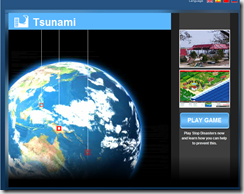
So I am pleased to highlight computer simulation/game geared for teenagers, produced for the UNISDR (United Nations Office for Disaster Risk Reduction) that puts them in control of preparing a city for an expected disaster.
No, it’s not a new game . . . it’s been around for years. But given today’s anniversary, today seems a good day to remind ourselves that preparedness, and community resilience, can save lives.
The player has five scenarios, with three levels of difficulty in each, to choose from. Earthquake, tsunami, hurricane, wildfire, flood . . . you choose

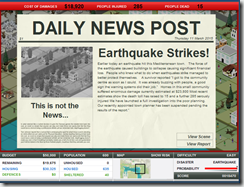
During a timed, and resource limited `setup period’ the player chooses what steps a community should take to prepare for an impending disaster. Once completed, the disaster simulation runs, telling you just how well (or badly) your mitigation efforts fared.

From the game’s FAQ file:
Who can play the Stop Disasters game?
Anyone with internet access can download and play the Stop Disasters game from this web site. The game will not be 'downloadable' as an exe file on your hard drive. Instead it will load into a browser window.Do I need a special computer?
No, any computer built within the last few years will be sufficient – Mac, PC or Linux based, with a screen resolution of 800x600 pixels.You’ll need an up to date browser, with Flash Player version 7 or higher. You can download the latest Flash plugin from here:
http://www.adobe.com/go/getflash/How long does it take?
Each scenario takes between 10 and 20 minutes to play, depending on the disaster you are trying to prevent and your skill level. There are five scenarios to play, and each can be played on easy, medium or hard difficulty levels.What age do you need to be to play?
The core audience is 9-16 year old children, but anyone can play and enjoy the game, and everyone will learn more about preventing disasters.How many players can play?
This is a single player game, but groups of children in a classroom environment can play collaboratively and discuss the best course of action to take. Additional learning material for students and teachers is available in the ‘Information’ section of this web site.How many times can I play?
You can play as many times as you like – we will keep track of your highest scores and record them on the web site, so you can compete against everyone in the world!However, just like natural hazards in real life some elements are random. There is no ‘perfect solution’ to each scenario and no ‘perfect score’, so every time you play things will be slightly different.
Can I play at school?
If your school allows access to this web site and the computer has the Flash plugin installed, then yes. We have created additional resources for teachers and encourage schools to play this game as a classroom exercise. Why not suggest it to your teacher at school?
Although most parents want to protect their kids from undo worry - when a disaster threatens, it threatens all of us – regardless of our age. Helping kids to understand more about emergency preparedness and community resilience will help them cope (and perhaps, even help) in the event they, or their community, are caught up in a disaster.


