Showing posts with label Romania. Show all posts

Monday, March 30, 2015

OIE/FAO Notifications Of Bird Flu In Italy & Romania

image

A busy avian flu season for Europe (prior to Mar. 13th)  – Credit Defra


# 9884


On Friday, in Media Reports: Bird Flu Detected In Romania & Italy, we looked at two  reported bird flu outbreaks in Europe. The Romanian outbreak – reportedly H5N1 – came on the heels of a similar announcement earlier last week from neighboring Bulgaria.


The outbreak in Italy wasn’t immediately identified, but it follows earlier outbreaks of LPAI H7, LPAI H5, and HPAI H5N8 viruses.


Today we’ve confirmation of both of these outbreaks, and of their subtypes, from separate reports issued by the OIE and the FAO.


First stop, Italy – where low path (LPAI) H7N1 has been identified on a farm in the Veneto region in the following FAO report.
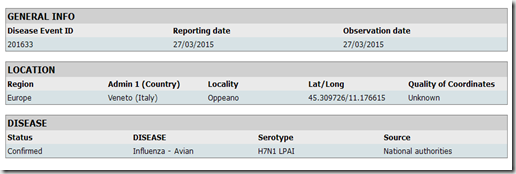
 

image


Of greater concern is an outbreak of HPAI H5N1 in waterfowl around the Danube Delta, as described in the following OIE Report, which describes 64 dead pelicans. 


image

image


Source of the outbreak(s) or origin of infection

  • Unknown or inconclusive

Epidemiological comments


On 25 March, the County Sanitary Veterinary and Food Safety Directorate (CSVFSD) of Tulcea was notified by the Danube Delta Biosphere Reserve Administration (ARBDD) about the identification of 64 carcasses of pelicans in an inhabited area, on Ceaplace island, Sinoe lake. This area is located at the border of Tulcea and Constanta Counties, and no other localities with domestic birds are found on a radius more than 10 km. The entire population of pelicans counted initially more than 250 birds, adults and young. Excluding the dead pelicans (found in different stages of putrefaction), no other birds were observed with clinical signs in the area. Also, in the area were observed other birds species, still unspecified.


After several years of relative quiescence on the bird flu front (at least, outside of China), we are suddenly seeing a remarkable surge in activity, involving several different strains.  


H5N1 is not only on the move in migratory birds – showing up in Eastern Europe, and Nigeria after five years absence – it is also raging in poultry in Egypt, and is spilling over into humans this winter at a record rate (see FAO: Egypt’s H5N1 Case Count Continues To Climb).


Meanwhile, the recently emerged H5N8 virus has not only spread across much of Eastern Asia, and into both Europe and North America, it has spawned a number of `local’ reassortant viruses. `New’ versions of H5N2, H5N3, and H5N1 have appeared in Taiwan, and in North America, and already they have had major impacts on the poultry industry in both regions. 


And while far less worrisome for now, we’ve also seen an unusual number of low path (LPAI) outbreaks (H5s & H7s) in poultry from Italy, to the UK, to Kansas.   


In many ways, the winter of 2014-15 has seen more bird flu activity – over a greater geographic range – than we’ve seen since the great bird flu expansion of 2006, when H5N1 escaped the confines of Asia and barnstormed much of  Europe (see H5N8: A Case Of Deja Flu?).


All of which has brought, once again, the role of migratory and wild birds in the spread of these viruses back to the forefront.  


While there are still a lot of missing pieces to this puzzle – and outbreaks often appear linked to or exacerbated by the movement of poultry products (legal and illicit), equipment, or personnel – this resurgence in bird flu has brought wild and migratory birds under new scrutiny.  


A few recent blogs on the topic include:


Erasmus Study On Role Of Migratory Birds In Spread Of Avian Flu
FAO On The Potential Threat Of HPAI Spread Via Migratory Birds
The North Atlantic Flyway Revisited

Friday, March 27, 2015

Media Reports: Bird Flu Detected In Romania & Italy

image


# 9875


Yesterday’s bird flu report from Bulgaria, very near the Romanian border (see OIE: H5N1 Kills 21 Pelicans In Bulgaria) has been quickly followed by multiple media reports that dead pelicans found this week in Romania have now tested positive for the H5N1 virus as well.


If confirmed by the OIE, this would be the first appearance of H5N1 in Romania since 2010.

Bird flu in Romania. Authorities found infected pelicans in the Danube

BURCHAREST  Romanian authorities have found in the Danube Delta for more than six decades of dead pelicans and laboratory tests six bodies have confirmed the presence of avian influenza virus H5N1. Informed on Friday by Agerpres, citing the report of the State Veterinary Office.

According to information from this office was 64 dead pelicans already discovered on Wednesday 25 March. Six bodies were handed over to the following day tests at the Central Veterinary Laboratory for the control of food safety and confirmed the occurrence of the virus H5N1 in all samples.

According to experts, is now in the Danube Delta are also other kinds of birds, but apart from pelicans was found dead bodies of any of them.

Any dead birds are the Dalmatian Pelican (Pelecanus crispus). It is a migratory birds in this annual time migrate from Africa to the Danube Delta.

Romanian authorities announced that in connection with the occurrence of bird flu in the Danube Delta tightened veterinary supervision of bird populations. Introduced three kilometers around the outbreak protection zone and a ten-kilometer control zone.

(Continue . . . )

A second report indicates these birds were discovered in Tulcea County, Romania.

image

Credit Wikipedia.


March 27, 2015 3:14 p.m.

Alert avian influenza in the Danube Delta. The virus was found in corpses of pelicans

Veterinary authorities in Tulcea County are on alert after Ceaplace island in the Danube Delta has been confirmed avian influenza virus. The disease was detected in several pelicans, found dead. The case came to the attention of Tulcea, after the island Ceaplace was notified that there are more dead pelicans. Inspectors have taken six corpses DSVSA Tulcea pelicans that have undergone testing. Following laboratory tests found the presence of avian influenza virus. These samples were sent for confirmation to the National Institute for Animal Health Diagnostic, which is the National Reference Laboratory for avian influenza. Integral on adevarul.ro


Meanwhile, a somewhat less informative media report out of Oppeano, Italy stating that `bird flu’ has broken out at a farm in the Veneto region, but without specifying the subtype of influenza.  Italy has reported H5N8, H5N1, and H7 subtypes previously, so we’ll probably  have to wait for an FAO or OIE notification to learn the cause of this outbreak.

image 

Credit Wikipedia


Outbreak of bird flu discovered in farm

It is a farm with an adjoining farm. Recommended immediate control measures with slaughter of all susceptible animals

OPPEANO - Discovered in a herd, also home to a farm , to Oppeano, an outbreak of avian influenza .
The Section veterinary and food safety of the region Veneto , with a note sent to the mayor of the town in the province of Verona and the veterinary service of ' Ulss 21 Legnago, has recommended the adoption of immediate measures to control, with slaughter of all susceptible animals and the destruction of carcasses and materials.


The positive virological and serological virus was confirmed by the National Reference Centre for the ' AI Institute zooprofilattico delle Venezie. " The positive virological - is written in the note of the Region - testifies to the presence of avian influenza in the company and the finding of only one out of 20 seropositive taken may indicate a recent introduction of virus ', which more so requires immediate action to prevent the disease from spreading.


A second report reads:


Outbreak of bird flu discovered on a farm

Alerting Oppeano in Veronese. The Health Authority of Legnago ordered the immediate slaughter of all the heads

OPPEANO .A outbreak of bird flu was discovered in a herd, also home to a farm, to Oppeano, in the province of Verona. Section veterinary and food safety of the region Veneto, with a note sent to the mayor of Oppeano and Veterinary Service Ulss 21 Legnago (Verona) recommended the adoption of immediate measures to control, with slaughter of all susceptible animals and the destruction of carcasses and materials. The National Reference Centre for Avian Influenza Institute of zooprofilattico venezie confirmed virological and serological positivity to the virus.


These past few months have seen a remarkable spread of HPAI H5 viruses around the world, arguably the most impressive geographic expansion of bird flu since the great H5N1 diaspora of 2006 (see H5N8: A Case Of Deja Flu?). 


Europe, Asia, Africa, and North America have all see either the return, or in some cases – the very first arrival – of these highly pathogenic viruses, and the losses to the poultry industry have been substantial. 


With the exception of Egypt’s record-setting H5N1 outbreak and occasional human cases in China, the impact on human health this winter been negligible.  Some of these viruses (H5N8 and H5N2) have no record of infecting humans, but as they are related to far less benign strains, they are viewed with understandable caution.


As these viruses spread through wild and migratory birds, and among commercial poultry, they have the potential to come in contact with other influenza viruses, and possibly reassort into new hybrids.  A process that could yield new subtypes with unpredictable results.