Showing posts with label OIE. Show all posts

Monday, March 30, 2015

OIE/FAO Notifications Of Bird Flu In Italy & Romania

image

A busy avian flu season for Europe (prior to Mar. 13th)  – Credit Defra


# 9884


On Friday, in Media Reports: Bird Flu Detected In Romania & Italy, we looked at two  reported bird flu outbreaks in Europe. The Romanian outbreak – reportedly H5N1 – came on the heels of a similar announcement earlier last week from neighboring Bulgaria.


The outbreak in Italy wasn’t immediately identified, but it follows earlier outbreaks of LPAI H7, LPAI H5, and HPAI H5N8 viruses.


Today we’ve confirmation of both of these outbreaks, and of their subtypes, from separate reports issued by the OIE and the FAO.


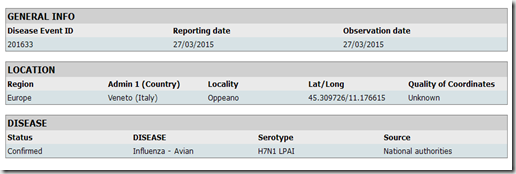
First stop, Italy – where low path (LPAI) H7N1 has been identified on a farm in the Veneto region in the following FAO report.
 

image


Of greater concern is an outbreak of HPAI H5N1 in waterfowl around the Danube Delta, as described in the following OIE Report, which describes 64 dead pelicans. 


image

image


Source of the outbreak(s) or origin of infection

  • Unknown or inconclusive

Epidemiological comments


On 25 March, the County Sanitary Veterinary and Food Safety Directorate (CSVFSD) of Tulcea was notified by the Danube Delta Biosphere Reserve Administration (ARBDD) about the identification of 64 carcasses of pelicans in an inhabited area, on Ceaplace island, Sinoe lake. This area is located at the border of Tulcea and Constanta Counties, and no other localities with domestic birds are found on a radius more than 10 km. The entire population of pelicans counted initially more than 250 birds, adults and young. Excluding the dead pelicans (found in different stages of putrefaction), no other birds were observed with clinical signs in the area. Also, in the area were observed other birds species, still unspecified.


After several years of relative quiescence on the bird flu front (at least, outside of China), we are suddenly seeing a remarkable surge in activity, involving several different strains.  


H5N1 is not only on the move in migratory birds – showing up in Eastern Europe, and Nigeria after five years absence – it is also raging in poultry in Egypt, and is spilling over into humans this winter at a record rate (see FAO: Egypt’s H5N1 Case Count Continues To Climb).


Meanwhile, the recently emerged H5N8 virus has not only spread across much of Eastern Asia, and into both Europe and North America, it has spawned a number of `local’ reassortant viruses. `New’ versions of H5N2, H5N3, and H5N1 have appeared in Taiwan, and in North America, and already they have had major impacts on the poultry industry in both regions. 


And while far less worrisome for now, we’ve also seen an unusual number of low path (LPAI) outbreaks (H5s & H7s) in poultry from Italy, to the UK, to Kansas.   


In many ways, the winter of 2014-15 has seen more bird flu activity – over a greater geographic range – than we’ve seen since the great bird flu expansion of 2006, when H5N1 escaped the confines of Asia and barnstormed much of  Europe (see H5N8: A Case Of Deja Flu?).


All of which has brought, once again, the role of migratory and wild birds in the spread of these viruses back to the forefront.  


While there are still a lot of missing pieces to this puzzle – and outbreaks often appear linked to or exacerbated by the movement of poultry products (legal and illicit), equipment, or personnel – this resurgence in bird flu has brought wild and migratory birds under new scrutiny.  


A few recent blogs on the topic include:


Erasmus Study On Role Of Migratory Birds In Spread Of Avian Flu
FAO On The Potential Threat Of HPAI Spread Via Migratory Birds
The North Atlantic Flyway Revisited

Friday, December 26, 2014

OIE Report: H5N8 Detected In Eastern Russia

image


# 9489


A hat tip to @NLInteligence for tweeting a link to a new OIE report announcing the detection of the H5N8 virus in a hunted Eurasian Wigeon – a dabbling duck  - taken apparently early in October in the far north town of Belaya Gora in Sakha,  Republic of Russia.


When H5N8 turned up in both poultry and wild birds in  Europe last month, it had traveled nearly 8,000 km from where it initially broke out in South Korea in January of this year, with no reports from the vast territory lying in between.

image

Reporting and surveillance in these regions is minimal, but today’s report adds at least one more dot on the map (3000 km north of South Korea) showing the spread of the H5N8 virus, and bolsters the theory that migratory birds are likely behind the spread of this avian virus westward into Europe.


The following is a mash up of some of the details from today’s OIE REPORT.


image

Wednesday, November 19, 2014

OIE: European H5N8 Strain `Closely Related’ To Korean Strain

image

Three recent Outbreaks Of H5N8


# 9346


From the OIE today, a press release in Q&A format which – among other things – characterizes the recently detected H5N8 virus outbreaks in Europe as belonging to the same clade as the outbreaks in Europe.  This supports – but doesn’t necessarily prove – the notion that the virus may have been imported to Europe via migratory birds.


The entire press release may be accessed at the link below: I’ve included some excerpts:


Questions and Answers on Highly Pathogenic H5N8 Avian influenza strain

(Excerpts)

What is the source of influenza A (H5N8)?

Based on the partial sequence data of the HA gene segment, the German, the Dutch and the British viruses were identified as closely related to the Republic of Korea H5N8 viruses. Investigations are continuing to determine the source. The viruses belong to the clade 2.3.4.6.

Have wild birds been identified as a carrier of the influenza A (H5N8) virus?

Wild birds can normally carry avian influenza viruses in their respiratory or intestinal tracts but they do not commonly get sick. They have historically been known as reservoirs and vectors of AI viruses. Around the world, surveillance measures have been put in place to monitor occurrence and characteristics of AI viruses in wild birds. To date, the infection with avian influenza viruses subtype H5N8 has been detected in wild birds in China[1], the Republic of Korea[2] and Japan[3]. The majority of avian influenza viruses does not cause disease in wild birds, but is very likely that wild birds might spread the virus via their migratory flyways.

How is influenza A(H5N8) transmitted and spread among birds?

All AI viruses can be transmitted among birds through direct contact with secretions from infected birds, especially faeces or through contaminated feed, water, equipment, and human clothing and shoes.

They are readily transmitted from farm to farm by the movement of domestic live birds, people (especially when shoes and other clothing are contaminated), and contaminated vehicles, equipment, feed, and cages. Highly pathogenic viruses can survive for long periods in the environment, especially when temperatures are low.

Several factors can contribute to the spread of all AI viruses including: the movements of people and goods, marketing practices (live bird markets), farming practices and the presence of the viruses in migratory wild birds.

(Continue . . . )


Saturday, January 04, 2014

OIE: Updated Q&A On MERS-CoV

image

Coronavirus – Credit CDC PHIL


# 8127


As researchers discover and publish more information on the origins and reservoir hosts of the MERS coronavirus it is important that agencies and organizations like the World Health Organization and the OIE update their FAQs (Frequently Asked Questions) and information sheets. 


The last OIE update was published in November (see OIE: Updated Q&A On MERS Coronavirus), and since then we've seen a number of new MERS studies, particularly involving camels (see EID Journal: MERS-Like Antibodies In Camels, UAE 2003-2013, The Lancet: Identification Of MERS Virus In CamelsEurosurveillance: Seroprevalence Of MERS-like Antibodies In Middle Eastern Camels), and so it is appropriate that a new version be posted.

.

My thanks to Lisa Schnirring for tweeting this first updated Q&A on the MERS virus  for the new year from the OIE, the World Organization For Animal Health. I've only included excerpts,  follow the link to read it in its entirety.


Update January 2014 - Questions and Answers MERS coronavirus (CoV)

What is MERS CoV?

MERS CoV is a particular strain of coronavirus which is thought to cause Middle East Respiratory Syndrome (MERS), a respiratory disease of humans. MERS CoV had not been seen in humans before September 2012. Since then sporadic outbreaks of MERS CoV with human cases have been detected in 9 countries.    
According to a recent WHO report released 31st December 2013, a total of 176 laboratory-confirmed cases in humans have been reported since September 2012, including 74 deaths.  


What are coronaviruses?

<SNIP>


What is the source of MERS CoV?

OIE together with its partner organizations the World Health Organization (WHO), the Food and Agriculture Organization (FAO) and national animal health authorities of affected countries is closely following investigations into a possible animal source of MERS CoV.

The current epidemiological investigation includes researching potential sources of exposure to the virus which are numerous and include other humans, the environment, food and water, as well as animals. Detailed information collected from relatives and other persons in contact with people infected with MERS CoV can help to provide important clues about the source of their infection. 

According to available information, most human cases of MERS do not report contact with animals.

Can animals become infected with MERS CoV?

Analyses carried out in November 2013 by a laboratory in the Netherlands seem to provide compelling evidence that MERS CoV has been isolated from 3 camels  on a farm in Qatar, also linked to two human cases of MERS CoV. In this event, the exposure source of the humans and the camels (and possibly other animals) is not known i.e. the direction of transmission between the two species is not known and it is also not known whether the animals and humans were exposed to some other source of infection. Further investigations are needed to assess the implications of these findings.      

Are animals responsible for MERS CoV infections in people?

More investigations are needed to assess the presence of MERS CoV in animal population and determine potential sources and modes of transmission. However a large survey could be difficult to conduct, because validated diagnostic tests are not widely available, and animals may only shed the virus for relatively short periods of time. Additional joint human health and animal health investigations are needed to establish the source of exposure for human infections with MERS CoV when the source has not been identified as another human. So far, three patterns of infection have been reported by WHO: 

- community acquired cases (the exposure sources remains unknown and might include an animal, food or environmental source)

-  hospital acquired infections

-  infection acquired through close human to human contact (household).

Did MERS CoV come from bats? 

Although a relative to this virus had already been detected in bat species, and a fragment of viral genetic material matching the MERS CoV was recently found in one bat from Saudi Arabia, more evidence is needed to directly link the MERS CoV to bats or other animal species.

What about the suspicion that camelidae and other animals play a role in MERS?  

Although recent results from a laboratory in the Netherlands seem to provide evidence that 3 camels were infected with MERS CoV, further investigations are needed to understand the significance of these findings and to assess the potential role of  camels and possibly other animals in MERS. Subsequently, samples taken from this same herd and tested using the same technique are negative. Important surveillance for MERS-CoV in animals is being implemented to better understand the epidemiology, and the same herd is under systematic retesting.

It is important to remain open minded about all potential sources of exposure for human and animal cases until more information is available.

What about serological tests, or detection and virus isolation tests  in animals?         

Serology tests aim to detect antibodies produced by the animal against the virus, and not to search for the presence of the virus itself. Often it is difficult and sometimes impossible to distinguish antibodies to different species or strains of viruses having genetic or antigenic similarities, due to what is known as serological ‘cross reactivity’.

Serology tests for MERS CoV have not yet been validated in animals and may not be reliable. If these tests, which may not be sufficiently specific, are used in animals there is a risk that ‘false positive’ results will occur because it may not be possible to differentiate antibodies to MERS CoV from antibodies to other coronaviruses, commonly found in animals.

That is why confirmatory tests in animals should focus on isolating and identifying the virus itself.

For that purpose, it is possible to use techniques to amplify genomic sequences with polymerase chain reaction (RT-PCR), confirmed by sequencing the amplicons, or to isolate the virus itself following viral culture. Because of genetic similarities with other strains, to confirm the presence of MERS-CoV, the analyses have to identify the species concerned (MERS-CoV), not only the genus (betacoronavirus). To date, because of the novelty of this virus strain, the use of the human PCR test might reveal false positive results resulting from close strains circulating in animals. The complete sequencing of the genome or virus isolation thus remains the most reliable way to confirm the   presence of MERS CoV.

What would happen if MERS CoV is identified in animals?    

If information from public health investigations identifies a possible animal source, OIE will support further joint investigations.

OIE Member Countries would be obliged to report to the OIE a confirmed case of MERS CoV in animals, as an “emerging disease” in accordance with article 1.1.3 of the OIE Terrestrial Animal Health Code. If MERS CoV was identified in an animal this would not necessarily mean that the animal is a source of human infection. Detailed investigations would then be needed to understand the relationship between any animal cases and human cases, and whether a finding in animals would be significant for human infection.

(Continue . . . )

Monday, November 18, 2013

OIE: Updated Q&A On MERS Coronavirus

image

Coronavirus – Credit CDC PHIL


# 7988


My thanks to Helen Branswell for tweeting this updated Q&A on the MERS virus from the OIE, the World Organization For Animal Health..


While some in the news media have jumped on the notion that people are contracting this virus directly from camels, the OIE says there is insufficient evidence to support that theory – recommending instead to keep an open mind - and not get too far ahead of what is actually known.


I’ve excerpted just a few segments (bolded underlined  emphasis are mine) – primarily those dealing with the issue of finding the virus in camels – so by all means, follow the link to read it in its entirety.


Update November 2013 - Questions and Answers MERS coronavirus (CoV)

(EXCERPTS)

What is the source of MERS CoV?
OIE together with its partner organizations the World Health Organization (WHO), the Food and Agriculture Organization (FAO) and national animal health authorities of affected countries is closely following investigations into a possible animal source of MERS CoV.

The current epidemiological investigation includes researching potential sources of exposure to the virus which are numerous and include other humans, the environment, food and water, as well as animals. Detailed information collected from relatives and other persons in contact with people infected with MERS CoV can help to provide important clues about the source of their infection.

To date, no formal proof has been highlighted on a potential animal origin. Exposure sources and modes of transmission also remain to be clarified.

Can animals become infected with MERS CoV?


Although experimental infection of animal cultured cells and recently monkeys with MERS CoV has been possible, to date the MERS CoV has not been naturally detected in animals.

Are animals responsible for MERS CoV infections in people?


To date there is no evidence that people have become infected through contact with animals. However there is also a possibility that MERS CoV may have evolved from other coronaviruses that have been circulating in certain animals. Additional public health investigations are needed to establish the source of exposure for human infections with MERS CoV when the source has not been identified as another human. So far, three patterns of infection have been reported by WHO:

  • community acquired cases (the exposure sources remains unknown and might include an animal, food or environmental source)

  • hospital acquired infections

  • infection acquired through close human to human contact (household).

Did MERS CoV come from bats? 

Although a relative to this virus had already been detected in bat species, and a fragment of viral genetic material matching the MERS CoV was recently found in one bat from Saudi Arabia, more evidence is needed to directly link the MERS CoV to bats or any other animal species.

What about the suspicion that camels play a role in MERS?

Currently there is no strong evidence to consider that camels are a source of infection for human cases of MERS. Based on available epidemiological data it is difficult to explain the relationship between positive serological results in camels and cases of human infections with MERS CoV. Indeed, to date, there is no potential similarity between the strain of MERS CoV isolated in humans and the suspicions shown in camels. It is important to remain open minded about all potential sources of exposure for human cases until more information is available.

(Continue . . . )


Tuesday, April 30, 2013

OIE Statement On Live Markets And H7N9

image

Credit Dr. Ian MacKay Virology Down Under 


# 7209


H7N9 is genetically a `bird flu’, but one of the ongoing mysteries in the H7N9 outbreak in China is how – with more than 125 people infected - only 46 positive virus samples have been detected out of nearly 70,000 tests conducted on poultry and their environment.


Thus far, the virus has not been detected on farms or commercial poultry operations, only in a handful of samples taken from live bird markets.


Today, the OIE – which has been in meetings with China’s Ministry of Agriculture – released  a press release on the H7N9 outbreak and the role they suspect that live-market birds may play in its spread.


Utilizing phrases  like `the team made the hypothesis’, `The experts believe’ and `live bird markets may play a key role’ – it is pretty obvious that major gaps remain in our understanding of how this virus is spreading and infecting humans.


The available data remains sparse and incomplete, and a lot of it – frankly – still doesn’t fit together particularly well. All of which helps explain the lack of certainty.


This from the OIE newsroom.


OIE expert mission finds live bird markets play a key role in poultry and human infections with influenza A(H7N9)

Paris, 30 April 2013 – The Ministry of Agriculture of the People’s Republic of China asked the Director General of the World Organisation for Animal Health (OIE) to send OIE experts to assess the situation with influenza A(H7N9) in animals and provide advice.


The mission took place in the spirit of the Tripartite framework between the OIE, the World Health Organization (WHO) and the Food and Agriculture Organization (FAO) of the United Nations. The WHO was leading a mission the week before in collaboration with the Chinese Ministry of Health, while FAO is represented in the country by its local officer, a veterinary doctor who provided support.


The OIE appreciated the availability and transparency of the Chinese authorities in sharing important information, acknowledged the rapid and considerable response made by the Veterinary services to investigate the animal source of human infections, and recognised their efforts to keep the international community informed about the disease situation, including official notifications to the OIE World Animal Health Information System (WAHIS).


According to the information and data collected, the mission confirms that many of the human cases of H7N9 appear to have a link with live bird markets. To date no human cases or animal infections of H7N9 have been detected on poultry farms. During the mission the team made the hypothesis that people could be infected through exposure to infected birds in markets or to a contaminated environment such as live poultry markets where virus is present.


The experts believe that live bird markets may play a key role in human and animal infections with H7N9 and that, even if the overall level of infection is relatively low (having not been detected yet in poultry farms), live bird markets provide an environment for amplification and maintenance of the H7N9 virus. Collaboration between human health and animal health sectors is useful to better understand transmission to humans.


The mission also confirms that currently infection with H7N9 does not cause visible disease in poultry therefore Veterinary Services must be especially involved in preventing its further spread in poultry, particularly through the supervision of the implementation of biosecurity measures on farms.


“Compared with H5N1, at this moment in time H7N9 is not pathogenic to poultry so there are no visible signs of infection, which makes surveillance, prevention and control of the virus in poultry a great challenge”, Dr Keith Hamilton, member of the OIE team, explained.


Because H7N9 infection is unlikely to show visible signs of disease in poultry, the use of reliable and accurate laboratory tests, complying with OIE Standards and guidance from OFFLU, will underpin surveillance and control of the H7N9 virus in poultry. OFFLU is the FAO/OIE global network of scientific expertise on animal influenza.


An extensive surveillance programme in animals is essential to establish the full extent and distribution of the H7N9 virus in the whole country. Effective surveillance will require cooperation between poultry owners and distributors and government Veterinary Services. Veterinary Services including laboratories will need appropriate resources for that purpose.


OIE Reference laboratories for avian influenza, including Harbin Veterinary Research Institute, other laboratories in China, as well as scientists of OFFLU  are conducting research on H7N9 to better understand the characteristics of this virus and to ensure that more appropriate diagnostic testing protocols are publicly available.


Recommendations


In case of outbreaks, destruction of infected poultry by Veterinary Services as well as poultry that have been in contact with infected birds is recommended. Culling of at risk-animals must be done following requirements for acceptable killing methods as described in the OIE Code.


There is no evidence to suggest that the consumption of poultry or eggs fit for human consumption could transmit the AI virus to humans. It is safe to eat properly prepared and cooked meat and eggs. Specific precautions when plucking poultry are recommended.


More assessment is needed to swiftly know whether poultry vaccination could be considered as an efficient control option for H7N9. It will be also important to verify whether the H7N9 virus is transmissible from humans to animals because if established, it could be a potential channel for the global spread of the virus.


Trade


Preventing the national and international spread of the H7N9 virus must be a priority.


The strict application by local and national veterinary authorities of Member Countries of OIE science-based standards published in the OIE Terrestrial Animal Health Code (volume 2; chapter 10.4) can prevent spread of the virus from infected poultry. These standards apply to international trade in live poultry, poultry meat, eggs and even feathers.


The application of these international standards also prevents imposition of unjustified trade barriers by importing countries. Controlling illegal trade must also be a priority.


For more from the OIE on this H7N9 virus, you may wish to visit their FAQ.


Questions and Answers on influenza A(H7N9)

Thursday, April 11, 2013

OIE: H7N9 Represents An `Exceptional Situation’


image

Map Credit ECDC


# 7014


While I was away from my desk Crof posted a statement (see OIE on the "exceptional nature" of H7N9) from the OIE (World Organization For Animal Health) that discusses the difficulties inherent in containing an avian influenza outbreak that doesn’t visibly sicken poultry.


First excerpts from the statement, and OIE FAQ, and then I’ll return with more.


The OIE, World Organisation for Animal Health, highlights the exceptional nature of the influenza A(H7N9) event notified by China

Paris, 11 April 2013 – According to the official reports sent to the OIE by the Chinese Veterinary Authorities, poultry that have tested positive for the presence of influenza virus A(H7N9) and are also suspected of being the source of reported human cases, do not show any visible signs of disease, making it very difficult to detect this virus in poultry.


“Based on the information currently available we are facing a rather exceptional situation, because we are dealing with an influenza virus of very low pathogenicity for poultry which has the potential to cause severe disease when it infects humans”, stated the Director General of the OIE, Dr Bernard Vallat.

(Continue . . . )


The OIE also has a rather extensive FAQ on H7N9 Avian Influenza, portions of which are excerpted below:


Can culling be used as a control measure?

If the infection is detected in animals, generally a culling policy is used in the efforts to control and eradicate the disease.

Requirements include (and are described in the OIE Terrestrial Animal Health Code):

  • humane destruction of all infected and exposed animals (according to OIE animal welfare standards);
  • appropriate disposal of carcasses and all animal products;
  • surveillance and tracing of potentially infected or exposed poultry;
  • strict quarantine and controls on movement of poultry and any potentially contaminated vehicles and personnel;
  • thorough decontamination of infected premises ;
  • a period at least 21 days before restocking.

In the case of low pathogenic avian influenza like the current outbreaks of H7N9 declared by China, stamping out is generally applied at the level of the infected farm or within a short radius around the infected premises. 


Does OIE recommend vaccination of animals to control the disease?

When appropriate vaccines are available, vaccination aims to protect the susceptible bird populations from potential infection. Vaccination reduces viral excretions by animals and the virus’ capacity to spread. Vaccination strategies can effectively be used as an emergency effort in the face of an outbreak or as a routine measure in an endemic area. Any decision to use vaccination must include an exit strategy, i.e. conditions to be met to stop vaccination.


Careful consideration must be given prior to implementing a vaccination policy and requires that the recommendations from the World Organisation for Animal Health (OIE) on vaccination and vaccines are closely followed (www.oie.int\downld\AVIAN INFLUENZA\Guidelines on AI vaccination.pdf).

In short, vaccination should be implemented when culling policies cannot be applied either because the disease is endemic and therefore widely present, or the infection in affected animals is too difficult to detect.


What are the OIE recommendations for trade in poultry from a country infected with influenza A(H7N9)?

The risk analysis to be used by importing countries in order to protect their territory from pathogens introduction is very complex and is based on a long list of OIE standards.

In the case of outbreaks of low pathogenic avian influenza of the H7 strain in potential exporting countries, the trade recommendations that apply can be found in the OIE Terrestrial Animal Health Code (Chapter 10.4; 2013). These measures are science-based and should not result in unjustified trade barriers; they include zoning and the testing of the animal populations of origin.


What compensation measures should be applied for the concerned farmers?

Systems for financial compensation of farmers and producers who have lost their animals as a result of mandatory culling requested by national authorities vary around the world; they may not exist at all in some countries. The OIE encourages national authorities to develop and propose compensation schemes because they are a key to early detection and transparency in reporting the occurrence of animal diseases, including avian influenza.

What are the food safety recommendations?

Animals which have been culled as a result of control measures in response to an outbreak of avian influenza, including the A(H7N9) virus, should not enter the food and feed chain as a precautionary and regulatory measure.

There is no evidence to suggest that the consumption of poultry or eggs fit for human consumption could transmit the AI virus to humans.


What is the public health risk associated with avian influenza?

AI viruses are highly species-specific, but have, on rare occasions, crossed the species barrier to infect humans. This disease should not be confused with seasonal human influenza (flu), a very common human disease (generally caused by human H1 and H3 viruses). Transmission of AI viruses to humans has occurred when there is close contact with infected birds or heavily contaminated environments.


Human disease has usually been related to the transmission of a highly pathogenic virus of animal origin. The current influenza A(H7N9) virus notified to the OIE by China is low pathogenic for poultry; investigations are being conducted to demonstrate possible links with the human cases, as the genetic similarity has already been established.


Due to the potential for human infection, it is recommended that people working with, or in contact with poultry suspected of being infected with AI viruses, wear protective clothing including face masks, goggles, gloves and boots.


What prevention measures are recommended at the farm level?

It is essential for poultry producers to maintain biosecurity practices to prevent introduction of the virus in their flock:

  • keep poultry away from areas frequented by wild fowl;
  • keep control over access to poultry houses by people and equipment;
  • do not provide elements on property that may attract wild birds;
  • maintain sanitation of property, poultry houses and equipment;
  • avoid the introduction of birds of unknown disease status into flock;
  • report illness and death of birds; 
  • appropriate disposal of manure and dead poultry; 
  • vaccinate animals when appropriate.


The `exit strategy’ on vaccination mentioned in the second section above has been a largely ignored feature of the OIE avian flu recommendations for years.


In Avian influenza and vaccination: what is the scientific recommendation?, the OIE reiterated their strong recommendation that humane culling be employed to control avian influenza, and advising that vaccines should only be used as a temporary measure.


While the OIE conceded that some nations may require the use of vaccines for `several years', they have consistently urged that countries move away from that program and towards the more conventional culling policy. 


A policy change that has thus far failed to take hold in places like China, Vietnam, Indonesia, and Egypt.


For some reasons behind this lack of movement towards a culling policy, you may wish to revisit Food Insecurity And The Control Of Bird Flu.

Friday, December 23, 2011

WHO/FAO/OIE: Call It A(H3N2)v


image

H3N2 influenza virions –CDC PHIL


# 6029


When a new flu strain appears there is often some confusion of what to call it, particularly when the HA and NA components are the same as other circulating flu viruses.


This is the problem we ran into when a novel H1N1 virus (now officially dubbed  A(H1N1)pdm09) emerged.  The media latched on to `Swine flu’, while scientific publications used a variety of nom de flus, including A/H1N1/09 and pdmH1N1.


It took more than two years before a consensus was reached (see WHO: Call It A(H1N1)pdm09).  And while that does not exactly roll off the tongue, it does have the the advantage of being precise.


Today we’ve a joint announcement from the World Health Organization, FAO, and OIE on a standardized nomenclature for the recently emergent trH3N2 virus that has been detected in a handful of people across several states since last summer.


They’ve decided to go with A(H3N2)v.


We’ll have to wait to see if this designation is adopted elsewhere. What will be done if another variant of the A(H3N2) virus should appear is not mentioned.


A hat tip to Giuseppe Michieli on FluTrackers for posting the following link.


Standardization of terminology for the variant A(H3N2) virus recently infecting humans

Joint announcement of FAO, OIE and WHO

23 December 2011

FAO, OIE and WHO continue working closely together to address influenza issues related to public health and animal health.


Since July 2011, twelve human cases of infection with a variant influenza A(H3N2) virus have been detected in the United States. To date, no report has been received from elsewhere in the world. This virus has different virological characteristics from current circulating seasonal influenza viruses in humans, and has a new gene constellation: 7 genes from the triple reassortant A(H3N2) viruses known to have been circulating in pigs in the North America and the M gene from an A(H1N1)pdm09 virus, a seasonal virus currently circulating in humans.


In order to improve communications and avoid confusion, FAO, OIE and WHO have established a working group of experts to standardize the terminology for variant influenza viruses. The joint recommendation for the above mentioned A(H3N2) virus is: A(H3N2)v , where “v” stands for “variant”.

An example of use of the terminology:

  • Sporadic human cases of infection with a variant influenza A(H3N2) virus A(H3N2)v have been reported in the USA. The A(H3N2)v virus is different from seasonal viruses currently circulating in humans.

Friday, November 18, 2011

WHO: The Inevitability Of Another Pandemic


# 5968


The World Health Organization is holding a 3-day conference this week in Mexico City called Health Risks in Human-Animal Ecosystems, attended by more than 100 experts from 30 countries.


Their goal is to coordinate, and improve, the global response to future outbreaks of zoonotic diseases; those that jump between animals and humans.


At this week’s conference, WHO Assistant Director-General of Health Security and Environment Keiji Fukuda warned on the inevitability of the world seeing another pandemic, calling it was a matter of when, not `if’.


He is further quoted by Reuters as saying:


"We do face the risk of another pandemic in the future. We know that the viruses which can cause influenza pandemic circulate in animals and then we don't know when one of those viruses then becomes highly infectious for people and then spreads around the world. We also don't know when something like that happens, which we do expect in the future someday, when something like that happens we don't know how severe the effect will be."


Working as an alliance, the WHO, FAO, and OIE formally joined forces in 2010 with the issuance of a Tripartite Concept Note outlining their collaborative efforts.


Their stated goal is to `coordinate global activities to address health risks at the animal-human-ecosystems interface’.

image


The WHO webpage Zoonoses and veterinary public health (VPH)  provides a description of zoonotic pathogens for us:


Any disease or infection that is naturally transmissible from vertebrate animals to humans and vice-versa is classified as a zoonosis according to the PAHO publication "Zoonoses and communicable diseases common to man and animals".

Over 200 zoonoses have been described and they have been known for many centuries. They are caused by all types of agents: bacteria, parasites, fungi, viruses and unconventional agents.


Twice in the last decade (SARS in 2003, and Swine Flu in 2009) we saw how quickly viruses normally found in non-human hosts can evolve and adapt to humans and spread globally.


Which is why efforts such as Global Early Warning System for Major Animal Diseases, including Zoonoses (GLEWS) have been set up to detect, and provide early warning of animal disease threats


The WHO lists the criteria by which events are assessed by the GLEWS task force as:


Triggers and GLEWS diseases
What triggers GLEWS

A potential event is assessed according to criteria derived from the International Health Regulations (2005) and the Terrestrial Animal Health Code from OIE:

  • Is the public health impact of the event serious?
    • High morbidity and/or high mortality in humans and/or animals.
    • Emerging disease with significant mortality and/or morbidity or zoonotic potential.
  • Is the event unusual or unexpected?
    • First occurrence or reoccurrence of a disease/strain.
    • Unusual event for the area or season.
    • Event associated with an unknown agent.
  • Is there significant risk of international spread or interference with international travel or trade?


You’ll find more information, including a priority list of zoonotic pathogens, on this page as well.


There are other efforts out there to detect or provide early warning for the next emerging pathogen, including (but not limited to):


While the 2009 H1N1 pandemic is ended, it is important to remember that the world remains at pre-pandemic phase III on the H5N1 virus. 


image


But as SARS showed us in 2003, sometimes a pathogen can emerge with little or no warning. Hence the need for nations, businesses, and individuals to be prepared for the unexpected.

Sunday, September 25, 2011

FAO-OIE-WHO Bird Flu Technical Update


# 5862


Earlier this month the three international agencies most closely associated with the tracking and control of bird flu (World Health Organization, FAO, OIE) issued a technical report on the current evolution of the H5N1 avian influenza virus.


The forward indicated that this report is intended for:


. . .  persons generally familiar with influenza viruses and the epidemiology of influenza in humans and animals.


Which I suspect describes most of my readers. The document can be downloaded from:


FAO-OIE-WHO Technical Update: Current evolution of avian influenza H5N1 viruses


7 September 2011

•  Highly pathogenic avian influenza H5N1 viruses continue to circulate in poultry and cause disease, and remain a threat to human and animal health.

 
•  Both animal and public health sectors at the national, regional, and international levels should maintain vigilance in regularly detecting, reporting, and characterizing animal influenza viruses, and in assessing and managing existing and evolving health
risks associated with these viruses. 


Although often neglected by the mainstream media (unless they can use the word `mutant’ in a headline), H5N1 avian influenza continues to pose a threat to birds and to other species, including humans.


image


As you can see by the chart above, the number of human cases reported has slowly been increasing since their nadir of 2008. Still, they remain far below the numbers we saw in 2003-2006.


While that might seem like good news, it isn’t necessarily as comforting as it may appear. 


Between budget cuts, pandemic fatigue, and other pressing public health concerns, surveillance and testing for the H5N1 virus remains quite limited in many parts of the world.


Best case, only the sickest of the sick - who have had direct contact with poultry - are likely to be tested for the virus. 


Meaning that the numbers we see probably do not reflect the full burden of the disease. A fact that is true for practically every illness.


surveillance

Source CDC 


Whether we are talking influenza, Lyme Disease, Salmonella poisoning, or bird flu . . . official case counts are usually just the tip of the pyramid.


The concern is that if the virus adapts better to human physiology, it could begin to produce less virulent infections in some people, and spread more easily undetected.


While solid evidence of that happening is scant, in a recent seroprevalence study of 800 villagers in Thailand (who reported no history of a serious influenza-like illness), (5.6%) had antibodies to A/Thailand/ 676/005H5N1, and (3.5%) were shown to be seropositive to A/Thailand/384/2006 H5N1.


Suggestive, at least, that milder or perhaps even subclinical infections with the virus may be occurring outside our view.


And in the past couple of years we’ve also seen a trend in Egypt towards less virulent infections along with a mortality rate half that seen elsewhere,  once again suggesting the virus might be adapting better to human physiology (see PLoS: Human-Type H5N1 Receptor Binding In Egypt).


Despite these recent studies, for now, the H5N1 virus does not appear to be ready for prime time.  Full adaptation to a humanized pathogen could take years, or even decades.


Or it might not happen at all.


The tripartite report updates the situation in Cambodia, which has seen a resurgence in H5N1 cases this year (see Cambodia: 8th Fatal H5N1 Case Of 2011, stating:


Eight human cases of H5N1 infection have been reported from Cambodia in 2011, all of which were in people under 19 years of age and all of which were fatal. This is the highest number of human H5N1 cases reported in one year from Cambodia. The basis for the increased incidence and the high mortality remain unclear.


All of these cases represent sporadic infections likely related to exposure to sick poultry, and are not linked to each other, with the exception of a mother and her child. There is no evidence of sustained human-to-human transmission of H5N1 virus in Cambodia or any other country. 


The report also addresses the recent announcement of a `mutated’ clade of H5N1 (see FAO Warns On Bird Flu), stating:


•  Predictably, the avian influenza H5N1 viruses also continue to evolve, especially in areas where they circulate endemically in poultry. The slowly evolving viruses are periodically regrouped and assigned new clade names. 


•  One clade, recently named H5N1 clade 2.3.2.1 has evolved from clade 2.3.2 viruses previously circulating among poultry in the eastern Asia since 2005. This clade has been increasingly found in poultry in several countries, and in some areas has become predominant over previously circulating clades. Hence, clade 2.3.2.1 viruses are not “new”. 


•  An older clade of H5N1 viruses, named clade 1, is now being reported only from southern Viet Nam and Cambodia. To date (September 2011), only clade 1 viruses  have ever been isolated from humans and animals in Cambodia.


•  The clade “nomenclature” (i.e. method of naming) for H5N1 viruses is regularly addressed by the standing WHO/FAO/OIE H5N1 Evolution Working Group. Maintaining a standard H5N1 clade nomenclature is important for effective communications among scientists working in the animal health and public health sectors, among influenza researchers, and with the public.


The report concludes:


Virus evolution and nomenclature: Human health


•  There is currently no evidence that any particular clade or strain of the H5N1 virus, including any newly evolved clade, is more transmissible or pathogenic in humans. Although three human cases of H5N1 virus infection have been associated with clade 2.3.2.1 viruses 2, there is no indication that clade 2.3.2.1 viruses pose any greater threat to human health than any of the other H5N1 viruses. 


•  As viruses spread more widely and intensively in poultry and wild birds, the likelihood of human exposures to infected birds increases. However, this does not increase the ability of the viruses to infect and transmit between people.


•  Three clade 2.3.2.1 viruses have already been identified by WHO’s Global Influenza Surveillance and Response System (GISRS; the group of experts that studies animal and human influenza viruses that may impact human health) to be considered for inclusion in future human inter-pandemic H5N1 vaccine viruses if needed.3


Although we continue to see isolated human infections around the world, for now H5N1 is primarily a threat to poultry.


Despite ongoing evolution and mutation, the virus remains poorly adapted to human physiology, and only causes rare, sporadic human infections.


The concern, of course, is that over time that could change.


And so the world remains at Pre-pandemic Phase III on the H5N1 virus, and we continue to watch for signs that the virus is adapting better to humans.


image

Wednesday, August 31, 2011

OIE Statement On H5N1 Clade 2.3.2.1


# 5799


We’ve already seen statements from the FAO (see FAO Warns On Bird Flu) and the World Health Organization (see WHO Statement On New Bird Flu Clade) regarding this week’s big bird flu news.  


Now it is the OIE’s (World Organisation For Animal Health) turn.


My thanks go to Giuseppe Michieli who posted the link to this OIE statement on FluTrackers today.


Avian influenza H5N1 clade 2.3.2.1

Paris, 31 August 2011 – OIE closely follows the evolution of avian influenza in domestic and wild birds around the world, and acknowledges the recent identification of an H5N1 virus described as clade 2.3.2.1.


Small genetic changes are known to routinely occur in influenza A viruses, including those that may affect humans or animals. The emergence of the H5N1 virus, such as clade 2.3.2.1 is one of such genetic mutations taking place as part of the natural evolution of the virus. This is not immediate cause for alert but, as with the emergence of any new strain, reinforces the need for sustained monitoring of viruses in animal populations so that changes in viruses circulating in the field are detected at an earliest stage and that most appropriate disease control strategies are chosen to best protect animal and public health.


OIE recommends keeping up with active surveillance in bird populations, encouraging national Veterinary Services to be prepared to quickly report and respond to unusual animal disease events that may represent more serious disease in animals or that may pose increased  risk to humans.


As is the case with human influenza vaccines whose composition needs to be reviewed every year, avian influenza vaccines need to be regularly tested to check whether they effectively combat the viruses circulating in the field. OIE Reference Laboratories and other partner laboratories are actively involved in ongoing surveillance and development of good quality vaccines that match the viruses of concern. The OIE Reference Laboratory in Harbin, China, has developed a new vaccine seed strain that experimentally protects poultry from the identified H5N1 virus clade 2.3.2.1. This vaccine, once available for field use, will be used in countries where H5N1 virus clade 2.3.2.1 has been identified. Registration and manufacturing of a poultry vaccine with the new seed strain is in progress.


OIE and OFFLU’s guidance on early detection and rapid response to animal disease events prove crucial in the prevention and control of animal influenzas, with positive implications for human health. OFFLU is a joint OIE/FAO worldwide network of expertise on avian influenza. It also provides animal influenza data to the World Health Organization regularly to assist with the selection of candidate influenza vaccines for humans.