Showing posts with label heartland Virus. Show all posts

Tuesday, May 27, 2014

Oklahoma DOH Reports 1st Heartland Virus Fatality

image

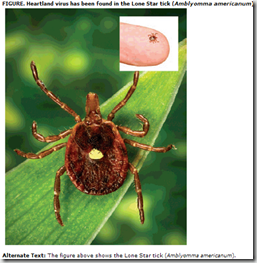
Lone Star Tick - Credit CDC MMWR


# 8671


In August of 2012, in a New Phlebovirus Discovered In Missouri, I wrote about the CDC’s announcement of a new tick-borne virus phlebovirus detected in two Missouri farmers with no epidemiological links and living 60 miles apart.


Dubbed `The Heartland Virus’ (HLV),  the virus was  named after the Heartland Regional Medical Center in St. Joseph, Mo which alerted the CDC back in 2009 about these cases.


Phleboviruses are part of the large family Bunyaviridae - which includes such infamous pathogens as Crimean-Congo hemorrhagic fever and Rift Valley FeverBunyaviruses -  are mostly spread via arthropod vectors (ticks, mosquitoes & sand flies).


This newly described `Heartland virus’  is genetically similar to another tickborne disease identified in China in 2011 called the SFTS virus (see EID Journal  dispatch Severe Fever with Thrombocytopenia Syndrome Virus, Shandong Province, China Jun 2012).  Since then, SFTS-like viruses have been found in ticks in Japan, Korea, and Australia.


Last March (see MMWR: Heartland Virus Disease — United States, 2012–2013) we saw an update from the CDC indicating that 6 more cases had been identified (5 in Missouri, 1 in Tennessee).   This from CDC’s emailed press release:


CDC studies to date have shown Heartland virus is carried by Lone Star ticks, which are primarily found in the southeastern and eastern United States. Additional studies seek to confirm whether ticks can spread the virus to people and to learn what other insects or animals may be involved in the transmission cycle. CDC is also looking for Heartland virus in other parts of the country to understand how widely it may be distributed.


Today, via the Oklahoma State Health Department  we learn that the number of cases has grown to 10, and that Oklahoma is reporting its first Heartland virus related fatality.


For Release:  May 27, 2014 – Pamela Williams, Office of Communications – 405-271-5601

Oklahoma State Health Department Confirms First Case and Death of Heartland Virus

The Oklahoma State Department of Health has confirmed the state's first case and death of Heartland virus. A Delaware County resident died recently from complications of the virus. The virus is found in the Lone Star tick (Amblyomma americanum), and is likely spread through tick bites. 

Heartland virus was first identified in Missouri in 2009. The Oklahoma case is only the tenth person confirmed with the virus and the second person to die from it. Other cases have occurred in Missouri and Tennessee. All of the patients diagnosed with Heartland virus reported spending several hours per day in outside activities or occupations.

Symptoms can include fever, fatigue, headaches, muscle aches, loss of appetite, nausea, bruising easily and diarrhea. There is no routine testing available for Heartland virus. However, protocols are in place for investigational diagnostic testing. Healthcare providers can contact the Oklahoma State Department of Health's Acute Disease Service at (405) 271-4060 for consultation regarding protocol enrollment for patients who have acute illnesses compatible with Heartland virus infection.


There is no vaccine or drug to prevent or treat the disease. Preventing bites from ticks and mosquitoes may prevent this and other infections. The Oklahoma State Department of Health recommends the following:


--Use insect repellents, following package instructions.
--Wear long sleeves and pants when outdoors so that ticks are easily seen and removed.
--Avoid bushy and wooded areas where ticks can be transferred onto you.
--Perform thorough tick checks soon and daily after spending time outdoors.
For more information on reducing exposure to ticks, visit:

http://www.ok.gov/health/Disease,_Prevention,_Preparedness/Acute_Disease_Service/Disease_Information/Tickborne_and_Mosquitoborne_Diseases/index.html.


The CDC’s Heartland Virus FAQ (updated March 26th), provides the following advice regarding HLV.

How can people reduce the chance of getting infected with Heartland virus?

There is no vaccine or drug to prevent or treat the disease. Preventing bites from ticks and mosquitoes may prevent this and other infections.

  • Use insect repellents
  • Wear long sleeves and pants
  • Avoid bushy and wooded areas
  • Perform thorough tick checks after spending time outdoors

Additional information on reducing exposure to ticks is available on the CDC Ticks website.


For more on this virus, and SFTS-like viruses in North America, you may wish to revisit: EID Journal: Novel Bunyavirus In Livestock - Minnesota

Thursday, March 27, 2014

MMWR: Heartland Virus Disease — United States, 2012–2013

image

Lone Star Tick - Credit CDC MMWR


# 8408


In August of 2012, in a New Phlebovirus Discovered In Missouri, I wrote about the CDC’s announcement of a new tick-borne virus detected in two Missouri farmers – living 60 miles apart, and with no epidemiological links - that was dubbed `The Heartland Virus’ (HLV) - named after the Heartland Regional Medical Center in St. Joseph, Mo which alerted the CDC back in 2009 about these cases


A 2012 NEJM report (A New Phlebovirus Associated with Severe Febrile Illness in Missouri), described the process that led to the identification of this novel virus:


Electron microscopy revealed viruses consistent with members of the Bunyaviridae family. Next-generation sequencing and phylogenetic analysis identified the viruses as novel members of the phlebovirus genus.

<SNIP>

This novel virus (which we called the Heartland virus) is a distinct member of the phlebovirus genus and is most closely related to tickborne phleboviruses, notably the recently isolated SFTSV


Phleboviruses are part of the family Bunyaviridae - which includes such nasties as Crimean-Congo hemorrhagic fever, Hantaviruses, and Rift Valley Fever. Bunyaviruses -  are mostly spread via arthropod vectors (ticks, mosquitoes & sand flies), with the exception of Hantaviruses (see Hantaviruses Revisited), which are spread via the feces and urine of rodents.


This newly described `Heartland virus’  is genetically similar to another tickborne disease identified in China in 2011 called the SFTS virus (see EID Journal  dispatch Severe Fever with Thrombocytopenia Syndrome Virus, Shandong Province, China Jun 2012).


Since then we’ve seen reports of SFTS in Japan and Korea as well (see Japan Announces 4th SFTS FatalityKorean CDC On SFTS Cases).  


And in September of 2013, we saw a report in the CDC’s EID Journal (Novel Bunyavirus in Domestic and Captive Farmed Animals, Minnesota, USA), where researchers found an unexpectedly high prevalence (10%-18%) of antibodies (using an ELSIA reagent kit developed by China’s CDC) to SFTS in the cattle, goats, sheep, and elk they tested.   


Since the Heartland Virus (HLV) and SFTF are antigenically cross reactive, the authors believed `the viruses detected in this region are most likely HLV or close relatives of HLV.’


Given the geographical separation of the first two cases in Missouri, and the detection of HLV-like antibodies in farmed animals as far away as Minnesota, one cannot be too surprised to learn that additional human cases of HLV (5 in Missouri, 1 in Tennessee) have now been identified, as is reported today by  the CDC’s MMWR.


Notes from the Field: Heartland Virus Disease — United States, 2012–2013

March 28, 2014 / 63(12);270-271

Daniel M. Pastula, MD1, George Turabelidze, MD2, Karen F. Yates, MS2, Timothy F. Jones, MD3, Amy J. Lambert, PhD4, Amanda J. Panella, MPH4, Olga I. Kosoy, MA4, Jason O. Velez4, Marc Fischer, MD4, J. Erin Staples, MD4 (Author affiliations at end of text)

Heartland virus is a newly identified phlebovirus that was first isolated from two northwestern Missouri farmers hospitalized with fever, leukopenia, and thrombocytopenia in 2009 (1). Based on the patients' clinical findings and their reported exposures, the virus was suspected to be transmitted by ticks. After this discovery, CDC worked with state and local partners to define the ecology and modes of transmission of Heartland virus, develop diagnostic assays, and identify additional cases to describe the epidemiology and clinical disease. From this work, it was learned that Heartland virus is found in the Lone Star tick (Amblyomma americanum) (Figure) (2). Six additional cases of Heartland virus disease were identified during 2012–2013; four of those patients were hospitalized, including one with comorbidities who died.

(Continue . . . )


The CDC’s emailed press release summarizes  the cases:


Ongoing investigations have yielded six more cases of Heartland virus disease, bringing to eight the total number of known cases. All of the six case-patients were white men over the age of 50. Their symptoms started in May to September and included fever, fatigue, loss of appetite, headache, nausea, or muscle pain. Four of the six new cases were hospitalized. One patient, who suffered from other health conditions, died. It is not known if Heartland virus was the cause of death or how much it contributed to his death. Five of the six new cases reported tick bites in the days or weeks before they fell ill.

Nearly all of the newly reported cases were discovered through a study conducted by the Missouri Department of Health and Senior Services and CDC who are actively searching for human cases at six Missouri hospitals.

<SNIP>

CDC studies to date have shown Heartland virus is carried by Lone Star ticks, which are primarily found in the southeastern and eastern United States. Additional studies seek to confirm whether ticks can spread the virus to people and to learn what other insects or animals may be involved in the transmission cycle. CDC is also looking for Heartland virus in other parts of the country to understand how widely it may be distributed.


The CDC’s Heartland Virus FAQ (updated yesterday, March 26th), provides the following advice regarding HLV.

How can people reduce the chance of getting infected with Heartland virus?

There is no vaccine or drug to prevent or treat the disease. Preventing bites from ticks and mosquitoes may prevent this and other infections.

  • Use insect repellents
  • Wear long sleeves and pants
  • Avoid bushy and wooded areas
  • Perform thorough tick checks after spending time outdoors

Additional information on reducing exposure to ticks is available on the CDC Ticks website.


How do I know if I have been infected with Heartland virus?

Currently, no tests are routinely available to tell if a person is infected with Heartland virus. Tests that will help a doctor diagnose Heartland virus infection are being developed. Consult your healthcare provider if you have any symptoms that concern you.


What is the treatment for Heartland virus disease?

There is no specific treatment for Heartland virus disease. Antibiotics are not effective against viruses. Supportive therapy can treat some symptoms. Some patients may need to be hospitalized for intravenous fluids, and treatment for pain or fever.


What should I do if I think someone might be infected with Heartland virus?

Consult your healthcare provider for proper diagnosis if you have any symptoms that concern you.

image

Monday, August 05, 2013

EID Journal: Novel Bunyavirus In Livestock - Minnesota

image

(Credit CDC)


# 7542


Bunyaviruses are an incredibly diverse family of negative stranded enveloped RNA viruses that are responsible for such dreaded diseases as Rift Valley Fever, Crimean - Congo Hemorrhagic Fever (CCHF), and Hantavirus.


While these viruses most commonly infect arthropods and rodents (and occasionally humans), curiously, one variety even infects plants - the (Tospovirsus) – and is responsible for tomato spotted wilt.


In the United States, probably the most common Bunyavirus infection reported is La Crosse (LAC) encephalitis, and less commonly Jamestown Canyon (JCV) and California encephalitis (CE). 


All three being mosquito vectored illnesses.


Over the past few years we’ve seen a new, often serious human infection emerge in Asia  - Severe Fever with Thrombocytopenia Syndrome (SFTS) - that produces a high fever, a low platelet count and and can lead to multiple organ failure.


SFTS first came to our attention in the spring and summer of 2009  after outbreaks were identified in China’s Hubei and Henan provinces.  While ticks were suspected as vectors, the pathogen behind this disease was not initially known.


In 2011, the NEJM published a study Fever with Thrombocytopenia Associated with a Novel Bunyavirus in ChinaSTFS has been associated with a 12% mortality rate in China.


Over the past year, we’ve seen reports of SFTS in Japan and Korea as well (see Japan Announces 4th SFTS FatalityKorean CDC On SFTS Cases).  Of note, we’ve also seen evidence of limited human-to-human transmission of this virus.


Person-to-person transmission of severe fever with thrombocytopenia syndrome virus.

Liu Y, Li Q, Hu W, Wu J, Wang Y, Mei L, Walker DH, Ren J, Wang Y, Yu XJ.

(Excerpt)

We concluded that SFTSV can be transmitted from person to person through contacting patient's blood.


Last year, in New Phlebovirus Discovered In Missouri we also learned of the discovery of another novel Bunyavirus – dubbed the Heartland Virus (HLV) - in two residents of Western Missouri. Last month CIDRAP NEWS reported that Researchers trace novel Heartland virus to Missouri ticks.


All of which serves as prelude to today’s report in the CDC’s EID Journal, where researchers in Minnesota conducted serological testing of domestic and captive farmed animals looking for evidence of SFTS and the Heartland virus.


What they found was an unexpectedly high prevalence (10%-18%) of antibodies (using an ELSIA reagent kit developed by China’s CDC) to SFTS in the cattle, goats, sheep, and elk they tested.   


Since the HLV and SFTF are antigenically cross reactive, the authors believe `the viruses detected in this region are most likely HLV or close relatives of HLV.’


The entire study is well worth reading, and is available at the link below.  I’ve excerpted the abstract and a small portion from the conclusion, as it speaks to the impact this discovery may have on public health.


Volume 19, Number 9—September 2013
Dispatch

Novel Bunyavirus in Domestic and Captive Farmed Animals, Minnesota, USA

Zheng XingComments to Author , Jeremy Schefers, Marc Schwabenlander, Yongjun Jiao, Mifang Liang, Xian Qi, Chuan Li, Sagar Goyal, Carol J. Cardona, Xiaodong Wu, Zerui Zhang, Dexin Li, James Collins, and Michael P. Murtaugh
Abstract

We tested blood samples from domestic and captive farmed animals in Minnesota, USA, to determine exposure to severe fever with thrombocytopenia syndrome virus and Heartland-like virus. We found antibodies against virus nucleoproteins in 10%–18% of samples from cattle, sheep, goats, deer, and elk in 24 Minnesota counties.


<SNIP>

Conclusion (EXCERPT)

Farmers, hunters, and persons with outdoor lifestyles may become infected when they are bitten by infected ticks. In addition, direct contact with secretions, body liquids, or feces from viremic animals would also put these persons and veterinarians at risk, if HLV- infected animals have substantial amounts of virus in blood and other tissues. The direct contact transmission of SFTSV has been reported in family clusters among persons with no history of tick bites, suggesting that person-to-person transmission may also occur (1315).


Evidence that a novel phlebovirus infects domesticated and captive farmed animals as shown in this study validates the concern that an SFTSV- or HLV-like emerging pathogen could pose a serious public health threat in the United States. Epidemiologic studies with a broader scope need to be conducted to elucidate viral ecology, and effective measures must be adopted to control this virus before it spreads among humans.


Although most people think first of Lyme disease when they get a tick bite, The CDC lists a growing number of diseases carried by ticks in the United States, including: Anaplasmosis, Babesiosis , Ehrlichiosis, Lyme disease, Rickettsia parkeri Rickettsiosis, Rocky Mountain Spotted Fever (RMSF), STARI (Southern Tick-Associated Rash Illness), Tickborne relapsing fever (TBRF), Tularemia, and 364D Rickettsiosis.

We’ve discussed a number these in the past, including:


Referral: Maryn McKenna On Babesia And The Blood Supply

NEJM: Emergence Of A New Bacterial Cause Of Ehrlichiosis

tick . . . tick . . . tick . . .

Minnesota: Powassan Virus Fatality


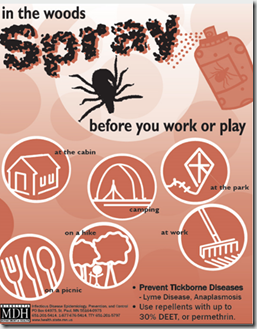
Given the smorgasbord of  of diseases carried by ticks it makes sense to avoid their bites whenever possibleThis advice from the Minnesota Department of Health.

image