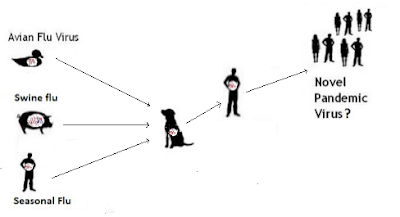
Just one of many scenarios - Dogs as `mixing vessels' for Influenza
#19,002
Until a little over 2 decades ago dogs and cats were thought to be poorly susceptible to influenza A viruses; but that all changed in 2004 when scores of captive cats (tiger, lions, etc.) in South East Asian zoos - fed on a diet of raw poultry - began dying from HPAI H5N1 (see 2006 WHO DON).
While rare, severe and even fatal canine infections with HPAI H5 have been reported, as we saw detailed in 2024's Microorganisms: Case Report On Symptomatic H5N1 Infection In A Dog - Poland, 2023, where the authors wrote:
A year later, in EID Journal: Antibodies to Influenza A(H5N1) Virus in Hunting Dogs Retrieving Wild Fowl, Washington, USA, researchers reported finding a low - but significant - number of healthy hunting dogs with antibodies to H5N1 (tested over a 2 month period in 2023).

While dog owners may be relieved by the relatively rare severe presentation of HPAI H5N1 in canines, as the following report indicates, that may present problems of its own.

While the risks for the general public of contracting avian flu are currently very low, those who have pets that are allowed to roam outdoors may be at slightly greater risk, along with anyone who deals with animal rescue or rehoming operations (see California: San Mateo County Warns Residents After Stray Cat Found With H5N1).
Until a little over 2 decades ago dogs and cats were thought to be poorly susceptible to influenza A viruses; but that all changed in 2004 when scores of captive cats (tiger, lions, etc.) in South East Asian zoos - fed on a diet of raw poultry - began dying from HPAI H5N1 (see 2006 WHO DON).
At roughly the same time dogs at a Florida racetrack unexpectedly began to fall ill from a variant of the equine H3N8 virus (see EID Journal article Influenza A Virus (H3N8) in Dogs with Respiratory Disease, Florida).Three years later another flu virus (avian H3N2) jumped to dogs in South Korea (see Transmission of Avian Influenza Virus (H3N2) to Dogs). The HA and NA genes of the A/canine/Korea/01/2007 (H3N2) isolate were closely related to those identified in chickens and doves in South Korea in 2003.
After nearly a decade of spreading in Asia, in 2015 canine H3N2 finally landed in North America (see CDC Statement On H3N2 Canine Influenza In Chicago Region) and quickly spread across the United States.As a result, during the middle of the last decade the notion that dogs might serve as intermediate hosts - or even mixing vessels - for novel influenza began to gain traction. A few, of many, reviews include:
Viruses Review: Potential Intermediates in the Cross-Species Transmission of Influenza A Virus to HumansAdmittedly, cats appear to be far more susceptible than dogs (see 2023's A Brief History Of Avian Influenza In Cats) - with hundreds more infections reported since - but as dogs tend to show fewer symptoms than cats, they may be less likely to be tested.
J. Virology: Zoonotic Risk, Pathogenesis, and Transmission of Canine H3N2
Study: Dogs As Potential `Mixing Vessels’ For Influenza
While rare, severe and even fatal canine infections with HPAI H5 have been reported, as we saw detailed in 2024's Microorganisms: Case Report On Symptomatic H5N1 Infection In A Dog - Poland, 2023, where the authors wrote:
The case described in our report confirms that on rare occasions the A/H5N1 virus can also induce a natural severe respiratory disease in dogs. While in some of them the infection remains asymptomatic, capable of shedding the virus [35], others exhibit mild symptoms such as transient fever [34], or even fatal disease [20].In 2023, Canada reported a fatal H5N1 infection in a domestic dog in Ontario (see press release below), which renewed concerns, particularly for those with hunting dogs.
Domestic dog tests positive for avian influenza in Canada(Continue . . . )
From: Canadian Food Inspection Agency
Statement
April 4, 2023 – Ottawa, Ontario
Today, the Canadian Food Inspection Agency and the Public Health Agency of Canada issued the following joint statement:
The Canadian Food Inspection Agency's (CFIA) National Centre for Foreign Animal Disease, confirmed on April 1, 2023, that a domestic dog in Oshawa, Ontario has tested positive for highly pathogenic avian influenza (HPAI).The domestic dog was found to have been infected with avian influenza after chewing on a wild goose, and died after developing clinical signs. The necropsy was completed on April 3, 2023, and showed respiratory system involvement. Further testing is underway. It is the only case of its kind in Canada.
A year later, in EID Journal: Antibodies to Influenza A(H5N1) Virus in Hunting Dogs Retrieving Wild Fowl, Washington, USA, researchers reported finding a low - but significant - number of healthy hunting dogs with antibodies to H5N1 (tested over a 2 month period in 2023).
Spillovers into companion animals are particularly worrisome because of their potential for spreading the virus to other animals, or to humans (see JAVMA: Companion Animals and H5N1 Highly Pathogenic Avian Influenza: Cause for Concern?).All of which brings us to the following memo from the Office of the Chief Provincial Veterinarian dated December 16, 2025, hosted on the Canadian Veterinary Medical Association (CVMA) website.
While dog owners may be relieved by the relatively rare severe presentation of HPAI H5N1 in canines, as the following report indicates, that may present problems of its own.
In 2023's Eurosurveillance: Asymptomatic infection with clade 2.3.4.4b HPAI A(H5N1) in carnivore pets, Italy, April 2023, the authors wrote:
Here we report a case of influenza A(H5N1) infection in a domestic cat and five dogs living on a rural backyard poultry farm where an HPAI H5N1 outbreak was notified; the infection in poultry was caused by an HPAI H5N1 virus strain belonging to the BB genotype that was characterised by the presence of a PB2 mutation related to mammalian adaptation.
In contrast, the affected pets in this report were completely asymptomatic, raising concerns over the possibility of subclinical infections with zoonotic viruses in animals in close contact with humans.
While the risks for the general public of contracting avian flu are currently very low, those who have pets that are allowed to roam outdoors may be at slightly greater risk, along with anyone who deals with animal rescue or rehoming operations (see California: San Mateo County Warns Residents After Stray Cat Found With H5N1).
The thing about risk, though, is it can change abruptly. And given the limits of surveillance and reporting, a specific risk may become elevated for days or even weeks before we ever learn about it.
While I dislike the phrase `the new normal', as long as HPAI H5 continues to circulate at high levels in our environment, we have to accept that this has become our `new reality'.
