
#19,314
Since H5Nx has never (as far as we know) circulated in the human population, the $64 question we keep returning to is whether there is any preexisting `immunity' in the general population against the virus - and if it exists - which community cohorts might have greater or lesser degrees of protection.This matters, because during the opening months of any novel flu pandemic, decisions would have to be made as to which groups to vaccinate with our expected limited supply of vaccines (see 2009's The Tracks Of Our Tiers).
While influenza generally hits the oldest population the hardest, over the past 110 years we've seen at least 3 notable exceptions:
- The 1918 pandemic showed a unique W-Shaped Curve (see below), where young adults (25-30) were particularly hard hit, while mortality rate actually dropped in those over the age of 60.

- In 1978, H1N1 returned after an absence of 20 years (potentially from a lab leak in Russia or China) sparking a pseudo-pandemic (aka `the Russian Flu') that primarily affected those under the age of 20 (see mBio: The Reemergence Of H1N1 in 1977 and The GOF Debate).
- While the average (mean) age of a flu-related fatality in a `normal’ flu season here in the United States is about 76 years, the average during the (relatively mild) 2009 H1N1 pandemic was half that; at 37.4 years (see Study: Years Of Life Lost Due To 2009 Pandemic).
Over the past 2 decades we've seen a lot work on the idea that the first flu HA type (Group 1 or 2) you are exposed to can shape your immune response to influenza for the rest of your life through a process called Original Antigenic Sin (OAS) (see PLoS Path.: Childhood Immune Imprinting to Influenza A).
- Those born prior to the mid-1960s were almost certainly first exposed to Group 1 flu viruses (H1N1 or H2N2)
- Those born after 1968 and before 1977 would have been exposed to Group 2 (H3N2)
- After 1977, both Group 1 and 2 viruses co-circulated, meaning the first exposure could have been to either one.
But as we've seen repeatedly over the past 19,000+ blogs, nothing about our immune system is ever that simple; recent research has also found Cross reactive H5N1 Neuraminidase Antibodies vary by age and previous influenza A exposure as well.
This suggests that any preexisting immunity is likely multilayered, and not automatically attributable to a single early exposure or age cohort.
Complicating matters, laboratory evidence of preexisting H5Nx immunity is no guarantor of any real-world immunity. The oft postulated `immunity' of those born before 1957 would likely be minor, and might be more than offset by other age-related factors.
While previous studies have found signs of systemic immunity in some cohorts, today's report in mBio also found that people born before 1957 had higher H5-reactive nasal IgG and IgA than later H3-imprinted groups.
Again, the real world impact of having these immune responses is unknown. They may `recognize' the H5N1 virus, but their impact on an individual's outcome is far from certain.
This is, nonetheless, a fascinating read. I've only reproduced the Abstract, and a few excerpts below. Follow the link to read it in its entirety. I'll have a brief postscript when you return.
Pre-existing systemic and nasal antibodies against avian H5 influenza A viruses vary according to childhood imprinting
Authors: Peta Edler , Kevin J. Selva , Ellie Reilly, Malet Aban, Ian G. Barr, Jennifer A. Juno , Adam K. Wheatley , Amy W. Chung, Stephen J. Kent , David J. Price , Marios Koutsakos marios.koutsakos@unimelb.edu.auAuthors Info & Affiliations
https://doi.org/10.1128/mbio.01892-26
PDF/EPUB
ABSTRACT
Avian influenza A viruses (IAVs) pose a constant pandemic threat, with the recent 2.3.4.4b clade of the H5 subtype causing high pathogenicity and spreading across animal species and geographic locations. Understanding human pre-existing immunity to avian H5 IAV can inform on population susceptibility, a critical aspect of pandemic preparedness.
To that end, we analyzed the IAV HA-specific antibodies across individuals born between 1928 and 1999 with different early life exposures to IAV subtypes. Individuals born prior to 1957 had the highest pre-existing serum antibodies to group 1 HA antigens, including the 2.3.4.4b H5 and a group 1 HA stem antigen.
These birth year-specific patterns were not reflected in the limited pre-existing serum neutralizing antibodies detectable against a 2.3.4.4b H5 IAV or in H5-specific memory B cell populations. They were, however, evident in pre-existing nasal IgG and IgA titers to H5, which were greater in individuals born prior to 1957.
Our findings demonstrate that the immunological biases afforded by early life exposure extend to antibodies detected in the nasal mucosa, the site of IAV replication.
IMPORTANCE
Understating pre-existing immunity to influenza A viruses (IAVs) of pandemic potential is an important aspect of pandemic preparedness. This includes an understanding of the heterogeneity of pre-existing immunity across the population. Here, we demonstrate that pre-existing antibodies to H5 IAV vary according to the year of birth and childhood imprinting. We demonstrate that this is the case for both systemic and nasal antibodies, highlighting the importance of understanding pre-existing mucosal immunity at the sites of influenza virus replication.
(SNIP)
DISCUSSION
The spread of 2.3.4.4b H5 viruses across a plethora of animal species highlights the need for preparedness should this high-pathogenicity IAV acquire adaptations that support human-to-human transmission. An important aspect of pandemic preparedness is understanding pre-existing population immunity and heterogeneity in susceptibility. Here, we show that pre-existing antibodies against the avian H5 can be detected in adults, but their levels vary according to early life exposure to group 1 or group 2 HAs. We demonstrate that this does not translate into differences in serum neutralization activity or differences in circulating MBC pools, but it does result in differential levels of nasal IgG and IgA against H5. These findings have potential implications for the use of H5 vaccines as well as our understanding of immune imprinting.
During the last pandemic, COVID hit the elderly the hardest, but history has shown that influenza can - and occasionally does - target younger cohorts.
Nearly 20 years ago, in A Predilection For The Young, I wrote about the disturbing skewing of H5N1 cases (and deaths) among younger individuals (see WHO Chart below).
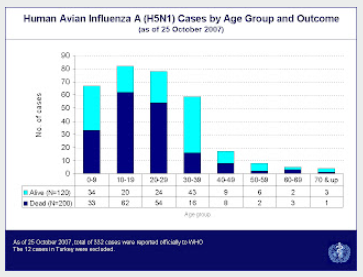
Six years later we saw the opposite trend with avian H7N9 in China (an HA Group 2 virus), which skewed heavily toward older adults (see H7N9: The Riddle Of The Ages).

While none of this can tell us exactly how an H5Nx pandemic might play out, the possibility of seeing a 1918-like age shift cannot be ignored. And even a relatively mild H5 pandemic that preferentially targets young adults or children would hit far differently than COVID.
