Showing posts with label Advisory. Show all posts

Friday, May 30, 2014

Public Health England Launches Airport MERS Advisory Campaign

image


# 8685


With the Holy month of Ramadan less than a month away, and the Hajj coming up in early October, the number of people passing through London airports traveling to or from the Middle East is only going to increase over the next few months. As the MERS outbreak continues unabated on the Arabian peninsula, concerns run high over its potential to spread.


Already, at least two known MERS-CoV infected passengers have transited through Heathrow, sparking intensive contact tracing and follow up of airline passengers (see  Public Health England Press Release On MERS Case Transiting London).


In an attempt to mitigate the risks of travelers unwittingly carrying the virus on air flights, or spreading it once they arrive at their destinations,  PHE (Public Health England) has issued two new informational posters on MERS for placement at airports, and is advising up their 999 and 111 systems on how to handle possible enquires. 


The first poster (at top of post) deals with passengers headed to the Middle East.  A number of US airports posted a similar notice a couple of weeks ago (see MERS Advisories Go Up In Some U.S. Airports) – although  unlike the new PHE posters - those did not specifically warn about contact with camels.


The second (below) is for returning passengers.


image


PHE has issued a press release on this campaign, with quotes from experts on the risks of MERS infection:


Posters featuring advice for travellers to and from the Middle East have been distributed to UK airports and airlines.

Public Health England (PHE) is providing two posters to major UK airports to warn about the risks of Middle East respiratory syndrome coronavirus (MERS-CoV). The first poster gives general advice for travellers to the Middle East, while the second issues advice for travellers returning to the UK.


MERS-CoV is a new type of coronavirus, first identified in a Middle Eastern citizen in 2012. Although cases continue to be reported from the Middle East, no new cases of MERS-CoV have been detected in the UK since the cases linked to the Middle East in February 2013.


PHE scientists recently met to review the current risk assessment and concluded the risk to UK residents and travellers to the Middle East remains very low. Travellers, particularly people with underlying or chronic medical conditions, are advised to avoid contact with camels in the Middle East, avoid drinking raw camel milk and handling raw camel meat, and adhere to good general food and hand hygiene measures.


After diagnosing one of the first cases of MERS-CoV in the world at the health protection laboratories in Colindale in September 2012, PHE remains at the forefront of providing public health advice and information on MERS-CoV.

Professor Nick Phin, Head of Respiratory Diseases for PHE, said:

There is growing evidence of the possible role of camels in transmitting MERS-CoV to humans. We advise travellers, particularly those with underlying or chronic medical conditions, to avoid contact with camels in the Middle East and practice good hand and respiratory hygiene to reduce the risk of respiratory illnesses.


Healthcare professionals are advised to remain vigilant for severe unexplained respiratory illness occurring in anyone who has recently travelled in the Middle East, as well as any unexplained cluster of severe respiratory illness or healthcare worker with unexplained severe respiratory illness.


PHE will continue to provide advice on infection control, urgent diagnostic investigation and identification of contacts of suspected cases who may need to be followed up to check on their health.

Dr Brian McCloskey, Director of Global Health at PHE, said:

The recent reports of cases in travellers visiting the region and the rise in global cases we’ve seen is concerning, and we will continue to monitor the global situation and adjust our risk assessment as appropriate.


The risk of UK residents contracting infection in the UK remains very low. The risk to UK residents travelling to Middle Eastern countries may be slightly higher than within the UK, but is still very low.


PHE will maintain its current enhanced levels of surveillance and continue to liaise with WHO and ECDC colleagues to ensure we have the best available information so that our advice is accurate and up to date.

Contact: infections-pressoffice@phe.gov.uk


Meanwhile, NHS Pathways has issued the following guidance to those who must respond to calls from the public regarding possible infection.


MERS Coronavirus – General Advice for responding to calls from the public


Important information for anyone taking calls within a 999 or NHS 111 service.  Please print and circulate copies of this instruction sheet to all staff handling 111 and 999 calls


Public Health England are planning to publish posters at airports in the UK on 29th May 2014 regarding Middle East Respiratory Syndrome Coronavirus (MERS-CoV).


There have been various public health alerts relating to passengers travelling by air from MERS--CoV affected countries in the Middle East.  Public Health England is issuing general guidance for members of the public travelling to and from the Middle East, which includes advice to call NHS 111. The countries covered by this travel advice include: Syria, Iraq, Lebanon, Palestinian Territories, Israel, Jordan, Saudi Arabia, Kuwait, Bahrain, United Arab Emirates, Oman, Yemen or Saudi Arabia.


If a caller identifies themselves as having been to a known MERS-CoV affected region within the 14 days before their symptoms started:

  • AND they have shortness of breath or cough with a fever
  • Triage their symptoms as normal
  • BUT if the final disposition is less urgent than ‘Contact a Primary Care Service within 12 hours’, you MUST upgrade the disposition to ‘Contact a Primary Care  Service within 12 hours’


It is vital that these callers are seen within this time frame They MUST tell the Primary Care Service that they have been to the Middle East when  they are seen.

Do not alter the disposition if it is more urgent than Contact Primary Care Service within 12 hours.
If an AMBULANCE has been dispatched to a caller who has declared travel to an affected area, ensure that the crew is made aware to enable them to follow the Public health guidance regarding MERS – CoV


If a caller identifies themselves as having travelled to the affected areas, but they DO NOT have any of the above symptoms:

  • Triage the presenting symptoms

If a caller identifies themselves as having travelled to the affected areas, but they DO NOT have ANY symptoms and are just concerned:

  • Pass the call to the NHS Pathways clinician for advice

FOR NHS Pathway’s Clinician


Reassure them that the risk of infection is low

  1. Give the following advice “If you develop shortness of breath or cough with a fever in the 2 weeks after return then”:
  • During normal working hours, contact a Primary Care Service within 12 hours.
  • Out of normal surgery hours, call 111

They MUST tell the Primary Care Service that they have been to the Middle East when they are seen.

Thursday, May 22, 2014

CDC Updated Traveler’s Advisory On MERS

image

Credit CDC


# 8652


Eight days ago, in MERS Advisories Go Up In Some US Airports, we looked at a traveler’s awareness campaign for those going to, or returning from, the Arabian peninsula on the dangers of MERS. At the time, I mentioned my surprise that there was no mention of avoiding camels, or camel products, in the CDC’s Traveler’s Advisory or in this newly released airport signage. 


Although the exact mode of transmission to humans remains uncertain, many Arabian camels have been found to carry the MERS Coronavirus (see here, here, & here) and camel exposure has been linked to at least some human infections. 


Consequently, many health agencies (including Hong Kong’s CHP, Canada’s PHAC, and the World Health Organization) have issued warning’s advising people to avoid contact with camels, and camel products in the Middle East.


This week the CDC has updated their MERS travel advisory, and it now includes information on camels, and the potential (but unquantified) risks from camel exposure.


MERS in the Arabian Peninsula

Alert - Level 2, Practice Enhanced Precautions

Updated: May 21, 2014

What is the Current Situation?

Cases of MERS (Middle East Respiratory Syndrome) have been identified in multiple countries in the Arabian Peninsula.* There have also been cases in several other countries in travelers who have been to the Arabian Peninsula and, in some instances, their close contacts. Two cases have been confirmed in two health care workers living in Saudi Arabia who were visiting the United States. For more information, see CDC’s MERS website.

CDC does not recommend that travelers change their plans because of MERS. Most instances of person-to-person spread have occurred in health care workers and other close contacts (such as family members and caregivers) of people sick with MERS. If you are concerned about MERS, you should discuss your travel plans with your doctor.

<SNIP>

Exposure to camels

The MERS virus has been found in some camels, and some MERS patients have reported contact with camels. However, we do not know exactly how people become infected with the virus—many people with MERS have had close contact with a person sick with MERS.

The World Health Organization has posted a general precaution for anyone visiting farms, markets, barns, or other places where animals are present. Travelers should practice general hygiene measures, including regular handwashing before and after touching animals, and avoid contact with sick animals. Travelers should also avoid consumption of raw or undercooked animal products. For more information, see http://www.who.int/csr/disease/coronavirus_infections/faq/en/External Web Site Icon.

The World Health Organization considers certain groups to be at high risk for severe MERS; these groups include people with diabetes, kidney failure, or chronic lung disease and people who have weakened immune systems. The World Health Organization recommends that these groups take additional precautions:

  • Avoid contact with camels.
  • Do not drink raw camel milk or raw camel urine.
  • Do not eat undercooked meat, particularly camel meat.

For more information, see http://www.who.int/csr/disease/coronavirus_infections/MERS_CoV_Update_09_May_2014.pdfAdobe PDF fileExternal Web Site Icon (recommendations begin on page 8).

(Continue . . . .)


Saturday, May 03, 2014

CDC Travel Advisory – MERS In The Arabian Peninsula

image


# 8563


With the discovery this week of the first imported case of MERS into the United States (see CDC Briefing On MERS In US: Audio & Transcript), the CDC has updated their travel advice to the Middle East, and are advising international travelers to observe and practice enhanced precautions when in the region.


An `Alert’ is a second tier notice, above `Watch’ but below `Warning’.   Travel notices are published the CDC’s Traveler’s Health Website.


The CDC considers countries in the Arabian Peninsula and surrounding areas to include: Bahrain, Iraq, Iran, Israel, Jordan, Kuwait, Lebanon, Oman, Palestinian territories, Qatar, Saudi Arabia, Syria, the United Arab Emirates (UAE), and Yemen.


MERS in the Arabian Peninsula

Updated: May 02, 2014

What is the Current Situation?

Cases of MERS (Middle East Respiratory Syndrome) have been identified in multiple countries in the Arabian Peninsula. There have also been cases in several other countries in travelers who have been to the Arabian Peninsula and, in some instances, their close contacts. One case has been confirmed in the United States in a traveler who had recently been to Saudi Arabia. For more information, see CDC’s MERS website.

If you are traveling to countries in or near the Arabian Peninsula,* CDC recommends that you pay attention to your health during and after your trip. You should see a doctor right away if you develop fever and symptoms of lower respiratory illness, such as cough or shortness of breath, within 14 days after traveling from countries in or near the Arabian Peninsula. Tell the doctor about your recent travel.

CDC does not recommend that travelers change their plans because of MERS. Most instances of person-to-person spread have occurred in health care workers and other close contacts (such as family members and caregivers) of people sick with MERS. If you are concerned about MERS, you should discuss your travel plans with your doctor.

Special advice for people traveling to the Arabian Peninsula to work in health care settings

If you are traveling to provide health care services in the Arabian Peninsula, please review CDC’s recommendations for infection control of confirmed or suspected MERS cases. CDC recommends that you practice these precautions and monitor your health closely.

What is MERS?

MERS is caused by a coronavirus known as MERS-CoV; coronaviruses cause a variety of illnesses, from the common cold to SARS (severe acute respiratory syndrome), which caused a global epidemic in 2003. MERS-CoV is different from any other coronavirus that has been previously found in people. Symptoms of MERS have included fever, cough, and shortness of breath. CDC is working with the World Health Organization and other partners to understand the public health risks from this virus.

What can travelers do to prevent MERS?

People traveling to provide health care services in the Arabian Peninsula should review CDC’s recommendations for infection control of confirmed or suspected MERS cases.

All travelers can take these everyday actions to help prevent the spread of germs and protect against colds, flu, and other illnesses:

  • Wash your hands often with soap and water. If soap and water are not available, use an alcohol-based hand sanitizer.
  • Avoid touching your eyes, nose, and mouth. Germs spread this way.
  • Avoid close contact with sick people.
  • Be sure you are up-to-date with all of your shots, and if possible, see your health care provider at least 4–6 weeks before travel to get any additional shots.
  • Visit CDC’s Travelers’ Health website for more information on healthy travel.
  • If you are sick:
    • Cover your mouth with a tissue when you cough or sneeze, and throw the tissue in the trash.
    • Avoid contact with other people to keep from infecting them.
    • See a doctor if you develop a fever and symptoms of lower respiratory illness, such as cough or shortness of breath, within 14 days after traveling from countries in or near the Arabian Peninsula.* You should tell the doctor about your recent travel.

(Continue . . . )

This advisory also contains information for clinicians who may encounter patients with respiratory symptoms with a travel history (within 14 days) from the Arabian peninsula, and an assortment of useful links.

Wednesday, October 09, 2013

FDA & CDC Warn On Weight Loss Supplement

image


# 7846


There is an erroneous belief that whatever over-the-counter (OTC) medicines and supplements may lack in effectiveness, they make up for in safety.  The truth is that most OTC meds, and even a lot of `natural’ supplements, are quite capable of causing illness or even death under the `right’ (read: `wrong’)  dosage and/or circumstances.


Last week, in The Perils Of Not Knowing Your Dose, we looked at the impact of acetaminophen (Tylenol ®) overdoses in this country each year. 


Last night the CDC issued a HAN Health Advisory, along with and advisory from the FDA, on an OTC weight loss product called OxyElite Pro that has been tentatively linked to a number of cases of acute hepatitis and/or liver failure. 

The FDA recommendation is to:

`. . . stop using any dietary supplement product labeled as OxyElite Pro while the investigation continues. Consumers who believe they have been harmed by using a dietary supplement should contact their health care practitioner’


Here are some excerpts from the CDC’s HAN Alert.


Distributed via the CDC Health Alert Network
October 8, 2013, 2:30 ET (14:30 PM ET)
HANINFO-00356

Acute Hepatitis and Liver Failure Following the Use of a Dietary Supplement Intended for Weight Loss or Muscle Building

Summary

Recently, a number of previously healthy individuals developed acute hepatitis and sudden liver failure of unknown cause after using a dietary supplement for weight loss or muscle building. CDC recommends increased vigilance by public health agencies, emergency departments, and healthcare providers for patients who develop acute hepatitis or liver failure following use of a weight loss or muscle building nutritional supplement. CDC requests that state health departments report such occurrences to the CDC. CDC also recommends that, as part of a comprehensive evaluation, clinicians evaluating patients with acute hepatitis should ask about consumption of dietary supplements.

Background

On September 9, 2013, the Hawaii Department of Health (DOH) was notified of seven patients with severe acute hepatitis and sudden liver failure of unknown cause. The patients were previously healthy and sought medical care from May through September 2013. Clinicians reported that the seven patients had all used OxyELITE Pro, a dietary supplement marketed for weight loss and muscle gain, prior to illness onset.

The investigation is ongoing and the data presented are preliminary. Thus far, clinicians have reported 45 patients to the Hawaii DOH in response to a public health alert. Of those, 29 patients, including the original seven, were confirmed to have acute hepatitis after using a nutritional supplement for weight loss or muscle building. The median age of the 29 patients is 33 years; 14 (48%) are male. The date of the first reported laboratory test was used as a proxy for illness onset and ranged from May 10 through October 3, 2013. The most commonly reported symptoms included loss of appetite, light-colored stools, dark urine, and jaundice. Median laboratory values reported at the peak of illness were the following:

  • aspartate aminotransferase (AST) 1,128 IU/L;
  • alanine transaminase (ALT) 1,793 IU/L;
  • alkaline phosphatase 150 IU/L; and
  • total bilirubin 12.6 mg/dL.

Ten patients had liver biopsy data available at the time of this report. Seven had histology consistent with hepatitis from drug/toxic injury, with findings including hepatocellular necrosis and cholestasis. Three patients had liver biopsy findings of acute hepatitis associated with other etiologies such as autoimmune hepatitis. Eleven (38%) patients were hospitalized, with a median duration of seven days. One patient died, and two patients received liver transplants. Two remain hospitalized, and all other hospitalized patients have been discharged.

Of the 29 identified patients, 24 (83%) reported using OxyELITE Pro during the 60 days prior to illness onset. There was no other dietary supplement or medication use reported in common by more than two patients.

National case finding efforts have identified several individuals from states outside Hawaii with reported OxyELITE Pro or other weight loss or muscle building dietary supplement use prior to the development of acute hepatitis of unknown cause. CDC, in collaboration with state health departments, is collecting additional clinical and epidemiologic information from these individuals to determine if this outbreak is national in scope.

<SNIP>

Recommendations

  • Clinicians evaluating patients with acute hepatitis should ask about consumption of dietary supplements as part of a comprehensive evaluation.
  • Clinicians should report patients meeting the case definition to the local or state health department, as well as the US Food and Drug Administration’s MedWatch program online at https://www.accessdata.fda.gov/scripts/medwatch/ or by phone at 1-888-INFO-FDA.
  • People who use dietary supplements for weight loss or muscle gain should do so with caution and under a medical provider’s close supervision.

And here is the Health Advisory from the FDA.


OxyElite Pro: Health Advisory - Acute Hepatitis Illness Cases Linked To Product Use

[Posted 10/08/2013]

AUDIENCE: Health Professional, Consumer

ISSUE: The FDA, along with the Centers for Disease Control and Prevention (CDC) and the Hawaii Department of Health (DOH), are investigating a growing number of reports of acute non-viral hepatitis in Hawaii. The Hawaii DOH has reported that 24 of these cases share a common link to a dietary supplement product labeled as OxyElite Pro.

BACKGROUND: OxyElite Pro is distributed by USPlabs LLC of Dallas, Texas, and is sold nation-wide through a wide range of distribution channels, including the internet and retail stores that sell dietary supplements. There have been 29 cases of acute non-viral hepatitis with an unknown cause identified in the state of Hawaii.  Eleven of the 29 cases have been hospitalized with acute hepatitis, two cases have received liver transplants and one person has died. CDC is also looking at other cases of liver injury nationwide that may be related. Symptoms of all types of hepatitis are similar and can include fever, fatigue, loss of appetite, nausea, vomiting, abdominal pain, dark urine, clay or gray-colored bowel movements, joint pain, yellow eyes, and jaundice.

The epidemiological investigation is being conducted by the Hawaii DOH and the CDC. As part of FDA’s associated investigation, the agency is reviewing the medical records and histories of patients identified by the Hawaii DOH. The FDA is also analyzing the composition of product samples that have been collected from some of these patients. Additionally, the FDA is inspecting the facilities involved in manufacturing the product and reviewing production and product distribution records. Because USPlabs LLC has informed FDA that it believes counterfeit versions of OxyElite Pro are being marketed in the US and have been on the US market for some time, FDA is also investigating whether counterfeit product is related to any of the cases of acute  hepatitis.

RECOMMENDATION: The FDA advises consumers to stop using any dietary supplement product labeled as OxyElite Pro while the investigation continues. Consumers who believe they have been harmed by using a dietary supplement should contact their health care practitioner.

Healthcare professionals and patients are encouraged to report adverse events or side effects related to the use of these products to the FDA's MedWatch Safety Information and Adverse Event Reporting Program:

  • Complete and submit the report Online: www.fda.gov/MedWatch/report.htm
  • Download form or call 1-800-332-1088 to request a reporting form, then complete and return to the address on the pre-addressed form, or submit by fax to 1-800-FDA-0178

[10/08/2013 - Recalls, Outbreaks & Emergencies - FDA]

[10/08/2013 - Health Alert Network Advisory  - CDC]

Friday, July 05, 2013

CDC HAN Advisory On H3N2v

image


# 7351


In the wake of 12 new cases of H3N2v (swine variant) influenza reported over the past week in Indiana, on Wednesday the CDC Released Updated H3N2v Guidance, and today updated their online Fact Sheet: Protect Yourself Against H3N2v.


Today’s FluView Report carried the following notice on the new cases reported this week:


Novel Influenza A Viruses:

Eight new human infections with influenza A (H3N2) variant (H3N2v) virus were reported by the Indiana State Department of Health and confirmed by CDC, bringing the total number of H3N2v cases reported this summer to 12. No person has been hospitalized as a result of their illness; no deaths have occurred. At this time no human-to-human transmission has been identified. Public health and agriculture officials are investigating the extent of disease among humans and swine, and additional cases may be identified as the investigation continues.


In addition, the CDC released a Health Alert Network (HAN) advisory today on the H3N2v virus.


HAN messages (Alert, Advisory, Update, or Info) are designed to ensure that communities, agencies, health care professionals, and the general public are able to receive timely information on important public health issues.


An `Advisory’ is a second tier message that Provides important information for a specific incident or situation, but may not require immediate action.


Variant Influenza Virus (H3N2v) Infections

Summary: This Health Alert Network Health Advisory provides an update on H3N2 variant virus (or “H3N2v”) activity and summarizes CDC’s updated H3N2v case definitions and recommendations for H3N2v surveillance for the summer and fall of 2013. It supersedes the last H3N2v-related HAN Health Advisory, HAN 325, which was issued August 3, 2012.

Background

The first cases of influenza A (H3N2) variant1 (H3N2v) virus infection this year were reported in June 2013. These cases were associated with exposure to swine at an agricultural fair prior to illness onset.

H3N2v viruses with the matrix (M) gene from the 2009 H1N1 pandemic virus were first detected in people in 2011 and were responsible for a multi-state outbreak in the summer of 2012 that resulted in 306 cases, including 16 hospitalizations and 1 fatality. Genetic sequencing by CDC has confirmed that H3N2v viruses isolated in June 2013 are nearly identical to those detected during summer 2012. Most cases of H3N2v identified during 2012 were associated with exposure to pigs at agricultural fairs. Agricultural fairs take place across the United States every year, primarily during the summer months and into early fall. Many fairs have swine barns, where pigs from different places come in close contact with each other and with people. These venues may allow spread of influenza viruses both among pigs and between pigs and people. Data indicate that infected pigs may spread influenza viruses even if they are not symptomatic (e.g., coughing and/or sneezing). Although instances of limited person-to-person spread of this virus have been identified in the past, sustained or community-wide transmission of H3N2v has not occurred.


Clinical characteristics of the 2012 and 2013 H3N2v cases have been generally consistent with those of seasonal influenza, and have included fever, cough, pharyngitis, myalgia, and headache. Of the 16 H3N2v hospitalized patients, most were at increased risk for complications of influenza because of age or the presence of an underlying medical condition. None of the persons ill with 2013 H3N2v infection have been hospitalized, and no deaths have occurred among them.


Rapid detection and characterization of novel influenza viruses remain important components of national efforts to prevent further cases and evaluate clinical illness associated with these viruses. As a result, clinicians are reminded to consider influenza as a possible diagnosis when evaluating patients with acute respiratory illnesses, and clinicians should consider the possibility of H3N2v in persons presenting with respiratory illness and recent swine contact or attendance at an agricultural fair. The H3N2v case definitions for 2013 (http://www.cdc.gov/flu/swineflu/case-definitions.htm) include laboratory-confirmed cases and cases under investigation for H3N2v virus infection; the probable case definition used in 2012 has been deleted.


CDC anticipates that state health departments will identify more H3N2v cases in 2013 as agricultural fair season continues. The number of cases may exceed those identified last year, and CDC recommends a surveillance strategy for 2013 designed primarily to identify increases in person-to-person transmission or clinical severity. Testing for H3N2v should focus primarily on persons with exposures known to be associated with H3N2v virus infection (e.g., fair attendance) and in settings where person-to-person transmission has been identified previously (e.g., influenza-like illness outbreaks in child-care centers).  For more information on 2013 testing recommendations, please see http://www.cdc.gov/flu/swineflu/h3n2v-surveillance.htm. Novel influenza A virus infections, which include those caused by H3N2v, remain notifiable conditions in the United States, and all confirmed cases should be reported to CDC within 24 hours.


CDC continues to share information and guidance for local and state public health officials regarding the surveillance and investigation of human infections with H3N2v. This information is available at http://www.cdc.gov/flu/swineflu/h3n2v-publichealth.htm.

Recommendations for H3N2v for clinicians, public health practitioners, and the public for the summer and fall of 2013 are summarized below:

Recommendations for Health Care Providers and Public Health Practitioners

  • Clinicians who suspect influenza in persons with recent exposure to swine should obtain a nasopharyngeal swab or aspirate from the patient, place the swab or aspirate in viral transport medium, and contact their state or local health department to arrange transport and request a timely diagnosis at a state public health laboratory.
  • Commercially available rapid influenza diagnostic tests (RIDTs) may not detect H3N2v virus in respiratory specimens. Therefore, a negative rapid influenza diagnostic test result does not exclude infection with H3N2v or any influenza virus. In addition, a positive test result for influenza A cannot confirm H3N2v virus infection, because these tests cannot distinguish between influenza A virus subtypes (i.e., they do not differentiate between other human influenza A viruses and H3N2v virus). Therefore, respiratory specimens should be collected and sent for sub-type specific real-time polymerase chain reaction (RT-PCR) testing at a state public health laboratory.
  • Enhanced surveillance for influenza during agricultural fair season is recommended to facilitate timely detection and investigation of H3N2v cases. Recommendations for influenza surveillance and testing can be found at http://www.cdc.gov/flu/swineflu/h3n2v-surveillance.htm.
  • Clinicians should consider antiviral treatment with oral oseltamivir or inhaled zanamivir in patients with suspected or confirmed H3N2v virus infection. Antiviral treatment is most effective when started as soon as possible after influenza illness onset. For more information on antiviral treatment for H3N2v virus infections, please see http://www.cdc.gov/flu/swineflu/h3n2v-treatment.htm.

Recommendations for the Public

  • Persons who are at high risk for influenza complications2 should avoid exposure to pigs and swine barns at fairs this year.
  • Persons engaging in activities that may involve swine contact at fairs should wash their hands frequently with soap and running water before and after exposure to animals; avoid eating or drinking in animal areas; and avoid close contact with animals that look or act ill. For additional information, please see http://www.cdc.gov/flu/swineflu/h3n2v-fairs-factsheet.htm.
  • Patients with influenza-like illness who are at high risk for influenza complications2 should see their health care provider promptly to determine if treatment with antiviral medications is warranted.
  • Patients who experience influenza-like symptoms following direct or close contact with pigs and who seek medical care should inform their health care provider about the exposure.
  • Influenza viruses have not been shown to be transmissible to people through eating properly handled and prepared pork or other products derived from pigs. For more information about the proper handling and preparation of pork, visit the USDA website fact sheet “Fresh Pork from Farm to Table” at http://www.fsis.usda.gov/wps/wcm/connect/27f02652-e30e-4772-83af-23aaabba220b/Pork_from_Farm_to_Table.pdf?MOD=AJPERES.

For more information:

1 Influenza viruses that circulate in swine are called swine influenza viruses when isolated from swine, but are called variant viruses when isolated from humans.

2 This includes persons with certain underlying chronic medical conditions such as asthma, diabetes, heart disease, or neurological conditions, pregnant women, and persons younger than 5 years, older than 65 years of age, or who have weakened immune systems. For additional information on persons at increased risk for influenza complications, please see http://www.cdc.gov/flu/about/disease/high_risk.htm.

Friday, November 02, 2012

CDC HAN Advisory: Additional NECC Products Found Contaminated

image

# 6690


Last night the CDC – as part of their investigation into the multistate fungal meningitis outbreak linked to contaminated steroid products distributed by the New England Compounding Center (NECC) -  issued a pair of HAN Advisories. 


  • The first, is a notification that two additional products produced by NECC (betamethasone and cardioplegia solution) have tested positive for bacterial contamination.  
  • The second advisory is essentially a HAN version of the FDA’s announcement on Wednesday of a total recall of all Ameridose products.  Ameridose is a a sister company to NECC.


The CDC’s Health Alert Network (HAN) is designed to ensure that communities, agencies, health care professionals, and the general public are able to receive timely information on important public health issues.


You can sign up for HAN messages, and scores of other CDC and HHS email notifications, by going to the CDC - Quick Subscribe GovDelivery page


There are 4 types of HAN releases, starting from the highest priority to the lowest.


  • Health Alert - Conveys the highest level of importance; warrants immediate action or attention.
  • Health Advisory - Provides important information for a specific incident or situation; may not require immediate action.
  • Health Update - Provides updated information regarding an incident or situation; unlikely to require immediate action.
  • Info Service -Provides general information that is not necessarily considered to be of an emergent nature.


Yesterday, the CDC also updated the number of confirmed infections due to these contaminated pharmaceuticals, which now total 377 cases of fungal meningitis, and 9 peripheral joint infections.


image


The following are excerpts from last night’s HAN Advisory on NECC contamination issues.


Contamination Identified in Additional Medical Products from New England Compounding Center

Summary: As part of the ongoing investigation of the multistate outbreak of fungal meningitis and other infections, the Centers for Disease Control and Prevention (CDC) and the Food and Drug Administration (FDA) continue to test medical products from the New England Compounding Center (NECC) in Framingham, Mass.

NECC is the firm that distributed and recalled injectable steroid medications implicated in the current outbreak of fungal meningitis and other infections. CDC and FDA are reporting today that product testing has identified bacterial contamination with several Bacillus species and closely related bacterial organisms in unopened vials of betamethasone and cardioplegia solution that were distributed and later recalled by NECC on October 6, 2012. These bacteria are commonly found in the environment and have been rarely reported as a cause of human disease; it is not known how product contamination with these species might affect patients.

Although clinical infection is possible, CDC has not received reports of laboratory-confirmed cases of infection due to Bacillus or closely related organisms linked to these products. CDC’s recommendations to healthcare providers for diagnosing and treating symptomatic patients who have received NECC products have not changed as a result of these findings. Additional microbial organisms may be identified in recalled NECC products as additional laboratory testing is completed.

<SNIP>

As part of the ongoing investigation, FDA and CDC have been testing various NECC products for evidence of contamination. Laboratory testing at CDC and FDA has found multiple species of Bacillus and closely related bacterial organisms in unopened vials of betamethasone and cardioplegia solution, as shown in the table below.

Medication
Lot number
Microbial contamination

Betamethasone
08202012@141
Paenibacillus pabuli/amolyticus, Bacillus idriensis, Bacillus flexus, Bacillus simplex, Lysinibacillus sp.

Betamethasone
07032012@22
Bacillus niabensis, Bacillus circulans

Betamethasone
07302012@52
Bacillus lentus, Bacillus circulans

Cardioplegia solution
09242012@55
Bacillus halmapalus, Brevibacillus choshinensis

Other cultures for these products, including fungal cultures, are pending.

Recommendations to Healthcare Providers
CDC and FDA have previously advised that healthcare professionals should cease use of any product produced by NECC. On October 15, FDA issued a MedWatch Safety Alert advising clinicians to follow-up with patients who received any injectable NECC product, including betamethasone or cardioplegia solution purchased from or distributed by NECC after May 21, 2012. Clinicians were also requested to report any suspected adverse events following use of these products to
FDA's MedWatch program.


CDC continues to investigate reports of potential infections in patients receiving other NECC products. As of November 1, CDC has received no reports of confirmed infections resulting from injection of any NECC product except those from the three recalled lots of preservative-free methylprednisolone acetate.[1]


CDC’s recommendations to healthcare providers for diagnosing and treating symptomatic patients who have received NECC products have not changed as a result of these findings. CDC continues to recommend routine laboratory and microbiologic tests, including bacterial and fungal cultures, deemed necessary by treating clinicians.


These bacteria have been rarely reported as a cause of human disease. Nevertheless, clinicians should consider these product findings when reviewing laboratory results from patients who have been exposed to a NECC product, since Bacillus and related bacteria are often considered in clinical results to be possible skin contaminants. Physicians should continue to report infections potentially related to NECC products to FDA’s MedWatch and to state health departments.


1. NECC lots of methylprednisolone acetate (PF) 80mg/ml:

  • Methylprednisolone Acetate (PF) 80 mg/ml Injection, Lot #05212012@68, BUD 11/17/2012
  • Methylprednisolone Acetate (PF) 80 mg/ml Injection, Lot #06292012@26, BUD 12/26/2012
  • Methylprednisolone Acetate (PF) 80 mg/ml Injection, Lot #08102012@51, BUD 2/6/2013

Thursday, August 23, 2012

Isaac’s Uncertain Future


image

# 6513


The National Hurricane Center has released their 11am forecast update on T.S. Isaac, and while the storm remains poorly organized, the forecast envisions a strengthening system as it crosses Haiti late tomorrow.


How much mountainous terrain the storm must cross, and exactly when it begins an anticipated more northwesterly turn, will determine just how much of an impact this storm will have on Florida early next week.


The 11 am discussion warns that: SIGNIFICANT UNCERTAINTY REMAINS ABOUT THE THREAT ISAAC POSES TO FLORIDA.


The forecast, for now, has Isaac at potentially hurricane strength off the west coast of Florida on Tuesday - but as the width of the `forecast cone’ suggests - it could be anywhere from off the east coast of Florida to the middle of the Gulf of Mexico.


image


As I’m sitting in the North East Quadrant of where the storm is forecast to be come Tuesday, I’ve already begun making plans. 


While I don’t anticipate it will become necessary, I’ve several pre-arranged places I can bug-out to, if evacuations are ordered in my area.


Knowing where you will go is essential, if you live in an evacuation zone. In addition, I’m always ready to leave at a moment’s notice (see Inside My New Bug Out Bag).  

bob 001a

My Bug-out-bag, Canteen, & Toiletry kit


A bug-out-bag should be a smaller version of a much larger emergency supply that every household should maintain. While a BOB should provide for 72 hours of your family's needs, if you live in hurricane country you should be prepared to stay at home, without outside assistance, for at least 1 to 2 weeks.


For more on how you can put together an emergency bug-out kit for you and your family, you may wish to visit Ready.gov  for some additional advice.


image


A reminder that September is National Preparedness Month, and so I’ll be doing a lot of preparedness blogging next month. 


If you haven’t already downloaded the Tropical Cyclone Preparedness Guide, now would be an excellent time to do so. It is a short (12-page), easy to follow guide that will walk you through the basics of understanding (and surviving) hurricanes and tropical storms.

image


When it comes to getting the latest information on hurricanes, your first stop should always be the National Hurricane Center in Miami, Florida. These are the real experts, and the only ones you should rely on to track and forecast the storm.


The second official information source you should have bookmarked is your local Office of Emergency Management. 


If you are on Twitter, you should also follow @FEMA, @CraigatFEMA, @NHC_Atlantic, @NHC_Pacific and @ReadydotGov.


While it may seem to be a lot of work to get prepared to deal with an emergency, it really isn’t.

Preparing is easy.


It’s worrying that’s hard.

Friday, September 09, 2011

T.S. Maria: Watches & Warnings Raised


image

# 5827


Although Maria remains a minimal tropical storm, warnings and watches have now been issued for the BVI and Puerto Rico.


From the NHC 8am Advisory:


SUMMARY OF WATCHES AND WARNINGS IN EFFECT...

A TROPICAL STORM WARNING IS IN EFFECT FOR...
* GUADELOUPE


* ST. MAARTIN...SABA...AND ST. EUSTATIUS

*ANTIGUA...ANGUILLA...BARBUDA...MONTSERRAT... NEVIS...SAINT KITTS AND THE BRITISH VIRGIN ISLANDS


* U.S. VIRGIN ISLANDS

A TROPICAL STORM WATCH IS IN EFFECT FOR...
* DOMINICA
* ST BARTHELEMY...ST MARTEEN...AND MARTINIQUE
* PUERTO RICO...INCLUDING VIEQUES AND CULEBRA

INTERESTS ELSEWHERE IN THE LESSER ANTILLES... THE DOMINICAN REPUBLIC...THE TURKS AND CAICOS ISLANDS...AND THE SOUTHEASTERN BAHAMAS SHOULD MONITOR THE PROGRESS OF MARIA.


Maria is expected to begin slow intensification after passing Puerto Rico, and could be at hurricane strength early next week. It is too soon to tell if Maria will affect the mainland of the United States.


Nevertheless, we are in the heart of hurricane season, and so everyone should have their emergency plan and preparations already in place.


For more on how to go about doing that, NOAA, FEMA, and the American Red Cross have released an updated preparedness guide for the 2011 tropical season.

image

Sunday, August 21, 2011

Sage Advice From The NHC


# 5770


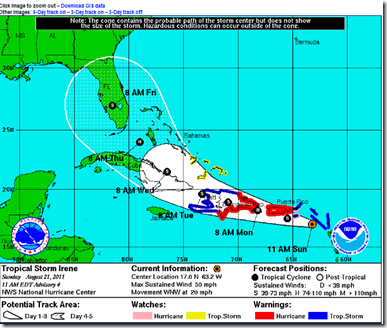
The 11 am advisory notes some small changes to the forecast track of Tropical Storm Irene, and the National Hurricane Center has issued an important reminder in their latest discussion:


THERE IS A FAIR AMOUNT OF SPREAD IN THE TRACK GUIDANCE MODELS...ESPECIALLY AT DAYS 4 TO 5. FOR EXAMPLE...THE GFDL MODEL TAKES IRENE TO THE  WEST OF THE FLORIDA PENINSULA WHILE THE HWRF MODEL TAKES IT THROUGH THE NORTHWESTERN BAHAMAS.

INTERESTS IN FLORIDA ARE ADVISED NOT TO FOCUS ON THE EXACT FORECAST TRACK BECAUSE OF THE INHERENT UNCERTAINTIES IN LONGER-RANGE FORECASTS.


image


This track may well shift several times over the next couple of days. It is also important to note that severe weather conditions can often occur more than 100 miles away from where the center of these storms pass.


image

Latest `spaghetti’ computer runs 11am 8/21/11


We’ll have a much better idea of where Irene will go, and how strong she may become, after this system clears the islands of Puerto Rico, Hispaniola, and Cuba.


Interests in Florida, and along the Gulf coast and Atlantic seaboard, should stay on top of this storm’s progress and make sure their hurricane plans and preparations are in order.

Thursday, August 11, 2011

U.S. Issues Dengue Warning For The Bahamas


# 5749

image


A couple of weeks ago in Dengue Roundup: Puerto Rico, Florida, Bahamas, I wrote about the rise in Dengue fever cases being reported in the Bahamas.  Those numbers have continued to climb, and this week the United States Embassy in Nassau issued the following email alert.


Emergency Message for U.S. Citizens: Bahamas, Dengue Fever Warning

Disease Outbreak

Western Hemisphere > Bahamas

8/9/2011

U.S. Embassy Nassau released the following Emergency Message for U.S. Citizens on August 9, 2011:

U.S. citizens should be aware of the recent dengue fever outbreak in The Bahamas.   In the past few weeks, over 200 cases have been reported and almost 1,000 cases have been reported of individuals suffering from symptoms that match dengue.


The Ministry of Health has begun spraying local communities, especially the more densely populated areas, and they have stressed to the public the importance of prevention.


The local government continues to combat this outbreak through greater public awareness of dengue and the importance of mosquito control.

(Continue . . . )


The lengthy email then goes into detail on the causes, transmission, symptoms, and treatment of the illness.


The email offers the following advice:


How Can I Prevent Dengue?


The best way to prevent dengue virus infection is to take special precautions to avoid being bitten by mosquitoes. Several dengue vaccines are being developed, but none is likely to be licensed by the Food and Drug Administration in the next few years.

When outdoors in an area where dengue fever has been found, use a mosquito repellent containing DEET, Picaridin, and oil of lemon eucalyptus are less effective than DEET so are not recommended as a substitute unless there is an allergy or a contraindication to DEET or it is unavailable. Dress in protective clothing-long-sleeved shirts, long pants, socks, and shoes.

Because Aedes mosquitoes usually bite during the day, be sure to use precautions especially during early morning hours before daybreak and in the late afternoon before dark.


Other precautions include:

Keep surrounding areas free from free standing water.


Wear long sleeves and light colored clothes.


Use insect repellent when outside.


Unscreened windows should be kept closed to prevent the mosquitoes from entering.


Carefully inspect your environment to detect and eliminate all areas with standing water where mosquitoes can breed, such as flower pots, containers, birdbaths, discarded tires, etc.

Wednesday, June 29, 2011

Arlene: First Tropical Storm of the 2011 Atlantic Season


# 5662


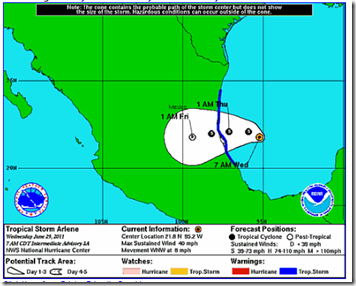
With only a short distance of open water to traverse before reaching the Mexican coastline, T.S. Arlene (named last night) is unlikely to reach hurricane intensity before it makes landfall tomorrow.


It should, however, prove to be a significant rainmaker as it slowly moves westward.


image


Some excerpts from the NATIONAL HURRICANE CENTER’s  7am (CST) advisory:


WTNT31 KNHC 291147
TCPAT1

BULLETIN
TROPICAL STORM ARLENE INTERMEDIATE ADVISORY NUMBER   3A
NWS NATIONAL HURRICANE CENTER MIAMI FL       AL012011
700 AM CDT WED JUN 29 2011

...ARLENE EXPECTED TO MAKE LANDFALL IN NORTHEASTERN MEXICO EARLY
TOMORROW...

SUMMARY OF 700 AM CDT...1200 UTC...INFORMATION
----------------------------------------------
LOCATION...21.8N 95.2W
ABOUT 175 MI...280 KM E OF TAMPICO MEXICO

MAXIMUM SUSTAINED WINDS...40 MPH...65 KM/H
PRESENT MOVEMENT...WNW OR 300 DEGREES AT 8 MPH...13 KM/H


MINIMUM CENTRAL PRESSURE...1002 MB...29.59 INCHES

<SNIP>

DISCUSSION AND 48-HOUR OUTLOOK
------------------------------
AT 700 AM CDT...1200 UTC...THE CENTER OF TROPICAL STORM ARLENE WAS LOCATED NEAR LATITUDE 21.8 NORTH...LONGITUDE 95.2 WEST.  ARLENE IS MOVING TOWARD THE WEST-NORTHWEST NEAR 8 MPH...13 KM/H.  A TURN TOWARD THE WEST IS FORECAST LATER TODAY.  ON THE FORECAST TRACK...


ARLENE IS EXPECTED TO MAKE LANDFALL ALONG THE NORTHEASTERN COAST OF MEXICO WITHIN THE WARNING AREA EARLY ON THURSDAY.


MAXIMUM SUSTAINED WINDS ARE NEAR 40 MPH...65 KM/H...WITH HIGHER GUSTS.  SOME STRENGTHENING IS FORECAST UNTIL LANDFALL ON THURSDAY.


TROPICAL STORM FORCE WINDS EXTEND OUTWARD UP TO 115 MILES...185 KM FROM THE CENTER.


While posing a minimal threat to the residents along the Mexican coastline, Arlene is a solid reminder that the tropical season is upon us.


All residents living within several hundred miles of the Atlantic and Gulf coasts should make advance preparations to deal with these storms.


For more on Hurricane Preparedness you may wish to revisit:


National Hurricane Preparedness Week 2011

Hurricane Preparedness Week: Inland Flooding

How Not To Be Gone With The Wind

Getting SLOSHed For Hurricane Season