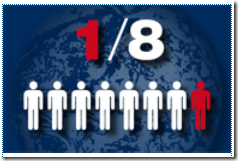
1 person in 8 is Undernourished Photo Credit – FAO
# 10,067
With tens of millions of birds in the United States destroyed (or soon to be) due to our worst HPAI outbreak in history, several recently introduced porcine diseases (see mBio: A Novel Pathogenic Mammalian Orthoreovirus In Diarrheic American Pigs) killing piglets, and a long list of other exotic or emerging epizootic diseases around the globe, concerns over the safety and viability of the world’s food supply are mounting.
Although the United States can absorb the kind of poultry loses we’ve taken these past few months, many resource limited regions have been severely tested by outbreaks of avian flu, FMD, and other food animal diseases.
Next week the CDC will sponsor a COCA Call that delves into the challenges of controlling these outbreaks, and why they seem to be occurring with more frequency.
While primarily of interest to healthcare providers, COCA (Clinician Outreach Communication Activity) calls are designed to ensure that practitioners have up-to-date information for their practices. The audio from these calls are posted several days after they are held. You can access COCA calls going back to 2012 at this link.
First the link to next week’s presentation, after which I’ll have a bit more:
Emerging and Exotic Diseases of Food Animals Threaten Global Food Security
Date:Thursday, May 28, 2015
Time:2:00 - 3:00 pm (Eastern Time)
Join by Phone:
- 800-369-2062 (U.S. Callers)
- 517-308-9046 (International Callers)
Passcode:1302224
Join by Webinar:https://www.mymeetings.com/nc/join.php?i=PW3643037&p=1302224&t=c
Presenter(s)
James A. Roth, DVM, PhD, Diplomate ACVM
Clarence Hartley Covault Distinguished Professor
Director, Center for Food Security and Public Health
Executive Director, Institute for International Cooperation in Animal Biologics
College of Veterinary Medicine
Iowa State UniversityOverview
New diseases of food animals are emerging at an increasing rate and are spreading regionally and globally. Many of the same factors leading to emergence of human diseases are responsible for the emergence of animal diseases, and many of the animal diseases are zoonotic. The challenges of controlling emerging food animal diseases are very different in intensive animal agriculture and small holder animal production and depend upon the veterinary and public health infrastructure available. During the COCA call, participants will learn about reasons for the increasing rate of emergence of food animal diseases, some specific examples, challenges for their control, and implications for public health and food security.
Objectives
At the conclusion of the session, the participant will be able to accomplish the following:
- Review recent examples of emerging diseases of food animals
- Discuss reasons for emergence and dissemination of diseases of food animals
- Describe challenges for control of zoonotic and non-zoonotic food animal diseases
- Suggest infrastructure changes needed to improve prevention and control of food animal diseases
Call Format
- Audio conference call on 5/28/15: 2:00 - 3:00 PM
- Web-on-demand training after 3:00 PM on 5/28/15
- Materials: PowerPoint slide set
 =
=
Previously we’ve explored some of the choices made by governments around the world to protect their animal food sources – not all of which have worked out as well as they might have hoped.
Two years ago in Food Insecurity, Economics, And The Control Of H7N9, we looked at some country’s decision to go with poultry vaccination instead of culling to control avian flu - despite OIE warnings that vaccination of poultry cannot be considered a long-term solution (see Does OIE recommend vaccination of animals to control the disease?).
Since then we’ve seen a number of studies suggesting that the proliferation of new avian flu viruses over the past couple of years may have arisen from the continued use of outmoded or ineffectual vaccines (see The HPAI Poultry Vaccine Dilemma).
As you might guess, this is a complex problem with answers are neither easy or clear cut. For more on global food insecurity, you may wish to visit the FAO’s most recent report:
The State of Food Insecurity in the World 2014
The State of Food Insecurity in the World 2014 presents updated estimates of undernourishment and progress towards the Millennium Development Goal (MDG) and World Food Summit (WFS) hunger targets. A stock-taking of where we stand on reducing hunger and malnutrition shows that progress in hunger reduction at the global level and in many countries has continued but that substantial additional effort is needed in others.
Sustained political commitment at the highest level is a prerequisite for hunger eradication. It entails placing food security and nutrition at the top of the political agenda and creating an enabling environment for improving food security and nutrition. This year’s report examines the diverse experiences of seven countries, with a specific focus on the enabling environment for food security and nutrition that reflects commitment and capacities across four dimensions: policies, programmes and legal frameworks; mobilization of human and financial resources; coordination mechanisms and partnerships; and evidence-based decision-making.


