Showing posts with label Europe. Show all posts

Monday, November 24, 2014

FAO Warns On H5N8’s Spread

image

H5N8 Branching Out To Europe & Japan


# 9367


The past couple of weeks have been marked by the rapid geographic expansion of the avian H5N8 virus – first seen less than a year ago on the Korean Peninsula.   Highly pathogenic in poultry – this virus has not yet been seen to infect humans – although it is a close cousin to the H5N1 virus which certainly can.


For now, the big threat is to agriculture, not public health. 


As we saw in 2006 (see H5N8: A Case Of Deja Flu?), newly emerging avian flu viruses can sometimes travel very rapidly across large distances – often aided and abetted by migratory birds and the poultry trade.  We saw the number of countries infected with avian H5N1 jump from 16 at the end of 2004 to 56 by the end of 2006.


With H5N8 now showing up in Germany, the UK, and the Netherlands, today the FAO has issued a warning to all nations to be alert and to be prepared to deal with this new bird flu threat.


New avian influenza’s rapid spread to Europe threatens poultry sector especially in low-resourced countries

FAO and OIE urge at-risk countries to step-up prevention efforts through increased bio-security

Photo: ©Scott Nelson/WPN for FAO

Surveillance systems to detect virus outbreaks include laboratory testing.

24 November 2014, Rome/Paris - A new bird flu strain detected in Europe which is similar to strains reported to be circulating in 2014 in Asia poses a significant threat to the poultry sector, especially in low-resourced countries situated along the Black Sea and East Atlantic migratory routes of wild birds, FAO and the World Organisation for Animal Health (OIE) warned today.

Germany, the Netherlands and the United Kingdom have confirmed the new avian influenza virus strain H5N8 on poultry farms, and German authorities have also found the virus in a wild bird.

Earlier this year, the People's Republic of China, Japan and the Republic of Korea reported outbreaks of H5N8 in poultry as well as findings in migratory birds and waterfowl. The fact that the virus has now been found within a very short time interval in three European countries, both in a wild bird and in three very different poultry production systems, suggests that wild birds may have played a role in spreading the virus, FAO and OIE experts said.

H5N8 has so far not been confirmed to infect people. However, it is highly pathogenic for domestic poultry, causing significant mortality in chickens and turkeys. The virus can also infect wild birds, which show little signs of illness. It is known from other influenza viruses that wild birds are able to carry the virus long distances.
Should poultry systems with low-biosecurity conditions become infected in countries with limited veterinary preparedness, the virus could spread through farms with devastating effects, both on vulnerable livelihoods as well as on country economies and trade. The best way for countries to safeguard against these impacts is to encourage better biosecurity and to maintain surveillance systems that detect outbreaks early and enable veterinary services to respond rapidly.

The new virus strain provides a stark reminder to the world that avian influenza viruses continue to evolve and emerge with potential threats to public health, food security and nutrition, to the livelihoods of vulnerable poultry farmers, as well as to trade and national economies. Therefore extreme vigilance is strongly recommended while progressive control efforts must be sustained and financed.

In particular, to protect poultry-related livelihoods and trade, FAO and OIE are recommending at-risk countries to:

  • increase surveillance efforts for the early detection of H5N8 and other influenza viruses;
  • maintain and further strengthen rapid response capacities of veterinary services;
  • reinforce biosecurity measures, with particular emphasis on minimizing contact between domestic poultry and wild birds;
  • raise awareness of hunters and other individuals who may come into contact with wildlife in order to provide early information on sick or dead wild birds.

The new strain of avian influenza has not resulted in human cases. Nevertheless it is related to the H5N1 virus, which is known to have spread from Asia into Europe and Africa in 2005-2006. The H5N1 epidemic, in which wild birds have also been implicated, has caused the deaths of nearly 400 people and hundreds of millions of poultry to date. Therefore prudent and precautionary interventions at the animal level are warranted.

Thursday, October 23, 2014

Avian H10N7 Linked To Dead European Seals

image 


# 9237


In 2011 a die off of seals in New England made headlines, which was eventually linked to an avian flu virus (see New England Seal Deaths Tied to H3N8 Flu Virus).  While not a new revelation that seals were susceptible to influenza viruses, this did raise concerns as in 2012, in mBio: A Mammalian Adapted H3N8 In Seals, we saw the first hints that this virus had recently adapted to bind to alpha 2,6 receptor cells, the type found in the human upper respiratory tract.


Until it landed in seals, this H3N8 strain was an avian adapted virus. That is, that it bound preferentially to the kind of receptor cells commonly found in the digestive and respiratory tracts of birds; alpha 2,3 receptor cells.


Seals were suddenly on the radar as potential `mixing vessels’ for influenza, much in the same way as pigs have been for years.  The good news being that seals have less opportunities to mingle with humans than do pigs.


Additional research, published this past September (see Nature Communications: Respiratory Transmission of Avian H3N8 In Ferrets), confirmed that this `virus has an increased affinity for mammalian receptors, transmits via respiratory droplets in ferrets and replicates in human lung cells.


In recent weeks there have been reports of large die offs of seals in Denmark and Germany (My thanks to Fred de Vries for the emailed head’s up), and this past week it was determined that a combination of avian H10N7 influenza, pneumonia, and bacterial infections were behind these deaths.


This report from the Technical University of Denmark.


Seals from several areas of Denmark were infected with influenza

Viral Zoonoses

National Veterinary Institute have found the influenza virus in seals from Anholt, fjord and three locations on the west coast. For the first time, identified a major flu outbreak among seals in Europe.

In recent months, we have found several dead seals along the Danish coasts than normal, and the National Veterinary Institute studies show that the cause of an outbreak of influenza.

In early July this year showed the National Veterinary Institute for the first time influenza type H10N7 two seals from Anholt. In September, the same virus was detected in dead seals from the fjord, and in October, the influenza virus has also been detected in dead seals at White Sands, Sædding and Skallingen on the west coast. The latter virus is not yet typed, but there are probably talking about the same H10N7 virus. The same virus is also detected in dead seals along the Swedish west coast.

"There are previously reported outbreaks of influenza in seals in Asia and the United States, but this is the first time that a major outbreak of influenza virus is found in seals in Europe," says Professor Lars Erik Larsen Section of Virology at the National Veterinary Institute.

Influenza virus weakens the seals, thus becoming more susceptible to other infections which may contribute to the deterioration of the disease and possibly lead to seal door.

"Initially, the seals probably got the flu by being in contact with birds or their droppings, but subsequently there has probably been no suggestion that the virus has infected from seal to seal," explains Lars Erik Larsen.

Do not touch the seals


Discovery of influenza virus in wild ducks are common, without giving rise to infection of other animals and humans. There are no reports of infection in people with the virus identified in these outbreaks among seals in Denmark, but other influenza viruses of the same type have previously caused light infection in humans.

"If you found dead seals should not touch them, but contact Naturstyrelses local wildlife consultant," says Special Mariann Chriél from the Section of Diagnostics and Emergency at the National Veterinary Institute.


Although known human infections with avian H10N7 are limited, we’ve discussed them on several occasions in the past.  In 2004, the first known human infections were reported among two Egyptian toddlers, as described in this report by WHO/CDS/CSR/RMD


Avian Influenza Virus A (H10N7) Circulating among Humans in Egypt

The National Influenza Center (NIC) in Egypt and the WHO Influenza Collaborating Centre in the UK reported the isolation of Avian Influenza A (H10N7) from two human specimens. They refer to two one-year-old infants, residents of Ismaillia, who recovered after presenting a fever and cough. The father of one of them is a poultry merchant who frequently traveled between Isamillia and Damietta. In the latter town, five cases of the same virus were isolated from wild ducks between 18 and 22 April 2004, from samples taken from a market of hunted migratory birds. Additional preliminary investigation tested negative in 75 human samples collected in Ismaillia and in 13 samples from migratory birds from the same market. No influenza outbreak has been reported among poultry in Egypt. At present, there are no public-health implications from this event.
 

And again, in 2012, in EID Journal: Human Infection With H10N7 Avian Influenza, we looked at a limited outbreak among workers at a chicken farm in Australia.  While their symptoms were mild and of short duration, the abattoir instituted enhanced PPE requirements for employees to try to prevent future infections.


Given its limited history of infecting humans, and the mild symptoms it has provoked, H10N7 seems an unlikely candidate to cause a serious public health threat. 


Of course, you could have said the same thing about avian H7 viruses two years ago.  All that changed when a new and deadly H7N9 emerged in China.


H10N7  – like all influenza A viruses –  has the ability to drift, mutate, or reassort with other influenza viruses and – over time -  continually re-invent itself.  


Which makes surveillance of events – such as this seal die off – an important part of the world’s efforts to detect the next emerging disease threat – and perhaps even stop it -  before it can pose a serious public health risk.

Tuesday, March 04, 2014

ECDC: 2013-14 Seasonal Influenza Risk Assessment

image

ECDC Weekly Infographic On Influenza


# 8346


Each year, usually in late February, the ECDC releases an updated Risk Assessment on their current influenza season, comparing it to previous years, and to reports coming from other regions around the world. 


Compared to North America, Europe’s flu season got off to a later start and hasn’t been anywhere near as A(H1)pdm09-dominated (or as severe) as what we’ve experienced on this side of the pond this year. 


From the Report:

In contrast to the season in the US with an overwhelming dominance of A(H1)pdm09 virus and substantial numbers of severe cases, A(H1)pdm09 virus is not as dominant in EU/EEA countries, possibly due to differences in prior exposure to A(H1)pdm09 virus or higher vaccination coverage among the age groups most likely to transmit the disease. In countries not yet affected, the pressure on primary and secondary care services is likely to be less intense than in the US.  


This year’s report (13-page PDF file) was posted today on the ECDC website. You’ll find their summary below, along with links to the report.


Seasonal influenza in Europe: ECDC risk assessment for the 2013-2014 season

04 Mar 2014

​Active circulation of influenza has started late in Europe in the 2013-2014 season, with a different timing across EU/EEA countries, states the annual ECDC risk assessment on seasonal influenza. The first countries affected have been Bulgaria, Greece, Portugal and Spain, where the A(H1)pdm09 influenza virus has dominated. Without any specific geographic pattern, influenza activity has since spread rapidly across Europe. In Bulgaria, Portugal and Spain, the season peaked in weeks 4 and 5/2014, while influenza activity still continues to increase in Greece.

Circulating virus types

In week 07/2014, circulating A(H1)pdm09 virus was dominant or co-dominant in 21 reporting countries while A(H3) was dominant in four countries. In contrast to the season in the US with an overwhelming dominance of A(H1)pdm09 virus and substantial numbers of severe cases, A(H1)pdm09 virus is not as dominant in EU/EEA countries. This may be due to differences in prior exposure to A(H1)pdm09 virus or higher vaccination coverage among the age groups most likely to transmit the disease.

Vaccine effectiveness

Data on viruses circulating so far indicate a good match with the current influenza vaccine. North American studies estimate high to moderate vaccine effectiveness, while a mid-season study from one Spanish region, Navarre, suggests lower effectiveness. This warrants further studies to understand the discrepancies. Vaccination of high-risk groups and healthcare workers, in accordance with national guidelines, in countries that are still at an early stage in their influenza season remains the most effective way of reducing serious outcomes and transmission of the disease.


Risk assessment for the remaining season

  • In countries with A(H1)pdm09 circulating, especially in countries where influenza activity has already peaked, a later circulation of A(H3) virus is possible. In the event of A(H3) virus circulation, some severe cases are likely, most probably in people older than those typically infected by A(H1)pdm09 virus.
  • In countries currently with no/low influenza activity, the dominant influenza virus strain and the intensity are unpredictable, but are likely to be similar to that observed in countries that have already passed their intensity peak (Bulgaria, Portugal and Spain). However, differences in vaccination coverage and natural immunity may influence both intensity and the number of severe cases.
  • In the few countries where A(H3) virus has been dominant so far, a second wave or a co-circulation of A(H1)pdm09 virus is possible.

Read full report: Seasonal influenza 2013-2014 in EU/EEA countries

More on seasonal influenza

Weekly infographic on Influenza in Europe 

Sunday, January 26, 2014

USGS: 6.0 Earthquake Strikes Greece

image

Credit USGS 


# 8223


A strong, relatively shallow earthquake and a moderate aftershock have struck the Southern coastline of Greece, and preliminary reports indicate there has been some local damage and possible injuries.  The towns closest to the epicenter are generally small (3K-5K pop.), and so the damage may not be as great as it might have been in a more populated area.


image

image


When it comes to earthquakes we usually think first of the Pacific’s Ring Of Fire, but Europe has a long history of destructive quakes as well.


In 2011,  in A Look At Europe’s Seismic Risks, we took look at some of the devastating earthquakes to strike Europe over the past 700 years, including the quake that leveled the Swiss town of Basel in 1356 and the horrific earthquake and tsunami that struck Portugal in 1755 on November 1st (All Saint’s Day).


In December of 2011, in WHO e-Atlas Of Natural Disaster Risks To Europe, we looked at some of the seismic risks to Europe. Also in 2011 (see UNDP: Supercities At Seismic Risk) we saw a report that stated that half of the world’s supercities (urban areas with 2 million – 15 million inhabitants) are at high risk for seismic activity.


And more recently, in January of this 2012 (see UN Agency Warns On Global Seismic Risks), the United Nations International Strategy For Disaster Reduction (UNIDSR.Org) issued a cautionary warning about ignoring seismic threats.


While we can’t predict where the next earthquake will strike, or do anything to stop it, we can prepare to deal with one when it happens.


For good, solid information on how prepare for `the big one’ (even if you live someplace other than Los Angeles), I would recommend you download, read, and implement the advice provided by the The L. A. County Emergency Survival Guide.

image

While US-centric, FEMA  has an earthquake hazard webpage with a lot of resources that would be of use to just about anyone, including the following preparedness information.


Emergencies happen every day.  Disasters, admittedly, less often. But in either event, preparedness is key.

Monday, December 23, 2013

The Call For Urgent Talks On `GOF’ Research Projects

image

BSL-4 Lab Worker - Photo Credit –USAMRIID


# 8101


It’s been more than two years since Dutch Virologist and flu researcher Dr. Ron Fouchier announced, at the  2011 ESWI Influenza Conference in Malta, that he’d created a `more transmissible’ form of the H5N1 virus (see Debra MacKenzie’s New Scientist: Five Easy Mutations).


That, combined with a similar announcement from Yoshihiro Kawaoka, a highly respected virologist at the University of Wisconsin-Madison School of Veterinary Medicine, set alarm bells ringing in the biosecurity community


In the months that followed we saw a protracted, and at times rancorous, debate over the merits and safety of so-called `Gain of Function’  (GOF) research on dangerous pathogens. GOF research involves the creation of viruses and/or  bacteria with enhanced virulence, transmissibility, or host range. 


By December of 2011 The Biosecurity Debate On H5N1 Research reached fevered pitch, which led to a group of internationally renowned Scientists to Announce a 60 Day Moratorium On Some H5N1 Research in January, 2012. That moratorium was subsequently extended until January of 2013 (see NIH Statement On Lifting Of The H5N1 Research Moratorium).

In March of 2012 the NIH - which funds many of these research projects - promulgated new DURC Oversight Rules (Dual Use Research of Concern), which also includes some types of GOF research. For those unfamiliar with the lexicon of biomedical research, DURC in this new policy is defined as:


. . . life sciences research that, based on current understanding, can be reasonably anticipated to provide knowledge, information, products, or technologies that could be directly misapplied to pose a significant threat with broad potential consequences to public health and safety, agricultural crops and other plants, animals, the environment,


After much heated debate, during the summer of 2012 Science Published The Fouchier Ferret Study and Nature Published The Kawaoka H5N1 Study.  But the debate over the safety, merits, and wisdom of conducting these sorts of experiments has continued.


Researchers in favor of GOF studies argue against undue restrictions and `censorship’ of science (see mbio Science Should Be in the Public Domain by Vincent R. Racaniello), while critics point out that the benefits of such research have been overstated (see Options VIII: Dr. Marc Lipsitch Argues Against HPAI GOF Experiments) and the risks have been downplayed.


All of which serves as prelude to an article over the weekend in in the Journal Nature (and SciAm) regarding a letter – signed by 56 scientists – sent to the European Commission, calling for `urgent talks’ over the future course of GOF research on influenza viruses, and other pathogens.


Scientists call for urgent talks on mutant-flu research in Europe

Benefits and risks of ‘gain-of-function’ work must be evaluated, they say.

Heidi Ledford

20 December 2013

A group of over 50 researchers has called on the European Commission to hold a scientific briefing on research that involves engineering microbes to make them more deadly.

In an 18 December letter to European Commission president José Manuel Barroso, the scientists — including representatives from the non-profit Foundation for Vaccine Research in Washington DC — urged the commission to organize the briefing, and to formally evaluate the risks and benefits of such 'gain-of-function' research.

(Continue . . . )


Although initial concerns were that the publication of the Fouchier or Kawaoka papers could serve as a blueprint for `bad actors’ to create a bio weapon, of even greater concern is the possibility of a laboratory accident that could result in the release of an `enhanced pathogen’.    


While accidents in well regulated Bio-level 4 labs are rare, they are not unheard of.  And many researchers doing GOF studies only have access to Bio-level 3 or 3+ labs, where safety standards are not as rigorous.


Last November, in BMC Medicine: Containing Laboratory Escape Of Pandemic Viruses, we looked at a report that found the risks of seeing an accidental release from one of these labs is far from zero.


They calculated a .3% chance of release from any given lab each year, which works out to be roughly one every 100 years of lab operation.  With hundreds of of BSL-3 and BSL-4 labs around the world, the odds of seeing an accident in any given year somewhere in the world go up substantially.


Between 2003 and 2009, US government laboratories had 395 incidents that involved the potential release of select agents, according to this report from CIDRAP NEWS.  While only 7 related infections were reported, this does add weight to some of the concerns being expressed by GOF research critics.  


Whether `an urgent meeting’  will help resolve  this controversy is difficult to predict, as there are strong feelings on both sides of this issue.  But as I wrote nearly 2 years ago, in Science At The Crossroads, one need only look at the public’s reaction to vaccines, GMO foods, and nuclear power to see that their trust in science, and scientists, continues to ebb badly.  


While seemingly a debate for Academia, how this debate is conducted, and how this issue is resolved, has to potential  to greatly affect the public’s perception – for better or worse – of the entire scientific community.


Stay tuned.

Monday, October 21, 2013

ECDC: Joint Scientific Opinion On Likelihood Of H3N2v Spreading To Europe

image

Reassortment of H3N2v - Credit CDC


# 7882


In 2011 a new strain of swine influenza  - originally dubbed trH3N2 but renamed H3N2v (swine variant influenza) in late 2011 – was discovered to have evolved in American pigs.  What made this virus different from the earlier trH3N2 novel strains was that it was a reassortant swine H3N2 which had acquired the matrix (M) gene from the 2009 H1N1 pandemic virus.


We first heard about this new strain on Sept. 2nd, 2011, via an early release from the CDC’s MMWR, which described two young children – one in Indiana and another in Pennsylvania - who were infected by a new swine-origin H3N2 virus (see Swine-Origin Influenza A (H3N2) Virus Infection in Two Children --- Indiana and Pennsylvania, July--August 2011). 


While these first two cases first appeared to be one-off, dead end transmissions, it was only a few days later that Pennsylvania Reported 2 More Novel Flu Cases.  On September 9th, 2011 the CDC updated their SOIV (Swine Origin Influenza Virus) page (see CDC Update On Recent Novel Swine Flu Cases), acknowledging the possibility that limited human-to-human transmission of this trH3N2 virus might be occurring.


By the end of 2011, 12 cases had been reported across 5 states.  While most human infections with this virus have only produced mild to moderate illness - as a precaution - in December of 2011 the CDC announced their intention of Developing A trH3N2 Seed Vaccine.


In 2012 more than 300 swine `variant’ infections were confirmed (see A Variant Swine Flu Review) in the United States, mostly linked to attendance of state and county fairs. Based on recently published studies, this was likely a substantial undercount (see CID Journal: Estimates Of Human Infection From H3N2v (Jul 2011-Apr 2012).


This year has seen far fewer reported infections, with just 19 cases reported thus far.  Exactly why we’ve seen this drop off isn’t clear, although better biosecurity at swine exhibits and improved hygiene by those in direct contact with pigs may be partially responsible.

image


Recently, scientists in Korea revealed they had found an H3N2v virus genetically closely related to the strains seen in the United States (see Study: Novel & Variant Swine Influenzas In Korean Pigs). Other regions  – particularly in Europe and Hong Kong -  have increased surveillance of their swine herds, looking for any signs this variant virus has shown up in their livestock as well.  


All of which serves as prelude to a report from the ECDC today on a recent joint scientific assessment of the risks of H3N2v showing up in European swine.   While they consider the risks to be low, they also acknowledge that:


It is not possible to predict which changes within H3N2v virus might  enable it to develop pandemic properties. Hence, it is not possible at present to set up a specific system to monitor such a risk. Nevertheless, it is recommended to reinforce the monitoring of influenza strains circulating in pigs in EU.


Follow the link below to access the full report.


Joint scientific opinion assesses the likelihood of swine-origin influenza A(H3N2) in the EU as low

21 Oct 2013

Influenza A(H3N2v) risks in EU

​The likelihood of the swine-origin influenza A(H3N2)v appearing in the EU is low. Nevertheless, it is important to reinforce the monitoring of influenza strains circulating in pigs and link this to surveillance of influenza viruses in humans concludes the joint scientific opinion of three EU agencies, European Food Safety Authority, European Medicines Agency and European Centre for Disease Prevention and Control. The opinion assesses and advises on the possible risks posed by influenza A(H3N2)v virus for animal health and the potential implications for animal and human health.

Pigs are an important host in influenza virus ecology since they are susceptible to infections with both avian and human influenza A viruses and can play a role in interspecies transmission. This can lead to co-infection and genetic reassortment of viruses of swine, human or avian origin.

In 2011, the United States of America reported a cluster of cases of human infection with a swine-origin influenza A(H3N2) variant virus H3N2v. In 2012, 309 influenza H3N2v virus infections in humans were identified in the US and 12 cases so far in 2013.


The joint scientific opinion assesses the following:

  • risk of introduction of H3N2v in EU
  • diagnostic capabilities to early detect H3N2v incursion in EU
  • implications and consequences of the possible evolution of H3N2v virus on pig health
  • the use of vaccines in relation to the possible evolution of variants of influenza viruses posing a risk to public and animal health
  • factors to be monitored that would suggest a risk for the emergence of a new pandemic influenza strain from the influenza A(H3N2v) virus


The joint opinion concludes that it is recommended to reinforce the monitoring of influenza strains circulating in pigs in EU because it is not possible to predict nor monitor changes to the H3N2v virus that might enable it to develop pandemic properties.

Links: - Joint scientific opinion on influenza A(H3N2)


Sunday, June 02, 2013

WHO: European Region MERS-COV Update

image


# 7354


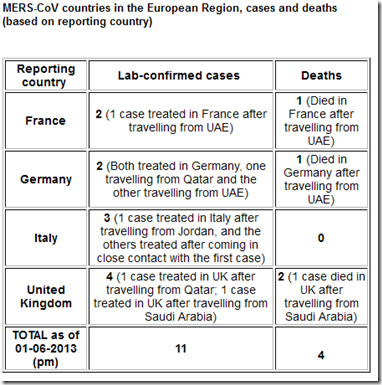
The World Health Organization’s Regional Office for Europe has produced a MERS-CoV update that focuses primarily on coronavirus cases that have been reported in the European region. 


All 11 European cases have either recently traveled in the Middle East, or have had close contact with someone who did. 


Small, limited clusters involving secondary transmission of the virus, have been reported in the UK, France, and Italy.  Earlier today the WHO released a full update on the novel coronavirus.


MERS-CoV update: 2 more cases reported in Italy, total in Europe rises to 11

02-06-2013

The Ministry of Health in Italy, through the European Union’s Early Warning Response System, has notified WHO of 2 more laboratory-confirmed cases with Middle East respiratory syndrome coronavirus (MERS-CoV) in the country.


Both the patients are close contacts of the recent laboratory-confirmed case of a 45-year-old man who had travelled to Jordan. The first patient is a two-year-old girl and the second patient is a 42-year-old woman. All three cases are in stable condition.


The man had returned to Italy on 25 May 2013 with symptoms of cough and fatigue. His condition deteriorated and he was hospitalised on 28 May 2013. Laboratory test was conducted by the influenza reference laboratory of Tuscany and confirmed by the National Center of NHI (Istituto Superiore di sanità).


Globally, from September 2012 to date, WHO has been informed of a total of 53 laboratory-confirmed cases of infection with MERS-CoV, including 30 deaths. Eleven of these cases have been reported from countries in the European Region and include 4 deaths.


WHO/Europe is coordinating the response to MERS-CoV with the European Union and the European Centre for Disease Prevention and Control (ECDC). The Regional Office is also facilitating information exchange and coordination among countries in the European Region and the Eastern Mediterranean Region.


Based on the current situation and available information, WHO encourages all Member States to continue their surveillance for severe acute respiratory infections (SARI) and to carefully review any unusual patterns.


WHO does not advise special screening at points of entry with regard to this event nor does it currently recommend the application of any travel or trade restrictions.

Monday, February 11, 2013

ECDC: Influenza Still On The Rise In Europe

image

ECDC Week 5 Influenza Report


# 6921


While the levels of influenza-like-activity have begun to drop across much of North America, some areas of the Northern Hemisphere have yet to see their seasonal peak.


This morning the ECDC released their latest (week 5) influenza surveillance report, that finds that flu activity continues to rise in many parts of the EU.


Some excerpts from the week 5 report:

image

Weekly reporting on influenza surveillance in Europe for the 2012–13 season started in week 40/2012 and active influenza transmission began around week 49/2012, approximately six weeks earlier than in the 2011/2012 season.

  • In week 5/2013, 19 countries reported concomitantly high/medium-intensity transmission and wide geographic spread. Twenty-two countries reported increasing trends in influenza activity.
  • In week 5/2013, the proportion of influenza-positive sentinel specimens continued to increase, reaching 55%.
  • Since week 40/2012, the proportions of influenza A and B viruses have remained similar (51% vs. 49%), but among type A viruses, the percentage of A(H1)pdm09 has continued to increase (64%), compared to 52% in week 2/2012.
  • For week 5/2013, of 71 hospitalised laboratory-confirmed influenza cases reported by six countries, 33 (46%) tested positive for influenza A viruses and 38 (54%) for type B viruses.


On 8 February, ECDC published its annual risk assessment for seasonal influenza 2012–2013, based on data up to week 3/2013. The risk assessment is available here.


Influenza activity continued to rise across Europe in week 5/2013. In a few countries, the epidemics seemed to have passed their peaks, although some countries experienced a resurgence of ILI rates.


The ECDC is now producing a weekly Infographic that provides a quick review of the flu season in Europe.


image


Unlike North America, which this year has seen a flu season dominated by H3N2 Influenza A virus, in Europe the flu this season is nearly equally divided between influenza A & B.


And among the influenza A strains identified, 64% have been the 2009 H1N1 strain, and 36% H3N2. This year, In North America, H1N1 has been a relatively minor player.


Elsewhere around the world, we are seeing flu on the rise in Hong Kong as well.

Saturday, January 19, 2013

EuroFlu: H1N1 & Influenza B Driving Their Flu Season


image

Credit EuroFlu report Week 2


# 6867


Dominated by the H3N2 virus, the United States and Canada continue to see a worse than average flu season (see yesterday’s CDC FluView & Canadian FluWatch reports) – while reports from Europe remain a mixed bag, with many countries reporting H1N1pdm09 or Influenza B leading this year’s viral charge.


Regions where H3N2 predominates generally see a more severe flu season, which may help explain why Europe hasn’t been hit nearly as hard as has North America.


Some excerpts from this week’s EuroFlu Report.


Large variation in influenza activity across the WHO European Region

Summary, week 2/2013


Consultation rates for influenza-like illness (ILI) and/or acute respiratory infection (ARI) are now increasing in almost all countries in the Region.


However, influenza activity is still largely limited to the western part of the Region, where widespread transmission is being reported by most countries currently.


While influenza A(H1N1)pdm09, A(H3N2) and type B viruses are circulating in the Region, the proportion of influenza A(H1N1)pdm09 continues to increase, relative to influenza B and A(H3N2), and accounts for 84% of influenza A viruses subtyped.


The number of reported hospitalizations due to severe acute respiratory infection (SARI) is increasing slowly along with a rising proportion of patients testing positive for influenza.


Virological surveillance for influenza

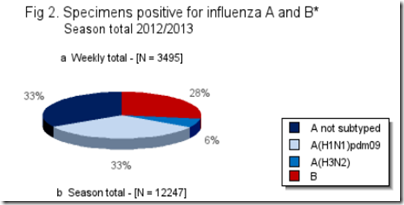
The number of specimens testing positive for influenza in the Region continues to rise, mainly due to increasing detections in the western part of the Region. Overall, a total of 3495 specimens tested positive for influenza in week 02/2013, the majority of which, 2532 (72%), were influenza A (Fig. 1).

image

The proportion of influenza A(H1N1)pdm09 viruses relative to A(H3N2) continues to increase. In week 2, among 1363 influenza A viruses subtyped, 1151 (84%) were A(H1N1)pdm09 while 212 (16%) were A(H3N2)(Fig. 2a).

image


This presents a very different picture from the 2011/2012 influenza season when A(H1N1)pdm09 detections were rare. In the 19 countries testing 20 or more sentinel specimens, influenza positivity ranged from 11% to 68%, with a median of 45% (mean: 44%).


Since the beginning of the season (week 40/2012), 12,247 influenza viruses from sentinel and non-sentinel sources have been typed: 8250 (67%) were influenza A and 3997 (33%) influenza B (Fig. 2b). Of the influenza A viruses, 4475 were subtyped: 2945 (66%) as A(H1N1)pdm09and 1530 (34%) as A(H3N2). In addition, since week 40/2012, the lineage has been determined for 497 influenza B viruses: 454 (91%) belonged to the B/Yamagata lineage and 43 (9%) to B/Victoria.


In another telling difference between the North American flu season and Europe’s are the age groups being hospitalized for SARI (Severe Acute Respiratory Infection).


Here in the United States where H3N2 currently reigns, laboratory confirmed influenza hospitalizations are overwhelmingly for those 65 and older (see CDC FluView chart below).


image


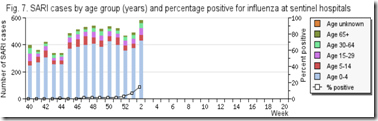
Whereas in Europe it is those under the age of 4 making up the majority of hospitalized cases. Once again, a pattern we’d expect to see when H1N1 and influenza B are the most active strains.


Hospital surveillance for SARI

Hospitalizations due to SARI have increased slightly over the past few weeks along with an increase in the proportion of respiratory specimens from patients testing positive for influenza (Fig. 7). Overall, the great majority of cases reported have been in the age-group 0–4 years (see Country data and graphs for individual country data).

image


While North America is likely about half-way through its flu season, for many parts of Europe flu activity is just starting to ramp up.


Influenza is unpredictable, so we’ll have to wait to see whether their contrarian pattern of seeing mostly H1N1 & Influenza B cases continues throughout the rest of their flu season.

Thursday, January 03, 2013

HPA: Flu Activity In The UK


# 6820


While the United States and Canada have reported an early start to the flu season this year, influenza has yet to take off in Hong Kong (see latest Flu Express (Week 52, 2012), and in the UK and parts of Europe the flu season is just now starting to pick up. 


image

The RED LINE indicates this year’s activity, compared to previous years.  The Blue Line indicates the unusually severe 1999-2000 flu season.


This latest flu updates from the HPA.


HPA National Influenza Report

Report published 3 January 2013

Figures (including all those found in this report) displaying data from these schemes are available to download as a pdf file:

HPA Weekly National Influenza Graphs (PDF, 713 KB)

PDF versions of previous reports are available on the archive page.

This week's report is available as a pdf:

HPA National Influenza Report - week 1 (2013) (PDF, 665 KB)

A summary report will be published weekly. For further information on the surveillance schemes mentioned in this report, please see the Sources of UK Flu Data page.

Increases continue to be seen for several indicators of influenza activity. A letter has been issued to the NHS that GPs may now prescribe antiviral medicines for the prophylaxis and treatment of influenza in accordance with NICE guidance.


Flu activity update: 3 January 2013

3 January 2013

Latest figures from the Health Protection Agency (HPA) up to 30 December 2012 show that flu activity continues to increase based on a number of indicators, including GP consultation rates in England and the proportion of calls to NHS Direct.


The latest figures show that GP consultation rates have increased slightly from 27.4 per 100,000 in week 51 to 32.7 per 100,000 in week 52 ending on 30 December. Meanwhile, 2.1% of the calls received by NHS Direct concerned influenza compared to 1.6% in week 51.


Professor John Watson, head of the respiratory disease department at the HPA said:


“Over the Christmas period we have seen a slight rise in flu activity across several of our indicators in line with the trend we expect to see at this time of year.


“However, the latest data should be interpreted with caution due to GP practices being closed on the bank holidays which may have impacted on GP consultation rates.

(Continue . . . )


Elsewhere in Europe, the most recent EuroFlu report states:


Influenza activity is increasing slowly in the WHO European Region

Summary, week 51/2012

Influenza activity is slowly increasing with more countries in different parts of the Region reporting sporadic co-circulation of influenza A(H1N1)pdm09, A(H3N2) and type B viruses. This week the reporting of influenza surveillance data is incomplete due to the Christmas holidays. This is reflected in the lower number of testing performed. However the percentage of influenza-positive samples from both sentinel and non-sentinel sources are similar to last week. The number of reported hospitalizations due to severe acute respiratory infection (SARI) remains similar to that seen in the previous several weeks: 1 influenza detection was reported (influenza B).

Monday, November 19, 2012

WHO Europe: Revising Pandemic Preparedness Plans

 image

The current WHO phase of pandemic alert for avian influenza H5N1 is 3.


# 6725


While not the damp squib that many pundits have mistakenly called it (see Lancet: Estimating Global 2009 Pandemic Mortality), the 2009 H1N1 influenza pandemic could have been worse.


A lot worse.


As it was, the Lancet study mentioned above found:


We estimate that globally there were 201 200 respiratory deaths (range 105 700—395 600) with an additional 83 300 cardiovascular deaths (46 000—179 900) associated with 2009 pandemic influenza A H1N1. 80% of the respiratory and cardiovascular deaths were in people younger than 65 years and 59% occurred in southeast Asia and Africa.


As we’ve seen with some previous pandemics, the greatest burden of illness and death was shifted to those under 65, a reversal of what we normally see with seasonal influenza. 


Still, when compared to 1918 – where between 50 and 100 million people died – the pandemic of 2009 was relatively mild.


We may not be nearly so lucky the next time around.


Preparations for an H5N1 pandemic – which began in earnest in 2005 – undoubtedly helped the world respond in 2009, but it is quite clear the world remains poorly equipped to deal with a major global health crisis.


Earlier this year the World Health Organization  published a 16-page document that looked at the lessons learned from the 2009 pandemic, called:


image


While the document goes into considerable detail, the following excerpt lists key areas where changes are recommended.


Key changes to national pandemic preparedness plans

 
The changes being made to pandemic plans follow to a large extent the findings from some evaluations performed by countries, as well as the two EU-wide assessments (TOR1 and TOR2) (7), the WHO/Europe evaluation of pandemic preparedness (8), the external review of the IHR (1) and of ECDC’s response to the pandemic (9). The changes address primarily the following areas:

  • intersectoral cooperation, collaboration and leadership
  • flexibility and adaptability of plans
  • strategies for vaccines and antivirals 
  • disease surveillance and monitoring of countermeasures
  • strategies for exchanging information and communicating risk
  • evaluation of the pandemic response and the transition to seasonal influenza.


Four countries (France, UK, Czech Republic, Finland) have updated their pandemic response plans since 2009, while many other countries are in the process of working on revisions.


You can view the latest versions of European national plans at this WHO Europe web address:


National preparedness plans

Follow the links below to view country-specific national pandemic preparedness plans.

(Continue . . . )


European pandemic guidance recommendations are being revised to more closely match the WHO global pandemic guidance. These new guidance recommendations will be presented at a WHO workshop in Copenhagen next month for countries of the South-eastern Europe Health Network (SEEHN), newly independent states, Switzerland and Turkey.


This from the World Health Organization:


Revising pandemic influenza preparedness strategies

16-11-2012

Evaluations of the response to the 2009 pandemic have shown that the world is ill-prepared to respond to a severe influenza pandemic or to any similar global, sustained and threatening public health emergency.


From the lessons learned it can be concluded that existing country pandemic plans have a number of gaps. Member States are in the process of revising their pandemic plans and 4 countries of the WHO European Region have published their revised plans.


A key activity of WHO/Europe in collaboration with the European Centre for Disease Prevention and Control (ECDC) is to provide a strong and clear guide, so that all countries of the Region can revise their pandemic influenza preparedness strategies. To this end, the existing European guidance is being revised in line with revisions from the WHO global pandemic guidance. This new version of the European guide will be discussed during a workshop on pandemic preparedness that will be held 5-7 December 2012 in Copenhagen, Denmark for countries of the South-eastern Europe Health Network (SEEHN), newly independent states, Switzerland and Turkey.


The meeting is organized in collaboration with the SEE Regional Health Development Centre for Communicable Diseases Surveillance in Tirana, Albania and will be facilitated by experts from WHO collaborating centres at the University of Nottingham, United Kingdom and the University of Geneva, Switzerland as well as WHO headquarters.


Experts from ECDC and Centers for Disease Control and Prevention (CDC) Central Asian Region, Almaty, Kazakhstan will also participate.

Friday, November 16, 2012

ECDC: Multidrug Resistant Infections Increasing In Europe

image

Consumption of antibiotics for systemic use in the community in EU/EEA countries, 2010 - Source

# 6721


November 18th is set aside each year by the ECDC and their partners as European Antibiotic Awareness Day. For the past 5 years they have mounted coordinated events to get the message out on the safe and sane use of antibiotics in the face of increasingly resistant bacteria.


You’ll find an excellent infographic, along with a number of other resources, available on the ECDC’s Antibiotics Awareness Day web page.

image


Coinciding with the 2012 observance, we have the release of new data on the consumption of antibiotics in the EU, along with numbers showing the rise in multi-drug resistant organisms.


A few excerpts from the ECDC news release, followed by links to the reports.  Follow the link for more.


Multidrug antibiotic resistance increasing in Europe

16 Nov 2012

On the occasion of the 5th edition of the European Antibiotic Awareness Day, ECDC releases new EU-wide data on antibiotic resistance and consumption. Antibiotic resistance still remains a major European and global public health problem and is, for a large part, driven by misuse of antibiotics. ECDC data show that over the last four years there has been a significant increasing trend of combined resistance to multiple antibiotics in both Klebsiella pneumoniae and E. coli in more than one-third of the EU/EEA countries. In several Member States, between 25 percent and up to more than 60 percent of Klebsiella pneumoniae from bloodstream infections show combined resistance to multiple antibiotics. Options for treatment of patients who are infected with such multidrug-resistant bacteria are limited to only few last-line antibiotics.


Antibiotic resistance is still a very serious threat to the health of European citizens, because it leads to increasing healthcare costs, extra length of stay in the hospital, treatment failures, and sometimes death. Speaking at a press event organised by ECDC and the European Commission in Brussels, ECDC Director Marc Sprenger said: “ECDC data show that over the last several years, there has been a Europe-wide increase of antibiotic resistance and of multidrug resistance in Gram-negative bacteria such as Klebsiella pneumoniae and Escherichia coli (E. coli). This means that, for patients who are infected with these bacteria, few last-line antibiotics, like carbapenems, remain available”.


Furthermore, ECDC data show that consumption of carbapenems – a major last-line class of antibiotics – increased significantly in EU/EEA countries from 2007 to 2010. This is the likely consequence of increasing multidrug resistance in Gram-negative infections, such as bloodstream infections or pneumonia, since carbapenems are often used to treat such infections. However, the percentage of carbapenem-resistant Klebsiella pneumoniae is already high and increasing in some countries in the EU.


He added: “There are, in contrast, some good news: in the past few years, meticillin-resistant Staphylococcus aureus (MRSA), has shown either a decrease or a stabilisation in most EU countries. Nevertheless, we must remain vigilant, as the percentage of Staphylococcus aureus resistant to meticilin remains above 25% in more than one fourth of the reporting countries, mainly in Southern and Eastern Europe”.

(Continue . . .)


News release
European Antibiotic Awareness Day 2012 – Latest data
European Antibiotic Awareness Day 2012 website
Antimicrobial resistance surveillance in Europe 2011


image 

ECDC Infographic – Click to enlarge


For a look at the CDC’s Get Smart About Antibiotics Week here in the United States, you wish to revisit:


A Health Crisis In Slow Motion

Thursday, July 26, 2012

ECDC: Climatic Suitability For Dengue Transmission in Europe


image

Credit ECDC


# 6452 


In 2007 Chikungunya made headlines as it spread rapidly across the Indian Ocean, hitting Reunion Island particularly hard.  A tropical disease - Chikungunya is spread by the bite of Aedes mosquitoes  - and until recently was found only in Africa and parts of the Indian Ocean.


So the unexpected outbreak of Chikungunya in September of 2007 in Northern Italy took many by surprise. 


I told the story in It's A Smaller World After All, but briefly: a traveler returning from India brought the virus back to the northeast Italian province of Ravenna, and before the outbreak had run its course, more than 290 people were infected.


This importation and subsequent spread of a rare tropical disease was a bit of a wake up call for Europe, and since then we’ve seen a good deal of study and concerns on the future of vector-borne diseases across Europe.


In 2010 the journal Eurosurveillance devoted an entire issue to The Threat Of Vector Borne Diseases, with perhaps the biggest threat outlined in Yellow fever and dengue: a threat to Europe? by P Reiter (excerpt below).


The history of dengue and yellow fever in Europe is evidence that conditions are already suitable for transmission. The establishment of Ae. albopictus has made this possible, and the possibility will increase as the species expands northwards, or if Ae. aegypti is re-established.


Last year in ECDC: Local Malaria Acquisition In Greece we saw more reasons for concern in the return of a scourge that had – due to diligent mosquito control measures over the past 50 years – been all but eliminated across Europe.


As global climate change occurs, and as mosquito species are spread inadvertently through the movement of trade goods, ships, and airplanes, the potential of new – potentially invasive – mosquito species setting up shop in Europe increases.


Which was the subject of an ECDC Review of status and public health importance of invasive mosquitoes in Europe last April.


While Malaria and Yellow Fever are of concern, the big worry has been the rapid global spread of Dengue fever over the past couple of decades might soon reach into Europe.


This explosive growth of Dengue around the world is well illustrated by the following graph from the World Health Organization.


Average annual number of dengue cases reported to the World Health Organization - has steadily increased since the 1950s, with 908 cases average reported between 1950 and 1959 and 968,564 cases average reported annually between 2000 and 2007.

What this graph doesn’t indicate is another doubling of dengue cases has taken place over the past 5 years.


All of which serves as prelude to  a 27-page technical report published by the ECDC today on the potential of Dengue Fever getting a foothold in continental Europe.


Below you’ll find the summary, and a link to the report.


ECDC report: Low risk of dengue transmission in Europe, while some areas climatically suitable

26 Jul 2012

ECDC

Europe appears to be at little risk from dengue transmission in comparison with other global locations, even though climatic conditions exist in some parts, new ECDC report concludes.


The report, entitledClimatic suitability for dengue transmission in continental Europe, summarises the key findings of a project, which developed a series of risk maps demonstrating the current and potential distribution of dengue in continental Europe.


The maps explore the geographical distribution and the climate suitability of dengue and the dengue mosquito vectors - Aedes aegyptiand Aedes albopictus - in Europe to assess which areas could be most suitable for dengue transmission.


The current risk to Europe appears to be minimal, yet some areas are more climatically suitable than others. However, the report provides a relative but not absolute calculation of the risk of dengue transmission.


Much of central and Mediterranean Europe is climatically suitable for Aedes albopictus, states the report; the VBORNET maps on current known distribution of Aedes albopictus show that this mosquito species is already present in many places in Mediterranean Europe. In addition, some areas could potentially be a suitable habitat for Aedes aegypti (the Mediterranean areas of Spain, France and Italy, south-eastern Europe).


The climatic suitability maps can be used as a tool for public health planning. A sensible strategy is to continue to monitor the spread of dengue mosquito vectors in Europeand expand vector surveillance in areas climatically suitable for these vectors.

In 2012 ECDC will produce guidelines to assist the Member States to implement invasive mosquito vector surveillance and improve coverage and harmonisation of data collection within the EU.


Technical report ‘Climatic suitability for dengue transmission in continental Europe‘


While the current risk of Dengue spread in Europe is considered minimal, the executive summary’s conclusion cautions that:


Suitability maps can be a useful tool for public health planning, but there are many potential sources of error that need to be properly understood.


The current risk to Europe from the transmission of dengue appears to be minimal, yet some areas of Europe are more suitable for transmission than others.


A sensible strategy is to continue to monitor the spread of Ae. albopictus across Europe, to maintain vigilance for Ae. aegypti, and to consider expanding vector surveillance in areas particularly suitable for these vectors.


Additional research is needed to better understand the ecology of dengue in a European context, and to assess the possible impacts of climate change and other important drivers of dengue on the risk of dengue in Europe.


For additional background on a variety of vector-borne diseases in Europe, and around the world, you may wish to revisit these earlier blogs.


A Pathogen That Still Plagues Mankind

ECDC: Mapping Disease Vectors

tick . . . tick . . . tick . . .

Tracking West Nile Virus In Europe

Borne In The USA

EID Journal:Vector-Borne Infections