Showing posts with label John Solomon. Show all posts

Thursday, September 23, 2010

Three Referrals: No Waiting


# 4928


Referrals to three blogs I’ve read this morning that I thought might be of interest to you. 


First Maryn McKenna – everyone’s favorite `scary disease girl’ – brings us details on yet another emerging resistance factor showing up in bacteria. 


This time it’s Verona integron-encoded metallo-beta-lactamase. 


But you can just call it  VIM.


Another new bad resistance factor. (Bonus: Another city stigmatized!)

By Maryn McKenna September 23, 2010  |


Next stop is Ian York’s Mystery Rays Blog where he takes us on a tour of the emerging Monkey Pox virus, its relationship to small pox, and as he does so well, includes a flashback of disease history for us as well.


Beware, the photos are not for the squeamish.


Monkeypox, smallpox

By iayork


And last, but not least, John Solomon weighs in on emergency evacuations in:


Emergency Evacuation: ‘Expected’ Vs. ‘Unexpected’ — They’re Very Different, But We Don’t Treat Them That Way

September 22nd, 2010 


After seeing tons of pseudo-scientific crap in my news feed this morning, blogs like these restore my faith in the value of the internet.


Thanks, guys.   I needed that.

Tuesday, September 14, 2010

Referral: The Economics Of Citizen Preparedness


# 4899


One of the best things about being a blogger in the Preparedness/Flublogia arena is the company I get to keep. 


Terrific and insightful writers like Scott McPherson, Crawford Kilian, Indigo Girl, Jimmy Jazz at Break Glass, Maryn McKenna, Ian York, John Solomon and others make every day a veritable treat for this humble blogger.


Perhaps the nicest part is that we feel free to work off each others posts, enlarging on (and often improving upon) each other’s thoughts and presentations. 


John, Scott, Indigo, or Crof will often write on a topic and that will spark an idea in me, that I will then write about in my blog.  And I’m happy to say, every once in awhile something I write serves as a muse for one of their blogs.


Which brings me to today’s post by John Solomon on his In Case of Emergency Blog that builds upon something I wrote about last week.


I’m not surprised that John – whose expertise in citizen preparedness far exceeds mine - adds considerable value to the topic.


Read:


The Economics Of Citizen Preparedness: Should Government Officials More Openly Acknowledge Its Readiness Messaging Is Financially, Socially Tiered?

September 14th, 2010 


Highly Recommended.

And if you aren’t already a regular visitor to John’s blog, you should be.

Saturday, August 28, 2010

Referral: Katrina Preparedness Advice


# 4841


image


On the five year anniversary weekend of Hurricane Katrina’s New Orleans and gulf coast landfall, John Solomon, editor of the In Case of Emergency blog brings us an impressive compendium of hurricane preparedness and evacuation advice collected by the New Orleans Times-Picayune.

On Katrina 5th Anniversary, A Compelling & Useful List Of Preparedness Tips, Lessons Learned From The Hurricane Survivors Themselves

August 28th, 2010 ·


Even if you don’t live in `hurricane country’, these tips are food for thought, and could apply to other disaster scenarios.


Well worth taking the time to review.

Monday, August 09, 2010

Referral: John Solomon On Flu Shots And Basic Preparedness


# 4790


One of the best things about reading a wide spectrum of blogs is that the reader can get more than one take on a subject. 


Although I blogged on National Immunization Month last week,  John Solomon  proves that point this morning by asking:


As U.S. Marks National Immunization Awareness Month, Should Shots Be Part Of The Basic Citizen Preparedness Steps?


Frankly, I think it’s a terrific idea.

Wednesday, August 04, 2010

A Handful Of Morning Referrals


# 4782


While I’m away for a few days of R&R my blogging efforts are going to be a bit light.  But I’ve a brand new netbook with me (Samsung N135) and a slightly slow wireless connection . . .  so I’m able, at least, to log on and view my major sources of information.


Since others are doing the heavy lifting this week, a few quick referrals seemed in order.


Overnight Crof at Crofsblog wrote about many of the intriguing questions that are raised by the WHO’s monitoring of H5N1 cases over the years in:


Thinking about H5N1


Ida at the Bird Flu Information Corner has some additional details on the recently announced bird flu fatality out of Indonesia:


Tangerang, Banten ::: Confirmed H5N1 case


Along with reports of more B2B outbreaks of H5N1 in that bird flu beleaguered nation.


Pesawaran, Lampung ::: H5N1 in chickens

Luwu Timur, South Sulawesi ::: Thousands of birds die of bird flu


A very happy referral to John Solomon’s In Case of Emergency Blog where he briefly relates his return to `active duty’ in CERT after the return of his Leukemia last year.


Now Ready CERT Member Comes Off ‘Disabled List’ To Help Ready New Yorkers At “National Night Out”


Great going John.  Congratulations.

Monday, June 21, 2010

A Carrington Event


Note: Although this first essay continues to get a lot of visits, you’ll find some updated information in the following blogs.

Recent Media Reports On Solar Maximum
NASA Braces For Solar Disruptions


# 4665


In September of 1859 Richard Carrington, a renowned English astronomer, observed and recorded a tremendous solar flare that – were it to be repeated today – would wreck havoc with our modern electronic infrastructure.


Here is how NASA science news described the effects.


Just before dawn the next day, skies all over planet Earth erupted in red, green, and purple auroras so brilliant that newspapers could be read as easily as in daylight. Indeed, stunning auroras pulsated even at near tropical latitudes over Cuba, the Bahamas, Jamaica, El Salvador, and Hawaii.


Even more disconcerting, telegraph systems worldwide went haywire. Spark discharges shocked telegraph operators and set the telegraph paper on fire. Even when telegraphers disconnected the batteries powering the lines, aurora-induced electric currents in the wires still allowed messages to be transmitted.


image

image


On Saturday, John Solomon at the In Case of Emergency Blog, wrote about the threat posed by severe space weather and the attentions being given it by FEMA and the Federal Government. 


Go ahead and read it.  I’ll have more when you return.


As you can see, this isn’t some esoteric plot device for a cheesy direct-to-DVD Sci-Fi movie, or prophesy driven 2012 drivel: space weather is a serious threat than can, and does, affect life on earth.


Our sun is a variable star, and it goes through many major, and minor cycles. The best documented of these is the 11-year/22-year sunspot cycle.


Roughly every 11 years (it runs anywhere from 9 to 14 years), the sun experiences a magnetic pole shift at the time of solar maximum – a period of high sunspot and solar flare activity.  


Every 22 years, the cycle completes, and the poles return to their `original’ position.


Our sun has, since 2006, been in a solar minimum or quiescent phase.   Very few sunspots and solar flares.


The next solar maximum was predicted to occur in 2012, but the sun’s sunspot activity remains low, and so now NASA is looking more towards 2013. 


This, again, from science.nasa.gov.


As the Sun Awakens, NASA Keeps a Wary Eye on Space Weather

June 4, 2010: Earth and space are about to come into contact in a way that's new to human history. To make preparations, authorities in Washington DC are holding a meeting: The Space Weather Enterprise Forum at the National Press Club on June 8th.


Many technologies of the 21st century are vulnerable to solar storms. [more]


Richard Fisher, head of NASA's Heliophysics Division, explains what it's all about:


"The sun is waking up from a deep slumber, and in the next few years we expect to see much higher levels of solar activity. At the same time, our technological society has developed an unprecedented sensitivity to solar storms. The intersection of these two issues is what we're getting together to discuss."


The National Academy of Sciences framed the problem two years ago in a landmark report entitled "Severe Space Weather Events—Societal and Economic Impacts." It noted how people of the 21st-century rely on high-tech systems for the basics of daily life. Smart power grids, GPS navigation, air travel, financial services and emergency radio communications can all be knocked out by intense solar activity. A century-class solar storm, the Academy warned, could cause twenty times more economic damage than Hurricane Katrina.


(Continue . . . )


The `money quote’ from this article comes at the end, from Richard Fisher:


"I believe we're on the threshold of a new era in which space weather can be as influential in our daily lives as ordinary terrestrial weather." Fisher concludes. "We take this very seriously indeed."


Solar flares the size of the `Carrington Event’ don’t happen very often, and in order to affect earth, the flare or CME (coronal mass ejection) must be pointed towards our planet.  


Still, in 1989 a geomagnetic storm fried several large power transformers in Quebec, causing a province-wide blackout.  And in 2003, a number of satellites were severely damaged by an extremely powerful CME which also caused some power outages in Europe.  


Over the past couple of decades we’ve become increasingly dependant upon computers, the Internet, cell phones, electronic devices, and of course . . . the electrical grid.  


Systems that are vulnerable to unusually severe geomagnetic storms.


In 2009 the National Academy of Science produced a 134 page report on the potential damage that another major solar flare could cause in Severe Space Weather Events—Understanding Societal and Economic Impacts.


You can read it for free online at the above link. 


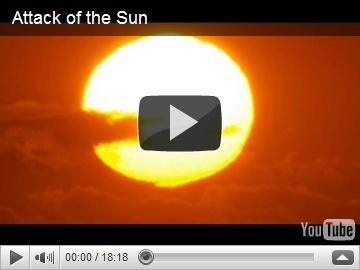
Last year Space.com produced a spectacular 18 minute video entitled Attack of the Sun, which may be viewed on YouTube  (dbl click image to view on the Youtube page).  


As you might imagine, this threat has been picked up and greatly amplified by a number of prophesy/ Mayan 2012/ End-of-the-World websites.  Hyperbole which tends to dilute its legitimacy among many people.


But if you take away the hype, you’ll find that this is a genuine issue.


Predictions over what kind of solar maximum we might see in 2012-2013 have been all over the board the past few years, ranging from above normal to below average. 

Complicating matters right now is the fact that the sun seems to be a bit off schedule. 


It has remained quiet longer than usual, and the level of solar activity right now is below what was expected by now.


Recent predictions have been for a mild solar maximum. 


But even a below average maximum is capable of unleashing a violent solar storm.


As far as preparing, governments and industry around the world are working to `harden’ critical infrastructure against geomagnetic storm damage. 


They’ve got a long way to go, however.


Another `Carrington Event’ may not happen in our lifetime, or it could happen this year. 


No one knows. 


I certainly don’t advocate lying awake at night worrying about it.   But I do believe that we all need to be prepared to deal with a variety of disaster scenarios.


And if you are well prepared for an earthquake, a hurricane, or a pandemic . . . you are automatically in a better position to weather the disruptions caused by a solar storm.


Some resources to get you started on the road to `all threats’ preparedness include:


FEMA http://www.fema.gov/index.shtm

READY.GOV http://www.ready.gov/

AMERICAN RED CROSS http://www.redcross.org/


And a few of my (many) preparedness essays include:


An Appropriate Level Of Preparedness
Inside My Bug Out Bag
Red Cross Unveils `Do More Than Cross Your Fingers’ Campaign
The Gift Of Preparedness


You can search this blog for more preparedness information by clicking this link.


And if you’d like to keep up with the current space weather, and forecasts, www.spaceweather.com is a terrific resource.   You’ll find forecasts, articles, and even the latest videos of solar activity.

image


I’m enough of a science geek that I try to check it every day.

Saturday, May 15, 2010

CAT 5 Got Your Tongue?


# 4569


This weekend is the 30th anniversary of the catastrophic – and deadly – eruption of Mount St. Helens in the Skamania County, Washington.  An event that would claim 57 lives and destroy 250 homes, 47 bridges, more than a dozen miles of railways, and close to 200 miles of roads.


The USGS has a retrospective look at this horrific eruption, including links to several videos.  


Mount St. Helens 30th Anniversary


Eruption forever altered landscape, knowledge of volcanoes
Released: 5/14/2010 5:12:20 PM

Vancouver, Wash. — On Sunday, May 18, 1980 at 8:32 a.m., the bulging north flank of Mount St. Helens slid away in a massive landslide -- the largest in recorded history.  Seconds later, the uncorked volcano exploded and blasted rocks northward across forest ridges and valleys, destroying everything in its path within minutes.


Nine hours of explosive volcanic activity ensued, altering the landscape, and what we know about volcanoes, forever.

Photographo of Mount St. Helens as it was erupting with a giant ash
 cloud rising up.

On Sunday, May 18, 1980 at 8:32 a.m., the bulging north flank of Mount St. Helens slid away in a massive landslide -- the largest in recorded history.   Seconds later, the uncorked volcano exploded and blasted rocks northward across forest ridges and valleys, destroying everything in its path within minutes.


The opening minutes of the eruption claimed the lives of 57 people.  Prevailing winds carried 520 million tons of ash eastward across the United States, producing darkness during daylight hours in Spokane, more than 250 miles away, and other communities is its path.  Water from melting snow and ice mixed with loose rock debris to form lahars – volcanic mudflows – that poured down river valleys ripping trees from their roots and engulfing roads, bridges and houses.


Thirty years later, excess sediment is still moving down those river drainages most affected by erupted debris on May 18, impressing upon all that hazards can persist long after an eruption is over. The eruption left an indelible effect on the regional economy and lives of citizens in the Pacific Northwest and beyond.


(Continue . . . )


Although a variety of scales are used to gauge natural disasters, CATEGORY 5 has generally become shorthand for a catastrophic or disastrous event.


CAT 5 Scales

The worst hurricanes are CAT 5’s, and the new EF-5 scale describes the most severe tornadoes recorded. Even pandemics are measured on a 5-point scale.


Note: There has been talk over the years of adding a Category 6 to the Hurricane Scale, and EF-6 already exists for an `inconceivable’ tornadic event.


Volcanic eruptions use the VEI (Volcanic Explosivity Index), which actually goes up to an 8 (mega-colossal), but Mount St. Helens was a 5 on that scale as well.  Earthquakes are measured using the open-ended Richter or Moment Magnitude scales, with `great quakes’ being 8.0 or greater.


Regardless of the official measurement used, CAT 5 has become synonymous with an extreme disaster.


And for most Americans –indeed, most people living in developed countries - the idea that they might be swept up in a Category 5 event seems inconceivable.


They live under the delusion that destructive tsunami’s, `great’ earthquakes, volcanic eruptions, catastrophic storms, and severe epidemic outbreaks only afflict poor, developing countries.


That somehow, our wealth and technology is protective against truly bad things happening on our soil.


Of course, those who were living in New Orleans in August of 2005 might tend to disagree with that assessment, as would the residents of Homestead, Florida in 1992, and those living in and around Oklahoma City during the F5 tornado of May 3rd, 1999. 


Disasters happen with considerable frequency in this country, just as they do around the world.   And as our population increases, the number of people living in `at risk’ locations – like on barrier islands, or in seismically active areas – grows.


This is something that disaster planners all know, and talk about every year, but few people seem to appreciate.


In fact, the destruction of New Orleans had been called the `mostly widely anticipated disaster in American History’. The levees designed to protect the city were built only high enough to withstand a Cateogory 3 storm, and since their initial construction had settled and fallen into disrepair.


Despite a number of near misses over the years - Camille, a monster Category 5 storm in 1969 and hurricanes Georges in 1998 and Ivan in 2004 - the city and its residents were woefully unprepared for the arrival of Hurricane Katrina.


The yearly admonition to have extra food and water, along with flashlights, lanterns and battery operated radios had been ignored by a large segment of the population. 


Many of those who waited and showed up at the Superdome `shelter of last resort’, showed up empty-handed expecting to be provided for. 


And lest we forget, Katrina was barely a CAT 3 storm at landfall.  Despite the wholesale destruction of New Orleans, she was not the worst that nature can serve up.  Not by a long shot.


image


Most Americans live in places that are subject to natural disasters of one kind or another.   Hurricanes, earthquakes, tornadoes, floods, wild fires . . . . the list of threat is long and impressive.


image

USGS map

As you can see by the map above, most of the United States is seismically active – with Alaska, Hawaii, the west coast, and the mid-west seeing the most – and strongest, quakes.


While we often talk about California, or the Pacific Northwest, of being at particular risk, the mid-west is not immune (see  A Not-So Gentle Reminder From FEMA) to great quakes.


Government warns of "catastrophic" U.S. quake

Thu Nov 20, 2008 6:42pm EST

KANSAS CITY, Missouri (Reuters) - People in a vast seismic zone in the southern and midwestern United States would face catastrophic damage if a major earthquake struck there and should ensure that builders keep that risk in mind, a government report said on Thursday.


The Federal Emergency Management Agency said if earthquakes strike in what geologists define as the New Madrid Seismic Zone, they would cause "the highest economic losses due to a natural disaster in the United States."


FEMA predicted a large earthquake would cause "widespread and catastrophic physical damage" across Alabama, Arkansas, Illinois, Indiana, Kentucky, Mississippi, Missouri and Tennessee -- home to some 44 million people.

(Continue. . )


While I don’t propose that people live in perpetual fear of disasters (I certainly don’t), I do believe that it is incumbent upon each and every one of us to be prepared to help ourselves, and our community, during a crisis.


And for that to happen, we have to openly discuss the possibilities, and plan for them.


Yesterday fellow blogger John Solomon of In Case of Emergency blog wrote in support of a National Disaster Preparedness day, something I agree with.


 If you aren’t reading John’s blog every day, you should.


China Holds Special Disaster Preparedness Day Similar To Japan’s — U.S. Should Follow Suit

May 14th, 2010 ·


We need to talk seriously, and often, about dealing with CAT 5 (or lesser) events in this country. Our general reluctance to discuss the realities of living on a volatile and sometimes hostile planet now will most certainly cost lives, and property, in the future.


Hurricane season is just around the corner as is the Western Wild fire season, Tornado alley saw two EF-4 tornadoes this week (and dozens of EF-3s an EF-2s), and it’s always earthquake season.


Disasters happen.

And so you need to have adequate emergency supplies (including a good first aid kit), to care for your family for at least the first 72 hours following a natural disaster.

Good places to get preparedness information include:


FEMA http://www.fema.gov/index.shtm

READY.GOV http://www.ready.gov/

AMERICAN RED CROSS http://www.redcross.org/

As a former paramedic, I can’t stress enough the importance of having a good first aid kit at home, and in your car.  And just as important, learning how to properly use one.

image


Taking a first-aid course, and CPR training, are both investments that could pay off big someday, for you, and for your loved ones. 


I’ve written on the necessity to have a `to go’, or bug out bag (BOB), several times in the past, including a tour of my own bag.


Inside My Bug Out Bag
What About BOB?


And a few of my (many) preparedness essays include:


An Appropriate Level Of Preparedness
Inside My Bug Out Bag
Red Cross Unveils `Do More Than Cross Your Fingers’ Campaign
The Gift Of Preparedness


The next disaster may strike with little or no notice.  You and your family may have only seconds to react.   Being ready means you can go on with life without worrying obsessively about those things you cannot predict or control.


As I tell people:


Preparing is easy.  Worrying is hard.

Friday, April 30, 2010

A Double Referral On Sheltering In Place


# 4536


SIP stands for Sheltering In Place, something that the Federal government would like to see more people willing and able to do in the event of a natural or man-made disaster.


Whether it be the aftermath of a hurricane, an earthquake, or a terrorist’s dirty bomb . . . people need to be prepared to care for themselves and their loved ones for hours, perhaps even days. 


It is for that reason that I’ve stressed the need for individual and community preparedness, and have urged that every household have enough supplies to last a minimum of 72 hours (food and water), a good first aid kit (and knowledge to use it), an emergency radio, and a family emergency plan.


As a paramedic, I’ve seen what a lack of preparedness and training can cost, in terms of suffering and even lives.  


And as a Floridian who has ridden out more than a few hurricanes, I know what happens to grocery store shelves before, and immediately after a big storm, and what it is like to be without power for an extended period of time.


Which is why I prefer to see people maintain a minimum of two-weeks of emergency supplies in their home.


John Solomon, writing on his In Case Of Emergency Blog, has two entries that I would refer you to this morning.   Both deal with the need for Sheltering In Place after a terrorist attack, and how that could save thousands of lives.


Yesterday, John wrote:


New Study Indicates Most Washington, D.C. Area Residents Would Be Willing To Follow Instructions To ‘Shelter In Place’ After ‘Dirty Bomb’


Followed today by:


“Gimme Shelter: The Need For A Contemporary Civil Defense Program”


Both essays raise important issues.   Highly recommended.


Personally, I prefer to think in terms of `all-threats’ preparedness. But for those who live in New York City, Washington D.C., or other large high-value areas, terrorist attacks certainly have to be considered. 


The bottom line, however, is that willingness to follow emergency instructions isn’t enough.  People have to be prepared to shelter in place before a disaster strikes if they hope to comply. 


Agencies like FEMA, READY.GOV and the HHS are constantly trying to get the preparedness message out, so that when (not `if') a disaster does occur, human losses can be minimized.


For more information on how to prepare for emergencies, up to and including a terrorist attach, the following sites should be of assistance.


FEMA http://www.fema.gov/index.shtm

READY.GOV http://www.ready.gov/

AMERICAN RED CROSS http://www.redcross.org/


And a few of my (many) preparedness essays include:


An Appropriate Level Of Preparedness
Inside My Bug Out Bag
Red Cross Unveils `Do More Than Cross Your Fingers’ Campaign
The Gift Of Preparedness

Friday, April 09, 2010

The Return of `In Case Of Emergency, Read Blog’


# 4483


John Solomon, who pens the In Case of Emergency blog, has been missing from the blogging scene for several months while undergoing a bone marrow transplant.  


This week, he returns, with encouraging news about his treatment, and several new blogs.    You can catch up by checking these four new entries on his site.


  • As Forecasters Predict “Above Average” Hurricane Season, FEMA’s Fugate In Video Challenges Public: “We’re Getting Ready…Are You?”
  • DHS Creates Community Preparedness Task Force; Will Hopefully Include Citizen POV
  • Whatever Administration Decides On Its Disaster Drilling Policy Review, Include The Public In The Drills
  • Back (And Hopefully) Better Than Ever
  •  


    Welcome back, John.