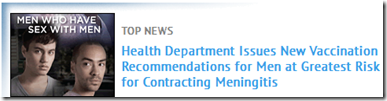
Credit NYC Department of Health
# 6989
Last October, in NYC: The Other Meningitis Outbreak, we looked at an early warning issued by the NYC health department to Men who are HIV-infected and who have had intimate contact with another man met through a website, digital application (“app”), or at a bar or party since September 1, 2012 – who may have been exposed to meningitis.
At the time, the New York City Department of Health and Mental Hygiene provided the following recommendation.
Health Department Reccomends Vaccination for HIV-Positive Men at High Risk of Meningitis
The Health Department issued recommendations today for vaccinating against invasive meningococcal disease – commonly known as meningitis – after a spike of cases reported over the past five weeks.
In January we saw an MMWR report (see MMWR: Invasive Meningococcal Disease Among MSM In New York City) and an expansion of vaccination recommendations to include:
. . . for men, regardless of HIV status, who have had intimate contact with another man that he met through a website, digital application (“App”), or at a bar or party since September 1, 2012 AND live in the following neighborhoods: Bedford-Stuyvesant, Brownsville, Bushwick, Clinton Hill, Crown Heights, Downtown Brooklyn, Dumbo, East New York, Prospect Heights and Williamsburg.
Yesterday, after recording four new cases since the first of the year, NYC issued a new Physician Health Alert (HAN) (PDF) and press release expanding their vaccination recommendations.
First from the HAN notice.
UPDATE: Invasive Meningococcal Disease in Men Who Have Sex with Men,Four New Cases Reported in 2013, Expanded Vaccine Recommendations
Please Share this Alert with All Emergency Medicine, Family Medicine, Primary Care Physicians, HIV Specialists, Infectious Disease, and Internal Medicine Staff in Your Facility
- Four new cases of invasive meningococcal disease have occurred in men who have sex with
men (MSM) in 2013, bringing the total number of cases to 22.- Providers must immediately notify the Department of Health and Mental Hygiene (DOHMH)
of suspect cases. Do not wait for culture confirmation to report a suspected case.- DOHMH has simplified and expanded its vaccine recommendations. Meningococcal vaccine
should now be offered to:
- (a) All HIV-infected MSM
- (b) MSM, regardless of HIV status, who regularly have close or intimate contact with men met through an online website, digital application (“app”), or at a bar or party.
Excerpts from the public press release:
March 6, 2013 – The Health Department issued new recommendations today for vaccinating against invasive meningococcal disease – commonly known as meningitis – after an increase in cases.
Vaccinations are now advised for men, regardless of HIV status, who regularly have intimate contact with other men met through a website, digital application (“App”), or at a bar or party. The Health Department also continues to recommend vaccinations for all HIV-positive men who have sex with men. Individuals who are not sure if they meet the criteria are advised to discuss their need for vaccination with their health care providers.
“Meningitis symptoms usually come on quickly, and the disease can be fatal if not treated right away,” said Health Commissioner Dr. Thomas Farley. “Vaccination is the best defense. I urge all men who meet these criteria – regardless of whether they identify as gay – to get vaccinated now and protect themselves from this disease before it is too late.”
Individuals who meet some, but not all, of the criteria are advised to discuss their need for vaccination with their health care provider.
- Read the most recent press release
For more on Meningococcal Meningitis, The New York City Department of Health and Mental Hygiene maintains a FAQ page.
What is invasive meningococcal disease?
Invasive meningococcal disease is a severe infection caused by the bacteria Neisseria meningitidis (meningococcus) that includes both meningitis (infection of the meninges - a thin lining covering the brain and spinal cord) or meningococcemia (infection of the blood). The infection can also occur as pneumonia (an infection of the lungs) or in joints, such as the knees. In 2009, there were 17 cases of invasive meningococcal disease reported among New York City residents (rate of 0.21 cases per 100,000 persons).
Who gets invasive meningococcal disease?
Anyone can get invasive meningococcal disease. Infants < 12 months of age have the highest rates of disease. Clusters of cases and outbreaks do occur but are rare in the United States.
How is invasive meningococcal disease spread?
The meningococcus is spread by direct close contact with nose or throat discharges of an infected person. About eight percent of healthy people carry this particular bacterium in their nose and throat without any signs of illness. Why certain people become ill upon acquiring the organism is not fully understood. Close living quarters, such as in military barracks and dormitories, favor transmission of the organism.What are the symptoms of invasive meningococcal disease?
Although most people exposed to the meningococcus bacteria do not become seriously ill, some may develop fever, headache, vomiting, stiff neck and a rash. Sometimes the disease can be fatal.

The CDC’s webpage on Meningococcal Disease.

