# 9465
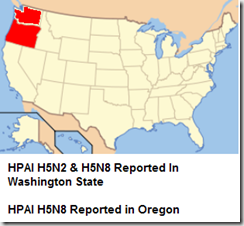
While not making huge headlines, one of the big stories of the week has been the encroachment of HPAI H5N8 (and HPAI H5N2) into the Pacific Northwest, likely carried in via migratory birds.
Just above the border in British Columbia, North America’s first outbreak of HPAI H5 (see CFIA: 11th Poultry Operation Identified With H5N2) - which began nearly 3 weeks ago - continues to plague poultry operations.
Today it was announced (h/t Sharon Sanders on FluTrackers) that Oregon is now the second state this week to detect the arrival of these highly pathogenic avian flu viruses (see Tuesday’s OIE/APHIS of HPAI H5N8 & H5N2 Detected In Washington State Wild Birds).
At this point no U.S. commercial poultry operations have been affected, and the risk to human health from these viruses is considered low. First stop, the Animal and Plant Health Inspection Service (APHIS) release on this latest detection:
H5N8 Found in Backyard Poultry in Oregon; Virus not found in commercial poultry in U.S. - No public health concern at this time
Dec. 18, 2014— The United States Department of Agriculture’s (USDA) Animal and Plant Health Inspection Service (APHIS) confirmed the presence of highly pathogenic (HPAI) H5N8 avian influenza in guinea fowl and chickens from a small backyard poultry flock in Winston, Oregon. The flock of approximately 100 birds has access to the outdoors. A pond and a marsh on the premises are frequented by migratory birds. The H5N8 virus has NOT been found in commercial poultry anywhere in the United States. There is no immediate public health concern, as the H5N8 virus has been found in birds in other parts of the world and has not caused any human infection to date.
Surveillance for avian influenza is ongoing in commercial poultry operations, live bird markets, and in migratory wild bird populations. Additionally, commercial poultry producers follow strict biosecurity practices and raise their birds in very controlled environments. Birds from the affected backyard flock will not enter the food chain. All poultry, poultry products and wild birds are safe to eat as long as they are properly handled and cooked to a temperature of 165 degrees Fahrenheit. The finding in Oregon was quickly reported and identified due to increased awareness of avian influenza in light of the HPAI H5 findings in wild birds in Washington State earlier this week. This H5N8 virus is the same virus that was found in the Washington State gyrfalcons.
Oregon State officials and USDA are working jointly to respond to this detection, following existing HPAI response plans. The State of Oregon quarantined the affected premises, and APHIS will assist the State in depopulating the remaining birds to prevent the spread of the disease. Additional surveillance of poultry around the infected premises will be conducted as outlined in the response plans. USDA notified the World Organization for Animal Health (OIE) of this detection today as required by the OIE. USDA expects trading partners to respond to this reported detection according to OIE’s science-based standards. USDA is working with trading partners to minimize trade impacts on poultry and poultry products as much as possible.
All bird owners, whether commercial producers or backyard enthusiasts, are encouraged to practice good biosecurity, prevent contact between their birds and wild birds, and to report sick birds or unusual bird deaths to State/Federal officials, either through your state veterinarian or through USDA’s toll-free number at 1-866-536-7593. Additional information on biosecurity for backyard flocks can be found at
healthybirds.aphis.usda.gov USDA is coordinating closely with its partners, including Washington and Oregon State officials, the U.S. Department of the Interior and the U.S. Department of Health and Human Services, on avian influenza surveillance, reporting, and control.
Meanwhile, the State of Oregon has released the following statement:
News release: Oregon activates avian influenza response plan
News release, Plants, Animals, Insects
December 19th, 2014
24 views
The State of Oregon has activated a multi-agency response plan following the confirmation of highly pathogenic H5 avian influenza in domestic birds in Douglas County. The Oregon Department of Agriculture is the lead state agency responding to the incident, working closely with the Oregon Department of Fish and Wildlife, and Oregon Health Authority. The US Department of Agriculture’s Animal Plant Health Inspection Service (USDA-APHIS) will play a key role in the response as well.
There is no immediate public health concern due to the avian influenza virus detected in Oregon. H5N8 virus has been found in other parts of the world and has not caused any human infection to date. Avian influenza does not affect poultry meat or egg products, which remain safe to eat. As always, both wild and domestic poultry should be properly cooked.
The H5N8 avian influenza virus was confirmed by USDA in guinea fowl and chickens from a small backyard poultry flock in Winston, Oregon. The flock of approximately 100 birds has access to the outdoors. A pond and a marsh on the premises are frequented by migratory birds. The virus has not been found in commercial poultry anywhere in the US. Surveillance for avian influenza is ongoing in commercial poultry operations, live bird markets, and in migratory wild bird populations.
The finding in Oregon was quickly reported and identified due to increased awareness of avian influenza in light of the high path avian influenza findings in wild birds in Washington earlier this week. This H5N8 virus is the same virus that was found in a Washington captive gyrfalcon.
ODA is advising commercial poultry growers and backyard flock owners to be vigilant with biosecurity measures and surveillance.
“Steps are being taken to contain the disease and we have not diagnosed avian influenza elsewhere in Oregon’s domestic poultry population, but the presence of the virus in migratory waterfowl poses a potential risk to our backyard poultry,” says ODA’s State Veterinarian Dr. Brad LeaMaster. “This event underscores the importance of biosecurity for backyard bird owners. We strongly encourage owners to take biosecurity measures to reduce the risk of spreading the disease. That includes preventing contact between their birds and wild birds. We also want them to monitor their flock closely and report sick birds.”
Backyard flock owners can report sick birds to the State Veterinarian’s office at 1-800-347-7028 or can call USDA toll free at 1-866-536-7593.
Oregon’s commercial poultry industry has a robust avian influenza testing program and ODA conducts weekly surveillance testing and health inspections at the state’s only live bird market in Woodburn. In addition, wild bird mortality surveillance is routinely conducted by the Oregon Department of Fish and Wildlife. Wild bird deaths can be reported to the ODFW toll-free line at 1-866-968-260


