Showing posts with label Portugal. Show all posts

Friday, November 14, 2014

ECDC: Rapid Risk Assessment On Portugal’s Legionnaire’s Disease Outbreak

image 

Credit ECDC


# 9322


Yesterday, in WHO: Legionnaire’s Disease Outbreak – Portugal, we saw the official announcement of one of the largest outbreaks of Legionella that we’ve seen inyears; more than 300 cases in a week’s time.  While not a record (Murcia, Spain saw 800+ cases in 2001), this is a very large cluster, and the outbreak is ongoing.


Based on the size and rapid growth of the cluster, the WHO called it a `major public health emergency’.  But Legionnaire’s is not a communicable disease, and so the threat is limited to those who are directly exposed to the environmental source of the bacteria.


The Legionella bacteria thrives in warm water, such as is commonly found in air-conditioning cooling towers, hot tubs, and even ornamental water fountains. When water is sprayed into the air the bacteria can become aerosolized and inhaled.


Those who are susceptible (often smokers, immunocompromised, elderly, etc.) can develop serious – even life threatening – pneumonia.


Today the ECDC has produced a Rapid Risk Assessment for the rest of the EU, which includes a good deal of background on Legionnaire’s disease.  I’ve only posted some excerpts, click the link to download the entire PDF.


RAPID RISK ASSESSMENT

Outbreak of Legionnaires’ disease in the Lisbon area, Portugal

13 November 2014

ECDC threat assessment for the EU


The large number of cases in a short period of time suggests an environmental source that has spread contaminated aerosols in the area. The Portuguese authorities are focusing the environmental investigation on such a possibility. Since 9 November they have implemented precautionary measures in closing cooling towers of major industrial installations in the area of Vila Franca de Xira. People who have been in the affected area in the past three weeks (longest documented incubation period is 19 days) may therefore have been at risk of infection, and could be currently incubating the disease and may develop symptoms up to three weeks after exposure.


People with underlying illness or a weakened immune system are at increased risk of developing the disease if exposed and may present with more severe disease.


Since Legionnaires’ disease cannot be transmitted from person-to-person, the risk remains limited to people who have been possibly exposed in the affected area during the period when the bacteria was spread in the environment. Travellers who have visited Vila Franca de Xira in the past three weeks and who develop symptoms of Legionnaires’ disease should seek rapid medical advice and indicate their possible exposure.


The health authorities in Portugal have kept the public informed through regular press releases and local information sessions about the disease and exposure risks.


To date, no cases associated with this outbreak have been detected outside of Portugal. The suspected cases reported in Peru and Angola were further excluded for Legionella. Legionnaires’ disease cases that are detected outside of Portugal and who match the case definition (see Annex 2) should be reported through ELDSNet (eldsnet@ecdc.europa.eu).

Conclusions


The outbreak of Legionnaires’ disease in Portugal with 311 cases reported as of 13 November 2014 is one of the largest in the European Union. Vila Franca de Xira is not considered a tourist destination and no case has so far been confirmed outside Portugal. Despite the magnitude of the outbreak, this event can be considered a local event. All cases were infected in Vila Franca de Xira where the outbreak is occurring.


Cooling towers of major industrial installations in the area of Vila Franca de Xira were closed and investigations to identify the source of the outbreak are ongoing.

Thursday, November 13, 2014

WHO: Legionnaire’s Disease Outbreak – Portugal

image

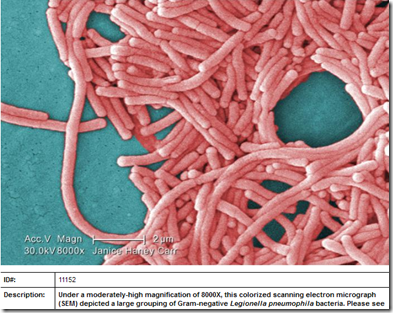
Legionella Bacteria - Photo Credit CDC PHIL


# 9319


Over the past few days I’ve noticed a few stories regarding an expanding outbreak of Legionnaire’s Disease in a suburb of Lisbon, Portugal.  Today, based on the rapid growth and unusually large size of the outbreak, the World Health Organization has issued the following Disease Outbreak News report.


Legionnaires' disease – Portugal

Disease outbreak news
13 November 2014

On 9 November 2014, WHO was notified by the National IHR Focal Point for Portugal of a large outbreak of Legionnaires' disease in Vila Franca de Xira, a suburban area of Lisbon.

Details of the cases are as follows:

The first 17 cases were identified between 6 and 7 November. Since then, the number of cases has increased exponentially. On 12 November, the Directorate-General for Health of Portugal reported a total of 302 cases of Legionnaires' disease. So far, 5 deaths have been confirmed to be caused by the disease. Four more deaths are currently being investigated. All cases have epidemiological links to the outbreak taking place in Vila Franca de Xira.

This is the biggest Legionella disease outbreak detected in Portugal, and it is evolving rapidly; therefore, the outbreak is considered to be a major public health emergency.

At present, the regional outbreak investigation team is in place and it is supported by a larger national team of experts in epidemiology, clinical, microbiology and environmental health, with other stakeholders from the municipality following the epidemiological situation and undertaking environmental investigations.

Precautionary measures

As precautionary measures, ornamental fountains in the outbreak area have been closed, and the chlorine concentration of tap water has been increased. Cooling towers of the main industrial facilities in the affected area have been closed down.

The Directorate-General for Health of Portugal has issued the following precautionary recommendations to the population, until the source of the outbreak has been identified and eliminated:

  • to avoid showers, Jacuzzis and whirlpools;
  • to disinfect shower heads by immersion in bleach solutions for about 30 minutes once a week,
  • to set the temperature on water heaters above 75ÂșC, if possible.

The Directorate-General for Health is liaising with the national agencies for health, environment and meteorology. It is also maintaining close communication and collaboration with partners in the European Union – especially, the European Centre for Disease Prevention and Control (ECDC) – and with the World Health Organization. WHO Regional Office for Europe and its Centre for Environment and Health in Bonn, Germany have been fully informed, and stand ready to mobilise experts, if required.


While an infectious pneumonia, Legionella is not considered a contagious disease.  It is transmitted environmentally. The bacteria thrives in warm water, such as is often found in air-conditioning cooling towers, hot tubs, and even ornamental water fountains. Improper maintenance or poor design can lead to the bacteria blooming.


When water is sprayed into the air the bacteria can become airborne, and if inhaled by a susceptible host, can cause a serious (and sometimes fatal) form of pneumonia.


While large outbreaks of Legionella are often traced to specific causes, quite often the source of the infection for sporadic cases remains a mystery.


Legionella got it’s name after it was identified as the bacterial cause of a large pneumonia outbreak at Philadelphia’s Bellevue Stratford Hotel during an American Legion convention in 1976. During this outbreak, 221 people were treated and 34 died.


We now know Legionella to be a major cause of infectious pneumonia, and that it can sometimes spark large outbreaks of illness. 


According to the CDC between 8,000 and 18,000 Americans are hospitalized with Legionnaire's Disease each year, although many more milder cases likely occur. For background information on the disease, the CDC maintains a fact sheet at Patient Facts: Learn More about Legionnaires' disease.