Showing posts with label SITREP. Show all posts

Friday, October 31, 2014

WHO Ebola Response Situation Report – Oct 31st

image


# 9263


The numbers coming out of West Africa continue to bounce around, with the total number of cases actually down by nearly 200 over the report from October 29th, but the number of fatalities slightly higher.


This drop in cases was attributed to some suspected cases in Guinea being ruled out.


Given the limits of surveillance and reporting in these three countries, there’s not a great deal of faith that the numbers we are getting truly represent the size or scope of this epidemic.


EBOLA RESPONSE ROADMAP SITUATION REPORT

SUMMARY

total of 13 567 confirmed, probable, and suspected cases of Ebola virus disease (EVD) have been reported in six affected countries (Guinea, Liberia, Mali, Sierra Leone, Spain, and the United States of America) and two previously affected countries (Nigeria, Senegal) up to the end of 29 October. There have been 4951 reported deaths. The cases reported are fewer than those reported in the Situation Report of 29 October, due mainly to suspected cases in Guinea being discarded.


Following the WHO Ebola Response Roadmap structure1, country reports fall into two categories: 1) those with widespread and intense transmission (Guinea, Liberia, and Sierra Leone); and 2) those with or that have had an initial case or cases, or with localized transmission (Mali, Nigeria, Senegal, Spain, and the United States of America). An overview of the situation in the Democratic Republic of the Congo, where a separate, unrelated outbreak of EVD is occurring, is also provided (see Annex 2).


1. COUNTRIES WITH WIDESPREAD AND INTENSE TRANSMISSION

A total of 13 540 confirmed, probable, and suspected cases of EVD and 4941 deaths have been reported up to the end of the 29 October 2014 by the ministries of health of Guinea and Sierra Leone, and 25 October by the Ministry of Health of Liberia (table 1). All districts in Liberia and Sierra Leone have now reported at least one case of EVD since the start of the outbreak (figure 1). Of the eight Guinean and Liberian districts that share a border with Cote d Ivoire, only one in Guinea is yet to report a confirmed or probable case of EVD.


A total of 523 health-care workers (HCWs) are known to have been infected with EVD up to the end of 29 October: 82 in Guinea; 299 in Liberia; 11 in Nigeria; 127 in Sierra Leone; one in Spain; and three in the United States of America (two were infected in the USA and one in Guinea). A total of 269 HCWs have died.

WHO is undertaking extensive investigations to determine the cause of infection in each case. Early indications are that a substantial proportion of infections occurred outside the context of Ebola treatment and care. Infection prevention and control quality assurance checks are now underway at every Ebola treatment unit in the three intense-transmission countries. At the same time, exhaustive efforts are ongoing to ensure an ample supply of optimal personal protective equipment to all Ebola treatment facilities, along with the provision of training and relevant guidelines to ensure that all HCWs are exposed to the minimum possible level of risk.

image

(Continue . . .)

Friday, September 12, 2014

WHO Ebola Roadmap: SitRep # 3

image

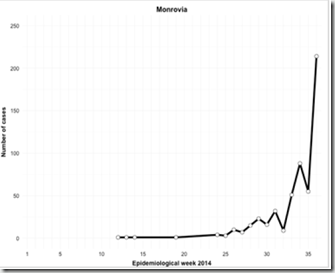
The Epi Curve from hell – Monrovia


# 9068


Today the World Health Organization has published their third Ebola Roadmap Situation Report, which continues to show the Ebola epidemic spiraling out of control in Western Africa.   The WHO also held a press briefing this morning (which I confess, I’ve not had time to listen to) with even more current numbers.  You’ll find the audio link below:


12 September 2014 virtual press briefing on support to Ebola affected countries and the Cuban Government commitment to help control the outbreak in west Africa

Speakers: Dr Margaret Chan, WHO Director- General and Dr Roberto Morales Ojeda, Minister of Public Health, Cuba.


I’ve only excerpted a portion of the SitRep, Follow the link to read the entire 7-page PDF file.


WHO: Ebola Response Roadmap Situation Report 3


12 September 2014

This is the third in a series of regular situation reports on the Ebola Response Roadmap1. The report contains a review of the epidemiological situation, and an assessment of the response measured against the core Roadmap indicators where available. Additional indicators will be reported as data are consolidated.


The data contained in this report are based on the best information available. Substantial efforts are ongoing to improve the availability and accuracy of information about both the epidemiological situation and the implementation of the response.


Following the roadmap structure, country reports fall into three categories: those with widespread and intense transmission (Guinea, Liberia, and Sierra Leone); those with an initial case or cases, or with localized transmission (Nigeria, Senegal); and those countries that neighbour areas of active transmission (Benin, Burkina Faso, Côte d’Ivoire, Guinea-Bissau, Mali, Senegal).


OVERVIEW

The total number of probable, confirmed and suspected cases in the current outbreak of Ebola virus disease (EVD) in West Africa was 4366, with 2218 deaths, as at 7 September 2014 (see table 1). Countries affected are Guinea, Liberia, Nigeria, Senegal and Sierra Leone. Figure 1 below shows the total number of cases by country that have been reported between the start of 30 December 2013 (epidemiological week 1) and end 7 September 2014 (epidemiological week 36).


image

1. COUNTRIES WITH WIDESPREAD AND INTENSE TRANSMISSION


There has been no indication of any down-turn in the epidemic in the three countries that have widespread and intense transmission (Guinea, Liberia, and Sierra Leone), with a surge in new cases in Liberia a particular cause for concern (see table 1). Transmission is continuing in urban areas, with the surge in Liberia being driven primarily by a sharp increase in the number of cases reported in the capital, Monrovia.

The figures below show the numbers of confirmed and probable new cases over time in each of the countries with widespread and intense transmission, accompanied by numbers of cases over time in capital cities. For Liberia, it is notable that the proportion of suspected cases that result in death is high (211 deaths from 453 suspected cases; 47%), which suggests that many of the suspected cases are in fact genuine cases.

(Continue . . . )


Monday, September 08, 2014

WHO: Liberia, Ebola Cases Increasing `Exponentially’

image

# 9055

On top of the news that a WHO doctor in Sierra Leone has contracted the virus , we’ve a somber assessment in today’s Situation Report from the World Health Organization , one that warns that `thousands’ of new cases are expected in Liberia alone over the next three weeks.

Ebola situation in Liberia: non-conventional interventions needed

Situation assessment - 8 September 2014

During the past weeks, a WHO team of emergency experts worked together with President Ellen Johnson Sirleaf and members of her government to assess the Ebola situation in Liberia.

Transmission of the Ebola virus in Liberia is already intense and the number of new cases is increasing exponentially.

The investigative team worked alongside staff from the Ministry of Health, local health officials, and other key partners working in the country.

All agreed that the demands of the Ebola outbreak have completely outstripped the government’s and partners’ capacity to respond. Fourteen of Liberia’s 15 counties have now reported confirmed cases.

Some 152 health care workers have been infected and 79 have died. When the outbreak began, Liberia had only 1 doctor to treat nearly 100,000 people in a total population of 4.4 million people. Every infection or death of a doctor or nurse depletes response capacity significantly.

Liberia, together with the other hard-hit countries, namely Guinea and Sierra Leone, is experiencing a phenomenon never before seen in any previous Ebola outbreak. As soon as a new Ebola treatment facility is opened, it immediately fills to overflowing with patients, pointing to a large but previously invisible caseload.

Of all Ebola-affected countries, Liberia has the highest cumulative number of reported cases and deaths, amounting, on 8 September, to nearly two thousand cases and more than one thousand deaths. The case-fatality rate, at 58%, is also among the highest.

Situation in Montserrado county

The WHO investigation concentrated on Montserrado county, which includes Liberia’s capital, Monrovia. The county is home to more than one million people. The teeming West Point slum, which has no sanitation, little running water, and virtually no electrical supplies, is also located in Monrovia, and is adjacent to the city’s major market district.

In Montserrado county, the team estimated that 1000 beds are urgently needed for the treatment of currently infected Ebola patients. At present only 240 beds are available, with an additional 260 beds either planned or in the process of being put in place. These estimates mean that only half of the urgent and immediate capacity needs could be met within the next few weeks and months.

The number of new cases is moving far faster than the capacity to manage them in Ebola-specific treatment centres.

For example, an Ebola treatment facility, hastily improvised by WHO for the Ministry of Health, was recently set up to manage 30 patients but had more than 70 patients as soon as it opened.

WHO estimates that 200 to 250 medical staff are needed to safely manage an Ebola treatment facility with 70 beds.

The investigation team viewed conditions in general-purpose health facilities as well as Ebola-specific transit and treatment facilities.

The John F Kennedy Medical Center in Monrovia, which was largely destroyed during Liberia’s civil war, remains the country’s only academic referral hospital. The hospital is plagued by electrical fires and floods, and several medical staff were infected there and died, depleting the hospital’s limited workforce further.

The fact that early symptoms of Ebola virus disease mimic those of many other common infectious diseases increases the likelihood that Ebola patients will be treated in the same ward as patients suffering from other infections, putting cases and medical staff alike at very high risk of exposure.

In Monrovia, taxis filled with entire families, of whom some members are thought to be infected with the Ebola virus, crisscross the city, searching for a treatment bed. There are none. As WHO staff in Liberia confirm, no free beds for Ebola treatment exist anywhere in the country.

According to a WHO staff member who has been in Liberia for the past several weeks, motorbike-taxis and regular taxis are a hot source of potential Ebola virus transmission, as these vehicles are not disinfected at all, much less before new passengers are taken on board.

When patients are turned away at Ebola treatment centres, they have no choice but to return to their communities and homes, where they inevitably infect others, perpetuating constantly higher flare-ups in the number of cases.

Other urgent needs include finding shelters for orphans and helping recovered patients who have been rejected by their families or neighbours.

Last week, WHO sent 1 of its most experienced emergency managers to head the WHO office in Monrovia. Coordination among key partners is rapidly improving, aiming for a better match between resources and rapidly escalating needs.

Implications of the investigation

The investigation in Liberia yields 3 important conclusions that need to shape the Ebola response in high-transmission countries.

First, conventional Ebola control interventions are not having an adequate impact in Liberia, though they appear to be working elsewhere in areas of limited transmission, most notably in Nigeria, Senegal, and the Democratic Republic of Congo.

Second, far greater community engagement is the cornerstone of a more effective response. Where communities take charge, especially in rural areas, and put in place their own solutions and protective measures, Ebola transmission has slowed considerably.

Third, key development partners who are supporting the response in Liberia and elsewhere need to prepare to scale up their current efforts by three- to four-fold.

As WHO Director-General Dr Margaret Chan told agencies and officials last week in New York City and Washington, DC, development partners need to prepare for an “exponential increase” in Ebola cases in countries currently experiencing intense virus transmission.

Many thousands of new cases are expected in Liberia over the coming 3 weeks.

WHO and its Director-General will continue to advocate for more Ebola treatment beds in Liberia and elsewhere, and will hold the world accountable for responding to this dire emergency with its unprecedented dimensions of human suffering.

Friday, September 05, 2014

WHO Ebola Response Roadmap SitRep #2 – Sept 5th

image

Ebola Hotspots – Sitrep # 2


# 9043


Today the World Health Organization has released their second in a series of weekly situation updates in their new Ebola Response Roadmap format (see last week’s SitRep #1).  This report describes Ebola transmission over the past three weeks in Liberia, Sierra Leone and Guinea as being `dramatically increased’, and both `widespread and intense‘.


A few excerpts from the report, but follow the link to download and read  data and graphic rich update it in its entirety.


WHO: Ebola Response Roadmap Situation Report 2

5 September 2014


This is the second in a series of regular updates on the Ebola Response Roadmap. The update contains a review of the epidemiological situation and response monitoring against the core Roadmap indicators. Additional indicators will be reported as data are consolidated.


The data contained in this report are based on the best information available. Disease Outbreak News will continue to give information on new cases as they are reported officially to WHO. Substantial efforts are being made to improve the availability and accuracy of information about both the epidemiological situation and the response implementation.


Following the roadmap structure, country reports fall into three categories: those with widespread and intense transmission (Guinea, Liberia, and Sierra Leone); those with an initial case or cases, or with localized transmission (Nigeria, Senegal); and those sharing land borders with areas of active transmission (Benin, Burkina Faso, Côte d’Ivoire, Guinea-Bissau, Mali, Senegal).

OVERVIEW


The total number of probable, confirmed and suspected cases in the current outbreak of Ebola virus disease (EVD) in West Africa was 3685, with 1841 deaths, as at 31 August (see http://www.who.int/csr/don/2014_09_04_ebola/en/). Countries affected are Guinea, Liberia, Nigeria, Senegal and Sierra Leone.1 The figure below shows the total number of cases by country that have been reported between the beginning of January 2014 (epidemiological week 1) and 31 August 2014 (epidemiological week 35).

image

In the past three weeks, cases have dramatically increased in the three countries with widespread and intense transmission, both inland and in the capitals. This highlights the urgent need to reinforce control measures and increase capacity for case management, safe burials, contact tracing, and social mobilization.

(Continue . . . )

Friday, August 29, 2014

WHO: Ebola Response Roadmap Situation Report # 1

image


# 9017


This morning the World Health Organization has released as 7 page PDF SitRep (Situation Report) on the Ebola Outbreak in Western Africa.   This comes one day after releasing their Ebola Response Roadmap, which calls for a massive international effort and nearly 500 million dollars to respond to the crisis.


A few excerpts from the report, but follow the link to download and read it in its entirety.


WHO: Ebola Response Roadmap Situation Report 1

29 August 2014

(Excerpt)

The figures below show the distribution of confirmed and probable cases in each of these countries, accompanied by numbers of cases over time in capital cities.


GUINEA


These data indicate that the reporting of cases in Guinea appears to have been relatively stable, but with a marked increase in the recent week. Priorities continue to be to reduce incidence in the epicentre (Gueckedou), and to address threatening foci in Conakry.
LIBERIA

image

LIBERIA


By contrast, in Liberia, cases are increasing in the epicentre (Lofa) and in the capital, Monrovia.

image

SIERRA LEONE


The incidence of cases in Sierra Leone has been relatively flat, although with increases in the past week. Problems in scaling up response measures persist, notably in two districts, Kenema and Kailahun. Numbers of cases increased in the capital, Freetown.


  image


Regarding Nigeria, the news yesterday that two new cases (1 confirmed, 1 suspected) had turned up in Port Harcourt means that containment of the virus has yet to be accomplished.


COUNTRIES WITH AN INITIAL CASE OR CASES, OR WITH LOCALIZED TRANSMISSION


To date, the only country with cases linked to a case imported from a country with widespread and intense transmission is Nigeria. The table below shows the distribution of cases in that country.

image 


The first 14 confirmed cases were all linked to persons, including health care workers, in close contact with an air traveller from Liberia, who entered Lagos on 20 July and died five days later. On 27 August, 1 additional case was confirmed in Port Harcourt by the Ministry of Health. A Ministry of Health and WHO team is in Port Harcourt supporting contact tracing and further investigation of the incident.


And lastly, a look at some of the response challenges on the ground.


There are serious problems with case management and infection prevention and control. The situation is worsening in Liberia and Sierra Leone.

  • In Guinea, the capacity to manage the current load of EVD cases is currently adequate in Gueckedou and in Conakry.
  • In Liberia, the capacity to cope with the increasing caseload remains dramatically low, especially in the capital, Monrovia, as well as in Bong and Nimba counties.
  • In Nigeria, a 40-bed isolation unit has been set up in the Mainland Hospital, and is sufficient to accommodate the patients currently isolated. The Ministry of Health has set up an isolation unit in Lagos town to care for cases.
  • In Sierra Leone, there is inadequate capacity to accommodate patients in Freetown. Patients must be transferred to Kenema, which is already overwhelmed by local demand.
  • Health care workers continue to be seriously affected in all countries, especially in Liberia and Nigeria.

Laboratory capacity


In Guinea, laboratory capacity currently appears to be sufficient. Support is being provided by the Pasteur Institute Dakar in Conakry, the European Union Mobile Laboratory in Gueckedou, and WHO.

  • In Liberia, specimens from Lofa county are tested in Guinea. Additional laboratory support is needed in Lofa to alleviate this burden. Specimens from other counties far from Lofa are sent to Monrovia, where laboratory capacity, supported by the United States Army Medical Research Institute of Infectious Diseases, US National Institutes of Health, and US Centers for Disease Control and Prevention, is stretched. The need for more laboratory support is being assessed in Bong (Pheebe hospital), Nimba and Bomi counties.
  • In Sierra Leone, additional laboratory support is needed in addition to the Kenema laboratory (supported by Metabiota and the US Department of Defense Critical Reagent Team) to cope with the increasing disease burden. A mobile laboratory from South Africa has been deployed to Freetown, where Ebola treatment centres are being constructed to care for patients locally and in better conditions, rather than referring them to Kenema.
  • In Nigeria, the Lagos University Teaching Hospital virology lab and the Lagos University Laboratory are being supported by WHO and an EU mobile team from the WHO Collaborating Centre in Hamburg, Germany.


Friday, August 22, 2014

WHO Ebola Messaging – Shadow Zones & Uncounted Cases

image

Credit CDC


# 8988


In every serious disease outbreak – in every nation of the world – there are always uncounted cases.  Sometimes, as with the H1N1 pandemic of 2009 or with our yearly seasonal flu, there are simply too many cases to test or count, and so we rely on estimates based on mathematical models.  

 
Often, mild cases of some diseases simply don’t seek medical help, and fall through the cracks, as the pyramid chart below illustrates.

image


But more ominously, particularly in under-developed regions of the world dealing with deadly illnesses, undercounts can result from serious deficits in their public health infrastructure, and a reluctance of people to come forward.


It has become increasingly apparent over the past month that the numbers we have on the Ebola outbreak in West Africa badly underestimate the true scope of the outbreak. Today, the World Health Organization weighs in on some of the reasons why the impact of this outbreak remains so difficult to quantify.


image

Twitter messaging From @WHO this morning.


This from an email sent to journalists.  I would expect it to be posted HERE at some point.


Why the Ebola outbreak has been underestimated

Situation assessment - 22 August 2014

The magnitude of the Ebola outbreak, especially in Liberia and Sierra Leone, has been underestimated for a number of reasons.


Many families hide infected loved ones in their homes. As Ebola has no cure, some believe infected loved ones will be more comfortable dying at home.


Others deny that a patient has Ebola and believe that care in an isolation ward – viewed as an incubator of the disease – will lead to infection and certain death. Most fear the stigma and social rejection that come to patients and families when a diagnosis of Ebola is confirmed.


These are fast-moving outbreaks, creating challenges for the many international partners providing support. Quantities of staff, supplies, and equipment, including personal protective equipment, cannot keep up with the need. Hospital and diagnostic capacities have been overwhelmed.


Many treatment centres and general clinics have closed. Fear keeps patients out and causes medical staff to flee.


In rural villages, corpses are buried without notifying health officials and with no investigation of the cause of death. In some instances, epidemiologists have travelled to villages and counted the number of fresh graves as a crude indicator of suspected cases.


In parts of Liberia, a phenomenon is occurring that has never before been seen in an Ebola outbreak. As soon as a new treatment facility is opened, it is immediately filled with patients, many of whom were not previously identified. This phenomenon strongly suggests the existence of an invisible caseload of patients who are not being detected by the surveillance system.


For example in Monrovia, Liberia’s capital, an Ebola treatment centre with 20 beds, which opened last week, was immediately overwhelmed with more than 70 patients.


An additional problem is the existence of numerous “shadow-zones”. These are villages with rumours of cases and deaths, with a strong suspicion of Ebola as the cause, that cannot be investigated because of community resistance or lack of adequate staff and vehicles.


In some areas, most notably Monrovia, virtually all health services have shut down. This lack of access to any form of health care contributed to the mobbing incident on Saturday at an Ebola holding facility in the West Point township, Liberia’s most disease-prone slum.

Rumours spread that the holding facility, hastily set up by local authorities in an abandoned schoolhouse, was actually a clinic for general health care. People from other communities brought their ailing family members there, where they were housed together with suspected Ebola patients.

The presence of patients from these other communities was resented by the West Point community, and this resentment contributed to the riot and subsequent looting, in which potentially contaminated materials were carried into these communities.

WHO epidemiologists in Sierra Leone and Liberia are working with other agencies, including Médecins Sans Frontières (Doctors without Borders) and the US Centers for Disease Control and Prevention, to produce more realistic estimates and thus communicate the true magnitude of needs.

WHO media contacts:
Gregory Hartl
Telephone: +41 22 791 4458
Mobile: +41 79 203 6715
Email:
hartlg@who.int
Fadéla Chaib
Telephone: + 41 22 791 3228
Mobile:+ 41 79 475 55 56
Email:
chaibf@who.int
Tarik Jasarevic
Mobile: +41 793 676 214

Monday, April 11, 2011

Japan: SEEDS Earthquake SITREP # 13


# 5483


Often lost amid the international coverage of the ongoing nuclear crisis in Japan is the fact that one month after the devastating 9.0 earthquake and the ensuing tsunami that swept across the coastline of Honshu Japan, the situation for tens of thousands of survivors remains dire.


  • Hundreds of thousands have been displaced from their damaged homes or forced to evacuate due to radiation concerns from the damaged Fukushima Daiichi reactors. 


  • Hundreds of thousands more are still without electricity, running water, or means of employment. 


  • Tens of thousands are either dead or missing.


Scores of relief agencies are at work, doing what they can to alleviate the misery, but their efforts are limited by the immense scope of the disaster, continuing aftershocks, and radiation and safety concerns.


SEEDS Asia is a non-profit organization formed in Kobe, Japan after their earthquake in 1995, and they have published a series of Situation Reports (SITREPS) in the wake of the Tohoku earthquake that give us some sense of the scope of Japan’s disaster. 


Today via Reliefweb, we’ve installment # 13.


image

Japan: The 2011 off the Pacific coast of Tohoku Earthquake - Situation Report 13

Source: SEEDS Asia

Date: 10 Apr 2011

Full_Report (pdf* format - 468.2 Kbytes)

I. Overview


- 150,000 evacuees still in shelter

- 430,000 households out of gas in affected area

- first move to temporary shelter started, government to build 70,000 units by Aug

- Japanese NGOs on the ground increasing, gap-filling by city/town and sector urgent


With the massive earthquake and the following tsunamis happened on 11 March 2011 (14:46 JST), the death toll is still raising and reached 13,013 today. The casualties and missing are expected to exceed 27,000, and after one month from the disaster, more than 14,000 are missing. According to the Ministry of Health, 82 children became orphaned in Iwate, Miyagi and Fukushima.


There are 150,000 evacuees still staying in evacuation shelters today. People near Fukushima Nuclear Power Plants continue evacuating to surrounding Prefectures and it is expected that the number will continue to increase. After a huge aftershock on 7 April, more than 430,000 households are out of electricity in the affected area.


First move to newly build temporary shelters started over the weekend (36 units in Rikuzen Takata, Iwate). Prime Minister Kan indicated plans to build total of 70,000 units in the affected area. Ministry of Land, Infrastructure, Transport and Tourism plans to build 30,000 units by mid May and other 30,000 units by mid August. Lack of land and building material is delaying the process.

Full_Report (pdf* format - 468.2 Kbytes)