Showing posts with label Tornado. Show all posts

Wednesday, March 04, 2015

Are You Ready For Tornado Season 2015?

image


# 9782


With another winter storm dumping snow and ice across the southland this week it may seem a bit early to be thinking about tornado season, but the spring thaw is only a few weeks away and with it will come the storms of spring.


We’ve actually been pretty lucky the past three years, as tornado activity has run  below average - but nothing guarantees that streak will continue.


During a three day period (Apr 25th-28th) of 2011 a storm system of epic proportions spawned 351 confirmed tornadoes across five southern states, killing 338 persons in Alabama, Arkansas, Georgia, Mississippi, and Tennessee.  This was the the third deadliest tornado outbreak in U.S. History. More than a dozen of these twisters reached intensities of 4 or 5 on the Enhanced Fujita [EF] scale, which can produce near total devastation.

Before and after imagery depicting tornado damage in the vicinity of the intersection of 15th St. E. and McFarland Blvd. E. in southeast Tuscaloosa, AL.

Before and after imagery depicting tornado damage in the vicinity of the intersection of 15th St. E. and McFarland Blvd. E. in southeast Tuscaloosa, AL. The before imagery is courtesy of Google, the after imagery was acquired from an altitude of 5,000 feet above ground level by the NOAA King Air April 29, 2011.


All but a small part of the United States is vulnerable to these storms, but the strongest generally occur in an area we call Tornado Alley (below Left), which runs from middle Texas north though Oklahoma, Kansas, Nebraska and South Dakota.


This is the area where you will generally find the largest and most powerful tornadoes; the F5 wedge type

image

TORNADO ALLEY                       DIXIE ALLEY

Fortunately, much of the mid-west is sparsely populated, and so the number of tornado deaths that occur here are actually less than in other areas of the country.   


DIXIE ALLEY (above right) sees more frequent, albeit usually less severe tornadoes.  Due to a higher population density, more deaths occur in Dixie Alley than in Tornado Alley most years.


Which is why every home and office should have a NOAA weather radio. Once thought of as mainly a source of local weather information, it has now become an `All-Hazards' alert system as well.


No one can say with any confidence how many destructive storms 2015 will bring - but when it comes to tornados - you only have to be hit by one to ruin your whole day.

image


NOAA’s Are You Weather-Ready? Severe Weather Preparedness has a lot of good information, and three tornado specific videos.

Get Weather-Ready: Before a Tornado

Get Weather-Ready: During a Tornado


GGet Weather-Ready: After a Tornado


In 2012 the CDC’s MMWR issued an analysis of the 2011 massive tornado outbreak, that stressed the importance of safe rooms.  Due to the length of the report, I’ve only reproduced a few excerpts. 

Follow the link to read:

Tornado-Related Fatalities — Five States, Southeastern United States, April 25–28, 2011

Weekly

July 20, 2012 / 61(28);529-533

(Media Synopsis)

Individuals who work or live in a tornado-prone area should develop a tornado safety plan prior to severe weather.

During April 25–28, 2011, the third deadliest tornado disaster occurred in the southeastern U.S. despite modern advances in tornado forecasting, advanced warning times, and media coverage.  CDC reviewed data from the American Red Cross, death certificates and the National Weather Service to describe the fatalities by demographic characteristics, shelter used, cause of death, and tornado severity in the affected states of Alabama, Arkansas, Georgia, Mississippi and Tennessee. Of the 338 deaths, approximately one-third were older adults, almost half occurred in single-family homes, and a quarter happened in mobile homes.  One-half of the 27 tornadoes were rated powerful (EF-4 or EF-5) and were responsible for almost 90 percent of the deaths. The use of safe rooms is crucial to preventing tornado-related deaths.

(Continue . . . .)


FEMA has a good deal of advice on exactly how to construct a safe room – either above or below ground.

Residential Safe Rooms


The information below will help you understand how having a safe room in your home can protect your family and save the lives of those you care about.

Find answers to your Questions about Building a Safe Room, including:

  • What is the cost of installing a safe room?
  • Can I install a safe room in an existing home?
  • Can I build the safe room myself?
  • Where is the best location for the safe room?
  • Where can I find plans for safe room construction?

And more....

Building a Safe Room in Your House

For more details about how you can build a safe room in your home, go to the FEMA P- 320, Taking Shelter from the Storm: Building a Safe Room for Your Home or Small Business page before downloading it from the FEMA Library.   

image


Having a good (and well rehearsed) family emergency plan is essential for any emergency. Even with a safe room, family members could become separated (they may be sent to different hospitals or shelters) in the post-disaster chaos.


Some may be injured and unable to provide information about their families.


So it is important to set up a plan, including meeting places and out-of-state contacts, and individual wallet information cards -  before you need it. To that end READY.GOV has some advice, and tools, to help you do just that.

Plan to Protect Yourself & Your Family

Family Emergency Plan

(PDF - 3Mb)

Prepare yourself and your family for a disaster by making an emergency plan.

Download the Family Emergency Plan (FEP) (PDF - 750Kb), print the pages and fill them in offline.

Your emergency planning should also address the care of pets, aiding family members with access and functional needs and safely shutting off utilities.

You may also want to inquire about emergency plans at work, daycare and school. If no plans exist, consider volunteering to help create one. Read more about school and workplace plans.

Once you’ve collected this important information, gather your family members and discuss the information to put in the plan. Practice your plan at least twice a year and update it according to any issues that arise.

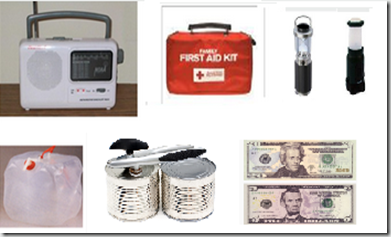
Together with adequate emergency supplies, a solid first aid kit, and an emergency battery operated NWS Weather Radio, these steps will go a long ways to protecting you, and your family, from a wide variety of potential disasters.
image

Basic kit : NWS radio, First Aid Kit, Lanterns, Water & Food & cash


This weekend, when we `spring ahead’ into Daylight Savings Time, is the perfect time to take a good hard look at your emergency plans, and supplies, and make any adjustments necessary.


For more on all of this, a partial list of some of my preparedness blogs include:

When 72 Hours Isn’t Enough

In An Emergency, Who Has Your Back?

An Appropriate Level Of Preparedness

The Gift Of Preparedness – 2014 Edition

Saturday, January 12, 2013

Safe Rooms: Improving Your Odds

image

Photo Credit Wikipedia – Dimmitt, Tx Tornado


# 6850


Nearly two years ago, over a three day period (Apr 25th-28th) a storm system of epic proportions spawned 351 confirmed tornadoes across five southern states, killing 338 persons in Alabama, Arkansas, Georgia, Mississippi, and Tennessee.


This was the the third deadliest tornado outbreak in U.S. History. More than a dozen of these twisters reached intensities of 4 or 5 on the Enhanced Fujita [EF] scale, which can produce near total devastation.


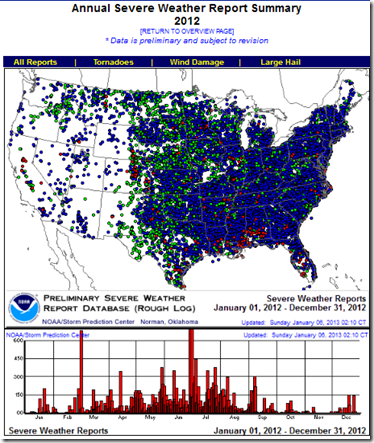
After a near-record setting 2011 tornado season (n=1691), 2012 proved somewhat less active (n=936), although certainly not without its moments.

image


No one can say with any confidence how many destructive storms 2013 will bring - but when it comes to tornados - you only have to be hit by one to ruin your whole day.


Last spring, the CDC’s MMWR issued an analysis of the previous year’s massive tornado outbreak, that stressed the importance of safe rooms.  Due to the length of the report, I’ve only reproduced a few excerpts. 


Follow the link to read:


Tornado-Related Fatalities — Five States, Southeastern United States, April 25–28, 2011
Weekly

July 20, 2012 / 61(28);529-533

(Media Synopsis)

Individuals who work or live in a tornado-prone area should develop a tornado safety plan prior to severe weather.

During April 25–28, 2011, the third deadliest tornado disaster occurred in the southeastern U.S. despite modern advances in tornado forecasting, advanced warning times, and media coverage.  CDC reviewed data from the American Red Cross, death certificates and the National Weather Service to describe the fatalities by demographic characteristics, shelter used, cause of death, and tornado severity in the affected states of Alabama, Arkansas, Georgia, Mississippi and Tennessee. Of the 338 deaths, approximately one-third were older adults, almost half occurred in single-family homes, and a quarter happened in mobile homes.  One-half of the 27 tornadoes were rated powerful (EF-4 or EF-5) and were responsible for almost 90 percent of the deaths. The use of safe rooms is crucial to preventing tornado-related deaths.

(Continue . . . .)

With the spring tornado season only a month or two away, now is the time to be creating a tornado safety plan – and if possible – setting up a safe room.


FEMA has a good deal of advice on exactly how to construct a safe room – either above or below ground.


Residential Safe Rooms

Having a safe room in your home can protect your family and save the lives of those you care about.

Find answers to your Questions about Building a Safe Room, including:

  • What is the cost of installing a safe room?

  • Can I install a safe room in an existing home?

  • Can I build the safe room myself?

  • Where is the best location for the safe room?

  • Where can I find plans for safe room construction?

  • And more....

Building a Safe Room in Your House

For more details about how you can build a safe room in your home, go to the Taking Shelter From the Storm: Building a Safe Room For Your Home or Small Business (FEMA 320) page before downloading it from the FEMA Library.

image

Residential Funding Opportunities

Grants, funding opportunities and various initiatives are available for individuals wishing to build a residential safe room.  See the resources below for additional information:

Examples and Case Studies

Learn how others have benefited from safe rooms.  See the following resources on the best practices case study web page.


Having a good (and well rehearsed) family emergency plan is essential for any emergency. Even with a safe room, family members could become separated (they may be sent to different hospitals or shelters) in the post-disaster chaos.


Some may be injured and unable to provide information about their families.


So it is important to set up a plan, including meeting places and out-of-state contacts, and individual wallet information cards -  before you need it. To that end READY.GOV has some advice, and tools, to help you do just that.


Plan to Protect Yourself & Your Family

Family Emergency Plan

(PDF - 3Mb)

Prepare yourself and your family for a disaster by making an emergency plan.


Download the Family Emergency Plan (FEP) (PDF - 750Kb), print the pages and fill them in offline.


Your emergency planning should also address the care of pets, aiding family members with access and functional needs and safely shutting off utilities.


You may also want to inquire about emergency plans at work, daycare and school. If no plans exist, consider volunteering to help create one. Read more about school and workplace plans.


Once you’ve collected this important information, gather your family members and discuss the information to put in the plan. Practice your plan at least twice a year and update it according to any issues that arise.


Together with adequate emergency supplies, a solid first aid kit, and an emergency battery operated NWS Weather Radio, these steps will go a long ways to protecting you, and your family, from a wide variety of potential disasters.


For more on all of this, a partial list of some of my preparedness blogs include:


When 72 Hours Isn’t Enough

In An Emergency, Who Has Your Back?

An Appropriate Level Of Preparedness

The Gift of Preparedness 2012

Monday, July 23, 2012

MMWR: Tornado Fatalities During April 2011 Outbreak


image

Credit FEMA


# 6445


During a three day period (Apr 25th-28th) of 2011 a storm system of epic proportions spawned 351 confirmed tornadoes across five southern states, killing 338 persons in Alabama, Arkansas, Georgia, Mississippi, and Tennessee. 


This was the the third deadliest tornado outbreak in U.S. History. More than a dozen of these twisters reached intensities of 4 or 5 on the Enhanced Fujita [EF] scale, which can produce near total devastation.


NOAA releases aerial imagery of Tuscaloosa, Ala. tornado damage

April 30, 2011

Before and after imagery depicting tornado damage in the vicinity of the intersection of 15th St. E. and McFarland Blvd. E. in southeast Tuscaloosa, AL.

Before and after imagery depicting tornado damage in the vicinity of the intersection of 15th St. E. and McFarland Blvd. E. in southeast Tuscaloosa, AL. The before imagery is courtesy of Google, the after imagery was acquired from an altitude of 5,000 feet above ground level by the NOAA King Air April 29, 2011.


Despite an early and accurate forecast, and the issuance of timely tornado watches and warnings, the death toll from this super-swarm of tornadoes was woefully high. 


Late last week the CDC released an analysis of these storm fatalities in their MMWR that stresses the importance of safe rooms.  Due to the length of the report, I’ve only reproduced the synopsis and a few excerpts. 


Follow the link to read:


Tornado-Related Fatalities — Five States, Southeastern United States, April 25–28, 2011

Weekly

July 20, 2012 / 61(28);529-533

(Media Synopsis)

Individuals who work or live in a tornado-prone area should develop a tornado safety plan prior to severe weather.

During April 25–28, 2011, the third deadliest tornado disaster occurred in the southeastern U.S. despite modern advances in tornado forecasting, advanced warning times, and media coverage.  CDC reviewed data from the American Red Cross, death certificates and the National Weather Service to describe the fatalities by demographic characteristics, shelter used, cause of death, and tornado severity in the affected states of Alabama, Arkansas, Georgia, Mississippi and Tennessee. Of the 338 deaths, approximately one-third were older adults, almost half occurred in single-family homes, and a quarter happened in mobile homes.  One-half of the 27 tornadoes were rated powerful (EF-4 or EF-5) and were responsible for almost 90 percent of the deaths. The use of safe rooms is crucial to preventing tornado-related deaths.


What is already known on this topic?

Known risk factors for death and injury from tornadoes are sheltering in mobile homes, proximity to the path of a tornado registering 4 or 5 on the Enhanced Fujita (EF) scale, being an older adult (aged ≥65 years), lack of accessibility to a safe room (e.g., a basement or reinforced shelter), and night-time tornado impacts. The southeastern United States is considered particularly vulnerable to tornado fatalities because of the high concentration of mobile homes and frequency of EF-4 and EF-5 tornadoes. Traumatic injury, including head injury, is the leading cause of death during tornadoes.

What is added by this report?

Although extensive public health warnings were broadcast before the tornadoes touched down, this was the third-deadliest tornado disaster in U.S. history, with 338 confirmed fatalities. Head injury was the cause of death in nearly 22% of fatalities. Approximately 47% of the fatalities were in single-family homes. A composite of the multistate deadly tornado tracks was created from the National Weather Service's tornado survey points in a geographic information system (GIS); more than 90% of the geocoded addresses were spatially linked to a deadly tornado.

What are the implications for public health practice?

To prevent tornado-related fatalities, public health messaging needs to specify what constitutes a safe room and to increase awareness that these should be used during all tornadoes. Spatial analysis of health impacts of tornadoes using GIS provides a better understanding of risk factors and the underlying characteristics of the affected population for public health preparedness and response.


Thankfully, this year has provided a far less violent spring storm season in the United States, although during the first 6 months of the year we have seen 68 storm-related fatalities (cite).


While I preach preparedness, there is admittedly one potentially fatal gap in my preparedness plan.  I have no `safe room’ in my current dwelling, and frankly, no good way to create one in what we euphemistically call a `manufactured home’.


When I lived in Missouri – which gets its fair share of tornadoes – having a full basement/storm shelter was both practical and a great comfort.


But here in Florida – where the water table is so high – basements are largely impractical. Luckily, Florida is less at risk for the really big tornadoes. We are, however, are a frequent target for hurricanes.


image

EF-3 or Greater Tornado Threat – Credit FEMA


Those living in tornado prone areas should seriously consider the possibility of creating one of these potentially life-saving additions to their home. To that end, FEMA has a good deal of advice on exactly how to construct a safe room – either above or below ground.


Residential Safe Rooms

Having a safe room in your home can protect your family and save the lives of those you care about.

Find answers to your Questions about Building a Safe Room, including:

  • What is the cost of installing a safe room?

  • Can I install a safe room in an existing home?

  • Can I build the safe room myself?

  • Where is the best location for the safe room?

  • Where can I find plans for safe room construction?

  • And more....

Building a Safe Room in Your House

For more details about how you can build a safe room in your home, go to the Taking Shelter From the Storm: Building a Safe Room For Your Home or Small Business (FEMA 320) page before downloading it from the FEMA Library.

Residential Funding Opportunities

Grants, funding opportunities and various initiatives are available for individuals wishing to build a residential safe room.  See the resources below for additional information:

Examples and Case Studies

Learn how others have benefited from safe rooms.  See the following resources on the best practices case study web page.


Having a good (and well rehearsed) family emergency plan is essential for any emergency. Even with a safe room, family members could become separated (they may be sent to different hospitals or shelters) in the post-disaster chaos.


Some may be injured and unable to provide information about their families.


So it is important to set up a plan, including meeting places and out-of-state contacts, and individual wallet information cards -  before you need it. To that end READY.GOV has some advice, and tools, to help you do just that.


Plan to Protect Yourself & Your Family

 
Family Emergency Plan


(PDF - 3Mb)

Prepare yourself and your family for a disaster by making an emergency plan.


Download the Family Emergency Plan (FEP) (PDF - 3 Mb), print the pages and fill them in offline.


Your emergency planning should also address the care of pets, aiding family members with access and functional needs and safely shutting off utilities.


You may also want to inquire about emergency plans at work, daycare and school. If no plans exist, consider volunteering to help create one. Read more about school and workplace plans.


Once you’ve collected this important information, gather your family members and discuss the information to put in the plan. Practice your plan at least twice a year and update it according to any issues that arise.


Together with adequate emergency supplies, a solid first aid kit, and an emergency battery operated NWS Weather Radio, these steps will go a long ways to protecting you, and your family, from a wide variety of potential disasters.


For more on all of this, a partial list of some of my preparedness blogs include:


Inside My New Bug Out Bag
Picking Up The Pieces
When 72 Hours Isn’t Enough
In An Emergency, Who Has Your Back?
An Appropriate Level Of Preparedness
The Gift Of Preparedness 2011


But the time to make these preps is now, before the storm clouds gather.


Thursday, May 03, 2012

CDC Statement On Helmets & Tornadoes

image

Photo Credit Wikipedia – Dimmitt, Tx Tornado


# 6316


File this one under `it’s probably better than nothing. . .  ‘


Although I’d never heard it suggested until the past couple of years, some experts and those in the media have been recommending the wearing of bicycle or motorcycle helmets to provide a degree of protection from flying debris during a tornado.


One such recommendation issued in 2009 can be found here, at the North Dakota State University Extension Service.


While it certainly sounds like a reasonable precaution (assuming you have a helmet handy, and donning one doesn’t delay your seeking more appropriate shelter), until now the CDC has not commented on the practice.


Today, we’ve a cautious statement from the CDC regarding the wisdom of using a helmet during a tornado.


For Immediate Release: May 3, 2012
Contact :
CDC Division of News and Electronic Media
(404) 639-3286

CDC Statement on Helmets and Tornadoes

The Centers for Disease Control and Prevention continues to recommend, as its first recommendation, that people in the path of a tornado find a shelter or a tornado-safe room. The safest place in the home is the interior part of a basement. If possible, get under something sturdy such as a heavy table or workbench.  If outdoors, lie down in a gully or ditch.


We understand that people who have seen the tragedy that tornadoes can impose are looking for any useful and effective ways to protect themselves. We don’t have research on the effectiveness of helmet use to prevent head injuries during a tornado, but we do know that head injuries are common causes of death during tornadoes, and we have long made the recommendation that people try to protect their heads.  Individuals may decide to use helmets to protect their heads. However, because the time to react may be very short, people who choose to use helmets should know where they are and have them readily accessible.  Looking for a helmet in the few seconds before a tornado hits may delay you getting safely to shelter.  For those who choose to use helmets, these helmets should not be considered an alternative to seeking appropriate shelter. Rather, helmets should be considered just one part of their overall home tornado preparedness kit to avoid any delay.


CDC continues to promote protective measures for use during natural disasters including tornadoes.  For more detailed information, go to http://emergency.cdc.gov/disasters/tornadoes/during.asp.

Friday, April 13, 2012

SPC Warns Of Weekend Severe Weather Risk


image


# 6280


Spring and early summer are the time of year that typically produces the greatest number of severe thunderstorms and tornado outbreaks, and this morning NOAA’s Storm Prediction Center has issued a forecast for Saturday that includes a high risk of severe weather across parts of the central U.S.


SPC AC 130602
   DAY 2 CONVECTIVE OUTLOOK RESENT 1
   NWS STORM PREDICTION CENTER NORMAN OK
   0102 AM CDT FRI APR 13 2012
   VALID 141200Z – 151200Z


   ...THERE IS A HIGH RISK OF SVR TSTMS ACROSS PARTS OF OK AND KS . . . THERE IS A MDT RISK OF SVR TSTMS ACROSS PARTS OF NW TX...CNTRL    AND WRN OK...CNTRL AND ERN KS...SE NEB...NW MO AND FAR SW IA...   ...THERE IS A SLGT RISK OF SVR TSTMS ACROSS PARTS OF THE MID-MO   VALLEY...UPPER MS VALLEY...SRN PLAINS AND CNTRL PLAINS...   TORNADO OUTBREAK LIKELY ACROSS THE SRN AND CNTRL PLAINS NWD INTO THE   MID-MO VALLEY FROM SATURDAY AFTERNOON THROUGH SATURDAY NIGHT ...SRN AND CNTRL PLAINS...


AN IMPRESSIVE UPPER-LEVEL LOW WILL MOVE EWD ACROSS FOUR CORNERS  REGION SATURDAY AS A POWERFUL 90 TO 110 KT MID-LEVEL JET EJECTS NEWD INTO THE SRN AND CNTRL PLAINS. AHEAD OF THE SYSTEM...A CORRIDOR OF  MODERATE TO STRONG INSTABILITY IS FORECAST ACROSS ECNTRL KS...CNTRL OK INTO NW TX. THIS COMBINED WITH STEEP MID-LEVEL LAPSE RATES AND  STRONG LOW-LEVEL SHEAR WILL BE VERY FAVORABLE FOR SEVERE STORMS AND  A TORNADO OUTBREAK WILL BE LIKELY ACROSS THE SRN AND CNTRL PLAINS FROM LATE SATURDAY AFTERNOON LASTING THROUGH THE EVENING AND INTO THE OVERNIGHT PERIOD.


image

March, April, May and June generally see the strongest, and most frequent tornadoes, but in truth - these violent windstorms can occur any time of the year - particularly in the south


image


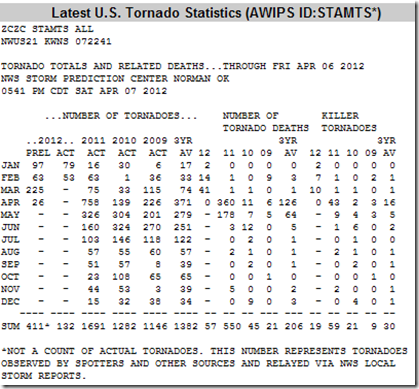
In an average year, more than 1,000 tornadoes are reported in the United States, but last year (2011) was unusually active. More than 750 tornadoes and 360 tornado-related deaths were reported during the month of April alone.


image

Credit http://www.spc.noaa.gov


All but a small part of the United States is vulnerable to these storms, but the strongest generally occur in an area we call Tornado Alley (below Left), which runs from middle Texas north though Oklahoma, Kansas, Nebraska and South Dakota.


This is the area where you will generally find the largest and most powerful tornadoes; the F5 wedge type

image

TORNADO ALLEY                       DIXIE ALLEY

Fortunately, much of the mid-west is sparsely populated, and so the number of tornado deaths that occur here are actually less than in other areas of the country.   


DIXIE ALLEY (above right) sees more frequent, albeit usually less severe tornadoes.  Due to a higher population density, more deaths occur in Dixie Alley than in Tornado Alley most years.


Which is why every home and office should have a NOAA weather radio. Once thought of as mainly a source of local weather information, it has now become an `All-Hazards' alert system as well.


image


In order to receive these broadcasts, you need a special receiver.  Many of these radios have a built in `Tone Alert', and will begin playing once they receive a special alert signal from the broadcaster.


Like having an emergency kit, a first aid kit, and a disaster plan - having a weather radio is an important part of being prepared. 


Despite dozens of major disasters (often weather related) that occur every year in this country, most Americans remain woefully unprepared to deal with emergencies.  


Agencies like FEMA, READY.GOV and the HHS are constantly trying to get the preparedness message out, so that when (not `if') a disaster does occur, human losses can be minimized.


For more information on how to prepare for emergencies, up to and including a pandemic, the following sites should be of assistance.


FEMA http://www.fema.gov/index.shtm

READY.GOV http://www.ready.gov/

AMERICAN RED CROSS http://www.redcross.org/


You’ll find more than you ever wanted to know about tornadoes available from the SPC Tornado FAQ.

Image Logo for The Online Tornado FAQ

Wednesday, September 21, 2011

NOAA: Lessons From The Joplin Tornado


# 5857


The spring of 2011 saw three record-breaking and deadly tornadic outbreaks across the United States.


First, over three days in mid-April (14th-16th), a severe storm system produced 179 confirmed tornadoes across 16 southern states, resulting in 43 fatalities and more than a half billion dollars in damage.


Two weeks later (Apr. 25th-28th), an even larger outbreak – now dubbed the 2011 Super Outbreak - spawned at least 336 tornadoes across 21 states. More than 300 people died, with the largest number of deaths (249) occurring in Alabama. 


Damage estimates for this outbreak exceeded 10 billion dollars.


After a remarkably quiet first three weeks of May, another severe storm system swept across the Midwest spawning at least 180 tornadoes over 5 days (May 21st-26th).


The worst of these was the massive F-5 tornado that struck Joplin, Missouri on May 22nd, killing 159 and injuring more than 1,000.


image

Photo Credit – NOAA 

Given the scale of destruction in Joplin, it is a wonder that more people weren’t killed. Fortunately, the city had at least a 20 minute warning via emergency sirens, NWS warnings, and local broadcasters.


Since this was a `warned event’ - yet yielded a high number of fatalities - the National Weather Service launched an investigation over the summer. More than 100 interviews were conducted in Joplin with tornado survivors, local business owners, EMS personnel, the media, and city officials.


image

PDF Download Link


Among their findings, many of Joplin’s residents did not act immediately when the tornado sirens sounded.  An excerpt from the executive summary explains:


The vast majority of Joplin residents did not immediately take protective action upon receiving a first indication of risk (usually via the local siren system), regardless of the source of the warning.  Most chose to further assess their risk by waiting for, actively seeking, and filtering additional information.


The reasons for doing so were quite varied, but largely depended on an individual‘s ― worldview, formed  mostly by previous experience with severe weather.


Most importantly, the perceived frequency of siren activation in Joplin led the majority of survey participants to become desensitized or complacent to this method of warning.  This suggests that initial siren activations in Joplin (and severe weather warnings in general) have lost a degree of credibility for most residents – one of the most valued characteristics for successful risk communication.  


Instead, the majority of Joplin residents did not take protective action until processing additional credible confirmation of the threat and its magnitude from a non-routine, extraordinary risk trigger.  This was generally achieved in different ways, including  physical observation of the tornado, seeing or hearing confirmation, and urgency of the threat on radio or television, and/or hearing a second, non-routine siren alert.


Having lived in Tornado Alley for a decade, I’m well acquainted with tornado warning fatigue.  Sirens go off with some frequency, and severe weather boxes appear in the corner of your local TV broadcast, but often nothing comes of it.


Nationally, the NWS says that 76% of all tornado warnings end up being false alarms. And even if a tornado is spawned, warnings go out across a broad area when only a small number of people are ultimately impacted.


The result is . . .  people stop responding to every alert.


Again from the report:


This report suggests that in order to improve warning response and mitigate user complacency, the NWS should explore evolving the warning system to better support effective decision making.


This evolution should utilize a simple, impact-based, tiered information structure that promotes warning credibility and empowers individuals to quickly make appropriate decisions in the face of adverse conditions.  Such a system should:  


a. provide a non-routine warning mechanism that prompts people to take immediate life-saving
action in extreme events like strong and violent tornadoes


b. be impact-based more than phenomenon-based for clarity on risk assessment


c. be compatible with NWS technological, scientific, and operational capabilities


d. be compatible with external local warning systems and emerging mobile communications
technology


e. be easily understood and calibrated by the public to facilitate decision making


f. maintain existing ―probability of detection‖ for severe weather events


g. diminish the perception of false alarms and their impacts on credibility


A tall order.


And one that is complicated by the sheer volume of `threat warnings’ we get on a daily basis. Everything from weather alerts, to elevated terrorism levels, to warnings that almost everything you eat, drink, or touch is either contaminated or will give you cancer.


After awhile, these warnings tend to fuzz out, blend in, and lose their impact.


While it is tempting to suggest scaling back these warnings, there are 7 scientists on trial in Italy right now – charged with manslaughter - over their failure to predict, and warn the public about an earthquake in 2009.


Charges levied, even though we don’t currently have the technology to accurately predict earthquakes .


Despite the daily clutter of warnings we receive – many of which never materialize - a failure of agencies to warn about known or suspected threats would not be well tolerated by the public.


For the NWS, the challenge will be to create an easily identifiable `immediate threat’ warning to elevate it above the `background noise’ of more generic or broad-based warnings.


As to the myriad other threats out there, they are all the more reason to incorporate an `all threats’ preparedness plan, instead of focusing on one type of scenario.


If you are well prepared for an earthquake, you are also well equipped to handle a hurricane, a pandemic, or any other type of disaster.


In order to promote this idea, FEMA, Ready.gov, and other agencies are promoting September as National Preparedness Month.  Follow this year’s campaign on Twitter by searching for the #NPM11 hash tag.


image

Tuesday, May 24, 2011

SPC: Another Major Severe Weather Threat Today


# 5569


image


The Storm Prediction Center in Norman Oklahoma has issued their 1 day convective outlook for May 24th, 2011, and they are calling for a high risk of severe thunderstorms (including hail, high winds, and tornadoes) across parts of Kansas and Oklahoma.


SPC AC 240559
  DAY 1 CONVECTIVE OUTLOOK 
  NWS STORM PREDICTION CENTER NORMAN OK
  1259 AM CDT TUE MAY 24 2011
  VALID 241200Z – 251200Z


...THERE IS A HIGH RISK OF SVR TSTMS ACROSS PARTS OF SOUTH CENTRAL AND SOUTHEAST KANSAS SWD INTO PARTS OF CENTRAL AND EASTERN  OKLAHOMA...

...THERE IS A MDT RISK OF SVR TSTMS ACROSS CENTRAL AND SOUTHEAST KANSAS...CENTRAL AND EASTERN OKLAHOMA...AND INTO WESTERN ARKANSAS...


...THERE IS A SLGT RISK OF SVR TSTMS FROM NEW ENGLAND SWD TO THE   MID-ATLANTIC REGION ... AND WWD INTO THE PLAINS...


After a record breaking number of tornadoes in April, the first three weeks of May – which is normally quite active – saw a marked decrease in severe weather reports around the nation.


All of that changed two days ago when nearly 50 twisters, and more than 700 reports of severe weather were recorded over a 24 hour period – including the horrific events in Joplin, Missouri ( see The Joplin Tornado: Search & Rescue Continues).


While it is impossible to predict exactly when and where tornadoes will strike, when atmospheric conditions set up as they appear to be doing today, severe weather somewhere in the watch area is almost certain to occur.


NOAA Radioimage

image image


No matter where you live, this morning would be a good time to check your NOAA weather radio, flashlights, and first aid kit


You should also review your family’s emergency communication plan - and if you haven’t already done so - decide where you would go in your home or business if a tornado threatens.


While we can’t prevent disasters like the one that befell Joplin, Missouri on Sunday . . .  we can be better able to deal with them.


To become better prepared as an individual, family, business owner, or community to deal with these types of disasters: visit the following preparedness sites.


FEMA http://www.fema.gov/index.shtm

READY.GOV http://www.ready.gov/

AMERICAN RED CROSS http://www.redcross.org/

Monday, May 23, 2011

The Joplin Tornado: Search & Rescue Continues


# 5567


image

Storm reports over the past 24 hrs includes 48 possible tornadoes across the Midwest.


After a very long night in Joplin Missouri, city officials held a press conference at 5:30 (CST) this morning where they confirmed that at least 89 people died in yesterday’s tornado, and that there are likely still people trapped in debris and unaccounted for.


Search and rescue operations are ongoing, and a door-to-door grid search of the city is planned at first light. 


Two fire stations were completely destroyed in the tornado, and St. Johns Hospital was severely damaged, resulting in a total evacuation of all patients to other facilities.


The city with a population of roughly 50,000 lies in the southwestern corner of the state, and reportedly had about 20 minutes warning before the twister struck.


The death toll is expected to rise, and thousands have likely sustained injuries from the storm, ranging from minor cuts and bruises to serious trauma. Power is out across much of the city, and one official estimated that 30% of the structures in the town had either been severely damaged or destroyed.


Some of the best coverage I’ve found comes from the hometown newspaper, The Joplin Globe. 


You’ll a long narrative, and many pictures at:


Storm descends on Joplin


The risk of severe weather has moderated a bit for today, but cannot be excluded as a possibility.  The following two forecast maps come from the Storm Prediction Center in Norman Oklahoma.


MONDAY Outlook

image


TUESDAY Outlook

image


Like Tuscaloosa, Alabama last month – Joplin, Missouri now will face a long, and difficult recovery period.


Those who live in and around the affected areas may find their homes damaged or uninhabitable, utilities unavailable for days or weeks, and their jobs and lives disrupted.


Those residents who were already prepared for a disaster - with a family or business emergency plan, bug-out bags, first aid kits, and a small stockpile of food and water in their homes – will find themselves better able to deal with the demands of the next few days.


This week, our focus will be on hurricane preparedness. But as yesterday’s tornado illustrates, disasters can strike anywhere, and with little or no warning.


Loved ones are apt to become separated (they may be sent to different hospitals or shelters) in the chaos and confusion following disasters like these.  Some may be injured and unable to provide information about their families.


So it is important to set up a plan, including meeting places and out-of-state contacts, and individual wallet information cards -  before you need it.


To that end READY.GOV has some advice, and tools, to help you do just that.

Family Emergency Plan
  • Identify an out-of town contact. It may be easier to make a long-distance phone call than to call across town, so an out-of-town contact may be in a better position to communicate among separated family members.
  • Be sure every member of your family knows the phone number and has a cell phone, coins, or a prepaid phone card to call the emergency contact. If you have a cell phone, program that person(s) as "ICE" (In Case of Emergency) in your phone. If you are in an accident, emergency personnel will often check your ICE listings in order to get a hold of someone you know. Make sure to tell your family and friends that you’ve listed them as emergency contacts.
  • Teach family members how to use text messaging (also knows as SMS or Short Message Service). Text messages can often get around network disruptions when a phone call might not be able to get through.
  • Subscribe to alert services. Many communities now have systems that will send instant text alerts or e-mails to let you know about bad weather, road closings, local emergencies, etc. Sign up by visiting your local Office of Emergency Management web site.


You’ll find some handy toolkits, and an online planning tool, available as well.


NEW Online Family
Emergency Planning Tools

Create An Family Emergency Plan Wih Our New Online Tools

Try the Online Family Emergency Plan (FEP) Tool

Wednesday, May 04, 2011

FEMA: Timeline Of Response To Southern Storms


# 5537


image

NOAA Tornado Tracks & Imagery


It has been seven days since the devastating round of severe weather moved through Alabama, Arkansas, Georgia, Mississippi, Kentucky, Tennessee and Virginia, leaving behind hundreds of fatalities, thousands of injuries, and tens of thousands in need. 


FEMA, along with other local, state, and national agencies, have been on the ground providing assistance for a solid week.  


They are ably assisted by organizations like the American Red Cross and the Salvation Army, along with other voluntary and faith-based organizations who are providing meals, shelter and other relief supplies.


Late yesterday FEMA released a timeline of the joint response to this disaster, which may be viewed at:


Southern Storms: Overview Of Recovery And Support Efforts By FEMA, The Federal Government, And Our Partners

Release Date: May 3, 2011
Release Number: HQ-11-58

» More Information on Alabama Severe Storms, Tornadoes, Straight-line Winds, and Flooding


» More Information on Georgia Severe Storms, Tornadoes, Straight-line Winds, and Associated Flooding


*Since the deadly tornadoes first struck parts of the country last week, the federal government has been in constant contact with all of the impacted states as they responded to and began recovery efforts from these devastating storms. At the request of the respective governors, FEMA currently has personnel on the ground in Alabama, Arkansas, Georgia, Mississippi, Kentucky, Tennessee and Virginia, and commodities strategically pre-positioned in the region to support the states. The following timeline provides an overview of these and other federal activities, to date, to support the impacted states, families and communities.*


(Continue . . . )

Sunday, May 01, 2011

Tuscaloosa: Before And After


# 5532


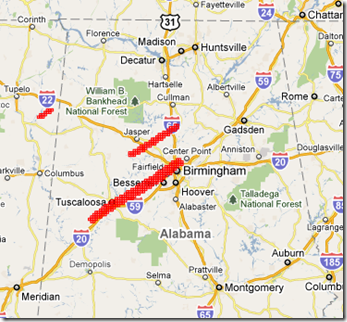
NOAA has released some before & after photographs of neighborhoods struck by last week’s Tuscaloosa-to-Birmingham F4 tornado, which claimed at least 65 lives and injured roughly 1,000 people.


NOAA releases aerial imagery of Tuscaloosa, Ala. tornado damage

April 30, 2011

Before and after imagery depicting tornado damage in the vicinity of the intersection of 15th St. E. and McFarland Blvd. E. in southeast Tuscaloosa, AL.

Before and after imagery depicting tornado damage in the vicinity of the intersection of 15th St. E. and McFarland Blvd. E. in southeast Tuscaloosa, AL. The before imagery is courtesy of Google, the after imagery was acquired from an altitude of 5,000 feet above ground level by the NOAA King Air April 29, 2011.


Hi-Res images available online.


Download PDF here. (Credit: Google - before photo; NOAA - after photo)


NOAA's National Geodetic Survey dispatched the NOAA King Air 350CER aircraft, equipped with specialized remote sensing equipment, on a mission to collect aerial photography at 5,000 feet from Tuscaloosa to Birmingham, Ala.

These "before and after" shots (pdf to right), taken yesterday afternoon, show damage caused by last week's tornado near 15th Street and McFarland Boulevard in Tuscaloosa.

Photos will be used to assist federal and local officials in response and recovery efforts.

Hi-Res images available online.

For more information, contact: John Ewald, john.ewald@noaa.gov, 240-429-6127.

NOAA's mission is to understand and predict changes in the Earth's environment, from the depths of the ocean to the surface of the sun, and to conserve and manage our coastal and marine resources. Visit us on Facebook.


These photos not only show the destructive power of these storms, they serve as a stark reminder of why having a family emergency plan (FEP) is so vital.


Loved ones are apt to become separated (they may be sent to different hospitals or shelters) in the chaos and confusion following a disaster like this.  Some may be injured and unable to provide information about their families.


So it is important to set up a plan, including meeting places and out-of-state contacts, and individual wallet information cards -  before you need it.


To that end READY.GOV has some advice, and tools, to help you do just that.


Family Emergency Plan
  • Identify an out-of town contact. It may be easier to make a long-distance phone call than to call across town, so an out-of-town contact may be in a better position to communicate among separated family members.
  • Be sure every member of your family knows the phone number and has a cell phone, coins, or a prepaid phone card to call the emergency contact. If you have a cell phone, program that person(s) as "ICE" (In Case of Emergency) in your phone. If you are in an accident, emergency personnel will often check your ICE listings in order to get a hold of someone you know. Make sure to tell your family and friends that you’ve listed them as emergency contacts.
  • Teach family members how to use text messaging (also knows as SMS or Short Message Service). Text messages can often get around network disruptions when a phone call might not be able to get through.
  • Subscribe to alert services. Many communities now have systems that will send instant text alerts or e-mails to let you know about bad weather, road closings, local emergencies, etc. Sign up by visiting your local Office of Emergency Management web site.


You’ll find some handy toolkits, and an online planning tool, available as well.


NEW Online Family
Emergency Planning Tools

Create An Family Emergency Plan Wih Our New Online Tools

Try the Online Family Emergency Plan (FEP) Tool


No Time for Online Forms?
Download the Family Emergency Plan (FEP) PDF pages, print and fill them in Offline.

Download the Family Emergency Plan - Acrobat Reader, 512Kb

Download all pages of The Family Emergency Plan - Acrobat Version, 3 MbDownload All FEP Pages 3 Mb
Download Adult Wallet Card Page of The Family Emergency Plan - Acrobat Version, 1.7 MbDownload the FEP Adult Folding Wallet Card 1.7 Mb
Download Child's Wallet Card Page of The Family Emergency Plan - Acrobat Version, 1.7 MbDownload the FEP Child's Folding Wallet Card 1.7 Mb
Download Additional Family Members Page of The Family Emergency Plan - Acrobat Version, 500 KbDownload the FEP Additional Family Members List 500 Kb
Acrobat Reader Required, 516KbDownload the FEP - Web Version - active input fields to enter information. 516Kb
Download The Family Emergency Plan - Microsoft Excel Version, 400 KbDownload the MS Excel FEP 400 Kb


Today, while the sun is shining, is an excellent day to complete your family emergency plan.

Tuesday, April 26, 2011

SPC Upgrades Today’s Severe Storm Forecast


# 5522


image


The Storm Prediction Center in Norman, Oklahoma has raised their risk assessment for severe storm to HIGH for later today across Northeast Texas, far Southeast Oklahoma, a slice of Northwest Louisiana, and the Southern half of Arkansas.


WOUS40 KWNS 261153
ARZ000-LAZ000-OKZ000-TXZ000-261800-
 

PUBLIC SEVERE WEATHER OUTLOOK  
NWS STORM PREDICTION CENTER NORMAN OK
0653 AM CDT TUE APR 26 2011

...OUTBREAK OF SEVERE STORMS AND TORNADOES EXPECTED OVER PARTS OF THE SOUTHERN PLAINS AND LOWER MISSISSIPPI VALLEY THIS EVENING AND
OVERNIGHT...

THE NWS STORM PREDICTION CENTER IN NORMAN OK IS FORECASTING THE DEVELOPMENT OF A FEW STRONG LONG TRACK TORNADOES AND WIDESPREAD
DAMAGING WIND OVER PARTS OF THE SOUTHERN PLAINS AND LOWER    MISSISSIPPI VALLEY THIS EVENING AND OVERNIGHT.


THE AREAS MOST LIKELY TO EXPERIENCE THIS ACTIVITY INCLUDE

          SOUTHERN ARKANSAS
          EXTREME NORTHWESTERN LOUISIANA
          SOUTHEASTERN OKLAHOMA
          NORTHEASTERN TEXAS

ELSEWHERE...SEVERE STORMS ARE ALSO POSSIBLE FROM...THE OHIO AND TENNESSEE VALLEYS THROUGH THE LOWER MISSISSIPPI VALLEY AND EASTERN  PORTIONS OF THE SOUTHERN PLAINS.


Tomorrow’s forecast has this area of severe weather shifting east.

image


This comes on the heels of yesterday’s tornado outbreak that left at least 7 dead in Arkansas and leaving the little town of Vilonia, Arkansas nearly destroyed.


There were 38 tornados reported yesterday, along with 97 reports of hail and nearly 400 reports of high winds.


image


To keep abreast of severe storm forecasts, you can visit NOAA’s Storm Prediction Center online.  There you’ll find interactive maps showing current and anticipated severe weather threats all across the nation.


image

image

Another resource is NOAA WEATHER RADIO.


Once thought of as mainly a source of local weather information, it has now become an `All-Hazards' alert system as well.


In order to receive these broadcasts, you need a special receiver.  Many of these radios have a special `Tone Alert', and will begin playing once they receive a special alert signal from the broadcaster.


Like having an emergency kit, a first aid kit, and a portable AM/FM radio - having a weather radio is an important part of being prepared. 


If you haven’t done so recently, now would be a good time to review your family or business emergency plan. 


Most Americans are woefully unprepared to deal with emergencies.  This despite dozens of major disasters (often weather related) that occur every year in this country.


Agencies like FEMA, READY.GOV and the HHS are constantly trying to get the preparedness message out, so that when (not `if') a disaster does occur, human losses can be minimized.


For more information on how to prepare for emergencies, including tornadoes, the following sites should be of assistance.


FEMA http://www.fema.gov/index.shtm

READY.GOV http://www.ready.gov/

AMERICAN RED CROSS http://www.redcross.org/


Meanwhile, keep a weather eye out, and monitor the situation in your area either through your battery operated NOAA radio or from your local broadcasters. 


If severe weather threatens, get to a place of safety.


Oklahoma City has had more than their share of tornadoes, and they offer advice on what to do on their Tornado Safety webpage.