Showing posts with label Wisconsin. Show all posts

Monday, May 04, 2015

H5N2: 8 More H5N2 Farms In Minnesota, 3 More In Wisconsin

image

# 10,008


Updates on HPAI H5 outbreaks in the Midwest since Friday night are starting to filter in, with Minnesota reporting 8 more farms, and 3 more counties, affected.   Wisconsin reported a single farm yesterday (see here), and reports two more today, bringing their total to 10 farms, encompassing roughly 1.6 million birds.


First this update from the Minnesota Board of Animal Health.


Daily Update on Avian Influenza - May 4

​ ST PAUL — The Minnesota Department of Public Safety Homeland Security and Emergency Management  Division (HSEM) activated the State Emergency Operations Center (SEOC) to coordinate the state’s ongoing response to avian influenza. HSEM will coordinate resource needs with several state agencies including the Minnesota Board of Animal Health and the Minnesota Department of Agriculture.

Additional HPAI cases in Minnesota
The Minnesota Board of Animal Health today announced eight presumptive positive flocks. The following Minnesota counties are affected:

  • Renville – 1st detection in county (12,900 turkeys)
  • Nicollet – 1st detection in county (1,102,900 chickens) 
  • Kandiyohi – 27th (89,200 turkeys), 28th (barns are being cleaned and disinfected due to exposure to potentially-infected birds) and 29th (11,200 turkeys) detections
  • Pipestone – 2nd detection (72,200 turkeys)
  • Swift – 4th (46,200 turkeys) and 5th (turkeys, flock size information coming soon) detections

Current Situation
Total number of affected farms – 80
Total number of counties – 21

image

(Continue . . . )


Wisconsin’s update follows:


DATCP announces 3rd Jefferson County and 5th Barron County avian influenza detections

May 4

DATCP announces 3rd Jefferson County and 5th Barron County avian influenza detections (PDF)

Media Contacts:       Raechelle Cline, 608-224-5005 or Jim Dick, Communications Director, 608-224-5020

MADISON, Wisc.— H5 avian influenza has been detected on two more farms in Barron and Jefferson counties, the Wisconsin Department of Agriculture, Trade and Consumer Protection announced today. Wisconsin now has 10 total cases.  While lethal to domestic poultry, the strain of virus detected is not known to have caused disease in humans and is not expected to pose a risk to public health or the food supply.

Details of the two new detections are as follows:

  • Barron—14,600 breeding turkeys (commercial)
  • Jefferson—127,970 chickens (commercial)

As with past detections, each property was immediately quarantined and neighboring properties with poultry will be notified about the situation.  Remaining birds will be depopulated and will not enter the food supply.  Following USDA protocols, surveillance and testing procedures will take place at properties near the affected facility to ensure the virus has not spread.

(Continue . . . )


We will probably get an update from Iowa, and possibly North or South Dakota later today.


Wednesday, April 22, 2015

APHIS: 13 More Minnesota Turkey Farms Hit By H5N2, 2 More In Wisconsin

image


# 9969


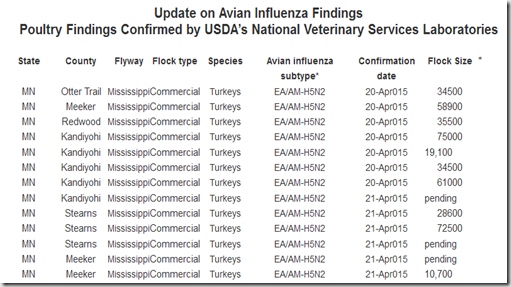
The news keeps getting worse coming out of Minnesota, where now 44 turkey farms have reportedly been hit by the highly pathogenic H5N2 virus. Thirteen of those farms were announced today on the APHIS website, and while the count of birds on several of the farms is pending, the known number of birds affected increases by at least 400,000.


image


Meanwhile there are reports, not yet appearing on the APHIS website, of two more farms in Wisconsin being hit by the virus. This from the Wisconsin Department of Agriculture.


Second avian influenza detection found in Jefferson county commercial egg-laying facility

April 22, 2015

Second avian influenza detection found in Jefferson county commercial egg-laying facility (PDF)

Media Contacts:  Raechelle Cline, 608-224-5005 or Jim Dick, Communications Director, 608-224-5020

MADISON, Wisc.—The Wisconsin Department of Agriculture, Trade and Consumer Protection, in cooperation with the US Department of Agriculture is responding to a detection of H5 avian influenza in an 800,000 bird egg-laying chicken flock in Jefferson county. There are now five cases in Wisconsin.  While lethal to domestic poultry, the strain of virus detected is not known to have caused disease in humans and is not expected to pose a risk to public health or the food supply.

The property was immediately quarantined and neighboring properties with poultry will be notified about the situation.  Remaining birds will be depopulated and will not enter the food supply.  Following USDA protocols, surveillance and testing procedures will take place at properties near the affected facility to ensure the virus has not spread.

The H5 avian influenza virus was first detected in Wisconsin at a commercial chicken flock in Jefferson County on Monday, April 13, which led to the depopulation of more than 180,000 egg-laying chickens.  Since then three additional flocks were detected in Barron, Juneau and Chippewa counties bringing the total of birds destroyed to nearly 400,000 in Wisconsin.  Multiple outbreaks of avian influenza have occurred most recently in Iowa, Minnesota, Missouri, Arkansas, the Dakotas and Kansas leading to the depopulation of more than 1 million turkeys and chickens since January.

Dr. Paul McGraw, Wisconsin state veterinarian, already issued a ban on poultry movement to shows, exhibitions and swap meets in Jefferson, Juneau and Barron counties.  Chippewa county was added to the ban this morning.

Wisconsinites are reminded that the avian influenza virus strain currently detected in Wisconsin and the other states presents low risk to public health. Poultry meat and egg products in the marketplace remain safe to eat. As always, both wild and domestic poultry should be properly cooked.

Officials are investigating how the virus entered the flock and may not have answers for some time.  Until then, backyard poultry owners and other poultry producers are encouraged to practice good biosecurity and to take steps that prevent contact between their birds and wild birds. They also should monitor their flock closely and report sick or dead birds to DATCP at 1-800-572-8981.

For more information on avian influenza and biosecurity measures, go to http://datcp.wi.gov/Animals/Animal_Diseases/Avian_Influenza/index.aspx.

Monday, April 20, 2015

Wisconsin Governor Issues Executive Order On Bird Flu

image


# 9962


A week ago today Wisconsin was added to the growing list of states reporting HPAI H5 – in either wild birds or poultry – when a chicken farm was hit in Jefferson County.  A few days later a turkey farm in Barron county was reported to be infected, as was a backyard flock in Juneau county.


Although we haven’t seen an update from APHIS yet this week, the specter of additional bird flu outbreaks among commercial chicken and turkey farms looms large across much of the Midwest. And so today Wisconsin’s governor Scott Walker issued an executive order to aid in combating the HPAI H5 virus.


First the press release from the Governor’s office, then a link and excerpts from the Executive Order.

Governor Scott Walker Authorizes National Guard to Assist in Response to Avian Flu Outbreak

Monday, April 20, 2015 - Press Release

Madison – Wisconsin Governor Scott Walker today signed Executive Order #156, authorizing the Wisconsin National Guard to assist authorities in the response to the avian influenza virus affecting Jefferson, Juneau, and Barron Counties.

“We must act quickly and efficiently to contain the outbreak and protect domestic poultry,” Governor Walker said.  “It is important to note, however, there is no threat to humans with the avian flu outbreak.”

According to the Wisconsin Department of Agriculture, Trade, and Consumer Protection (DATCP), avian influenza virus has been detected in three Wisconsin poultry flocks, affecting tens of thousands of chickens and turkeys.  Read more here.

Governor Walker’s Executive Order allows the Wisconsin National Guard to assist in the response and help contain the outbreak, as well as offer assistance in site clean-up.  The state veterinarian, through DATCP, requested up to 14 Guard personnel be made available, on a rotating schedule, for immediate assistance.  This assistance from the Wisconsin National Guard is necessary because federal resources are thin, due to avian influenza virus outbreaks in other states, particularly in the Midwest.

If you find a sick or dead bird, do not touch it.  For domestic birds, call DATCP’s Division of Animal Health at 1-800-572-8981, and for wild birds, call the Wisconsin Department of Natural Resources at 1-800-433-1810

A copy of Executive Order #156 is attached.


The executive order has five provisions;


1. Proclaim that a State of Emergency exists throughout the State of Wisconsin, and is currently focused in Jefferson, Barron and Juneau counties; and


2. Designate the WEM Administrator as the State Coordinating Officer to oordinate all state agencies of the State of Wisconsin to assist in the response and recovery efforts to this situation; and


3. Call to state active duty such elements of the Wisconsin National Guard as the Adjutant General deems necessary to assist civil authorities for purposes of assisting in response and recovery efforts as well as providing security and other essential services; and


4. Authorize the Adjutant General to utilize personnel called to state active duty pursuant to this order in emergency status; and


5. Authorize the Department of Agriculture, Trade and Consumer Protection to issue area-wide quarantine orders for feed, poultry and poultry products.


While the risks to human health are considered low, a failure to get control of HPAI in America’s poultry producing states could result in enormous economic losses to the industry, and send ripples through many sectors of the the economy.

Thursday, April 16, 2015

Wisconsin Reports Two More Counties Hit By HPAI H5

image


# 9947


On Monday, Wisconsin reported their first outbreak of HPAI H5N2 (see APHIS: Wisconsin Reports HPAI H5N2 In Commercial Chickens) in Jefferson County, which also marked the first big outbreak in commercial chickens in the United States.


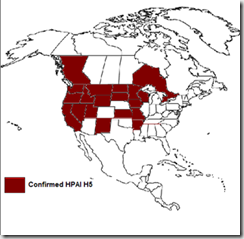
Today, Wisconsin’s Department of Agriculture is reporting outbreaks in farms in two more counties (see map) – one in a backyard flock and the other in a commercial turkey farm.


None of the three affected counties are immediately adjacent to one another, illustrating just how agile these HPAI H5 viruses have been as they’ve hop-scotched across the western United States.


Avian influenza detected in Juneau and Barron County poultry

April 16, 2015

Avian influenza detected in Juneau and Barron County poultry (PDF)

Media Contacts:   Raechelle Cline, 608-224-5005 or Jim Dick, Communications Director, 608-224-5020

MADISON, Wisc.—The Wisconsin Department of Agriculture, Trade and Consumer Protection, in cooperation with the US Department of Agriculture is responding to the detection of avian influenza in an additional two poultry flocks in Wisconsin. There are now three cases in Wisconsin.  These flocks are within the Mississippi flyway where this strain of avian influenza has previously been identified. While lethal to domestic poultry, the strain of virus detected is not known to have caused disease in humans and is not expected to pose a risk to public health or the food supply.

The affected flocks are in:

  • Juneau County—40 mixed breed birds in a backyard flock
  • Barron County—126,000 turkeys in a commercial turkey flock

The properties were immediately quarantined and neighboring properties with poultry will be notified about the situation.  Remaining birds will be depopulated and will not enter the food supply.  Following USDA protocols, surveillance and testing procedures are underway at properties near the affected facility to ensure the virus has not spread.

The H5 avian influenza virus was first detected in Wisconsin at a commercial chicken flock in Jefferson County on Monday, April 13, which will result in the depopulation of more than 180,000 egg-laying chickens.  Multiple outbreaks of avian influenza have occurred most recently in Iowa, Minnesota, Missouri, Arkansas, the Dakotas and Kansas leading to the depopulation of more than 1 million turkeys and chickens since January.

Wisconsinites are reminded that the avian influenza virus strain currently detected in Wisconsin and the other states presents low risk to public health. Poultry meat and egg products in the marketplace remain safe to eat. As always, both wild and domestic poultry should be properly cooked.

Officials are investigating how the virus entered the flock and may not have answers for some time.  Until then, backyard poultry owners and other poultry producers are encouraged to practice good biosecurity and to take steps that prevent contact between their birds and wild birds. They also should monitor their flock closely and report sick or dead birds to DATCP at 1-800-572-8981.


Monday, April 13, 2015

APHIS: Wisconsin Reports HPAI H5N2 In Commercial Chickens

image


# 9933


The list of states reporting HPAI H5 continues to expand this morning , with a farm containing 200,000 chickens in Jefferson County Wisconsin the latest to be affected. 


Wisconsin becomes the 14th state to report HPAI H5 – in either wild birds or poultry – since the virus migrated to North America last fall.


This from APHIS.


USDA Confirms Highly Pathogenic H5N2 Avian Influenza in Jefferson County, Wisconsin

Last Modified: Apr 13, 2015


CDC considers the risk to people from these HPAI H5 infections in wild birds, backyard flocks and commercial poultry, to be low

WASHINGTON, April 13, 2015 -- The United States Department of Agriculture’s (USDA) Animal and Plant Health Inspection Service (APHIS) has confirmed the presence of highly pathogenic H5N2 avian influenza (HPAI) in a commercial layer flock in Jefferson County, Wisconsin.  The flock of 200,000 chickens is located within the Mississippi flyway where this strain of avian influenza has previously been identified. CDC considers the risk to people from these HPAI H5 infections in wild birds, backyard flocks and commercial poultry, to be low.  No human infections with the virus have been detected at this time.

Samples from the turkey flock, which experienced increased mortality, were tested at the Wisconsin Veterinary Diagnostic Laboratory and the APHIS National Veterinary Services Laboratories (NVSL) in Ames, Iowa confirmed the findings. NVSL is the only internationally recognized AI reference laboratory in the United States.   APHIS is working closely with the Wisconsin Department of Agriculture, Trade and Consumer Protection on a joint incident response. State officials quarantined the premises and birds on the property will be depopulated to prevent the spread of the disease. Birds from the flock will not enter the food system.

(Continue . . . )