Showing posts with label Minnesota. Show all posts

Tuesday, May 05, 2015

Minnesota Reports 2 More Presumptive Positive Farms: Growing Economic Impact Of HPAI H5

image

Credit MBAH


# 10,014


The first major layoff of workers due to the growing bird flu epidemic was announced today, where 233 employees at a Hormel plant in Faribault, Minnesota were told due to a lack of product (turkeys) the company would be moving to a single production line later this month.


See MPRNews report :  Jennie-O cuts 233 in Faribault; first mass Minn. layoff tied to bird flu


Today’s update from the Minnesota Board of Animal Health acknowledges this impact, along with the their need to distribute  biosecurity protocols for the upcoming county and state fair season, as they add another two presumptive positive farms to that state’s list of infected premises.


FOR IMMEDIATE RELEASE
May 05, 2015

Daily Update on Avian Influenza - May 5

​ ST PAUL — The Minnesota Department of Public Safety Homeland Security and Emergency Management  Division (HSEM) activated the State Emergency Operations Center (SEOC) to coordinate the state’s ongoing response to avian influenza. HSEM will coordinate resource needs with several state agencies including the Minnesota Board of Animal Health and the Minnesota Department of Agriculture.

Additional HPAI cases in Minnesota
The Minnesota Board of Animal Health today announced two presumptive positive flocks. The following Minnesota county is affected:

  • Kandiyohi – 30th (turkeys, flock size information coming soon) and 31st (turkeys, flock size information coming soon) detections

Current Situation
Total number of affected farms – 82
Total number of counties – 21

image

Total number of birds affected in Minnesota – 5,487,232 (not including pending flocks)

All affected farms remain under quarantine.

Visit the USDA's website for information on all HPAI findings in the United States.

To date, animal health officials have completed the following response zone activities:

  • Appraisals have been approved for 78 of the affected premises.
  • Birds on 73 of the affected farms have been euthanized.
  • Composting is in progress on 69 of the affected farms. Animal health officials and producers are working on carcass disposal on other farms.
  • Sampled 704 backyard flocks falling within the control areas of affected farms.

Personnel Assisting in Response Efforts

  • 81 state employees
  • 129 USDA employees
  • 210 total

Jennie-O workers in Faribault
The Minnesota Department of Employment and Economic Development (DEED) has been in close contact and working with Jennie-O Turkey Store on the layoff it announced today and will continue to provide support to separated employees.

  • DEED is in the process of establishing informational meetings for impacted workers. All known impacted workers will receive notice of these meetings and are welcome to attend. There will be information on Unemployment Insurance and the Dislocated Worker program, and an opportunity to enroll in the Dislocated Worker program to receive customized services which may include job search assistance, counselor-approved training, and related support.
  • Impacted employees can call DEED’s Dislocated Worker Rapid Response toll-free number with questions at 866-213-1422 or online. 

Poultry at county fairs
The Minnesota Dept. of Agriculture and USDA APHIS Liaisons are working with a task force of local veterinarians to distribute biosecurity outreach materials to County Fair Boards throughout the state in preparation for the County Fair season. Many county fairs have poultry exhibitions and county officials are asked to further distribute the information to people who raise or exhibit poultry.

(Continue . . .)


We may get additional reports from Wisconsin, Iowa, and possibly other states later today.

Monday, May 04, 2015

H5N2: 8 More H5N2 Farms In Minnesota, 3 More In Wisconsin

image

# 10,008


Updates on HPAI H5 outbreaks in the Midwest since Friday night are starting to filter in, with Minnesota reporting 8 more farms, and 3 more counties, affected.   Wisconsin reported a single farm yesterday (see here), and reports two more today, bringing their total to 10 farms, encompassing roughly 1.6 million birds.


First this update from the Minnesota Board of Animal Health.


Daily Update on Avian Influenza - May 4

​ ST PAUL — The Minnesota Department of Public Safety Homeland Security and Emergency Management  Division (HSEM) activated the State Emergency Operations Center (SEOC) to coordinate the state’s ongoing response to avian influenza. HSEM will coordinate resource needs with several state agencies including the Minnesota Board of Animal Health and the Minnesota Department of Agriculture.

Additional HPAI cases in Minnesota
The Minnesota Board of Animal Health today announced eight presumptive positive flocks. The following Minnesota counties are affected:

  • Renville – 1st detection in county (12,900 turkeys)
  • Nicollet – 1st detection in county (1,102,900 chickens) 
  • Kandiyohi – 27th (89,200 turkeys), 28th (barns are being cleaned and disinfected due to exposure to potentially-infected birds) and 29th (11,200 turkeys) detections
  • Pipestone – 2nd detection (72,200 turkeys)
  • Swift – 4th (46,200 turkeys) and 5th (turkeys, flock size information coming soon) detections

Current Situation
Total number of affected farms – 80
Total number of counties – 21

image

(Continue . . . )


Wisconsin’s update follows:


DATCP announces 3rd Jefferson County and 5th Barron County avian influenza detections

May 4

DATCP announces 3rd Jefferson County and 5th Barron County avian influenza detections (PDF)

Media Contacts:       Raechelle Cline, 608-224-5005 or Jim Dick, Communications Director, 608-224-5020

MADISON, Wisc.— H5 avian influenza has been detected on two more farms in Barron and Jefferson counties, the Wisconsin Department of Agriculture, Trade and Consumer Protection announced today. Wisconsin now has 10 total cases.  While lethal to domestic poultry, the strain of virus detected is not known to have caused disease in humans and is not expected to pose a risk to public health or the food supply.

Details of the two new detections are as follows:

  • Barron—14,600 breeding turkeys (commercial)
  • Jefferson—127,970 chickens (commercial)

As with past detections, each property was immediately quarantined and neighboring properties with poultry will be notified about the situation.  Remaining birds will be depopulated and will not enter the food supply.  Following USDA protocols, surveillance and testing procedures will take place at properties near the affected facility to ensure the virus has not spread.

(Continue . . . )


We will probably get an update from Iowa, and possibly North or South Dakota later today.


Wednesday, April 29, 2015

HPAI H5: Minnesota Reports 11 More Farms, Iowa Reports 4 More As `Probable’

image


# 9993


Although we don’t have a good count on the number of birds affected, tonight the Minnesota Board of Animal Health has announced an additional 11 farms have been hit with the HPAI H5N2 virus since yesterday’s update – putting the total at 67 farms across 19 counties.

https://www.bah.state.mn.us/avian-influenza

image

All of the counties – except 1 (Steele) – have reported previously outbreaks.


Meanwhile Iowa – which has seen fewer farms, but far larger numbers of birds affected - reports four more probable outbreaks. Kossuth County becomes the 6th Iowa county to report outbreaks of the highly infectious avian virus.

image


FOUR ADDITIONAL CASES OF HIGHLY PATHOGENIC AVIAN INFLUENZA IN BUENA VISTA AND KOSSUTH COUNTIES


CDC considers the risk to people to be low

DES MOINES – The Iowa Department of Agriculture and Land Stewardship is responding to four probable cases of highly pathogenic avian influenza (HPAI) in commercial poultry farms in Buena Vista and Kossuth counties.  These four new cases would join eight cases of the disease in Iowa that were previously announced. State officials have quarantined the premises and once the presence of the disease is confirmed, all birds on the property will be humanely euthanized to prevent the spread of the disease.

Buena Vista 2 – Turkey farm with an estimated 50,000 birds that experienced increased mortality.  Initial testing showed it positive for H5 avian influenza.  Additional confirmatory testing is pending from the APHIS National Veterinary Services Laboratories (NVSL) in Ames.

Buena Vista 3 – Turkey farm that has experienced increased mortality.  An estimate on the number of birds at the site is still pending. Initial testing showed it positive for H5 avian influenza.  Additional confirmatory testing is pending from the APHIS National Veterinary Services Laboratories (NVSL) in Ames.

Buena Vista 4 – Commercial laying operation with an estimated 63,000 birds that has experienced increased mortality.  Initial testing showed it positive for H5 avian influenza.  Additional confirmatory testing is pending from the APHIS National Veterinary Services Laboratories (NVSL) in Ames.

Kossuth County – Chicken breeder farm with an estimated 19,000 birds that has experienced increased mortality.  Initial testing showed it positive for H5 avian influenza.  Additional confirmatory testing is pending from the APHIS National Veterinary Services Laboratories (NVSL) in Ames.

As the Department receives final confirmations of the disease updated information will be posted to the Iowa Department of Agriculture and Land Stewardship’s website at www.iowaagriculture.gov/avianinfluenza.asp.

The Center for Disease Control (CDC) and Iowa Department of Public Health considers the risk to people from these HPAI H5 infections in wild birds, backyard flocks and commercial poultry, to be low.  No human infections with the virus have ever been detected there is no food safety risk for consumers.

(Continue . . . )


Wednesday, April 22, 2015

APHIS: 13 More Minnesota Turkey Farms Hit By H5N2, 2 More In Wisconsin

image


# 9969


The news keeps getting worse coming out of Minnesota, where now 44 turkey farms have reportedly been hit by the highly pathogenic H5N2 virus. Thirteen of those farms were announced today on the APHIS website, and while the count of birds on several of the farms is pending, the known number of birds affected increases by at least 400,000.


image


Meanwhile there are reports, not yet appearing on the APHIS website, of two more farms in Wisconsin being hit by the virus. This from the Wisconsin Department of Agriculture.


Second avian influenza detection found in Jefferson county commercial egg-laying facility

April 22, 2015

Second avian influenza detection found in Jefferson county commercial egg-laying facility (PDF)

Media Contacts:  Raechelle Cline, 608-224-5005 or Jim Dick, Communications Director, 608-224-5020

MADISON, Wisc.—The Wisconsin Department of Agriculture, Trade and Consumer Protection, in cooperation with the US Department of Agriculture is responding to a detection of H5 avian influenza in an 800,000 bird egg-laying chicken flock in Jefferson county. There are now five cases in Wisconsin.  While lethal to domestic poultry, the strain of virus detected is not known to have caused disease in humans and is not expected to pose a risk to public health or the food supply.

The property was immediately quarantined and neighboring properties with poultry will be notified about the situation.  Remaining birds will be depopulated and will not enter the food supply.  Following USDA protocols, surveillance and testing procedures will take place at properties near the affected facility to ensure the virus has not spread.

The H5 avian influenza virus was first detected in Wisconsin at a commercial chicken flock in Jefferson County on Monday, April 13, which led to the depopulation of more than 180,000 egg-laying chickens.  Since then three additional flocks were detected in Barron, Juneau and Chippewa counties bringing the total of birds destroyed to nearly 400,000 in Wisconsin.  Multiple outbreaks of avian influenza have occurred most recently in Iowa, Minnesota, Missouri, Arkansas, the Dakotas and Kansas leading to the depopulation of more than 1 million turkeys and chickens since January.

Dr. Paul McGraw, Wisconsin state veterinarian, already issued a ban on poultry movement to shows, exhibitions and swap meets in Jefferson, Juneau and Barron counties.  Chippewa county was added to the ban this morning.

Wisconsinites are reminded that the avian influenza virus strain currently detected in Wisconsin and the other states presents low risk to public health. Poultry meat and egg products in the marketplace remain safe to eat. As always, both wild and domestic poultry should be properly cooked.

Officials are investigating how the virus entered the flock and may not have answers for some time.  Until then, backyard poultry owners and other poultry producers are encouraged to practice good biosecurity and to take steps that prevent contact between their birds and wild birds. They also should monitor their flock closely and report sick or dead birds to DATCP at 1-800-572-8981.

For more information on avian influenza and biosecurity measures, go to http://datcp.wi.gov/Animals/Animal_Diseases/Avian_Influenza/index.aspx.

Monday, April 20, 2015

H5N2 Impacts 5.3M Chickens In Iowa, Two More Farms In Minn. - APHIS

image


# 9963


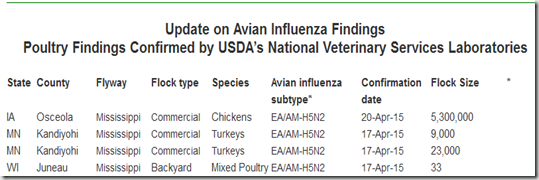
APHIS updated their current listing of poultry farms to be hit by the HPAI H5 virus shortly after 5pm today, and a farm in Iowa – with 5.3 million chickens either infected or exposed – singlehandedly more than doubles the number of birds on the culling block since the virus began to spread across the United States last December.

image


With the exception of 200,000 chickens affected 10 days ago in Wisconsin, the H5N2 story in American poultry this winter has been almost entirely centered around turkeys.  While considered less susceptible to HPAI H5N2 than turkeys, today’s announcement will no doubt raise additional  red flags for chicken producers across the nation.


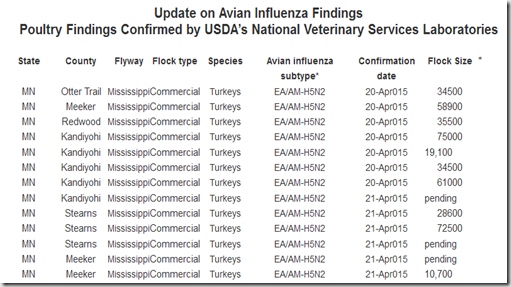
The APHIS report also indicates two more Minnesota turkey farms have been hit in recent days, bring that state’s total to 28 farms involving roughly 1.7 million turkeys.

Friday, April 17, 2015

Minnesota DNR Asks Turkey Hunters To Help With Bird Flu Surveillance

image

Credit Wikipedia


# 9954


Mid-April in Minnesota means the start of the spring  turkey season for hunters, and this year, with HPAI H5 viruses having been detected in at least 16 states, local authorities are both warning hunters of the risks of (see Minnesota DNR Offers Bird Flu Safety Advice To Hunters)  – and enlisting their aid in monitoring – these avian flu viruses.


With 26 farms hit in Minnesota alone (as of 4/16), and the bulk of those sitting in 5 centrally located counties (Kandiyohi, Pope, Meeker, Swift and Stearns), the DNR is asking hunters – starting on Monday – to make the turkeys they take available for testing for the avian flu virus.


image


The USDA’s National Veterinary Services Laboratories has a list with (as of 4/15/15) 55 infected wild birds sampled from across 10 western states, but thus far Minnesota has not reported HPAI H5 in any wild or migratory birds.  It is hoped that testing the birds taken by hunters this spring will answer some important questions about how the virus is spreading.


This press release from the  Minnesota DNR.


 news release
Wild turkey hunters asked to help with avian influenza surveillance

(Released April 17, 2015)

Successful wild turkey hunters in Kandiyohi, Pope, Meeker, Swift and Stearns counties can help determine if highly pathogenic avian influenza (HPAI) is present in Minnesota wildlife by allowing a sample to be collected from their turkeys.

“HPAI has not yet been found in wild turkeys, but it has been found in domestic turkeys in these and other Minnesota counties,” said Michelle Carstensen, wildlife health program supervisor with the Minnesota Department of Natural Resources. “We chose those five counties to enlist the help of hunters because they have sufficient wild turkey populations.”

Starting Monday, April 20, the DNR is asking successful hunters in these counties to call to schedule an appointment at one of the participating wildlife offices and allow a sample to be collected from their turkey. Samples will include a swab of the trachea and, if the bird has not yet been field dressed, a swab of the cloaca as well. Successful turkey hunters in these counties must call the following offices beginning April 20 to schedule an appointment:

  • Sauk Rapids, 320-223-7840
  • New London, 320-354-2154
  • Glenwood, 320-634-0342
  • Carlos Avery, 651-296-5290

Sampling only takes a few minutes and the hunter will retain the bird. Hunters are asked to keep wild turkeys in their vehicles, and DNR staff will come out to take the samples at the vehicles. Hunters also will be asked to provide their contact information, harvest information and approximate harvest location.

The 2015 spring wild turkey season is open until Thursday, May 28. The DNR hopes to collect 300 total samples from turkeys to test for HPAI. At this time, the DNR will not be sampling wild turkeys harvested in other counties. Unless their bird is found positive, individual hunters will not be notified of results.

The DNR recommends turkey hunters practice good hygiene while field dressing their birds and cook the meat to an internal temperature of 165 degrees Fahrenheit to kill any viruses and bacteria.

The Centers for Disease Control and Prevention considers the risk to people from HPAI infections in wild birds, backyard flocks and commercial poultry, to be low. No human infections with the virus have been detected.

More information about safe handling of wild turkeys and other information on avian influenza in Minnesota is available on the DNR website at www.mndnr.gov/ai.

Find more topics related to avian influenza on the Minnesota Board of Animal Health website at www.bah.state.mn.us/avian-influenza.

Tuesday, April 14, 2015

APHIS: H5N2 Confirmed In 8 More Minnesota Turkey Farms

image


# 9941


USDA’s APHIS has announced 8 more turkey farms in Minnesota have been struck by the highly pathogenic H5N2 virus, bringing to 22 the number of farms affected, spread across 12 counties.  Newly added counties in today’s announcement  include Redwood, La Sueur, and Swift (2 farms).


Today’s report pushes the number of Minnesota turkeys either killed, or to be culled, due to the H5N2 virus to roughly 1.4 million birds.


While migratory birds are being eyed as spreading the virus, how it is making it into so many farms - despite enhanced biosecurity measures - remains unanswered.


USDA Confirms Highly Pathogenic H5N2 Cases in Six Minnesota Counties

Published: Apr 14, 2015

 CDC considers the risk to people from these HPAI H5 infections in wild birds, backyard flocks and commercial poultry, to be low

WASHINGTON, April 14, 2015 -- The United States Department of Agriculture’s (USDA) Animal and Plant Health Inspection Service (APHIS) has confirmed the presence of highly pathogenic H5N2 avian influenza (HPAI) in an additional eight commercial turkey flocks in Minnesota.  There are 22 total confirmed cases in Minnesota.  These flocks are within the Mississippi flyway where this strain of avian influenza has previously been identified. CDC considers the risk to people from these HPAI H5 infections in wild birds, backyard flocks and commercial poultry, to be low.  No human infections with the virus have been detected at this time.

The affected flocks are in:

  • Kandiyohi County – 30,000 turkeys (4th detection in the county)
  • La Sueur County – 21,500 turkeys (1st detection in the county)
  • Meeker County – 25,000 turkeys (2nd detection in the county)
  • Meeker County – 20,000 turkeys (3rd detection in the county)
  • Stearns County – 76,000 turkeys (5th detection in the county)
  • Swift County – 160,000 turkeys (1st detection in the county)
  • Swift County – 154,000 turkeys (2nd detection in the county)
  • Redwood County – 56,000 turkeys (1st detection in the county)

Samples from the turkey flocks were tested at the University of Minnesota Veterinary Diagnostic Laboratory and the APHIS National Veterinary Services Laboratories (NVSL) in Ames, Iowa confirmed the findings. NVSL is the only internationally recognized AI reference laboratory in the United States.   APHIS is working closely with the Minnesota Board of Animal Health on a joint incident response. State officials quarantined the premises and birds on the property will be depopulated to prevent the spread of the disease. Birds from the flock will not enter the food system.

(Continue . . .)

Friday, April 10, 2015

Minnesota: Four More Farms Hit By HPAI H5N2

image


# 9927


The number of commercial turkey operations in Minnesota hit by the HPAI H5N2 avian flu continues to rise, with 4 new farms announced today, making a total of 13. The hardest hit county has been Stearns, which reports its 4th infected farm today.


The three new areas reporting this avian flu virus are Cottonwood, Lyon and Watonwan counties, all clustered in the southwestern part of the state. 


According to media reports a team of USDA  epidemiologists arrived earlier this week to help state and local agencies figure out how the virus is spreading to new farms despite the enhanced biosecurity measures that are in place.


While migratory birds are strongly suspected of carrying and dispersing the virus along the Pacific and Mississippi Flyways, thus far Minnesota has yet to report finding the virus in any wild birds (see Wild Bird Findings confirmed by USDA’s National Veterinary Services Laboratories).


This is today’s announcement from APHIS.


USDA Confirms Highly Pathogenic H5N2 Cases in Four Minnesota Counties

Last Modified: Apr 10, 2015


CDC considers the risk to people from these HPAI H5 infections in wild birds, backyard flocks and commercial poultry, to be low

WASHINGTON, April 10, 2015 -- The United States Department of Agriculture’s (USDA) Animal and Plant Health Inspection Service (APHIS) has confirmed the presence of highly pathogenic H5N2 avian influenza (HPAI) in an additional four commercial turkey flocks in Minnesota.  There are thirteen total confirmed cases in Minnesota.  These flocks are within the Mississippi flyway where this strain of avian influenza has previously been identified. CDC considers the risk to people from these HPAI H5 infections in wild birds, backyard flocks and commercial poultry, to be low.  No human infections with the virus have been detected at this time.

The affected flocks are in:

  • Cottonwood County - 48,000 turkeys
  • Lyon County - 66,000 turkeys
  • Stearns County 45,000 turkeys (4th detection in the county)
  • Watonwan County - 30,000 turkeys

Samples from the turkey flocks, which experienced increased mortality, were tested at the University of Minnesota Veterinary Diagnostic Laboratory and the APHIS National Veterinary Services Laboratories (NVSL) in Ames, Iowa confirmed the findings. NVSL is the only internationally recognized AI reference laboratory in the United States.   APHIS is working closely with the Minnesota Board of Animal Health on a joint incident response. State officials quarantined the premises and birds on the property will be depopulated to prevent the spread of the disease. Birds from the flock will not enter the food system.


The United States has the strongest AI surveillance program in the world.  As part of the existing USDA avian influenza response plans, Federal and State partners as well as industry are responding quickly and decisively to these outbreaks by following these five basic steps: 1) Quarantine – restricting movement of poultry and poultry-moving equipment into and out of the control area; 2) Eradicate – humanely euthanizing the affected flock(s); 3) Monitor region – testing wild and domestic birds in a broad area around the quarantine area; 4)  Disinfect – kills the virus in the affected flock locations; and 5) Test – confirming that the poultry farm is AI virus-free.  USDA also is working with its partners to actively look and test for the disease in commercial poultry operations, live bird markets and in migratory wild bird populations.

(Continue . . . )


Monday, April 06, 2015

APHIS: 2 More Minnesota Turkey Farms Hit By H5N2

image


# 9995


The USDA’s APHIS has announced that two more Minnesota farms have been hit by the Highly Pathogenic H5N2 virus, bringing to 7 the number commercial flocks hit so far in that state.  Stearns county, with three farms now reporting the virus, has been the hardest hit.


For now – in North America, anyway – the biggest concerns lie with poultry producers. 


While related to the H5N1 virus – which has killed several hundred people around the globe – these particular H5 viruses (H5N2 & H5N8) have not demonstrated a similar ability to infect and sicken humans. The CDC is taking a cautious approach to all of of these recently arrived HPAI viruses, however,  and has issued guidance for the testing, and prophylactic treatment of those exposed. 


USDA Confirms Highly Pathogenic H5N2 Avian Influenza in 3rd Stearns County, Minnesota Commercial Turkey Flock

Last Modified: Apr 6, 2015


CDC considers the risk to people from these HPAI H5 infections in wild birds, backyard flocks and commercial poultry, to be low

WASHINGTON, April 06, 2015 -- The United States Department of Agriculture’s (USDA) Animal and Plant Health Inspection Service (APHIS) has confirmed the presence of highly pathogenic H5N2 avian influenza (HPAI) in a third commercial turkey flock in Stearns County, Minnesota.  This is the sixth confirmation in a commercial flock in Minnesota.  The flock of 76,000 turkeys is located within the Mississippi flyway where this strain of avian influenza has previously been identified. CDC considers the risk to people from these HPAI H5 infections in wild birds, backyard flocks and commercial poultry, to be low.  No human infections with the virus have been detected at this time.

This flock is in the control area for a previous detection.   As part of our response protocol, samples were tested by the University of Minnesota Veterinary Diagnostic Laboratory as part of our standard surveillance work. The APHIS National Veterinary Services Laboratories in Ames, Iowa confirmed the findings. APHIS is working closely with the Minnesota Board of Animal Health on a joint incident response. State officials quarantined the premises and birds on the property will be depopulated to prevent the spread of the disease. Birds from the flock will not enter the food system.

(Continue . . .)

USDA Confirms Highly Pathogenic H5N2 Avian Influenza in Kandiyohi County, Minnesota Commercial Turkey Flock

Last Modified: Apr 6, 2015


CDC considers the risk to people from these HPAI H5 infections in wild birds, backyard flocks and commercial poultry, to be low

WASHINGTON, April 06, 2015 -- The United States Department of Agriculture’s (USDA) Animal and Plant Health Inspection Service (APHIS) has confirmed the presence of highly pathogenic H5N2 avian influenza (HPAI) in a molting breeder replacement turkey flock in Kandiyohi County, Minnesota.  This is the seventh confirmation in a commercial flock in Minnesota.  The flock of 26,000 turkeys is located within the Mississippi flyway where this strain of avian influenza has previously been identified. CDC considers the risk to people from these HPAI H5 infections in wild birds, backyard flocks and commercial poultry, to be low.  No human infections with the virus have been detected at this time.

Samples from the turkey flock, which experienced increased mortality, were tested at the University of Minnesota Veterinary Diagnostic Laboratory and the APHIS National Veterinary Services Laboratories in Ames, Iowa confirmed the findings. APHIS is working closely with the Minnesota Board of Animal Health on a joint incident response. State officials quarantined the affected premises and birds on the property will be depopulated to prevent the spread of the disease. Birds from the flock will not enter the food system.

(Continue . . . )

Although migratory birds are viewed as the primary suspects in the spread of these avian viruses, exactly how they are managing to infect commercial flocks in California, Minnesota, Missouri, and Arkansas hasn’t been determined.  


This update today from the USDA.


Update on Avian Influenza Findings

Last Modified: Apr 6, 2015

Print

Since December 2014, the United States Department of Agriculture has confirmed several cases of highly pathogenic avian influenza (HPAI) H5 in the Pacific, Central, and Mississippi flyways (or migratory bird paths). The disease has been found in wild birds, as well as in a few backyard and commercial poultry flocks. The Centers for Disease Control and Prevention (CDC) considers the risk to people from these HPAI H5 infections to be low. No human cases of these HPAI H5 viruses have been detected in the United States, Canada, or internationally.

Poultry Findings Confirmed by USDA’s National Veterinary Services Laboratories Include:

Captive Wild Bird Findings Confirmed by USDA’s National Veterinary Services Laboratories:

Wild Bird Findings confirmed by USDA’s National Veterinary Services Laboratories are available here.

Surveillance for avian influenza is ongoing in commercial poultry operations, live bird markets, and in migratory wild bird populations.

USDA is coordinating closely with its partners, including Arkansas, California, Idaho, Kansas, Minnesota, Missouri, Nevada, Oregon, Utah and Washington State officials, the U.S. Department of the Interior and the U.S. Department of Health and Human Services, on avian influenza surveillance, reporting, and control efforts.  The United States has the strongest AI surveillance program in the world, where we actively look for the disease and provide 100% compensation to affected producers to encourage reporting.

USDA continues to inform OIE and international trading partners of these findings.  USDA is working with trading partners to minimize trade impacts on poultry and poultry products as much as possible.

All bird owners, whether commercial producers or backyard enthusiasts, need to continue practicing good biosecurity, preventing contact between their birds and wild birds, and reporting sick birds or unusual bird deaths to State/Federal officials, either through your state veterinarian or through USDA’s toll-free number at 1-866-536-7593.  Additional information on biosecurity for backyard flocks can be found at healthybirds.aphis.usda.gov

USDA emphasizes that poultry, poultry products and wild birds (see biosecurity and wild birds) are safe to eat if they are properly handled and cooked to a temperature of 165 degrees Fahrenheit.

(Continue . . . )

Saturday, March 28, 2015

USDA: 3rd Minnesota Turkey Farm Hit By H5N2

image


# 9878


Just 24 hours after the 2nd infected Minnesota turkey farm was announced, we learn of a facility in Stearns county that has tested positive.  The first outbreak, in neighboring Pope county, was reported 3 weeks ago.


image 

This week Wyoming became the 11th state to report HPAI H5 viruses in either wild birds, or poultry,  which has led to repeated warnings to both commercial and backyard poultry operations on the need for enhanced biosecurity (see USDA Avian Flu Biosecurity Videos).


This from APHIS.


USDA Confirms Highly Pathogenic H5N2 Avian Influenza in Stearns County, Minnesota Commercial Turkey Flock

Last Modified: Mar 28, 2015

Print

CDC considers the risk to people from these HPAI H5 infections in wild birds, backyard flocks and commercial poultry, to be low

WASHINGTON, March 28, 2015 -- The United States Department of Agriculture’s (USDA) Animal and Plant Health Inspection Service (APHIS) has confirmed the presence of highly pathogenic H5N2 avian influenza (HPAI) in a commercial turkey flock in Stearns County, Minnesota.  This is the third confirmation in a commercial flock in Minnesota.  The flock of 39,000 turkeys is located within the Mississippi flyway where this strain of avian influenza has previously been identified. CDC considers the risk to people from these HPAI H5 infections in wild birds, backyard flocks and commercial poultry, to be low.  No human infections with the virus have been detected at this time.

Samples from the turkey flock, which experienced increased mortality, were tested at the University of Minnesota Veterinary Diagnostic Laboratory and the APHIS National Veterinary Services Laboratories in Ames, Iowa confirmed the findings. APHIS is working closely with the Minnesota Board of Animal Health on a joint incident response. State officials quarantined the affected premises and birds on the property will be depopulated to prevent the spread of the disease. Birds from the flock will not enter the food system.

The Minnesota Department of Health is working directly with poultry workers at the affected facility to ensure that they are taking the proper precautions. As a reminder, the proper handling and cooking of poultry and eggs to an internal temperature of 165 ˚F kills bacteria and viruses.

As part of existing avian influenza response plans, Federal and State partners are working jointly on additional surveillance and testing in the nearby area. The United States has the strongest AI surveillance program in the world, and USDA is working with its partners to actively look for the disease in commercial poultry operations, live bird markets and in migratory wild bird populations.

USDA will be informing the World Organization for Animal Health (OIE) as well as international trading partners of this finding. USDA also continues to communicate with trading partners to encourage adherence to OIE standards and minimize trade impacts. OIE trade guidelines call on countries to base trade restrictions on sound science and, whenever possible, limit restrictions to those animals and animal products within a defined region that pose a risk of spreading disease of concern.

These virus strains can travel in wild birds without them appearing sick. People should avoid contact with sick/dead poultry or wildlife. If contact occurs, wash your hands with soap and water and change clothing before having any contact with healthy domestic poultry and birds.

All bird owners, whether commercial producers or backyard enthusiasts, should continue to practice good biosecurity, prevent contact between their birds and wild birds, and report sick birds or unusual bird deaths to State/Federal officials, either through their state veterinarian or through USDA’s toll-free number at 1-866-536-7593.  Additional information on biosecurity for backyard flocks can be found at http://healthybirds.aphis.usda.gov.

(Continue . . .)


Friday, March 27, 2015

APHIS: USDA Confirms 2nd H5N2 Outbreak In Minnesota Turkey Flock

image

# 9876


Three weeks after we first learned from APHIS: HPAI H5N2 In A Minnesota Turkey Farm in Pope County, we are informed that a second farm has been affected in Lac Qui Parle County.  


Given that these counties are not immediately adjacent, and a  CIDRAP News report (see Wild birds nixed as Minnesota H5N2 source) from earlier this week quoted the Minnesota Department of Natural Resources (DNR) saying they found no evidence of the H5N2 strain in samples from wild birds in the area, it will be very interesting to see if there are any epidemiological links between the two poultry operations.


Here is the statement, posted on the APHIS website, this afternoon.


USDA Confirms Highly Pathogenic H5N2 Avian Influenza in Commercial Turkey Flock in Minnesota

Last Modified: Mar 27, 2015

Print

CDC considers the risk to people from these HPAI H5 infections in wild birds, backyard flocks and commercial poultry, to be low

WASHINGTON, March 27, 2015 -- The United States Department of Agriculture’s (USDA) Animal and Plant Health Inspection Service (APHIS) has confirmed the presence of highly pathogenic H5N2 avian influenza (HPAI) in a commercial turkey flock in Lac Qui Parle County, Minnesota.  This is the second confirmation in a commercial flock in Minnesota.  The flock of 66,000 turkeys is located within the Mississippi flyway where this strain of avian influenza was previously identified. CDC considers the risk to people from these HPAI H5 infections in wild birds, backyard flocks and commercial poultry, to be low.  No human infections with the virus have been detected at this time.

Samples from the turkey flock, which experienced increased mortality, were tested at the University of Minnesota Veterinary Diagnostic Laboratory and the APHIS National Veterinary Services Laboratories in Ames, Iowa confirmed the findings. APHIS is working closely with the Minnesota Board of Animal Health on a joint incident response. State officials quarantined the affected premises and birds on the property will be depopulated to prevent the spread of the disease. Birds from the flock will not enter the food system.

The Minnesota Department of Health is working directly with poultry workers at the affected facility to ensure that they are taking the proper precautions. As a reminder, the proper handling and cooking of poultry and eggs to an internal temperature of 165 ˚F kills bacteria and viruses.

As part of existing avian influenza response plans, Federal and State partners are working jointly on additional surveillance and testing in the nearby area. The United States has the strongest AI surveillance program in the world, and USDA is working with its partners to actively look for the disease in commercial poultry operations, live bird markets and in migratory wild bird populations.

USDA will be informing the World Organization for Animal Health (OIE) as well as international trading partners of this finding. USDA also continues to communicate with trading partners to encourage adherence to OIE standards and minimize trade impacts. OIE trade guidelines call on countries to base trade restrictions on sound science and, whenever possible, limit restrictions to those animals and animal products within a defined region that pose a risk of spreading disease of concern.

These virus strains can travel in wild birds without them appearing sick. People should avoid contact with sick/dead poultry or wildlife. If contact occurs, wash your hands with soap and water and change clothing before having any contact with healthy domestic poultry and birds.

All bird owners, whether commercial producers or backyard enthusiasts, should continue to practice good biosecurity, prevent contact between their birds and wild birds, and report sick birds or unusual bird deaths to State/Federal officials, either through their state veterinarian or through USDA’s toll-free number at 1-866-536-7593.  Additional information on biosecurity for backyard flocks can be found at http://healthybirds.aphis.usda.gov.

(Continue . . . )

Friday, March 06, 2015

APHIS: HPAI H5N2 In A Minnesota Turkey Farm

image

1st Detection of HPAI H5 In the Mississippi Flyway


# 9786


In what can only be viewed as an troubling sign for the poultry industry, the recently arrived HPAI H5N2 avian flu virus – a new reassortant of the H5N8 virus which first appeared in Asia in early 2014 – has dramatically leapfrogged hundreds of miles east and has infected a commercial turkey farm in Minnesota.


Although this subtype is not known to infect humans, this is a highly pathogenic virus in domestic poultry, and it continues to spread quickly around the world via asymptomatic wild and migratory birds.


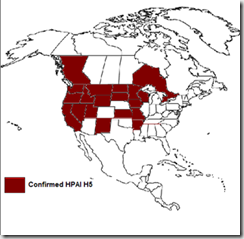
Since November we’ve seen H5N8 and/or H5N2/H5N1 turn up in six western states as well as in British Columbia – all of which lie either beneath, or adjacent to, the Pacific Flyway.  


While these flyways are predominately north-south corridors, their overlapping allows for a lateral (east-west) movement of avian viruses as well – often via shared nesting areas and ponds – something we’ve looked at recently in The North Atlantic Flyway Revisited & FAO On The Potential Threat Of HPAI Spread Via Migratory Birds.


image

Credit FAO

The Mississippi Americas Flyway covers 2/3rds of North America, and is overlapped by the Pacific Flyway on its western border, and the the Atlantic Americas Flyway on the east.


With HPAI H5 now detected in the upper Midwest, the concern has to be how much farther will these viruses spread, and how well entrenched will they become in North American birds.


We’ve the following announcement, issued late yesterday, from the USDA’s APHIS, after which I’ll be back with a bit more:

USDA Confirms H5N2 Avian Influenza in Commercial Turkey Flock in Minnesota


First Finding in the Mississippi Flyway

The United States Department of Agriculture’s (USDA) Animal and Plant Health Inspection Service (APHIS) has confirmed the presence of highly pathogenic H5N2 avian influenza in a commercial turkey flock in Pope County, Minnesota. This is the first finding in the Mississippi flyway. It is the same strain of avian influenza that has been confirmed in backyard and wild birds in Washington, Oregon and Idaho as part of the ongoing incident in the Pacific flyway.

Samples from the turkey breeder replacement flock, which experienced increased mortality, were tested at the University of Minnesota Veterinary Diagnostic Laboratory and the APHIS National Veterinary Services Laboratories in Ames, Iowa confirmed the finding. APHIS is partnering closely with the Minnesota Board of Animal Health on a joint incident response. State officials quarantined the affected premises and the remaining birds on the property will be depopulated to prevent the spread of the disease. Birds from the involved flock will not enter the food system.

CDC considers the risk to people from these HPAI H5 infections in wild birds, backyard flocks, and commercial poultry, to be low. No human infections with these viruses have been detected at this time. The Minnesota Department of Health is working directly with poultry workers at the affected facility to ensure they are taking the proper precautions. As a reminder, the proper handling and cooking of poultry and eggs to an internal temperature of 165 ˚F kills bacteria and viruses.

Federal and State partners are working jointly on additional surveillance and testing in the nearby area, following existing avian influenza response plans. The United States has the strongest AI surveillance program in the world, and USDA is working with its partners to actively look for the disease in commercial poultry operations, live bird markets, and in migratory wild bird populations.

USDA will be informing OIE and international trading partners of this finding. USDA also continues to communicate with trading partners to encourage adherence to OIE standards and minimize trade impacts. OIE trade guidelines call on countries to base trade restrictions on sound science and, whenever possible, limit restrictions to those animals and animal products within a defined region that pose a risk of spreading disease of concern. These virus strains can travel in wild birds without them appearing sick. People should avoid contact with sick/dead poultry or wildlife. If contact occurs, wash your hands with soap and water and change clothing before having any contact with healthy domestic poultry and birds.

All bird owners, whether commercial producers or backyard enthusiasts, should continue to practice good biosecurity, prevent contact between their birds and wild birds, and to report sick birds or unusual bird deaths to State/Federal officials, either through your state veterinarian or through USDA’s toll-free number at 1-866-536-7593. Additional information on biosecurity for backyard flocks can be found at healthybirds.aphis.usda.gov

(Continue . . . )


Over the past year we’ve seen the unprecedented global spread of HPAI H5 viruses (primarily H5N8 & H5N2), with novel reassortants winging their way from Asia, to Europe and North America via wild and migratory birds.


While none of these North American reassortants appears to pose a threat to human health, the CDC remains cautious and has issued specific guidance documents (see CDC Interim Guidance For Testing For Novel Flu  & CDC Interim Guidance On Antiviral Chemoprophylaxis For Persons With Exposure To Avian Flu).


The concern – beyond HPAI H5’s considerable threat to the poultry industry – is that these viruses are constantly changing.  They can hook up with other influenza viruses and reassort – producing new hybrid strains - possibly with unpredictable results. 

image

Shift, or reassortment, happens when two different influenza viruses co-infect the same host swap genetic material. 


This  rapid emergence and spread of a variety of H5 avian viruses (H5N1, H5N2, H5N2, H5N5, H5N6, H5N8) over the past 12 months recently prompted the World Health Organization to issue a pointed warning (see WHO: H5 Currently The Most Obvious Avian Flu Threat).


While no one can predict the future for any of these viruses - the greater the diversity of novel viruses in circulation - the greater the chances of someday seeing one successfully adapt to humans.

.

For more on this rapidly expanding array of novel flu viruses you may wish to revisit:


The Expanding Array Of Novel Flu Strains

EID Journal: Predicting Hotspots for Influenza Virus Reassortment

Viral Reassortants: Rocking The Cradle Of Influenza

Friday, August 31, 2012

Minnesota Reports Swine H1N2v Flu


# 6530


File this under - `Once you start looking, no telling what you’ll find’.


Enhanced surveillance for H3N2v flu cases associated with contact with pigs by Minnesota’s Department of Health has turned up 1 confirmed, and 2 probable human cases of H1N2v influenza.


The H1N2 virus is one of three flu strains that commonly circulate in swine (H1N1, H3N2, & H1N2).


H1N2 is assumed to be a reassortment between the H1N1 and H3N2 virus. It has on rare occasions been detected in humans. 


image

Credit CDC


Minnesota reported a human infection with A/H1N2 in December of 2011, and it was said to be similar to an H1N1 virus (A/New Caledonia /20/99-like) that circulated as recently as 2007. 


Michigan reported an H1N2 human infection in 2007. 


As has been pointed out in this blog before, we honestly don’t know how often these novel swine (or avian)origin flu viruses jump to humans. Given the limits of testing and surveillance, it is probably more common than the numbers suggest.


Heightened surveillance around the country for the H3N2v virus may very well tell us a good deal about other variant viruses that we know can occasionally show up in the human population.


Here is the Press release from the MDH.

image


News Release
August 31, 2012
 

Three human cases of influenza linked to swine exposure at State Fair

Strain is different from the one that prompted current surveillance and prevention efforts

Three people are believed to have developed a strain of influenza known as variant H1N2 (H1N2v) after exhibiting pigs or spending time in the swine barn at the Minnesota State Fair.


One of the three cases has been confirmed by CDC. Test results for the other two are pending.


The H1N2v strain is different from the H3N2v strain that has prompted stepped up surveillance and prevention efforts nationwide, after causing 289 reported cases of illness and one death since the beginning of the year.


Officials at the Minnesota Department of Health (MDH) say they are not currently aware of any additional human influenza cases caused by H1N2v, and they do not anticipate changing their current public health recommendations regarding human exposure to swine.


They emphasized, however, that they will continue to assess the situation and conduct aggressive surveillance for additional influenza cases.


Current recommendations include asking individuals at high risk for severe influenza to avoid swine contact at exhibitions, fairs, live markets and other venues, including the swine barn at the State Fair. High risk individuals include children under five years of age, pregnant women, people 65 years of age or older and those with chronic medical conditions.


"For the past two weeks, we have been looking very hard for cases of influenza in people who have been exposed to swine," said Richard Danila, Deputy State Epidemiologist. "We have also worked closely with our veterinary colleagues to remain informed about potential infections in swine at the Fair. It is because of this careful surveillance that these cases have come to our attention.


"Right now, we don’t have any basis for changing our recommendations to the public," Danila said.


The illness has been confirmed in a teenage girl who was exhibiting pigs at the fair and became ill on Aug. 26. The other two cases occurred in an elementary-school-aged boy who became ill on Aug. 27 after spending all day in the swine barn on Aug. 24, and a woman in her late seventies who became ill on Aug. 26 after spending a prolonged period of time in the swine barn and at the swine show in the Exhibit Hall on Aug 24.


Both the boy and the older woman had underlying health conditions, and were treated with antiviral drugs. The woman was hospitalized, but has now been released. All three patients have recovered or are recovering.


The teenager was tested for influenza after she reported illness to nursing staff at the Fair. The other cases were reported to MDH by health care providers. Health care providers have been asked to report cases of influenza-like illness in people who report that they have had contact with swine. Swine exhibitors have been asked to report it if they experience symptoms of influenza.


Fair officials have also been monitoring swine for possible symptoms of illness, so they can be tested. Two pigs at the swine exhibit were found to be infected with the same H1N2 virus earlier this week, and were both isolated from contact with other pigs. Infection with H1N2 is not considered unusual in pigs.

-MDH-


For more on the H1N2 virus, you may wish to revisit:

Hong Kong Swine Influenza Surveillance
CDC: Variant Influenza Strains
CDC Confirms 2 More Novel Flu Infections
If You’ve Seen One Triple Reassortant Swine Flu Virus . . .

Monday, August 20, 2012

Minnesota Reports First H3N2v Case


image


# 6503


Today Minnesota announced that they have joined the short list of states reporting H3N2v flu infections that have predominately been associated with exposure to pigs at county fairs. 


This brings to 10 the number or states reporting cases since July 12th, 2012.


Thus far, nearly all of the cases reported have had had direct contract with pigs or their environment, and the CDC has not found sustained and efficient transmission among humans.


The concern, of course, is that over time this virus might evolve to a more human-adapted virus. So public health officials track these outbreaks with considerable interest.


Today’s announcement from the Minnesota Health Department follows:


News Release
August 20, 2012
Minnesota Department of Health - Minnesota Department of Agriculture - Minnesota Board of Animal Health

First cases of new influenza strain reported in Minnesota

Minnesota has recorded its first confirmed case and a second probable case of a new influenza strain that people acquire through contact with pigs.


The two cases were reported in a pre-school-age child and an older sibling from a family living in the Twin Cities metro area. Both children developed symptoms of the illness two days after the family visited a live animal market in Dakota County on Aug. 10. Neither child required hospitalization, and both are recovering.


Both children were tested for the virus that causes the new flu strain, but only the younger child tested positive. However, the older child is considered a “probable” case, based on the child’s history of flu-like illness and the family connection to the younger child.


Officials at the Minnesota Department of Health (MDH) believe both children were most likely exposed to the new flu strain from pigs while they were at the animal market.


People usually get the new strain of flu – known as variant H3N2 (H3N2v) - from pigs rather than other people. A few cases have been reported where an individual got the illness from another person, but there was no further spread of the illness to additional people.


In addition to the Minnesota case, over 200 cases of the illness have been reported in eight states since the beginning of the year. Most have occurred in children who were exhibiting pigs at state or county fairs, or people who visited swine exhibits at fairs.

(Continue . . . )


In a related story, the CDC updated their webpage on preventing the transmission of the H3N2v virus late this afternoon as well.


Take Action to Prevent the Spread of Flu Between People and Pigs at Fairs

Pigs have their own influenza viruses (called swine influenza) that are usually different from human flu viruses. While rare, influenza can spread from pigs to people and from people to pigs. When people get swine flu viruses, it’s usually after contact with pigs. This has happened in different settings, including fairs. Right now, the Centers for Disease Control and Prevention (CDC) is concerned about a new flu virus that has been found in U.S. pigs and that has infected people too. This virus – called H3N2v – may spread more easily to humans from pigs than is usual for swine flu viruses.

There are ways to reduce the spread of influenza viruses between pigs and people.

CDC Recommendations For People At High Risk:

  • If you are at high risk of serious flu complications and are going to a fair where pigs will be present, avoid pigs and swine barns at the fair this year. This includes children younger than 5 years, people 65 years and older, pregnant women, and people with certain long-term health conditions (like asthma, diabetes, heart disease, weakened immune systems, and neurological or neurodevelopmental conditions).

CDC Recommendations for People Not at High Risk:

  • Don’t take food or drink or eat, drink or put anything in your mouth in pig areas.
  • Don’t take toys, pacifiers, cups, baby bottles, strollers, or similar items into pig areas.
  • Wash your hands often with soap and running water before and after exposure to pigs. If soap and water are not available, use an alcohol-based hand rub.
  • Avoid close contact with pigs that look or act ill.
  • Take protective measures if you must come in contact with pigs that are known or suspected to be sick. This includes wearing protective clothing, gloves, masks that cover your mouth and nose, and other personal protective equipment.
  • Watch your pig (if you have one) for signs of illness and call a veterinarian if you suspect it might be sick.
  • Avoid contact with pigs if you have flu-like symptoms. Wait 7 days after your illness started or until you have been without fever for 24 hours without the use of fever-reducing medications, whichever is longer. If you must have contact with pigs while you are sick, take the protective actions listed above.

A seasonal flu vaccine will not protect against H3N2v, but influenza antiviral drugs that can treat H3N2v as well as seasonal flu illness in people. These are prescription drugs. Early treatment is better, so see your health care provider as soon as you get sick if you have been exposed to pigs and get flu-like symptoms. Tell your doctor about your exposure and whether you have a high risk factor.