Showing posts with label HPAI H5. Show all posts

Friday, May 22, 2015

Referral: CIDRAP Recaps Yesterday’s HPAI H5N2 News

image

Credit Minn. Board Animal Health


# 10,076


Although we’ve seen a decline in the number of new farms reporting HPAI H5 infection across the upper Midwest, the avian virus continues to impact additional farms in Iowa, and even states that haven’t reported a new cases in several days dare not relax.   


It is hoped that warmer weather will continue to diminish the avian flu threat over the summer, but what comes next fall and winter is anyone’s guess. 


Which is why Iowa announced yesterday that they will join Minnesota, New York, and several other states which have already decided to prohibit the display, trade, or sale of poultry at state and county fairs and other public venues through the end of 2015.  


Excerpts from the official statement follow:


EXHIBITIONS OF BIRDS CANCELLED FOR 2015 DUE TO AVIAN INFLUENZA


Fairs, livestock auctions, swap meet and exotic sales will not include birds

DES MOINES – The Iowa Department of Agriculture and Land Stewardship today announced an order to cancel all live bird exhibitions at county fairs, the Iowa State Fair, and other gatherings of birds due to avian influenza. The Department’s order begins immediately, is effective through the end of 2015, and also prohibits live birds from being sold at livestock auction markets, swap meets and exotic sales.

Iowa has over 25 million birds and more than 60 farms impacted by H5N2 highly-pathogenic avian influenza (HPAI). The purpose of the Department’s directive is to minimize the risk of potential further spread of the virus to other poultry.  The Center for Disease Control (CDC) and Iowa Department of Public Health consider the risk to the public related to HPAI H5 infections to be very low.  No human infections of the virus have ever been detected and there is no food safety risk for consumers.

“We are asking producers and bird owners to increase their biosecurity measures and we feel this is a needed step to further minimize the risk of spreading the virus,” said Iowa Secretary of Agriculture Bill Northey.  "The scale of this outbreak has been unprecedented, so we think it is important we take every possible step to limit the chance that this disease will spread any further."

(Continue . . . )


With more on all of this, plus concerns over media reports of lax biosecurity at some farms and a recap of recent outbreaks in Iowa, CIDRAP News  Editor Robert Roos penned the following report last night.


Iowa bans bird shows as avian flu outbreaks persist

Robert Roos | News Editor | CIDRAP News

May 21, 2015

Iowa state officials today announced a ban on live-bird shows and some sales for the rest of this year in an effort to stop the spread of avian flu, and followed up by reporting another chicken outbreak, which followed two turkey outbreaks announced yesterday.

Meanwhile, a Reuters story today said that on the basis of a reporter's experience, recommended biosecurity measures were not being enforced at several farms in northwestern Iowa, where the state's outbreaks are concentrated.

(Continue . . . )


Thursday, May 07, 2015

Minnesota & Iowa Each Add Two More `Presumptive’ H5N2 Outbreaks

image

Credit MBAH Media Tool Kit


# 20,022


While Wisconsin has now gone three days without reporting a new outbreak, and the number of new  presumptive outbreaks in Minnesota and Iowa have decreased in recent days, the avian flu outbreak in the upper Midwest continues to wreak havoc having claimed well over 26 million birds.


Although wild and migratory birds are still viewed as the likely conveyance of the virus across much of the western United States, increasingly questions are being asked regarding the role of `lateral transmission’ -  the spread from farm to farm via other means – in its dispersal.


This is a topic we’ve discussed often in the past, including in Bird Flu Spread: The Flyway Or The Highway?   and  Bird Flu’s Airborne `Division’,  and it is the subject of an AP report today:


Vet: Bird Flu may be Spreading from Farm to Farm in Minnesota

May 7, 2015 02:21 PM

Minnesota's state veterinarian suggested Wednesday that bird flu may be spreading from farm-to-farm in the state's top turkey-growing counties, a possibility they downplayed in the early days of the outbreak.

They said instead that they suspected the virus was being carried into the state by migratory waterfowl that would spread it via their droppings, then accidentally tracked into barns by farm workers or perhaps by rodents.

(Continue . . . )


While there has been no lack of theories regarding how the avian influenza virus has spread so rapidly amid what has been purported to be extremely heightened biosecurity measures, so far we’ve not seen definitive answers. 


Frankly, it would not be surprising to find that a variety of factors – ranging from birds migratory birds to human activity – have played a role in its spread.


We’ve two updates this afternoon,  first this one from the Minnesota Board of Animal Health.


FOR IMMEDIATE RELEASE
May 07, 2015

Daily Update on Avian Influenza - May 7

​ ST PAUL — The Minnesota Department of Public Safety Homeland Security and Emergency Management  Division (HSEM) activated the State Emergency Operations Center (SEOC) to coordinate the state’s ongoing response to avian influenza. HSEM will coordinate resource needs with several state agencies including the Minnesota Board of Animal Health and the Minnesota Department of Agriculture.

Additional HPAI cases in Minnesota
The Minnesota Board of Animal Health today announced two presumptive positive flocks. The following Minnesota counties are affected:

  • Kandiyohi – 32nd detection (turkeys, flock size information coming soon)
  • Swift – 6th detection (turkeys, flock size information coming soon)

Current situation
Total number of affected farms – 84
Total number of counties – 21

image

(Continue . . . .)

And this report from Iowa’s Department of Agriculture.


TWO PROBABLE CASES OF HIGHLY PATHOGENIC AVIAN INFLUENZA IN OSCEOLA AND CHEROKEE COUNTIES


CDC considers the risk to people to be low

DES MOINES – The Iowa Department of Agriculture and Land Stewardship is responding to two probable cases of highly pathogenic avian influenza (HPAI) in commercial poultry farms in Osceola and Cherokee counties.  These two new cases would join 35 cases of the disease in Iowa that were previously announced. State officials have quarantined the premises and once the presence of the disease is confirmed, all birds on the property will be humanely euthanized to prevent the spread of the disease.

Osceola 3 – A layer pullet farm with an estimated 100,000 birds that has experienced increased mortality.  Initial testing showed it positive for H5 avian influenza.  Additional confirmatory testing is pending from the APHIS National Veterinary Services Laboratories (NVSL) in Ames.

Cherokee 4 – Turkey farm that has experienced increased mortality.  An estimate on the number of birds at the site is still pending. Initial testing showed it positive for H5 avian influenza.  Additional confirmatory testing is pending from the APHIS National Veterinary Services Laboratories (NVSL) in Ames.

As the Department receives final confirmations of the disease updated information will be posted to the Iowa Department of Agriculture and Land Stewardship’s website at www.iowaagriculture.gov/avianinfluenza.asp.

The Center for Disease Control (CDC) and Iowa Department of Public Health considers the risk to people from these HPAI H5 infections in wild birds, backyard flocks and commercial poultry, to be low.  No human infections with the virus have ever been detected and there is no food safety risk for consumers.

Wednesday, May 06, 2015

CIDRAP H5N2 Round Up - Iowa Adds 3 More Farms

image

States & Provinces with Confirmed HPAI H5

# 15,016


Last night I reported on two more Minnesota farms presumed to be infected with the H5N2 virus,  but we’ve two reports filed a bit later in the evening that add to yesterday’s bird flu information.  First , Jim Wappes of CIDRAP NEWS has an excellent round up of the day’s avian influenza news, followed by the latest report out of hard-hit Iowa.


H5N2 suspected on 5 more Iowa, Minnesota farms

 Jim Wappes | Editorial Director | CIDRAP News

May 05, 2015

Barn turkey

Courtesy of Minnesota Board of Animal Health

Officials in Iowa and Minnesota today reported five more likely outbreaks of H5N2 avian flu, while a Minnesota turkey company announced H5N2-related layoffs and federal officials freed up $330 million for response efforts.

The outbreaks in Iowa involve two turkey farms and a chicken laying operation of 60,000 hens, the Iowa Department of Agriculture and Land Stewardship (IDALS) said today. Initial tests showed that birds on all three operations tested positive for the H5 strain of avian flu, and confirmatory tests from the National Veterinary Services Laboratories (NVSL) in Ames, Iowa, are pending.

Both turkey farms are in Buena Vista County in northwestern Iowa. An IDALS news release said both farms experienced increased deaths in turkeys but did not specify the size of either flock. The county has now had 10 outbreaks.

The commercial laying operation is in Sioux County, which also lies in northwestern Iowa but borders South Dakota. The flock of an estimated 60,000 chickens also experienced increased mortality, the IDALS release said.

The agency said 20,096,846 poultry in 27 outbreaks in 11 counties have now been affected in Iowa. The vast majority of the birds—19,310,471—have been egg-laying chickens.

(Continue . . . )


Meanwhile, the Iowa Department of Agriculture has updated their website, showing that in that state alone the number of birds affected is very near 20 million.


For Immediate Release
Tuesday, May 5, 2015

THREE PROBABLE CASES OF HIGHLY PATHOGENIC AVIAN INFLUENZA IN BUENA VISTA AND SIOUX COUNTIES


CDC considers the risk to people to be low

DES MOINES – The Iowa Department of Agriculture and Land Stewardship is responding to three probable cases of highly pathogenic avian influenza (HPAI) in commercial poultry farms in Buena Vista and Sioux counties.  These three new cases would join 25 cases of the disease in Iowa that were previously announced. State officials have quarantined the premises and once the presence of the disease is confirmed, all birds on the property will be humanely euthanized to prevent the spread of the disease.

Buena Vista 9 – Turkey farm that has experienced increased mortality.  An estimate on the number of birds at the site is still pending. Initial testing showed it positive for H5 avian influenza.  Additional confirmatory testing is pending from the APHIS National Veterinary Services Laboratories (NVSL) in Ames.

Buena Vista 10 – Turkey farm that has experienced increased mortality.  An estimate on the number of birds at the site is still pending. Initial testing showed it positive for H5 avian influenza.  Additional confirmatory testing is pending from the APHIS National Veterinary Services Laboratories (NVSL) in Ames.

Sioux 4 – Commercial laying operation with an estimated 60,000 birds that has experienced increased mortality.  Initial testing showed it positive for H5 avian influenza.  Additional confirmatory testing is pending from the APHIS National Veterinary Services Laboratories (NVSL) in Ames.

As the Department receives final confirmations of the disease updated information will be posted to the Iowa Department of Agriculture and Land Stewardship’s website at www.iowaagriculture.gov/avianinfluenza.asp.

image

Wednesday, April 29, 2015

HPAI H5: Minnesota Reports 11 More Farms, Iowa Reports 4 More As `Probable’

image


# 9993


Although we don’t have a good count on the number of birds affected, tonight the Minnesota Board of Animal Health has announced an additional 11 farms have been hit with the HPAI H5N2 virus since yesterday’s update – putting the total at 67 farms across 19 counties.

https://www.bah.state.mn.us/avian-influenza

image

All of the counties – except 1 (Steele) – have reported previously outbreaks.


Meanwhile Iowa – which has seen fewer farms, but far larger numbers of birds affected - reports four more probable outbreaks. Kossuth County becomes the 6th Iowa county to report outbreaks of the highly infectious avian virus.

image


FOUR ADDITIONAL CASES OF HIGHLY PATHOGENIC AVIAN INFLUENZA IN BUENA VISTA AND KOSSUTH COUNTIES


CDC considers the risk to people to be low

DES MOINES – The Iowa Department of Agriculture and Land Stewardship is responding to four probable cases of highly pathogenic avian influenza (HPAI) in commercial poultry farms in Buena Vista and Kossuth counties.  These four new cases would join eight cases of the disease in Iowa that were previously announced. State officials have quarantined the premises and once the presence of the disease is confirmed, all birds on the property will be humanely euthanized to prevent the spread of the disease.

Buena Vista 2 – Turkey farm with an estimated 50,000 birds that experienced increased mortality.  Initial testing showed it positive for H5 avian influenza.  Additional confirmatory testing is pending from the APHIS National Veterinary Services Laboratories (NVSL) in Ames.

Buena Vista 3 – Turkey farm that has experienced increased mortality.  An estimate on the number of birds at the site is still pending. Initial testing showed it positive for H5 avian influenza.  Additional confirmatory testing is pending from the APHIS National Veterinary Services Laboratories (NVSL) in Ames.

Buena Vista 4 – Commercial laying operation with an estimated 63,000 birds that has experienced increased mortality.  Initial testing showed it positive for H5 avian influenza.  Additional confirmatory testing is pending from the APHIS National Veterinary Services Laboratories (NVSL) in Ames.

Kossuth County – Chicken breeder farm with an estimated 19,000 birds that has experienced increased mortality.  Initial testing showed it positive for H5 avian influenza.  Additional confirmatory testing is pending from the APHIS National Veterinary Services Laboratories (NVSL) in Ames.

As the Department receives final confirmations of the disease updated information will be posted to the Iowa Department of Agriculture and Land Stewardship’s website at www.iowaagriculture.gov/avianinfluenza.asp.

The Center for Disease Control (CDC) and Iowa Department of Public Health considers the risk to people from these HPAI H5 infections in wild birds, backyard flocks and commercial poultry, to be low.  No human infections with the virus have ever been detected there is no food safety risk for consumers.

(Continue . . . )


Two CDC Updates: HPAI H5 & H3N2 Canine Flu

image

CDC HPAI Risk Assessment


# 9992


Although neither of these viruses have shown the ability to infect humans, they are nevertheless newly arrived pathogens in North America, are spreading with impressive speed, and are capable of further evolution.  


All of which means that – while they currently pose little threat to human health -  they need to be carefully watched.


The CDC has updated their HPAI H5 webpage, and has published an announcement on the sequencing of the canine H3N2 virus, which they say shows no overt signs of being better able to infect humans than the H3N8 canine flu.


H5 Viruses in the United States

Page last updated: April 29, 2015

Highly pathogenic avian influenza (HPAI) H5 infections have been reported in U.S. domestic poultry (backyard and commercial flocks), captive wild birds, and wild birds. HPAI H5 detections began in December 2014 and have continued into April 2015. USDA is reporting that H5 viruses have been detected in birds in 18 U.S. states; 13 states have experienced outbreaks in poultry flocks and 5 states have detected H5 in wild birds.

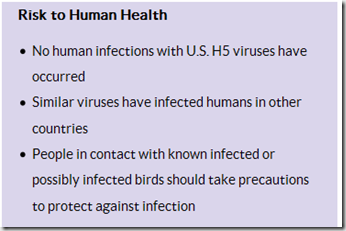
No human infections with these viruses have been detected at this time, however similar viruses have infected people in other countries and caused serious illness and death in some cases. Human infections with other avian influenza viruses have occurred after close and prolonged contact with infected birds or the excretions/secretions of infected birds (e.g., droppings, oral fluids).

While the health risk posed to the general public by these domestic HPAI outbreaks is low at this time, it is possible that human infections with these viruses may occur. CDC has guidance for clinicians and public health professionals in the United States on appropriate follow-up, preventive treatment, testing, specimen collection and processing of samples from patients who may be infected with H5 viruses and has been in close contact with state health departments from all 16 states that have detected H5 in birds.

CDC Recommendations for the Public
  • As a general precaution, people should avoid wild birds and observe them only from a distance; avoid contact with domestic birds (poultry) that appear ill or have died; and avoid contact with surfaces that appear to be contaminated with feces from wild or domestic birds.
  • People who have had contact with infected bird(s) should monitor their own health for possible symptoms (for example, conjunctivitis, or flu-like symptoms).
  • People who have had contact with infected birds may also be given influenza antiviral drugs preventatively.
  • Health care providers evaluating patients with possible HPAI H5 infection should notify their local or state health departments which in turn should notify CDC. CDC is providing case-by-case guidance at this time.
  • There is no evidence that any human cases of avian influenza have ever been acquired by eating properly cooked poultry products.
  • CDC will update the public as new information becomes available.


Update on H3N2 Canine Influenza (Dog Flu) Virus

April 28, 2015 – Experts from CDC’s Influenza Division have analyzed genetic sequences of the H3N2 canine influenza A virus recently detected in the United States and found no evidence suggesting an increased potential for this virus to infect humans or cause severe disease in humans. Therefore, the risk to humans posed by this virus continues to be low and is equivalent to that associated with previously circulating H3N8 canine influenza viruses.

CDC conducts year-round surveillance and genetic analysis on circulating human and novel influenza A viruses in order to assess human health risk and prepare for vaccine virus selection. This work is based in part on an informal inventory of genetic mutations that are associated with viral characteristics like increased transmissibility or severity. While genetic analysis of the H3N2 canine flu virus did not show any of these markers, the agency will continue to analyze this virus and watch the field situation closely.

H3N2 canine flu virus is responsible for an outbreak of dog flu reported in the Chicago area according to a press release issued by Cornell University, home to the New York State Animal Diagnostic Laboratory. Dog flu is a contagious respiratory disease in dogs. Two canine influenza viruses have been identified worldwide: an influenza A H3N8 virus and an influenza A H3N2 virus. No human infections with either of these canine influenza viruses have ever been reported.

Previously, canine influenza A H3N8 viruses have been identified in U.S. dog populations. However, testing at the New York State Animal Diagnostic Laboratory and the Wisconsin Veterinary Diagnostic Laboratory showed that the dog flu virus responsible for the current outbreak in dogs is an H3N2 virus. This virus is similar to H3N2 dog flu viruses that have been detected in dogs in parts of Asia since 2007.

Updates on ongoing antigenic and phenotypic analyses will be shared when they are available. For more information on canine influenza (dog flu), please visit Key Facts about Canine Influenza.

Monday, April 27, 2015

New Scientist: The Downsides To Using HPAI Poultry Vaccines

image

Poultry Vaccination - Photo Credit OIE


# 9983


Last week, in The HPAI Poultry Vaccine Dilemma,  I wrote at some length on the problems inherent in turning to a poultry vaccine to control the HPAI H5 viruses spreading across North America.


This is a topic we’ve looked at repeatedly over the years, including in 2012’s Egypt: A Paltry Poultry Vaccine and 2009’s  Indonesia: Debate Over Poultry Vaccination.


Last November we looked at an EID Journal dispatch - Subclinical Highly Pathogenic Avian Influenza Virus Infection among Vaccinated Chickens, China – which addressed many of these concerns, and what they called  the `multiple disadvantages of HPAI mass vaccination, including the creation of vaccine-escape flu variants


Although HPAI vaccines can often prevent serious illness in poultry flocks, they often fail to prevent viruses from spreading, and eventually evolving into new strains.  As these new variants appear, the vaccines become even less effective – turning their use into a gigantic slippery slope. 


One that China, Egypt, Vietnam, and Indonesia have been unable to get off, despite warnings from the OIE that poultry vaccines must be considered a `short-term solution’ and counties must have an `exit strategy’ (see Avian influenza and vaccination: what is the scientific recommendation?).


Although the USDA has steadfastly supported quarantine and culling as the preferred method of dealing with bird flu in the United States, nervous poultry producers are calling for a vaccine option.  


So I’m happy to report that the New Scientist has weighed in on this issue today as well, with an article by Debora MacKenzie.  Follow the link to read:


US farms hit by bird flu – but a vaccine might make things worse

17:08 27 April 2015 by Debora MacKenzie

For similar stories, visit the US national issues and Bird Flu Topic Guides

Bird flu is rampaging across the Midwestern US this week. So far 8 million chickens and turkeys have been destroyed to stop the spread of H5N2, an offspring of Asia's H5N1 bird flu. Minnesota, the top US turkey producer, declared an agricultural emergency after announcing infected farms almost daily for two weeks. Iowa, the top egg producer, killed 3.8 million hens on one farm alone.

US agriculture officials hope the outbreaks will diminish as summer warmth and sunshine destroys flu viruses in the environment. But their bird flu problems may be only beginning. Wild ducks could infect the rest of the continent next autumn.

And while H5N2, unlike H5N1, seems to pose little threat to humans, the $45 billion US poultry industry is already suffering, as China, South Korea and Mexico ban US produce. Producers are calling for a poultry vaccine, and the US Department of Agriculture says it is developing one. But that might just make the problem worse by encouraging the spread of "silent" infections.

(Continue . . .)

Third Ontario Farm Hit By HPAI H5

image


# 9982


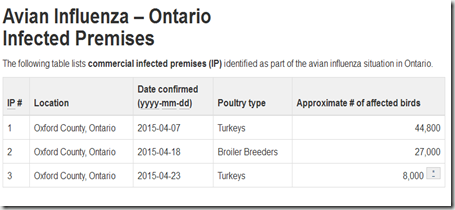
Although Canada’s food Inspection Agency CFIA hasn’t exactly shouted the news from the highest rooftop, over the past several days their Avian Influenza Website has quietly updated a timeline and infected premises table showing a third Ontario farm has tested positive for the HPAI H5 virus.


Timeline of Events - Notifiable Avian Influenza - Ontario – 2015

April 24

The CFIA notifies national industry associations and key international trading partners of IP3.

April 23

The Animal Health Laboratory at the University of Guelph notifies the CFIA of the detection of presumptive H5 avian influenza at a turkey farm in Oxford County, Ontario. This is IP3.

The premises has been under quarantine since April 19, 2015 and is part of the second avian influenza control zone.

Samples from the affected farm are sent to the CFIA National Centre for Foreign Animal Disease (NCFAD) for official confirmation.


The last statement from the CFIA, released on the 22nd (see The Canadian Food Inspection Agency Establishes a Second Avian Influenza Control Zone) dealt with the second infected premises.  This morning, the Ottawa Sun and Toronto Sun are both carrying a report on this third infected farm.


Third Ontario farm hit with deadly bird flu


Megan Stacey, Postmedia Network

First posted: Monday, April 27, 2015 07:14 AM EDT | Updated: Monday, April 27, 2015 07:19 AM EDT

WOODSTOCK, Ont. -- The strain has begun to wear on Southwestern Ontario poultry farmers now battling a third case of deadly bird flu.

This one -- an 8,00-bird turkey farm -- is within a quarantine zone where heightened levels of biosecurity were meant to safeguard against the virus.

(Continue . . . )

Friday, April 24, 2015

APHIS: 3 More Minnesota Farms Hit By HPAI H5N2, 1 In Wisconsin

image

HPAI H5 Detections In North America


# 9977


We seem to be getting into a pattern where individual states are announcing outbreaks, but those reports are taking a couple of days to show up on the USDA’s APHIS website. 


Case in point, as of yesterday Wisconsin was reporting 6 outbreaks, yet this evening’s APHIS update still only shows 4, and yesterday’s reported outbreak in Sac County, Iowa has yet to appear on their list. 


It may be that APHIS is waiting for full subtype information to to come back from the lab before posting.


In any event, APHIS announced three new outbreaks today in Minnesota, and one of the  Wisconsin cases we learned of yesterday morning.   Given the volume of testing going on - including ongoing surveillance of flocks within the quarantine zones surrounding infected farms - it is little wonder that the release of data is at times erratic.


image


Although the APHIS tally lists 7,837,073 bird now affected, there are a several farms where the numbers are still pending, and several other farms that the states have announced as being infected, but are not yet listed. 


All of which means the real number is probably in excess of 8 million birds by now, and still growing.

North Dakota Reports 2nd Outbreak Of HPAI H5

image


# 9975


Not quite two weeks after their first farm was struck in Dickey County, today the North Dakota Department of Agriculture has announced a second farm in adjacent LaMoure County as been hit by a highly pathogenic H5 virus.   Final sub typing is pending, but the expectation is that this will turn out to be HPAI H5N2.


Avian influenza confirmed in second North Dakota flock

Submitted April 24, 2015

BISMARCK, N.D. – The United States Department of Agriculture’s (USDA) Animal and Plant Health Inspection Service (APHIS) has confirmed the presence of highly pathogenic H5 avian influenza (HPAI) in a commercial turkey flock in LaMoure County, North Dakota. The premises contained approximately 69,000 turkeys and also about 2,000 chickens. A presumptive positive case was first identified by the University of Minnesota’s Veterinary Diagnostic Laboratory and confirmed by the APHIS National Veterinary Services Laboratories in Ames, Iowa. This is the second case confirmed in North Dakota. A response team has been working with a Dickey County poultry farm since the first case was confirmed earlier this month.

The State Board of Animal Health and the North Dakota Department of Agriculture are working closely with USDA-APHIS and local officials in the LaMoure County response. The premises has been quarantined and the flock will be destroyed to prevent the spread of the disease. Domestic birds in a 6-mile control zone around the affected farm will be monitored and tested; and movement is being restricted to help prevent the spread of HPAI. Birds from the flock will not enter the food system.

There is no immediate public health concern due to this finding. The risk to people from HPAI is low despite the disease often being fatal for birds. No human infections with these viruses have been detected in the U.S.

“We have activated the avian influenza response plan that has been in place for some time,” said North Dakota State Veterinarian Dr. Susan Keller. “It is a collaborative effort with help from federal and state agencies, local officials and poultry producers.”

The avian influenza response team is working around the clock to control the outbreak and serve as a resource to residents. In an emergency clause, the North Dakota legislature has allotted $300,000 of federal spending authority to respond to and combat avian influenza.

Due to the recent findings of HPAI in North Dakota and surrounding states, poultry owners should immediately report death loss to their local and state veterinarian, restrict access to their property, prevent contact between their birds and wild birds and practice enhanced biosecurity.

Avian influenza exists in many wild birds and can be transmitted by contact with infected birds or ingestion of contaminated food and water.

As the number of HPAI cases continue to rise across the Midwest, scientists anticipate warmer temperatures will slow the spread of the disease. Typically, influenza viruses are hampered by warm, dry conditions.

More information about avian influenza and biosecurity recommendations is available at www.nd.gov/ndda/disease/avian-influenza and from the USDA-APHIS at www.aphis.usda.gov.


We should get an update on other avian flu activity from the USDA’s APHIS website sometime after 5pm EST.

Thursday, April 23, 2015

Iowa, Wisconsin & Minnesota Report Additional HPAI H5 Outbreaks

image


# 9972


The new bird flu ritual, which began in earnest earlier this week, is waiting for the daily update from the USDA’s APHIS avian flu website, which tends to come in sometime after 5pm EDT.   Today that update has been running considerably later than usual. 


However, earlier today the state of Wisconsin announced a Second avian influenza detection found in Barron county commercial turkey facility, bringing the number of outbreaks in that state to 6, involving 1.2 million birds.


And in the past few minutes the state of Iowa released a statement regarding their third HPAI outbreak.


CASE OF HIGHLY PATHOGENIC AVIAN INFLUENZA IN SAC COUNTY, IOWA
CDC considers the risk to people to be low

DES MOINES – The Iowa Department of Agriculture and Land Stewardship is responding to a case of highly pathogenic avian influenza (HPAI) in a commercial turkey flock in Sac County, Iowa.   The facility has 34,000 turkeys and is within the 10 kilometer monitoring zone surrounding the initial HPAI case in Buena Vista County.  This is the third case of HPAI in Iowa.

The flock has experienced increased mortality and samples have been sent to the Iowa State University Veterinary Diagnostic Laboratory.  Preliminary results showed the birds positive for an H5 strain of avian influenza.  Samples were then sent to the APHIS National Veterinary Services Laboratories (NVSL) in Ames, Iowa to further confirm the findings.

State officials quarantined the premise and birds on the property will be humanely euthanized to prevent the spread of the disease.


In the past couple of hours, amid media reports that a large chicken farm in Becker County has also been hit,  we’ve seen Minnesota Governor Dayton sign an executive order declaring bird flu an emergency. As of this writing nothing has been posted on the Governor’s website, but the Minnesota Board of Animal Health has posted the following statement:


In Response to Avian Influenza, Governor Mark Dayton Issues Emergency Order Declaring Peacetime State of Emergency

Executive Order activates Minnesota Emergency Operations Plan to respond to Avian Influenza

ST. PAUL, MN – Governor Mark Dayton today issued Emergency Executive Order 15-09, declaring a Peacetime State of Emergency in Minnesota in response to the discovery of H5N2 avian influenza cases statewide.

Under the Governor’s Executive Order:

• The Division of Homeland Security and Emergency Management (HSEM) will activate the Minnesota Emergency Operations Plan to support the efforts of the Minnesota Board of Animal Health and the Minnesota Department of Agriculture, to coordinate response efforts across all agencies of state government.

• Supplementing Emergency Executive Order 15-06 extending relief to certain motor vehicle drivers and carries pertaining to hours of service, in addition to the previous exemption of weight restriction.

• And the Adjutant General of Minnesota will order to state active duty such personnel and equipment of the military forces of the State as required, and for such a period of time as necessary to provide assistance and emergency relief services.


While stating that Animal health officials are currently investigating possible additional cases of HPAI in Minnesota flocks,  the Minnesota Board of Animal Health only lists two additional farms on their list tonight.  Not included is the Becker county chicken farm mentioned above.

image


At approximately 6:30 EST APHIS updated their HPAI listing, but only included the two  Minnesota outbreaks mentioned above.  They still only show three outbreaks in Wisconsin – when the Wisconsin website is already reporting six, and they have no update on the Iowa outbreak. 

image

Hopefully we’ll get caught up with those in tomorrow night’s update. 


As has been advised by the CDC since late January (see CDC Interim Guidance On Antiviral Chemoprophylaxis For Persons With Exposure To Avian Flu) Minnesota is offering antivirals to poultry workers who have been exposed to these high path viruses. 


So far, however, we’ve seen no evidence that the North American reassortant H5 viruses are able to infect humans, but these steps are recommended out of an abundance of caution.


This from the Minnesota Board of Animal Health.


Poultry Workers

MDH is monitoring the health of workers, who have had contact with infected poultry, and providing guidance on infection control, the use of personal protective equipment, and providing support for any other health-related aspects of response.


• People who had close, unprotected contact with infected flocks are recommended to receive an antiviral drug called Tamiflu.
• Workers are then contacted daily for 10 days and monitored for development of respiratory symptoms.
• As of today, MDH has completed follow-up contacts for 41 flocks.
• In total, 140 people had been involved in care of the 41 flocks and were interviewed and evaluated.
• MDH is currently monitoring 78 poultry personnel for potential symptoms of infection, such as development of an eye infection or respiratory symptoms.
• The MDH 10-day monitoring period has been completed for 62 people and 14 flocks; no infections with this virus were detected.


And so the bird flu beat goes on for another day . . . .

EID Journal: The Rapidly Expanding Range Of HPAI Viruses

image

# 9971


What a difference a year makes.


In January of 2014 a new, HPAI H5N8 virus (which had only rarely been sighted in China before) turned up in a big way in South Korea’s poultry and wild bird population, and proceeded to infect dozens of farms, resulting in the culling of millions of birds.  


The virus briefly appeared in Southern Japan (see Japan: Detection Of H5 Avian Flu At Poultry Farm) in April of last year, but was pretty much considered an `Asian’ problem – and one that was far less well distributed across the landscape than was H5N1.


But early last November the world awoke to find HPAI H5N8 had made its way to western Europe, when a farm in Germany reported the virus (see Germany Reports H5N8 Outbreak in Turkeys), followed 10 days later  by reports from the Netherlands (see
Netherlands: `Severe’ HPAI Outbreak In Poultry), and again from Japan (see Japan: H5N8 In Migratory Bird Droppings).

image

H5N8 Branching Out To Europe & Japan


Suddenly H5N8 was on the move, in a manner which we hadn’t seen since the great H5N1 diaspora of 2006 – when that virus spread out of Asia and into Europe, Africa, and the Middle East.


Soon the UK, Italy, China and Russia would be added to the list of nations where H5N8 was showing up, as would Taiwan towards the end of the year. 

But the biggest surprise came when HPAI H5 virus literally crossed oceans and turned up – first in Canada’s Pacific Northwest (see Fraser Valley B.C. Culling Poultry After Detecting H5 Avian Flu) in early December – and then began spreading across the western United States (see EID Journal: Novel Eurasian HPAI A H5 Viruses in Wild Birds – Washington, USA).

.

And somewhat ominously, as H5N8 has arrived in Taiwan, Canada, and the United States, it  reassorted with local avian flu viruses and produced unique reassortant viruses (H5N2 and H5N1 in North America, H5N2, H5N3 in Taiwan).

image

How viruses shuffle their genes (reassort)


Of these, H5N2 appears to be spreading the fastest, and causing the most damage to the poultry industry.  But the possibility of seeing additional reassortments emerge is real, and their behavior – and their pathogenicity in birds and humans – is quite frankly, impossible to predict.


Yesterday the EID Journal published a dispatch on the recent arrival of these HPAI H5 viruses, their evolution to date, and how their propensity for viral reassortment may lead to the creation of additional subtypes in the future.  I’ve only posted some excerpts, follow the link to read it in its entirety.


Dispatch

Rapidly Expanding Range of Highly Pathogenic Avian Influenza Viruses

Jeffrey S. HallComments to Author , Robert J. Dusek, and Erica Spackman

Author affiliations: US Geological Survey National Wildlife Health Center, Madison, Wisconsin, USA (J.S. Hall, R.J. Dusek); US Department of Agriculture, Athens, Georgia, USA (E. Spackman)

Abstract

The movement of highly pathogenic avian influenza (H5N8) virus across Eurasia and into North America and the virus’ propensity to reassort with co-circulating low pathogenicity viruses raise concerns among poultry producers, wildlife biologists, aviculturists, and public health personnel worldwide. Surveillance, modeling, and experimental research will provide the knowledge required for intelligent policy and management decisions.

The recent introduction of highly pathogenic avian influenza (HPAI) subtype H5N8 virus into Europe and North America poses major risks to poultry industries, zoologic collections, and wildlife populations; thus, this introduction warrants continued and heightened vigilance.

First discovered in early 2014 in poultry and wild birds in South Korea, HPAI H5N8 virus apparently arose in China from reassortment events between HPAI subtype H5N1 virus (clade 2.3.4.4) and several low pathogenicity viruses (LPAIVs) (13). The H5N8 virus was subsequently detected in waterfowl in Russia in September 2014, and since then, H5N8 virus and reassortants have been detected in poultry and wild birds in Europe (Netherlands, Germany, Italy, the United Kingdom, Hungary, and Sweden), Taiwan, Japan, Canada (British Columbia), and the western and central United States (Washington, Oregon, California, Idaho, Utah, Minnesota, Missouri, Arkansas, Kansas, Wyoming, and Montana).

Wild waterfowl are a primary natural host for LPAIVs, and infection rates in these populations peak at autumn migratory staging locations, where large numbers of immunologically naive juvenile birds congregate (4). The HPAI H5N8 virus has apparently adapted to wild waterfowl hosts: few or no clinical signs or adverse effects are apparent in these hosts when infected with the virus. Thus, it seems probable that the virus was disseminated out of Russia into Europe, East Asia, and North America by migrating waterfowl during autumn 2014 (5).

The HPAI H5N8 virus has encountered, interacted with, and reassorted with co-circulating LPAIVs in migratory and overwintering waterfowl populations, creating new HPAI viruses (HPAIVs). In Taiwan, new Eurasian lineage reassortant HPAIVs (i.e., H5N2 and H5N3 subtypes) and the parental H5N8 subtype virus have been detected in poultry and wild birds (6). In North America, HPAI H5N8 virus continues to circulate among waterfowl and commercial and backyard poultry flocks. In addition, new HPAIV reassortants (i.e., H5N2 and H5N1 subtypes) that are combinations of HPAI H5N8 virus and genetic elements from Eurasian and North American viruses are also circulating in these populations (7,8) (Figure).

<SNIP>

As HPAIVs continue spreading and evolving, the questions posed here, along with many more questions, will need to be answered to understand the risks to agriculture, zoologic collections, wildlife, and, potentially, human populations. As other researchers have recently pointed out, robust, targeted surveillance programs among wild birds (11) and poultry, modeling of the movements of HPAIV-infected wild birds, and experimental research studies will provide the knowledge required for intelligent policy and management decisions regarding agriculture, wildlife, and public health.

(Continue . . .)


While we can’t know what new reassortments may appear next fall or winter in North America, the idea that somehow we in North America are somehow insulated from the Asian and Eurasian avian flu strains by oceans and distance seems pretty well demolished.


For more on how these viruses may be able to cross oceans and continents, you may wish to revisit:

USGS: Alaska - A Hotspot For Eurasian Avian Flu Introductions

Erasmus Study On Role Of Migratory Birds In Spread Of Avian Flu

PNAS: H5N1 Propagation Via Migratory Birds

EID Journal: A Proposed Strategy For Wild Bird Avian Influenza Surveillance

PLoS One: North Atlantic Flyways Provide Opportunities For Spread Of Avian Influenza Viruses

Wednesday, April 22, 2015

CDC Website & USDA Statement On HPAI H5

image

HPAI H5 Detections In North America


# 9968


Earlier today the USDA, in conjunction with the CDC, held a 45 minute press conference on recent developments surrounding the spread of highly pathogenic avian influenza (HPAI) H5 viruses across the western half of the country.


As this presser was well attended by the mainstream media, it has already received a lot of press coverage.  Sharon Sanders of FluTrackers live-tweeted the event, and her notes are available at this link.


While there were no huge revelations during today’s event, the information provided by USDA Chief Veterinary Officer John Clifford, CDC Medical Officer Dr. Alicia Fry and USDA Southeast Poultry Research Director David Swayne was impressively frank, thorough, and well presented.   


Where there were areas of uncertainty – such as the (likely low) potential risk to human health posed by these viruses, or whether and where the virus will spread in the fall – that uncertainty was acknowledged. Always a good sign in effective risk communications.


This afternoon USDA Chief Veterinary Officer John Clifford posted a summary on the USDA’s blog site, which you can access at:


What You Need to Know About the Current Highly Pathogenic Avian Influenza Outbreaks

Posted by Dr. John Clifford, USDA Chief Veterinary Officer, on April 22, 2015 at 3:36 PM


Meanwhile the CDC has a website on H5 Viruses in the United States where the reader can access the latest information available:


image

Highly pathogenic avian influenza (HPAI) H5 infections have been reported in U.S. domestic poultry (backyard and commercial flocks), captive wild birds, and wild birds. HPAI H5 detections began in December 2014 and have continued into March 2015.

No human infections with these viruses have been detected at this time, however similar viruses have infected people in other countries and caused serious illness and death in some cases. While the public health risk posed by these domestic HPAI outbreaks is considered low at this time, it is possible that human infections with these viruses may occur.

Most human infections with avian influenza viruses have occurred after close and prolonged contact with infected birds or the excretions/secretions of infected birds (e.g., droppings, oral fluids). CDC has posted guidance for clinicians and public health professionals, and is working with state health departments and animal health colleagues to minimize public health risk.

CDC Recommends
  • As a general precaution, people should avoid wild birds and observe them only from a distance; avoid contact with domestic birds (poultry) that appear ill or have died; and avoid contact with surfaces that appear to be contaminated with feces from wild or domestic birds.
  • People who have had contact with infected bird(s) should monitor their own health for possible symptoms (for example, conjunctivitis, or flu-like symptoms).
  • People who have had contact with infected birds may also be given influenza antiviral drugs preventatively.
  • Health care providers evaluating patients with possible HPAI H5 infection should notify their local or state health departments which in turn should notify CDC. CDC is providing case-by-case guidance at this time.
  • There is no evidence that any human cases of avian influenza have ever been acquired by eating properly cooked poultry products.
  • CDC will update the public as new information becomes available.

The HPAI Poultry Vaccine Dilemma

image

Poultry Vaccination - Photo Credit OIE


# 9967


Overnight Reuters (see U.S. could use vaccines being developed to fight bird flu in poultry) and the AP (see With bird flu spreading, USDA starts on potential vaccine) have issued reports that echo and update a story we saw from CIDRAP News several weeks ago (see USDA at work on poultry vaccine for H5N8, H5N2) – that the United States may need to reconsider its policy on the use of HPAI H5 poultry vaccines.


It should be quickly noted that any decision to use HPAI H5 vaccines in poultry is still months away, and their use would likely be limited, and targeted (as in ring vaccination around infected farms), rather than as a broad based open-ended vaccination plan. 


Throughout the United States, and indeed, most of the world, the preferred method of controlling H5 and H7 avian flu outbreaks in poultry has been immediate quarantine and the culling of infected or exposed birds. 


While vaccination may seem an easy solution to a vexing problem, the experience over the past 10 years hasn’t been entirely positive.


For some countries – mostly in Asia and the Middle East – where H5N1 has caused huge losses for a decade, poultry vaccines have long been an attractive option.  This, despite repeated warnings from the OIE that vaccination of poultry cannot be considered a long-term solution to combating  avian flu (see Does OIE recommend vaccination of animals to control the disease?)


“Any decision to use vaccination must include an exit strategy, i.e. conditions to be met to stop vaccination”. – OIE on H7N9 Poultry Vaccines.


According to 2012’s Impact of vaccines and vaccination on global control of avian influenza by David Swayne, more than 113 billion poultry vaccine doses were used from 2002 to 2010. Five countries accounted for 99% of vaccine used: 1) China (90.9%), 2) Egypt (4.6%), 3) Indonesia (2.3%), 4) Vietnam (1.4%), and 5) Hong Kong Special Administrative Region (< 0.01%).


With the exception of Hong Kong, all of these countries remain firmly entrenched with H5 viruses after more than a decade of avian flu vaccine use, and none show any signs of looking for the recommended `exit’.


While it can be argued that these vaccines have saved millions of poultry from culling, have prevented financial ruin for farmers, and has lessened food instability in developing areas of the world, there has also been a downside. 


Poultry vaccines don’t always prevent disease – sometimes they only mask the symptoms of infection, and that can not only allow viruses to spread stealthily, it can also put human health at risk.


In 2009 Professor C.A. Nidom, of the Institute of Tropical Disease, Airlangga University, Indonesia warned against relying on poultry vaccines to control Indonesia’s bird flu problem (see Indonesia: Debate Over Poultry Vaccination), while  Zhong Nanshan, a hero of the SARS outbreak and respiratory disease specialist in China, warned that vaccinated poultry can still become infected (and possibly transmit) the H5N1 virus.


Chinese expert issues new bird flu warning

www.chinaview.cn 2009-02-06 17:59:50

GUANGZHOU, Feb. 6 (Xinhua) -- A leading Chinese expert on respiratory diseases has warned the public to be aware that poultry can be infected with the bird flu virus but show no symptoms.

"Special attention should be paid to such animals, including those that have been vaccinated," said Zhong Nanshan.

"The existing vaccines can only reduce the amount of virus, rather than totally inactivating it," he said.

(Continue . . . )


More recently, in 2012’s Egypt: A Paltry Poultry Vaccine, a study conducted by the Virology department at St. Jude Children’s Research Hospital  looked at the effectiveness of six commercially available H5 poultry vaccines deployed in Egypt, and found only one (based on a locally acquired H5N1 seed virus) actually appeared to offer protection. 


Over the past 6 months roughly 180 Egyptians have contracted H5N1 from contact with infected poultry, and we’ve seen  reports of large numbers of poultry outbreaks – even among previously vaccinated poultry (see Egypt H5N1: Poultry Losses Climbing, Prices Up 25%).


Poorly matched vaccines, often inconsistently or haphazardly applied, have increasingly been linked to driving vaccine-escape flu variants, and may be at least partially responsible for the sudden proliferation of new avian flu subtypes we’ve seen emerge over the past couple of years (H5N3, H5N5, H5N6, H5N8, H7N9, H10N8, etc. ).


Last November the EID Journal dispatch Subclinical Highly Pathogenic Avian Influenza Virus Infection among Vaccinated Chickens, China  addressed these exact concerns (bolding mine):


HPAI mass vaccination played a crucial role in HPAI control in China. However, this study demonstrated multiple disadvantages of HPAI mass vaccination, which had been suspected (13,14). For example, this study showed that H5N1 subtype HPAI virus has evolved into multiple H5N2 genotypes, which are all likely vaccine-escape variants, suggesting that this virus can easily evolve into vaccine-escape variants.

This observation suggests that HPAI mass vaccination, which is highly effective in the beginning of an outbreak, may lose its effectiveness with time unless the vaccine strains are updated. Moreover, this study showed that vaccinated chicken flocks can be infected with vaccine-escape variants without signs of illness.


Last month, in Recombinant H5N2 Avian Influenza Virus Strains In Vaccinated Chickens, which stated in its cautionary discussion (bolding mine):


In this study, three H5N2 influenza virus strains isolated from chickens were identified as novel reassortants with a highly pathogenic viral genotype. Surprisingly, the affected birds had been vaccinated with killed influenza vaccines but still showed characteristic clinical symptoms of avian influenza and eventually died.

These results are in agreement with previous work indicating that AIVs can continue genetic evolution under vaccination pressure [20]. Moreover, this study highlights the importance and necessity of periodic reformulation of the vaccine strain according to the strains circulating in the field in countries where vaccines are applied to control avian influenza.


One can’t know how things would have played out in Egypt or China had they not elected to rely so heavily on H5 avian flu vaccines, but there is enough evidence of a long-term downside to give one at least a little pause.  


The USDA has always focused on prevention and containment when it comes to H5 and H7 avian flu in this country, and it is pretty obvious they would rather not to have to go down the avian flu vaccine path if they can avoid it. 


One obvious economic downside is that vaccinated poultry may not be readily accepted by foreign markets, since it hinders testing for the virus.


But given the speed of H5’s spread this winter and its potential impact on the poultry industry, new strategies must at least be explored and considered, even those that have some potential downside to them.   


Given the less-than-sterling outcomes we’ve seen in China and Egypt with their poultry vaccination schemes - and the difficulty of `exiting’  once embarking down that vaccine road - the USDA will  have a lot they must consider before deciding on whether and what to recommend regarding the use of avian flu vaccines here in the United States.


Stay tuned.

Monday, April 20, 2015

Media Report: HPAI H5 Bird Flu In Manipur Poultry

image

Credit Wikipedia


# 9958


Reports of avian flu (likely H5N1) in and around India continue this winter, with the far Northeastern state of Manipur reporting an outbreak in poultry that according to one source (see Bird flu in Manipur :: Govt takes action; Cullings to start from today) began roughly two weeks ago, and that has just now been confirmed by laboratory analysis.


Bird flu in Manipur, culling of fowl starts

IANS  |  Imphal

April 20, 2015 Last Updated at 16:12 IST

Bird flu or avian influenza has resurfaced in northeastern state of Manipur and the culling of poultry fowl began on Monday, official said.

Manipur Chief Secretary P.C. Lawmkunga told reporters: "Samples of sick poultry birds from the ICAR (Indian Council of Agriculture Research) poultry unit at Lamphelpat were found to contain H5 strain of avian influenza virus."

He said the Bhopal-based National Institute of High Security Animal Diseases has confirmed the outbreak of Avian Influenza at the poultry unit of ICAR.

"Culling of birds at the ICAR farm started today (Monday)," said Lawmkunga, adding that the culling of poultry birds at the farm would continue for the next few days.

(Continue . . . .)


Like many other regions of the world, after several relatively quiet years, we are seeing a resurgence of H5N1 activity in and around the Indian Sub-continent.  Last week, we saw the FAO: Bhutan Reports H5N1 In Domestic Birds and H5N1 In Telangana Poultry, while prior to that we saw reported H5N1 outbreaks in a town called Amethi in Uttar Pradesh (see Watching India (Again) . . . .) .


In February we saw Myanmar Reports H5N1 Outbreak, while last fall we saw outbreaks of H5N1 in India’s southern Kerala state and northern Chandigarh's Sukhna Lake region.


Unlike Egypt, China, and many other Southeast Asian countries which have dealt extensively with H5N1, India has never reported a human infection. Whether this is due to the clade of the virus circulating in India, the use of antivirals by cullers, less-than-comprehensive surveillance/testing & and reporting, or some other factor is unknown. 


After several years during which the H5N1 threat appeared to be slowly waning, highly pathogenic bird flu appears to have renewed vigor  And joining it this time are a plethora of other HPAI H5 viruses – like H5N2, H5N8, H5N6 – that are spreading today much like H5N1 did a decade ago.


While H5N1 and its cronies have never managed to figure out how to spread efficiently in humans, they are constantly reassorting and re-inventing themselves.  And so we watch outbreaks like these - all around the world - for any signs that these viruses are changing.