Showing posts sorted by date for query eastern earthquakes rare but powerful. Sort by relevance Show all posts

Saturday, February 11, 2023

Why We Need An Improved Culture Of Preparedness


#17,284

While we struggle with the remainder of our 3-year COVID pandemic, and peer into the darkness looking for the next global disease threat, one thing we can count on is that we'll see a number of local or regional natural disasters in the year ahead. 

Last year, the United States experienced 18 Billion-dollar-plus weather or climate disasters, as listed by NOAA. 

In 2022, there were 18 weather/climate disaster events with losses exceeding $1 billion each to affect the United States. These events included 1 drought event, 1 flooding event, 11 severe storm events, 3 tropical cyclone events, 1 wildfire event, and 1 winter storm event. Overall, these events resulted in the deaths of 474 people and had significant economic effects on the areas impacted. The 1980–2022 annual average is 7.9 events (CPI-adjusted); the annual average for the most recent 5 years (2018–2022) is 17.8 events (CPI-adjusted).

Weather/climate related disasters are the most common, but they are far from the only disaster threats we all face.  

Nearly half of the nation's population lives in or near an active seismic zone, while millions more live along coastlines vulnerable to tsunamis generated by earthquakes that may have occurred thousands of miles away. 


The `big one' in California (see Dr. Lucy Jones: `Imagine America Without Los Angeles’) is arguably the most anticipated major U.S. disaster of all time. While long predicted, in 2019 the SSA (Seismological Society of America) held their annual meeting, and a study was presented that concludes that California's recent lack of major quakes has no precedent in the past 1000 years. 

They suggest that the `earthquake drought' of the last 100 years in California was unlikely to last, and that the next 100 years are likely to be far more seismically active than the last.

There are other areas in the continental United States equally ripe for a big quake, including the Pacific Northwest (see FEMA: Cascadia Rising 2016)  and the New Madrid Seismic Zone (NMSZ) that includes eight Central U.S. States.

In recent years Oklahoma has see a huge upsurge in seismic activity (see M5.6 Quake In Northern Oklahoma), while northern Alabama, Georgia, South Carolina, and Eastern Tennessee - and even New York City and parts of New England  - can experience infrequent, but strong temblors (see USGS: Eastern Earthquakes - Rare But Powerful).

There are also nearly a dozen `very high risk' volcanoes in the continental US (4 in Washington, 4 in Oregon & 3 in California), along dozens of `lesser' threats. While earthquake damage is generally localized, volcanic eruptions  can affect property and populations thousands of miles away.

https://pubs.usgs.gov/sir/2018/5140/sir20185140.pdf

Not all of these threats originate on earth.  While asteroid strikes are rare (see Russia: Hundreds Injured By Meteorite Strike), severe space weather is a genuine threat that the United States (and most other countries) take seriously (see USGS: Preparing The Nation For Severe Space Weather).

  • In 2012 the earth narrowly missed being hit by a massive solar storm, one that - had it been earth-directed - could have caused extensive damage to our electrical grid and electronic infrastructure (see NASA: The Solar Super Storm Of 2012). 
  • In 1989  an earth-directed storm caused a major power outage in Quebec, and in 2003, power stations in Europe were affected by another solar event (see NASA's The Day the Sun Brought Darkness)
  • And the Granddaddy of them all, the 1859 Carrington Event, which sparked electrical fires in telegraph offices, sparked auroras as far south as Cuba, and if repeated today would cause massive failures of the grid. 

While most CMEs pose little direct physical danger to us on the earth’s surface (we are protected by the earths magnetic field and atmosphere), a large CME can wreak havoc with electronics, power generation, and radio communications. 

As we become more dependent upon sensitive electronic equipment (think power grid, internet, communications, etc.) these storms increasingly threaten both our economy and our society.

In 2013 Lloyds issued a risk assessment for the insurance industry called Solar storm Risk to the north American electric grid which calls another `Carrington’ class event inevitable, and the effects likely catastrophic, but the timing was unknowable.

And then there are the man-made disasters, either deliberate, through negligence, or simply bad luck. 

In December of 2018, in NIAC: Surviving A Catastrophic Power Outage, we looked at a NIAC (National Infrastructure Advisory Council) 94-page report that examined the United State's current ability to respond to and recover from a widespread catastrophic power outage. 

https://www.hsdl.org/?view&did=819354
https://poweroutage.us/https://poweroutage.us/

Six years ago, in DHS: NIAC Cyber Threat Report - August 2017, we looked at a 45-page report addressing urgent cyber threats to our critical infrastructure that called for `bold, decisive actions'.

A year before that, in The Blue Ribbon Study Panel Report on Biodefense, we saw an 84 page Bipartisan Report of The Blue Ribbon Study Panel On Biodefense that looked at our nation’s vulnerability to a biological attack, an accidental release, or naturally occurring pandemic with a highly pathogenic biological agent.

What once might only could have been created in a multi-million dollar lab can now be done on a limited budget in a basement somewhere (see 2018's National Academy Of Sciences: Biodefense in the Age of Synthetic Biology).

But even if you discount a deliberate attack, we’ve seen lab accidents involving `select agents’ – like Anthrax, Ebola, H5N1, and even Smallpox – over the past few years, many involving government labs (see CDC Grand Rounds - Strengthening A Culture of Lab Safety).

How many other accidents that have gone unreported around the globe is unknown.
 
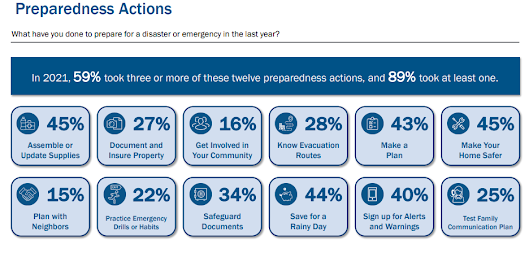
Despite all of these past events, and the certainty that more will follow, according to FEMA's 2021 Household Survey on Preparedness, only 59% of households took 3 or more (of 12 recommended) preparedness steps in 2021.

Although that is up 2% from the 2019 survey, it is far from ideal. 

Whether it is due to a CAT 5 Hurricane, a major earthquake, a solar storm, or a blizzard, you and your family may be called upon to fend for yourselves -  without power, water, or emergency services - for days, or even weeks. 

So . .  if a disaster struck your region today, and the power went out, stores closed their doors, and water stopped flowing from your kitchen tap for the next 7 to 14 days . . . you are you prepared with:

  • A battery operated NWS Emergency Radio to find out what was going on, and to get vital instructions from emergency officials
  • A decent first-aid kit, so that you can treat injuries
  • Enough non-perishable food and water on hand to feed and hydrate your family (including pets) for the duration
  • A way to provide light when the grid is down.
  • A way to cook safely without electricity
  • A way to purify or filter water
  • A way to handle basic sanitation and waste disposal. 
  • A way to stay cool (fans) or warm when the power is out.
  • A small supply of cash to use in case credit/debit machines are not working
  • An emergency plan, including meeting places, emergency out-of-state contact numbers, a disaster buddy, and in case you must evacuate, a bug-out bag
  • Spare supply of essential prescription medicines that you or your family may need
  • A way to entertain yourself, or your kids, during a prolonged blackout
If not, you've got some important work to do. A good place to get started is by visiting Ready.gov.

Some of my practical preparedness blogs from the past year you may wish to revisit include:


Wednesday, September 07, 2022

#NatlPrep: Half Of All Americans Need An Earthquake Plan


2014 Update To The USGS Seismic Risk Map


Note: September is National Preparedness Month. Follow this year’s campaign on Twitter by searching for the #NatlPrep #BeReady or #PrepMonth hashtags.

This month, as part of #NPM22, I’ll be rerunning some updated preparedness essays, along with some new ones.

#16,994

In 2006 the USGS calculated that earthquakes posed a significant risk to 75 million Americans living in 39 States. Since then, populations have changed and/or shifted and ongoing research has uncovered new seismic risks (see USGS: Updated U.S. Seismic Risk Hazard Maps), providing geologists with a better understanding of the extent of ground shaking from these quakes.

A new study, published in 2015 in the journal Earthquake Spectra, nearly doubled – to 143 million - the number of Americans who live or work in areas susceptible to potentially damaging ground shaking.

The New Madrid Seismic Zone (NMSZ), the Pacific Northwest (Cascadia fault), coastal South Carolina, Alaska and Hawaii,  and even New York City and parts of New England are at risk of seeing significant seismic activity.

But of course, due to popular culture, everyone's first thought is California.
 
In 2019 the SSA (Seismological Society of America) held their annual meeting, and a study was presented that concludes that California's recent lack of major quakes has no precedent in the past 1000 years.
The Current Unlikely Earthquake Hiatus at California’s Transform Boundary Paleoseismic Sites

Glenn P. Biasi, Katherine M. Scharer

Seismological Research Letters (2019) 90 (3): 1168-1176.
https://doi.org/10.1785/0220180244

ABSTRACT

Paleoseismic and historical earthquake records used to quantify earthquake recurrence rates can also be used to test the likelihood of seismically quiescent periods. At principal paleoseismic sites in California on the San Andreas, San Jacinto, Elsinore, and Hayward faults, no ground‐rupturing earthquake has occurred in the last 100 yr, yet this interval is about three times the average interearthquake period for the ensemble of sites.
(Continue . . . )

California, they announced, has been in an earthquake drought for the past 100 years. One, that the SSA warns, is unlikely to continue. In a news release they wrote:

They agree that the next 100 years of California earthquakes along these faults could be a busy one. “If our work is correct,” Scharer and Biasi note, the next century isn’t going to be like the last one, but could more like the century that ended in 1918.”

Earthquakes aren't the only seismic hazard in California, or the United States, as there are nearly a dozen `very high risk' volcanoes in the continental US (4 in Washington, 4 in Oregon & 3 in California), along dozens of `lesser' threats. While earthquake damage is generally localized, volcanic eruptions can affect property and populations thousands of miles away.


When you add in that the Gulf and Atlantic coastlines are susceptible to tsunamis generated from distant earthquakes (see East Coast Tsunami Threats), then there is better than a 50-50 chance that you live in an area that is at risk of some seismically induced disaster.

While the `big one' in California (see Dr. Lucy Jones: `Imagine America Without Los Angeles’) is perhaps the most anticipated major disaster of all time, there are other areas in the continental United States equally ripe for a big quake.

FEMA and the U.S. government conducted a huge drill six years ago (see FEMA: Cascadia Rising 2016) involving 20,000 people from both the United States and Canada, in order to prepare for a catastrophic M9.0 quake & tsunami off the Pacific coast.

And in 2011 – during the bicentennial of the four great New Madrid earthquakes of 1811-12 – FEMA and other federal agencies mounted the largest National Level Exercise (NLE) to that date, revolving around a catastrophic earthquake occurring in the New Madrid Seismic Zone (NMSZ) that would involve eight Central U.S. States.

In recent years Oklahoma has see a huge upsurge in seismic activity (see M5.6 Quake In Northern Oklahoma), while northern Alabama, Georgia, Tennessee, Texas, Utah  - and even New York City and parts of New England - can experience infrequent, but strong temblors (see USGS: Eastern Earthquakes - Rare But Powerful).

Perhaps least appreciated is the seismic history of South Carolina, which in 1886 was struck by an (Est. 7.3-7.6 magnitude) quake that devastated much of Charleston, South Carolina. Shaking was felt as far north as Boston, south to Cuba, and west as far as New Orleans.

An earthquake of that size today, in the same area, it is estimated would produce:
  • 45,000 injuries
  • 9,000 hospitalizations
  • 900 fatalities
  • 200,000 displaced or homeless persons
  • 20 billion dollars in Damage
Even if you don't live or work in the shake zone of one of the events, should a great quake strike any one of them, the economic and societal impacts could easily spread far beyond the damaged area.

Imagine an M8.0 New Madrid quake collapsing major bridges that cross the Mississippi river, buckling the Midwest's railroad tracks and interstate highways, and taking out the dozens of critical natural gas pipelines that snake through that region.

A quake of that size could impact the transportation of food, the delivery of energy (power, gas, coal, etc.), the national power grid, and the nation's economy in ways we can only partially imagine.

While we can't prevent the next big quake from happening, we can prepare for it.

Working to improve earthquake awareness, preparation, and safety is Shakeout.org, which promotes yearly earthquake drills and education around the country (see A Whole Lotta Shakeouts Going On).


The third Thursday in October (Oct 20th in 2022) is International Shakeout Day, when dozens of states and countries practice earthquake safety. If you live in or near one of these seismically active areas, I strongly would urge you, your family, and your employees take part in these yearly drills.

But after the shaking stops, you'll have to find ways to cope with the aftermath.

While the government will send help, you could find yourself pretty much on your own for several days and living in less than comfortable conditions for weeks.For starters - and as a bare minimum - every household should have a disaster plan, a good first aid kit (and the knowledge to use it), an emergency battery operated NWS weather radio, and emergency supplies to last a minimum of 72 hours during a disaster.


While 72 hours is an admirable start, I wouldn't feel comfortable with it. Here in the United States many agencies and organizations recommend that households work towards having a 10-to-14 day supply of food, water, and emergency supplies on hand.


As the (above) graphic illustrates (see #NatlPrep: FEMA National Household Preparedness Survey), while we've seen some improvement over past few years, Americans still have a long way to go if we are to cultivate a culture of preparedness.

For more on earthquake preparedness, both here in the United States, and around the world, you may wish to revisit:


Tuesday, September 14, 2021

#NatlPrep: Prolonged Grid Down Preparedness


Current Texas Power Outages 

Note: September is National Preparedness Month.  Follow this year’s campaign on Twitter by searching for the #NatlPrep #BeReady or #PrepMonth hashtags.

This month, as part of #NPM21, I’ll be rerunning some updated preparedness essays, along with some new ones.

#16,186

Last night CAT 1 hurricane Nicholas battered the Texas coast leaving - at last report - nearly 500,000 people temporarily without electrical power. In late August a much stronger CAT 4 hurricane Ida struck southeastern Louisiana, plunging more than a million people into darkness, and two weeks later roughly 100,000 remain without power.

Last summer, Cat 4 hurricane Laura slammed into Southwest Louisiana, leaving tens of thousands without electricity for weeks, and there are similar tales following almost every major landfalling hurricane. 

  • In 2017, Puerto Rico was without power for months following Hurricane Maria, which undoubtedly contributed to the excess mortality there following the storm (see NEJM Mortality in Puerto Rico after Hurricane Maria).
  • A few weeks earlier, Hurricane Irma left millions of Floridians without electrical power for days.  According to press reports, at least a dozen people died due to heat-related complications at one Florida nursing home. 
  • In late June of 2012 a Derecho swept across the Eastern United States – killing 15 people – and leaving millions without electrical power (see Picking Up The Pieces). The region remained under an EHE (Extreme Heat Event) advisory for two weeks, leading to at least 32 additional heat-related deaths (see MMWR: Heat-Related Deaths During an Extreme Heat Event). 

Prolonged power outages - which can occur for a variety of reasons, not just hurricanes - are one of the most common things people should be prepared for during, and following a disaster. 

Beyond the loss of lights, fans, and air conditioners - without power - ATMs and gas pumps won't work, credit/debit cards may not work, wells and municipal water supplies may be offline, and grocery store shelves will be wiped clean in hours. 

To those of us who live in hurricane country, prolonged power outages are a rare - but miserable - fact of life. But nowhere in the country is exempt, tornadoes in the Midwest - earthquakes, wild fires, and `red flag days' in the western states - and equipment failures anywhere can lead to a extended grid down situation.

And between our aging electrical infrastructure and increasing power demands, matters are likely only to get worse. 

Every four years the ASCE (American Society of Civil Engineers) releases a report card on America’s infrastructure, and their most recent report (2021) warns that our cumulative GPA for infrastructure sits at only a C-, and two of our most vulnerable infrastructures are drinking water and the electrical grid (see When Our Modern Infrastructure Fails).

For Energy, which they rate as a C-, they warn:

Overview

In a digital, connected world, Americans increasingly rely on readily available and uninterrupted electricity. Over the last four years, transmission and distribution and reliability-focused pipeline investments have increased, and outages have declined slightly. Annual spending on high voltage transmission lines grew from $15.6 billion in 2012 to $21.9 billion in 2017, while annual spending on distribution systems — the “last mile” of the electricity network — grew 54% over the past two decades. Utilities are taking proactive steps to strengthen the electric grid through resilience measures.
 
However, weather remains an increasing threat. Among 638 transmission outage events reported from 2014 to 2018, severe weather was cited as the predominant cause. Additionally, distribution infrastructure struggles with reliability, with 92% of all outages occurring along these segments. In the coming years, additional transmission and distribution infrastructure, smart planning, and improved reliability are needed to accommodate the changing energy landscape, as delivery becomes distributed and renewables grow.

In December of 2018, in NIAC: Surviving A Catastrophic Power Outage, we looked at a NIAC (National Infrastructure Advisory Council) 94-page report that examined the United State's current ability to respond to and recover from a widespread catastrophic power outage. 
https://www.hsdl.org/?view&did=819354
What is a catastrophic power outage?
• Events beyond modern experience that exhaust or exceed mutual aid capabilities
• Likely to be no-notice or limited-notice events that could be complicated by a cyber-physical attack
• Long duration, lasting several weeks to months due to physical infrastructure damage
• Affects a broad geographic area, covering multiple states or regions and affecting tens of millions of people
• Causes severe cascading impacts that force critical sectors—drinking water and wastewater systems, communications, transportation, healthcare, and financial services—to operate in a degraded state
 (Excerpt From Dec 2018 NIAC Report)
Four years ago, in DHS: NIAC Cyber Threat Report - August 2017, we looked at a 45-page report addressing urgent cyber threats to our critical infrastructure that called for `bold, decisive actions'. 

Two years earlier, well known journalist Ted Koppel published a book called Lights Out: A Cyberattack, A Nation Unprepared, Surviving the Aftermath, that explored our vulnerability to a deliberate cyber attack.

While the NIAC report and Koppel's book both concentrate on a deliberate cyber or physical attack on the grid, there are other plausible ways the grid could fail, and the outcome would be every bit as bad (or perhaps, even worse).
Perhaps the most worrisome is a `Carrington-class' Solar storm. 
According to NASA, we actually came very close to seeing it happen in 2012 (see NASA: The Solar Super Storm Of 2012).  We've a report and a 4 minute video from NASA explaining earth's close call, then I'll return with more.
Near Miss: The Solar Superstorm of July 2012

July 23, 2014: If an asteroid big enough to knock modern civilization back to the 18th century appeared out of deep space and buzzed the Earth-Moon system, the near-miss would be instant worldwide headline news.

Two years ago, Earth experienced a close shave just as perilous, but most newspapers didn't mention it. The "impactor" was an extreme solar storm, the most powerful in as much as 150+ years.

"If it had hit, we would still be picking up the pieces," says Daniel Baker of the University of Colorado.  
(Snip)
A ScienceCast video recounts the near-miss of a solar superstorm in July 2012. 
Play it
(Continue . . . )

Regardless of how it happens (natural or deliberate), or the scale (local, regional, national), our fragile power grid is the Achilles heel of our nation, and our economy.   

While some scenarios - like an EMP attack - are frankly too overwhelming for the average person to prepare for, there are plenty of less severe grid down scenarios that can be partially mitigated by a modicum of individual preparedness. 

Most disasters boil down to unscheduled camping - for days, or sometimes weeks - in your home, in a community shelter, or possibly even in your backyard.  Preparedness can not only make that process possible, it can make it less miserable as well. 
So . . . if a disaster struck your region today, and the power went out, stores closed their doors, and water stopped flowing from your kitchen tap for the next 7 to 14 days  . . .  do you already have:
  • A battery operated NWS Emergency Radio to find out what was going on, and to get vital instructions from emergency officials
  • A decent first-aid kit, so that you can treat injuries
  • Enough non-perishable food and water on hand to feed and hydrate your family (including pets) for the duration
  • A way to provide light when the grid is down.
  • A way to cook safely without electricity
  • A way to purify or filter water
  • A way to stay cool (fans) or warm when the power is out.
  • A small supply of cash to use in case credit/debit machines are not working 
  • An emergency plan, including meeting places, emergency out-of-state contact numbers, a disaster buddy,  and in case you must evacuate, a bug-out bag
  • Spare supply of essential prescription medicines that you or your family may need
  • A way to entertain yourself, or your kids, during a prolonged blackout
If your answer is `no’, you have some work to do.  A good place to get started is by visiting Ready.gov.

Last year, in My New Solar Power System (Updated For 2020), I outlined my `off-the-shelf' low cost solar power solution for prolonged power outages (see photo below); one that provides fans, lights, communications, and limited power for other low-power devices (cell phones, tablets, etc.). 


In June of 2020, I described my `home-brew' solar/CPAP power station in My New (And Improved) Solar Battery Project (for CPAP).  Although neither of these solutions will run air-conditioning, refrigerators, or big screen TVs, they nevertheless can provide useful amounts of power during a prolonged grid down disaster. 

Whether you go with a USB system, buy a `solar generator' - or build an `old school' system like mine - having the ability to generate and store electricity can reduce a prolonged power outage from being a genuine emergency to more of an inconvenience. 
But if you want to be prepared for the next grid down emergency, you need to invest the time and money now, before the next threat appears on the horizon. Once it become apparent, it is usually too late to do anything about it.

Wednesday, September 08, 2021

#NatlPrep: Half Of All Americans Need An Earthquake Plan


2014 Update To The USGS Seismic Risk Map 

Note: September is National Preparedness Month.  Follow this year’s campaign on Twitter by searching for the #NatlPrep #BeReady or #PrepMonth hashtags.

This month, as part of #NPM21, I’ll be rerunning some updated preparedness essays, along with some new ones.

#16,170

In 2006 the USGS calculated that earthquakes posed a significant risk to 75 million Americans living in 39 States. Since then, populations have changed and/or shifted and ongoing research has uncovered new seismic risks (see USGS: Updated U.S. Seismic Risk Hazard Maps), providing geologists with a better understanding of the extent of ground shaking from these quakes.


A study, published in 2015 in the journal Earthquake Spectra, nearly doubled – to 143 million - the number of Americans who live or work in areas susceptible to potentially damaging ground shaking.

The New Madrid Seismic Zone (NMSZ), the Pacific Northwest (Cascadia fault), coastal South Carolina and even New York City and parts of New England are at risk of seeing significant seismic activity. 

But of course, due to popular culture, everyone's first thought is California. 

In 2019 the SSA (Seismological Society of America) held their annual meeting, and a study was presented that concludes that California's recent lack of major quakes has no precedent in the past 1000 years.
The Current Unlikely Earthquake Hiatus at California’s Transform Boundary Paleoseismic Sites

Glenn P. Biasi, Katherine M. Scharer

Seismological Research Letters (2019) 90 (3): 1168-1176.
https://doi.org/10.1785/0220180244

ABSTRACT

Paleoseismic and historical earthquake records used to quantify earthquake recurrence rates can also be used to test the likelihood of seismically quiescent periods. At principal paleoseismic sites in California on the San Andreas, San Jacinto, Elsinore, and Hayward faults, no ground‐rupturing earthquake has occurred in the last 100 yr, yet this interval is about three times the average interearthquake period for the ensemble of sites. 
        (Continue . . . )

California, they concluded, has been in an earthquake drought for the past 100 years.  One, that the SSA warns, is unlikely to continue.   In a news release they wrote:
They agree that the next 100 years of California earthquakes along these faults could be a busy one. “If our work is correct,” Scharer and Biasi note, the next century isn’t going to be like the last one, but could more like the century that ended in 1918.”
Earthquakes aren't the only seismic hazard in California, or the United States, as there are nearly a dozen `very high risk' volcanoes in the continental US (4 in Washington, 4 in Oregon & 3 in California), along dozens of `lesser' threats. While earthquake damage is generally localized, volcanic eruptions  can affect property and populations thousands of miles away.

https://pubs.usgs.gov/sir/2018/5140/sir20185140.pdf
When you add in that the Gulf and Atlantic coastlines are susceptible to tsunamis generated from distant earthquakes (see East Coast Tsunami Threats), then there is better than a 50-50 chance that you live in an area that is at risk of some seismically induced disaster.

While the `big one' in California (see Dr. Lucy Jones: `Imagine America Without Los Angeles’) is perhaps the most anticipated major disaster of all time, there are other areas in the continental United States equally ripe for a big quake.

FEMA and the U.S. government conducted a huge drill five years ago (see FEMA: Cascadia Rising 2016) involving 20,000 people from both the United States and Canada, in order to prepare for a catastrophic M9.0 quake & tsunami off the Pacific coast. 

And in 2011 – during the bicentennial of the four great New Madrid earthquakes of 1811-12 – FEMA and other federal agencies mounted the largest National Level Exercise (NLE) to that date, revolving around a catastrophic earthquake occurring in the New Madrid Seismic Zone (NMSZ) that would involve eight Central U.S. States.

In recent years Oklahoma has see a huge upsurge in seismic activity (see M5.6 Quake In Northern Oklahoma), while northern Alabama, Georgia and Eastern Tennessee - and even New York City and parts of New England - can experience infrequent, but strong temblors (see USGS: Eastern Earthquakes - Rare But Powerful).

Perhaps least appreciated is the seismic history of South Carolina, which in 1886 was struck by an (Est. 7.3-7.6 magnitude) quake that devastated much of Charleston, South Carolina. Shaking was felt as far north as Boston, south to Cuba, and west as far as New Orleans.

An earthquake of that size today, in the same area, it is estimated would produce:
  • 45,000 injuries
  • 9,000 hospitalizations
  • 900 fatalities
  • 200,000 displaced or homeless persons
  • 20 billion dollars in Damage

Even if you don't live or work in the shake zone of one of the events, should a great quake strike any one of them, the economic and societal impacts could easily spread far beyond the damaged area.

Imagine an M8.0 New Madrid quake collapsing major bridges that cross the Mississippi river, buckling the Midwest's railroad tracks and interstate highways, and taking out the dozens of critical natural gas pipelines that snake through that region.

A quake of that size could impact the transportation of food, the delivery of energy (power, gas, coal, etc.), the national power grid, and the nation's economy in ways we can only partially imagine.

While we can't prevent the next big quake from happening, we can prepare for it.

Working to improve earthquake awareness, preparation, and safety is Shakeout.org, which promotes yearly earthquake drills and education around the country (see A Whole Lotta Shakeouts Going On).


The third Thursday in October (Oct 28th in 2020)  is International Shakeout Day, when dozens of states and countries practice earthquake safety. If you live in or near one of these seismically active areas, I strongly would urge you, your family, and your employees take part in these yearly drills.

But after the shaking stops, you'll have to find ways to cope with the aftermath. 

While the government will send help, you could find yourself pretty much on your own for several days and living in less than comfortable conditions for weeks.For starters - and as a bare minimum - every household should have a disaster plan, a good first aid kit (and the knowledge to use it), an emergency battery operated NWS weather radio, and emergency supplies to last a minimum of 72 hours during a disaster.


While 72 hours is an admirable start, I wouldn't feel comfortable with it. Here in the United States many agencies and organizations recommend that households work towards having a 10-to-14 day supply of food, water, and emergency supplies on hand.  

As the (above) graphic illustrates (see #NatlPrep: FEMA National Household Preparedness Survey), while we've seen some improvement over past few years, Americans still have a long way to go if we are to cultivate a culture of preparedness.

For more on earthquake preparedness, both here in the United States, and around the world, you may wish to revisit:

Friday, September 11, 2020

#NatlPrep: Half Of All Americans Need An Earthquake Plan


2014 Update To The USGS Seismic Risk Map

Note: This is day 11 of National Preparedness Month. Follow this year’s campaign on Twitter by searching for the #NatlPrep #BeReady or #PrepMonth hashtags.

This month, as part of NPM20, I’ll be rerunning some updated preparedness essays, along with some new ones.


#15,450

In 2019 the SSA (Seismological Society of America) held their annual meeting, and a study was presented that concludes that California's recent lack of major quakes has no precedent in the past 1000 years.

The Current Unlikely Earthquake Hiatus at California’s Transform Boundary Paleoseismic Sites

Glenn P. Biasi, Katherine M. Scharer

Seismological Research Letters (2019) 90 (3): 1168-1176.
https://doi.org/10.1785/0220180244

ABSTRACT

Paleoseismic and historical earthquake records used to quantify earthquake recurrence rates can also be used to test the likelihood of seismically quiescent periods. At principal paleoseismic sites in California on the San Andreas, San Jacinto, Elsinore, and Hayward faults, no ground‐rupturing earthquake has occurred in the last 100 yr, yet this interval is about three times the average interearthquake period for the ensemble of sites. 
        (Continue . . . )

California, they concluded, has been in an earthquake drought for the past 100 years.  One, that the SSA warns, is unlikely to continue.   In a news release they wrote:
They agree that the next 100 years of California earthquakes along these faults could be a busy one. “If our work is correct,” Scharer and Biasi note, the next century isn’t going to be like the last one, but could more like the century that ended in 1918.”

Five years ago, in USGS: Nearly Half Of U.S. Population Exposed to Potentially Damaging Earthquakes, we looked at the results of a new study – published in the journal Earthquake Spectra, that nearly doubled – to 143 million - the number of Americans who live or work in areas susceptible to potentially damaging seismic ground shaking.

Of particular note, this study didn’t include earthquakes due to human activity – such as `fracking’ - nor did it take into consideration the amplification of ground shaking due to soil type, which could exacerbate the effects of some earthquakes. Nor does it include those who live or work near active volcanoes (see USGS: California’s Exposure to Volcanic Hazards).

When you add in that the Gulf and Atlantic coastlines are susceptible to tsunamis generated from distant earthquakes (see East Coast Tsunami Threats), then there is better than a 50-50 chance that you live in an area that is at risk of some seismically induced disaster.

While the `big one' in California (see Dr. Lucy Jones: `Imagine America Without Los Angeles’) is perhaps the most anticipated major disaster of all time, there are other areas in the continental United States equally ripe for a big quake.

FEMA and the U.S. government conducted a huge drill four years ago (see FEMA: Cascadia Rising 2016) involving 20,000 people from both the United States and Canada, in order to prepare for a catastrophic M9.0 quake & tsunami off the Pacific coast. 

And in 2011 – during the bicentennial of the four great New Madrid earthquakes of 1811-12 – FEMA and other federal agencies mounted the largest National Level Exercise (NLE) to that date, revolving around a catastrophic earthquake occurring in the New Madrid Seismic Zone (NMSZ) that would involve eight Central U.S. States.

In recent years Oklahoma has see a huge upsurge in seismic activity (see M5.6 Quake In Northern Oklahoma), while northern Alabama, Georgia and Eastern Tennessee - and even New York City and parts of New England - can experience infrequent, but strong temblors (see USGS: Eastern Earthquakes - Rare But Powerful).

Perhaps least appreciated is the seismic history of South Carolina, which in 1886 was struck by an (Est. 7.3-7.6 magnitude) quake that devastated much of Charleston, South Carolina. Shaking was felt as far north as Boston, south to Cuba, and west as far as New Orleans.

An earthquake of that size today, in the same area, it is estimated would produce:
  • 45,000 injuries
  • 9,000 hospitalizations
  • 900 fatalities
  • 200,000 displaced or homeless persons
  • 20 billion dollars in Damage

Even if you don't live or work in the shake zone of one of the events, should a great quake strike any one of them, the economic and societal impacts could easily spread far beyond the damaged area.

Imagine an M8.0 New Madrid quake collapsing major bridges that cross the Mississippi river, buckling the Midwest's railroad tracks and interstate highways, and taking out the dozens of critical natural gas pipelines that snake through that region.

A quake of that size could impact the transportation of food, the delivery of energy (power, gas, coal, etc.), the national power grid, and the nation's economy in ways we can only partially imagine.

While we can't prevent the next big quake from happening, we can prepare for it.

Working to improve earthquake awareness, preparation, and safety is Shakeout.org, which promotes yearly earthquake drills and education around the country (see A Whole Lotta Shakeouts Going On).


The third Thursday in October (Oct 15th in 2020)  is International Shakeout Day, when dozens of states and countries practice earthquake safety. If you live in or near one of these seismically active areas, I strongly would urge you, your family, and your employees take part in these yearly drills.

But after the shaking stops, you'll have to find ways to cope with the aftermath. 

While the government will send help, you could find yourself pretty much on your own for several days and living in less than comfortable conditions for weeks.For starters - and as a bare minimum - every household should have a disaster plan, a good first aid kit (and the knowledge to use it), an emergency battery operated NWS weather radio, and emergency supplies to last a minimum of 72 hours during a disaster.


While 72 hours is an admirable start, I wouldn't feel comfortable with it. Here in the United States many agencies and organizations recommend that households work towards having a 10-to-14 day supply of food, water, and emergency supplies on hand.  

As the (above) graphic illustrates (see #NatlPrep: FEMA National Household Preparedness Survey), while we've seen some improvement over past few years, Americans still have a long way to go if we are to cultivate a culture of preparedness.

For more on earthquake preparedness, both here in the United States, and around the world, you may wish to revisit: