Showing posts sorted by relevance for query NPM. Sort by date Show all posts

Sunday, August 15, 2010

NPM10 Just Two Weeks Away


# 4810


A brief reminder that September is National Preparedness Month (NPM10), and Ready.gov, FEMA, The Citizen Corp, the Ad Council, and a host of other preparedness organizations urge you, your family, and your business to take part.


As you can see by the widget atop my sidebar, I’m a coalition member myself.  Joining is free, easy, and most of all . . . important. 


Some of the details include:


image

National Preparedness Month 2010

What is National Preparedness Month (NPM)?

September is National Preparedness Month! This awareness month is sponsored by the Ready Campaign in partnership with Citizen Corps and the Ad Council. NPM is designed to encourage Americans to take simple steps to prepare for emergencies in their homes, businesses, and communities.

How do I register my organization?

You can register to become a NPM Coalition Member by visiting http://ready.adcouncil.org.

In the past we have had as many as 3,200 NPM Coalition Members who worked to create a culture of preparedness in the United States. We hope your organization will join us in spreading this emergency preparedness message in 2010!

What does it mean to be a NPM Coalition Member?

By joining the Coalition, your organization would agree to promote emergency preparedness in any way that it can during September.

Who can sign up to be an NPM Coalition Member?

NPM Coalition membership is open to all public and private sector organizations at no cost.

What do I get for being a Coalition Member?

Once you register you will receive access to the NPM Website where you can find a toolkit that includes templates, resources, and tips to assist you with promoting emergency preparedness. You will also find an NPM calendar where you can post your events and see what other organizations are doing in your community. In addition, you can share your success stories and read about the successes of others.


Your organization will also be listed on our Web site!


Community resilience, along with building individual and family preparedness is something I’ve stressed often in this blog, because frankly, I’ve seen what happens when people are unprepared to deal with an emergency. 


You can click on the PREPAREDNESS link in my sidebar to dozens of my essays on the subject, but a few recent ones I’d call your attention to include:


In An Emergency, Who Has Your Back?
NPM10 And Building A Culture Of Preparedness

An Appropriate Level Of Preparedness


All next month I’ll be running preparedness columns.  Some new, and some repeats.  But all of them designed to get people thinking about how they will deal with an emergency.


And it needn’t be a hurricane or an earthquake.  Emergencies come in all sizes.   Even a `little’ emergency can be costly if you are unprepared.


For those of you on Twitter,  look for the hash tag #NPM10 for tweets relating to National Preparedness Month. 


I would strongly urge you to follow FEMA online at www.twitter.com/fema, www.facebook.com/fema, and www.youtube.com/fema. 


Also, follow FEMA Administrator Craig Fugate's activities at www.twitter.com/craigatfema. 


And as far as bloggers are concerned, I’d recommend following John Solomon’s  In Case Of Emergency blog, and Jimmy Jazz’s Break Glass blogs.  


Both deal heavily with preparedness and security issues.

Thursday, July 29, 2010

A Reminder About National Preparedness Month


# 4765


September is National Preparedness Month (NPM10) , and as you can see by the widget atop my sidebar, I’m a coalition member myself. 


Joining is free, easy, and important.  I hope you’ll all find ways to take part.


image


Building individual, family, business, and community preparedness is something I’ve stressed repeatedly in this blog over the past 5 years, because frankly, I’ve seen what happens when people are unprepared to deal with an emergency. 


You can click on the PREPAREDNESS link in my sidebar to dozens of my essays on the subject, but a few recent ones I’d call your attention to include:


In An Emergency, Who Has Your Back?
NPM10 And Building A Culture Of Preparedness

An Appropriate Level Of Preparedness


FEMA issued a news release yesterday outlining and updating this year’s National Preparedness Month  campaign, which I’ve reproduced below.


July 28, 2010

No.: HQ-10-146

FEMA News Desk: 202-646-3272

News Release

FEMA'S READY CAMPAIGN AND CITIZEN CORPS ENCOURAGE PARTICIPATION IN THE NATIONAL PREPAREDNESS MONTH COALITION


Seventh annual National Preparedness Month, in September, encourages Americans to take steps to prepare


WASHINGTON - The Federal Emergency Management Agency (FEMA) today announced that to date more than 1,900 national, regional, tribal, state and local organizations and businesses have pledged their support and joined the 2010 National Preparedness Month (NPM) Coalition. This is approximately 200 more than last year at this time.  The registration for the Coalition continues through September.


This September marks the seventh annual NPM.  Led by FEMA's Ready Campaign in partnership with Citizen Corps and The Advertising Council, NPM is a nationwide effort encouraging individuals, families, businesses and communities to work together and take action to prepare for emergencies.


NPM Coalition members will sponsor events and activities throughout the month highlighting the steps that individuals, families and communities can take to prepare.  Ready and The Advertising Council will also introduce new Spanish-language public service advertisements in conjunction with NPM activities.  Additionally, the Ready Campaign released a new NPM Widget to help promote the month.


"National Preparedness Month is a great way to get Americans and our communities and businesses to come together in planning and preparing for a disaster," said FEMA Administrator Craig Fugate. "Disasters can hit any place, any time, so it's essential that we take concrete steps together, now, to ensure a better response later."


This year, NPM focuses on encouraging all Americans to take active steps toward getting involved and becoming prepared. Preparedness is everyone's responsibility. Americans have to work together as a team to ensure that individuals, families and communities are ready. Individuals are encouraged to: make a family emergency plan; put together an emergency supply kit; be prepared to help your neighbor; and work as a team to keep everyone safe.


National Preparedness Month Coalition membership is open to all public and private sector organizations.  Click here to register for membership.


Follow FEMA online at www.twitter.com/fema, www.facebook.com/fema, and www.youtube.com/fema.  Also, follow Administrator Craig Fugate's activities at www.twitter.com/craigatfema.  The social media links provided are for reference only. FEMA does not endorse any non-government websites, companies or applications.


FEMA's mission is to support our citizens and first responders to ensure that as a nation we work together to build, sustain, and improve our capability to prepare for, protect against, respond to, recover from, and mitigate all hazards.


For those of you on Twitter,  look for the hash tag #NPM10 for tweets relating to National Preparedness Month.

Thursday, June 23, 2011

NPM 2011: A Time To Remember, A Time To Prepare


# 5647


image


Although this is only June, and National Preparedness Month (NPM) 2011 happens in September, Ready.gov, FEMA, and the Citizen Corps are kicking off their awareness campaign and looking for coalition members.


This year – being the 10th anniversary of 9/11 – we are being asked to remember past disasters as well as prepare those that may come in the future.


As you might expect, Avian Flu Diary has already signed up.  And you can too.


I’ll let Ready.gov explain the process. Click on the image below to go to the sign up page.


image


I’ll have much more on this campaign over the next couple of months, and like last year, will highlight preparedness articles during the month of September.

Tuesday, August 26, 2008

A Reminder Of Why September Is National Preparedness Month


# 2256


September is the peak of the Atlantic Hurricane Season, and this year we are expecting an above average number of storms.    Today, as of 0800 hrs EDT, here are the areas the forecasters at the National Hurricane Center are watching. 


TC Activity


As you can see, we  have the remnants of Fay in Alabama, a full fledged Hurricane Gustav (probably headed for the Gulf of Mexico), and three (count'em, three) areas of suspicion in the Atlantic.


While the suspect areas in mid-ocean may never develop into any threat to land, Gustav shows every sign of being a very bad boy. 


He is forecast to strike Haiti later today, then skirt the southern coast of Cuba, and emerge into the Gulf of Mexico for the weekend.


After that, where he goes is anyone's guess.


Everyone along the gulf coast, from Florida to Mexico, needs to be watching this one carefully.


As I stated, September is National Preparedness month. 


And as this Ready.gov site tells us, we need to be prepared for emergencies.  We need to be ready for hurricanes, floods, earthquakes, tornadoes, and yes . . . even pandemics.


September is National Preparedness Month - Photo of an Emergency Preparedness Kit in a Blue Container


National Preparedness Month 2008

Sponsored by the U.S. Department of Homeland Security's (DHS) Ready Campaign

Join the Ready Campaign and our DHS partner Citizen Corps this September for the fifth annual National Preparedness Month (NPM). Register now to be a part of the 2008 NPM Coalition — visit http://ready.adcouncil.org.


This year the focus of NPM is to encourage citizens to take important preparedness steps:


In 2007, NPM had a record number of more than 1,800 NPM Coalition Members who worked to create a culture of emergency preparedness in the United States. We invite you to read the National Preparedness Month 2007 Journal to learn about some of the events and activities that took place across the country last year. In addition, President George W. Bush issued a proclamation declaring September as National Preparedness Month.


We hope your organization will join us in spreading the emergency preparedness message this year - and every year! If you have any questions, please don't hesitate to contact us at Ready@dhs.gov.


Monday, August 15, 2011

National Preparedness Month Just Two Weeks Away


# 5755


image


Now only two weeks away, National Preparedness Month (NPM) 2011 is set to run throughout the month of September. Starting in June, Ready.gov, FEMA, and the Citizen Corps began their campaign to recruit 6,000 coalition members to help spread the message.


image

Progress as of 8/15/11 - Photo Credit FEMA


It isn’t too late for you to join, either as an individual, organization, or business. Follow the link below to learn more and to sign up.


National Preparedness Month Coalition

Click to join button Login Button

Welcome! Join this community to:

1. Download the coalition members toolkit
2. Add your event to the calendar
3. Participate in national preparedness discussions
4. Connect with fellow coalition members by posting in the Community Forum for national or general topics or in a Regional Forum for regional topics.


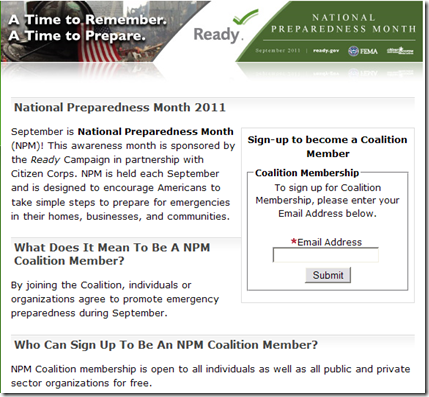
September is National Preparedness Month (NPM)! This awareness month is sponsored by the Ready Campaign in partnership with Citizen Corps. NPM is held each September and is designed to encourage Americans to take simple steps to prepare for emergencies in their homes, businesses, and communities.

(Continue . . . )


As you might expect, Avian Flu Diary has already signed up, and will devote considerable blog space to the subject of preparedness during the month of September.


Not sure how to participate?


You can view Highlights from Last Year's Events to get some ideas, and the NPM website will provide you with many toolkits that you can customize for your own use – including sample blogs, emails, tweets, and other promotional materials.


The goal of NMP11 is to foster a culture of national preparedness, and to encourage everyone to plan and be prepared to deal with an event where they can go at least three days without electricity, running water, local services, or access to a supermarket.


And in order to do that, Ready.gov wants you to:


image

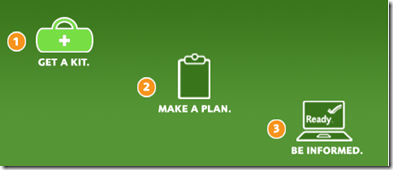
GET A KIT

MAKE A PLAN

BE INFORMED


I hope you’ll join us this year in making NPM 2011 the most successful national preparedness campaign to date and to promote the idea that individual, family, and business preparedness is a year-round priority.

Saturday, July 30, 2011

NPM 2011: Just Over A Month Away


image


# 5726


Now just over a month away, National Preparedness Month (NPM) 2011 will observed throughout the month of September. In June Ready.gov, FEMA, and the Citizen Corps began their awareness campaign and they continue to look for new coalition members.


This year – being the 10th anniversary of 9/11 – we are being asked to remember past disasters as well as prepare those that may come in the future.


As you might expect, Avian Flu Diary has already signed up.  And you can too.


Follow the link below to learn more and join.


National Preparedness Month Coalition

Click to join button Login Button

Welcome! Join this community to:

1. Download the coalition members toolkit
2. Add your event to the calendar
3. Participate in national preparedness discussions
4. Connect with fellow coalition members by posting in the Community Forum for national or general topics or in a Regional Forum for regional topics.


September is National Preparedness Month (NPM)! This awareness month is sponsored by the Ready Campaign in partnership with Citizen Corps. NPM is held each September and is designed to encourage Americans to take simple steps to prepare for emergencies in their homes, businesses, and communities.


(Continue . . . )


Over the past 30 days FEMA has declared no fewer than 12 Major disasters within the United States.  And in June, they classified 10 events as major disasters.


image


While these major events affected thousands of Americans, every day thousands more are affected by smaller, more localized emergencies.


Household accidents, car wrecks, heart attacks, fires, floods,  storm damage . . .   


While we can’t prevent most emergencies and disasters  . . . we can be better prepared to deal with them.


As Ready.gov urges.

image 


By joining the National Preparedness Month coalition, and holding events to promote awareness, you will be helping to spread this vital message. 


And that’s a win-win situation.


For you, your family, and your community.

Wednesday, May 19, 2010

Become An NPM 2010 Coalition Member


# 4578


image


Sharp-eyed visitors to this blog have no doubt already noticed the new National Preparedness Month 2010 logo on my sidebar. 


Although this is only May, and NPM 2010 happens in September, the Ad Council in concert with Ready.gov, FEMA, and Citizen Corps are kicking off their awareness campaign and looking for coalition members.


As you might expect, Avian Flu Diary has already signed up.  And you can too.


I’ll let Ready.gov explain the process. Click on the image below to go to the sign up page.


image


Once you sign up you’ll have access to the NPM toolkit, which includes PowerPoint presentations, brochures, posters, web badges and logos, videos, and a calendar where you can post planned activities online.


It’s free, and easy.  


And by taking part in NPM 2010 you’ll be helping to create a culture of preparedness in your workplace, your community and in your circle of friends and family.


Something that could save lives during an emergency.


For more potentially life saving preparedness information, go to:


FEMA http://www.fema.gov/index.shtm

READY.GOV http://www.ready.gov/

AMERICAN RED CROSS http://www.redcross.org/


And a few of my (many) preparedness essays include:


An Appropriate Level Of Preparedness
Inside My Bug Out Bag
Red Cross Unveils `Do More Than Cross Your Fingers’ Campaign
The Gift Of Preparedness


You can search this blog for more preparedness information by clicking this link.

Thursday, September 01, 2011

National Preparedness Month Kicks Off


image


#5800


Despite not performing well for the cable news TV cameras - which has led many to call the storm over-hyped - Hurricane Irene has become the 10th billion dollar+  weather disaster in the U.S. this year, claiming more than 40 lives and producing devastating inland flooding across several states.


Six days after she made landfall, hundreds of thousands of people from North Carolina to Maine remain without electricity and many thousands are dealing with damaged property.


And even as our East Coast works to recover from this storm’s effects the NHC is watching another hurricane (Katia) in the Atlantic and a growing area of suspicion in the GOM.  


image


All which highlights the importance of taking part in National Preparedness Month which begins today, September 1st.


This year, nearly 6,000 volunteer coalition members have offered to find ways to promote preparedness in their neighborhoods, businesses, and communities.


image


Once again Avian Flu Diary is pleased to join in, and will present preparedness essays all through the month of September, as well as promoting NPM11.


It isn’t too late to join this coalition, and help promote preparedness in your business or community. Follow the link below to learn more and to sign up.


National Preparedness Month Coalition

Click to join button Login Button

Welcome! Join this community to:

1. Download the coalition members toolkit
2. Add your event to the calendar
3. Participate in national preparedness discussions
4. Connect with fellow coalition members by posting in the Community Forum for national or general topics or in a Regional Forum for regional topics.


September is National Preparedness Month (NPM)! This awareness month is sponsored by the Ready Campaign in partnership with Citizen Corps. NPM is held each September and is designed to encourage Americans to take simple steps to prepare for emergencies in their homes, businesses, and communities.

(Continue . . . )


The goal of NMP11 is to foster a culture of national preparedness, and to encourage everyone to plan and be prepared to deal with an event where they can go at least three days without electricity, running water, local services, or access to a supermarket.


And in order to do that, Ready.gov wants you to:

image

GET A KIT

MAKE A PLAN

BE INFORMED


I hope you’ll join us this year in making NPM 2011 the most successful national preparedness campaign to date and to promote the idea that individual, family, and business preparedness is a year-round priority.

Friday, July 02, 2010

Countdown To National Preparedness Month


# 4693


image


In early May ago I signed up for - and added the logo/widget to my sidebar - for National Preparedness Month 2010 which happens in September.


Although still two months away the Ad Council in concert with Ready.gov, FEMA, and Citizen Corps are looking for coalition members. 


And you, or your business, can help.


I’ll let Ready.gov explain the process. Click on the image below to go to the sign up page.


image


Once you sign up you’ll have access to the NPM toolkit, which includes PowerPoint presentations, brochures, posters, web badges and logos, videos, and a calendar where you can post planned activities online.


It’s free, and easy.  


And by taking part in NPM 2010 you’ll be helping to create a culture of preparedness in your workplace, your community and in your circle of friends and family.


Something that could save lives during an emergency.


For more potentially life saving preparedness information, go to:


FEMA http://www.fema.gov/index.shtm

READY.GOV http://www.ready.gov/

AMERICAN RED CROSS http://www.redcross.org/

Wednesday, January 01, 2014

Preparing For An Unpredictable New Year

image


# 8119


When it comes to making forecasts for the coming year, I generally default to the late Baltimore Sun columnist Jack Germond’s incredibly droll (and 100% safe) New Year’s Eve prediction he issued a couple of decades ago that, `There will be a flood somewhere.’


Not being afraid to go out on a limb, I go a little further, saying:


There will be a flood – or some other disaster - and some people will suffer unnecessarily because they weren’t adequately prepared.


Shocking, I know.  


But despite a nearly constant barrage of preparedness messaging from governments, organizations, and humble bloggers like myself, half of all American families haven’t even taken the most basic of disaster preparedness steps, and I’d guess fewer than 10% are really well prepared for a serious event.


Last year, an American Red Cross poll (Coastal Hurricane Preparedness May 2013), found only about half the respondents had an evacuation plan, 1/3rd have no home disaster supplies, and only about half reported having a family communications plan.


During the first decade of promoting their National Preparedness Month (NPM), FEMA and READY.Gov have seen some signs of progress (see graphic below).

image

The goal of this yearly campaign is to foster a culture of national preparedness, and to encourage everyone to plan and be prepared to deal with an event where they can go at least 72 hours without electricity, running water, local services, or access to a supermarket.


Still,  far too many American families and businesses remain poorly equipped to deal with a major disaster. And that knowledge keeps emergency planners up at night.


For those who equate prepping with sensationalized cable TV and Internet `Doomsday-type’ preppers, rest assured we aren’t talking about digging a bunker, laying in a 10-year supply of freeze dried foods, or stockpiling guns and ammo.


But disruptions that follow hurricanes, tornado outbreaks, floods, and other natural disasters can potentially last for days or even weeks, and so – if you are able to do so - being prepared for 10 days to 2 weeks makes a good deal of sense (see When 72 Hours Isn’t Enough).


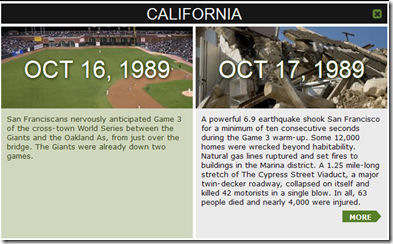
In 2012, in Making The Most Of The Day Before Tomorrow, I highlighted a very effective graphic from  Ready.gov that shows the `day before disaster’ for all 50 states. The date when it was still not too late to prepare.


Click through to the interactive map, to see each state’s date with destiny.


image


If you click on California, for example, you’ll get:

image

You get the idea. 

The takeaway point is, you never know whether today is the day before your disaster . . .


We’ll be covering a lot of preparedness topics during 2014 – along with our regular litany of emerging infectious diseases – because in a world as crowded, complex, and interconnected as ours, bad things are sure to happen.


And among those `bad things’ is the potential for seeing epidemics or even a pandemic.


But the smart money says, you shouldn’t prepare for a specific emergency or disaster, but instead create an `All Hazards approach’  to preparedness, one that  will leave you in good stead no matter what comes down the pike.


To get you started, I would invite you to visit:


FEMA http://www.fema.gov/index.shtm

READY.GOV http://www.ready.gov/

AMERICAN RED CROSS http://www.redcross.org/


If you are on Twitter, I would recommend you follow @FEMA, @CraigatFEMA, @NHC_Atlantic, @NHC_Pacific and @ReadyGov.


And lastly, in NPM13: The Greatest Prep Of All,  I wrote about what I consider to be the most important preparedness step you can take – having, and being,  a disaster buddy.  Cultivating a network of family and friends to whom you can turn for help in a disaster, to who can turn to you for aid,  if they need it.


Because - while I can’t predict what disaster will happen, or when, or even where – its a safe bet that in 2014 hundreds of thousands of people around the world will find themselves wishing  they were better prepared in the midst of a crisis.


With a little bit of pre-planning and effort, you needn’t be one of them.


You can use this link to read earlier NPM preparedness posts on this blog.

Thursday, September 26, 2013

NPM13: Create A Family Communications Plan

image

Note: This is day 25 of National Preparedness Month.  Follow this year’s campaign on Twitter by searching for the #NPM or #NPM13 hash tag.

This month, as part of NPM13, I’ll be rerunning some updated  preparedness essays (like this one) , along with some new ones.


# 7814


Those of us who were living in Florida during the `bad old days’ of the cold war remember well the Cuban Missile Crisis of 1962.


Although it is hard to imagine it today, much of Florida was on a war footing with fears of a nuclear attack that might come at any time, thousands of military streaming into the state, and schools running daily `duck & cover’ and emergency evacuation exercises.


Kids were sent home with civil defense pamphlets on the basics of radiation poisoning and how to build an in-home fallout shelter.


image

As an 8-year-old with a scientific bent, these were exciting times.


What I didn’t full appreciate at the time was my parents were faced with an agonizing dilemma. My twin-brother and I attended a nearby elementary school, while my 17-year old sister attended high school some distance away.


If the alert went up, they realized they might only have time to get to one school to pick up their kids.


Logic dictated that the pick up my brother and I, based on our ages, and the fact that there were two of us. My sister was given instructions to go to the home of one of her high school friends, and our folks would  either contact her or pick her up there.


More than 50 years ago, in the face of a potential crisis, my family cobbled together their own emergency communications plan including an alternate rendezvous point.


While a nuclear attack is (thankfully) far less likely today, the same principles hold true when it comes to having a communications plan, and a meet-up point.


And since a tornado, earthquake, house fire, or some other disaster can strike without warning . . .  these are the sorts of plans every family needs to make now. Before they are needed.


This from Ready.gov.


 MAKE A PLAN

Your family may not be together when a disaster strikes so it is important to plan in advance: how you will get to a safe place; how you will contact one another; how you will get back together; and what you will do in different situations. Read more about Family Communication during an emergency.

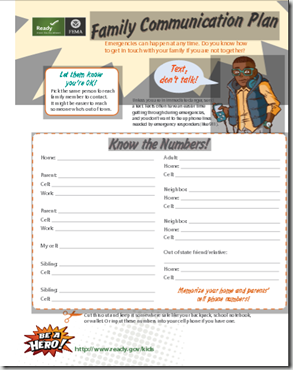
Ready.gov has made it simple for you to make a family emergency plan. Download the Family Communication Plan for Parents and Kids (PDF - 1.2 Mb) and fill out the sections before printing it or emailing it to your family and friends.

You should also inquire about emergency plans at places where your family spends time: work, daycare and school, faith organizations, sports events and commuting. If no plans exist, consider volunteering to help create one. Talk to community leaders, your colleagues, neighbors and members of faith or civic organizations about how you can work together in the event of an emergency. You will be better prepared to safely reunite your family and loved ones during an emergency if you think ahead and communicate with others in advance. Read more about school and workplace plans.


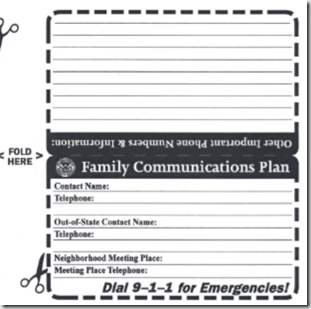
READY.GOV has made things  easier today, as they’ve developed  several Family Emergency Communication Kits geared for both adults and kids, which can be downloaded from the net. With just a few minutes effort, you can have your own emergency communications plan and emergency meeting place set up.


image

While the above version is geared to kids, the version below is more suitable for teenagers and adults.


image

Appendix C of the Are You Ready? Guide (contains blank contact cards and a family communications plan form)


Filling out these cards may seem a small step, but that's what most preparedness involves.


Taking small, organized steps that, when put together, create a fabric of individual and community preparedness.  If you do just one small step each day, in almost no time you’ll find yourself and your family far better prepared to face any emergency.


For more on how to prepare, visit these websites:


FEMA http://www.fema.gov/index.shtm

READY.GOV http://www.ready.gov/

AMERICAN RED CROSS http://www.redcross.org/


And you can use this link to read earlier NPM preparedness posts on this blog.

Monday, August 31, 2020

#NPM 2020 : Creating A Culture Of Preparedness


#15,444

Tomorrow, September 1st, marks the start of National Preparedness Month (#NPM), which has been promoted by FEMA, Ready.gov, and others (including AFD) since 2004.  Each year, during the month of September, I double down on preparedness blogs in support of this campaign. 

This year will be no different, although personally, the stakes have never felt higher. 

We are just now entering the height of hurricane season, in what has already been a record breaking year.  The earth, and the United States in particular, has been in a major earthquake drought for years, and as we all know - droughts - even good ones, end eventually. 

  • When Category 4 Hurricane Harvey battered and flooded east Texas in 2017, it ended an 11+ year drought in major (CAT 3+) land-falling hurricanes in the Continental United States. Since then, we've seen Irma, Michael, and Laura.
  • When a novel swine-origin H1N1 virus emerged in 2009, it ended a 40 year drought in flu pandemics, and just ten years later we have our 2nd pandemic. 

Over the next couple of years, the sun will climb back towards solar maximum, putting the earth at risk of damaging solar storms (see USGS: Preparing The Nation For Severe Space Weather). 

In 2014 a study was published suggesting the odds of earth being struck by one of these solar super storms is actually a lot higher than we’ve previously thought.  From a NASA article:

In February 2014, physicist Pete Riley of Predictive Science Inc. published a paper in Space Weather entitled "On the probability of occurrence of extreme space weather events."  In it, he analyzed records of solar storms going back 50+ years.  By extrapolating the frequency of ordinary storms to the extreme, he calculated the odds that a Carrington-class storm would hit Earth in the next ten years.

The answer: 12%.

In 2018's NIAC: Surviving A Catastrophic Power Outage, we looked at the President's National Infrastructure Advisory Council (NIAC) report on the potential for a prolonged grid-down scenario, along with a dismal report card on America's infrastructure from the ASCE (American Society of Civil Engineers).

And of course, to these catastrophic disasters we can always add floods, droughts, heatwaves, blizzards, and other weather related events both in the United States, and around the world, which could affect food harvests, supply chains, and global stability. 

While we can't predict what the next big disaster will be, or where it will strike, we do know that whatever comes over the next year or two will be greatly complicated by our ongoing pandemic, and global recession. 

Governments will almost certainly be slower to respond, and recoveries will take longer than usual.


As the (above) graphic illustrates (see #NatlPrep: FEMA National Household Preparedness Survey), while we've seen some improvement over past few years, Americans still have a long way to go if we are to cultivate a culture of preparedness.

The goal is to have every American household prepared to handle at least a week without essential services (electricity, running water, open grocery stores, etc.) in the event of a local or regional disaster. And frankly, 2 weeks would be better. 

In recent years preparedness has gotten a bit of a bad name.  The popular image of a prepper - promulgated by the media and cable TV - is that of a nut out gathering squirrels, as they wait anxiously for doomsday.

While that archetype undoubtedly exists, most `preppers' are regular folks who gear up to deal with more reasonable, and more survivable, scenarios like hurricanes, floods, blizzards, and yes, even pandemics. 

While I don't consider myself a survivalist (I don't own a stitch of camo), my years as a paramedic, and decades living on sailboats and in the backwoods of Missouri, have instilled in me a strong desire to be prepared for emergencies.

I know first hand what it is like when things go pear-shaped, and there's no one to call for help.

Which is why I promote the idea of having, and being, a `disaster buddy',and why when I give presents to friends and family, they are almost always in the form of `preps' (see The Gift Of Preparedness - 2019 Holiday Edition).

I hope you'll join me during the month of September in improving your, and your family's, resilience against the unexpected.  Even little preps - like having a week's worth of food and water in the pantry - can pay big dividends in a disaster.

Because, no matter what the emergency, the advantage always goes to those who are best prepared.

Monday, September 23, 2013

NPM13: Radiological Emergencies

image

Photo Credit CDC PHE


Note: This is day 23 of National Preparedness Month.  Follow this year’s campaign on Twitter by searching for the #NPM or #NPM13 hash tag.

This month, as part of NPM13, I’ll be rerunning some updated  preparedness essays, along with some new ones (like this one).


# 7801


For most Americans, the idea that we might have to deal with a radiological emergency sounds like something out of the Cold War era (1950s to the1980s), when multiple Soviet warheads were targeted on every major American city and nuclear annihilation seemed all but unavoidable . Today, we’ve pulled back from that brink, have reduced our nuclear stockpiles by 80%, and a global thermonuclear war seems unlikely.


But radiological threats remain, both due to deliberate acts, and due to accidents and natural disasters.   One need look only as far as the Fukushima disaster of 2011 to see how quickly a radiological emergency can affect a large population. 

This from the CDC’s PHE website:


A radiological or nuclear incidents occurring within the U.S. homeland or elsewhere could take a number of forms, including: contamination of food or water with radioactive material; placement of radiation sources in public locations; detonation of radiological dispersal devices that scatter radioactive material over a populated area; an attack on a nuclear power plant or a high-level nuclear waste storage facility; or an improvised nuclear device.


The CDC, HHS, FEMA, and other agencies take these threats seriously, as is evidenced by a multi-million dollar contract let last week by the HHS to stockpile Thrombosomes – freeze-dried platelets – used for the treatment of acute radiation sickness.


HHS funds development of freeze-dried platelets for disaster response

New product could improve care for Acute Radiation Syndrome and daily medical care

Date: September 20, 2013

Organization: Cellphire Inc. of Rockville, Md.

Funding: This contract is for $11 million in the first 18 months and can be extended if milestones are met for a total of up to five years and up to $56.7 million.

About this contract:  Cellphire will further develop Thrombosomes as a possible treatment for acute radiation syndrome. Thrombosomes is a novel freeze-dried blood product derived from human platelets.

Using a proprietary stabilization method, Cellphire can convert platelets into a powder that can be stored at room temperature for extended periods. When the product is needed, the powder can be reconstituted rapidly using sterile water and injected to restore normal clotting.

(Continue . . .)


The CDC’s Public Health Emergency Website lists six types of radiological threats, with links to tell you more about them.


Illustration of an IND

Nuclear Emergencies

  • A nuclear emergency involves the explosion of a nuclear weapon or improvised nuclear device (IND).
  • The explosion produces an intense pulse of heat, light, air pressure, and radiation.
  • Nuclear explosions produce fallout (radioactive materials that can be carried long distances by the wind).

Learn more about nuclear emergencies


Illustration of a dirty bomb

Dirty Bomb or Radiological Dispersal Device (RDD)

  • A dirty bomb (also known as a radiological dispersal device) is a mix of explosives such as dynamite, with radioactive powder or pellets.
  • A dirty bomb cannot create an atomic blast.
  • When the explosives are set off, the blast carries radioactive material into the surrounding area.

Learn more about dirty bombs


Illustration of a radiological exposure device

Radiological Exposure Device (RED)

  • A radiological exposure device (also called a hidden sealed source) is made of or contains radioactive material.
  • REDs are hidden from sight to expose people to radiation without their knowledge.

Learn more about radiological exposure devices


Illustration of an power plant accident

Nuclear Power Plant Accident

  • An accident at a nuclear power plant could release radiation over an area.
  • Nuclear power plants have many safety and security procedures in place and are closely monitored by the Nuclear Regulatory Commission (NRC) External Web Site Icon

Learn more about nuclear power plant accidents


Illustration of a transportation accident

Transportation Accidents

  • It is very unlikely that a transportation accident involving radiation would result in any radiation-related injuries or illnesses.
  • Shipments involving significant amounts of radioactive material are required to have documentation, labels, and placards identifying their cargo as radioactive.

Learn more about transportation accidents


Illustration of an occupational accident

Occupational Accidents

  • Radiation sources are found in a wide range of settings such as health care facilities, research institutions, and manufacturing operations.
  • Accidents can occur if the radiation source is used improperly, or if safety controls fail.

Learn more about occupational accidents


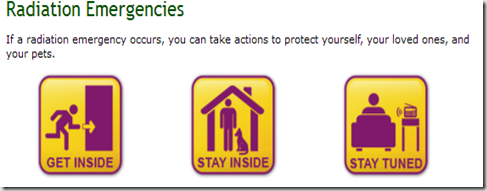
Preparing for a radiological emergency isn’t so very different from what you would do for any other type of disaster.  You want to be prepared to shelter-in-place, stay out of harm’s way, and keep up with advisories.  Steps that are explained on PHE’s  Radiation Emergencies - What should I do?  webpage.


image

Get Inside

Get Inside

In a radiation emergency you may be asked to get inside a building and take shelter for a period of time.

  • This action is called "sheltering in place."
  • Get to the middle of the building or a basement, away from doors and windows.
  • Bring pets inside.

Learn about sheltering options


Stay Inside

Stay Inside

Staying inside will reduce your exposure to radiation.

  • Close and lock windows and doors.
  • Take a shower or wipe exposed parts of your body with a damp cloth.
  • Drink bottled water and eat food in sealed containers.

Learn what to do while taking shelter


Stay Tuned

Stay Tuned

Emergency officials are trained to respond to disaster situations and will provide specific actions to help keep people safe.

  • Use radios, televisions, computers, mobile devices, and other tools to get the latest information.
  • Emergency officials will provide information on where to go to get screened for contamination.

Learn how to stay informed


The goal of NPM2013 is to foster a culture of national preparedness, and to encourage everyone to plan and be prepared to deal with any disaster where they can go at least 72 hours without electricity, running water, local services, or access to a supermarket.

image

These are, of course, minimum goals.


Disruptions that accompany hurricanes, floods, pandemics, and yes . . . even radiological disasters  . .  can potentially last for days or even weeks, and so – if you are able to do so - being prepared for 10 days to 2 weeks makes a good deal of sense (see When 72 Hours Isn’t Enough).


While a radiological hazard may be far down your list of `probable’ threats, the common sense steps you take to prepare for any disaster will serve you well, even in a radiation emergency.  For more on `all hazards’ preparedness, I’d invite you to visit:


FEMA http://www.fema.gov/index.shtm

READY.GOV http://www.ready.gov/

AMERICAN RED CROSS http://www.redcross.org/


And you can use this link to read earlier NPM preparedness posts on this blog.

Tuesday, December 13, 2011

Solar Power Preparedness On A Budget


# 6004


Note: This is an update to of one my preparedness columns that has been very popular in the past. Instructions on how to set up a simple solar charging system for your home.


I re-run it about once a year, usually during the holidays when news is slow.


As former live-aboard boater, I lived off the grid – using a solar system like I describe in this essay  – for many months at a time.


During my 10 years living in Rural Missouri, we had several storm related power outages that lasted more than 24 hours, and were grateful for the 12 volt backup system I maintained.


Earthquakes, tornadoes, hurricanes, and other localized disasters can disrupt power supplies for hours or even days.


A little bit of preparedness now, can make things a whole lot easier to deal with later.

To view more of my preparedness essays, click the NPM  or Prepare links in the Quick Search in my sidebar.


I’ve had several requests for information on how to construct a down and dirty (read : Cheap) solar power system for those with light duty requirements. If you are looking for a system to run power tools, a microwave oven, refrigerator, freezer, or your desktop computer   . . . the system described below will be woefully inadequate.


However, if what you want is something cheap, easy to built, and that will allow you to recharge Ni-cad batteries and cell phones, run LED lights or 12 volt fans, and maybe give you a few hours a day on your laptop computer . . .  then I present an inexpensive and easy to put together alternative.


With a bit of judicious shopping, a simple solar power setup can be had for  under $200, and can be put together in an afternoon or two.


Increase your budget to about $300 and you can more than double your capacity.


The price of solar panels continues to come down, with newer panels providing more watts per dollar.  Deals can often be found by looking in surplus stores, by buying discontinued models, or by purchasing panels with cosmetic blemishes. 


Is Solar for Me?

Solar power, of course, requires a good exposure to sunlight. The more sunlight you can access, the more efficient the output from your panels. If you live somewhere that has few sunny days, or you have no place to mount a solar panel that will catch good direct sunlight for 5 or 6 hours each day, the odds are that solar is not a good investment.


panel


Simply put, solar panels generate small amounts of electricity from direct exposure of the cells to sunlight. Most solar panels generate 14 to 17 volts, enough to charge a 12 volt battery, and their ability to charge is rated in watts. A 15-watt panel generates 15 watts of electricity at roughly 15 volts each hour. This is roughly the equivalent of 1 amp of charging per hour into your battery.


Larger (more expensive) panels may produce 30, 40, 80, 120 watts of power (or more). For each 15 watts, think (roughly) 1 additional amp/hr. A 60-watt panel would therefore generate about 4 amps per hour during prime sunlight hours.


Of course, the electricity generated from a solar panel only is available when the sun is shining. At night, or when clouds obscure the sun, the power output stops. This is not very handy for those who would like to have lights at night. So to our solar panel we must add a storage device, a 12-volt battery or quite often, a bank of batteries. This allows us to bank electricity during the day, and draw it out, as needed, even during the night.


When we draw electricity from the battery bank, we can do so either as 12 volt or, with the aid of a device called an inverter, as 110 volt house current.


Think of a fully charged battery like a bucket filled with water. When you run LED lights, or convert power to 110v with the inverter, you are removing water. Sometimes, like with the LED's you take little sips, other times, when using the inverter, you take massive gulps. Either way, the amount of the water in the bucket goes down until it is empty.


The solar panel adds very small amounts of water to your bucket every hour the sun shines on it. The amount of water it adds is determined by the amount of direct sunshine and the watt rating of the solar panel.


As long as you add as much back to your bucket each day as you draw out, the battery remains fully charged. If you draw out too much, the battery is partially discharged, and you will have to wait several days for the solar panel to catch up.


The Solar Triad +1


To create a Solar Power system, you need basic components. The solar panel, a battery, and an inverter. You could get by without an inverter and only draw out 12 volt power from your batteries, but that is very limited, and as you will find, small inverters are very inexpensive. I would also add a 4th item, an inexpensive battery charger, for those times when the grid is up, so you can quickly recharge your batteries.


A 15 watt solar panel can often be purchased for less than $100. A suitable battery, for under $60. And a 400 watt inverter will run you about $22. All totaled, you can be in business for roughly $200. Not bad.


If your solar panel is larger than 15 watts, you'll probably want to add a solar panel charge controller. These run around $30, and can prevent overcharging of your batteries. If you use a small solar panel, they are not necessary.


To that, I would recommend an automotive battery charger, which will run about $25, although they can often be found for much less in yard sales. A 6/2 amp charger is fine. This will allow you to top off your battery during those times the grid is functioning. And by adding a 2nd battery, you can be using one battery while charging another. Total cost? Right at $300.


Most batteries will tell you how many amp/hrs they are rated for. This is not the same thing as cranking amps. Those are for short duration, and are for turning a starter on a car or engine. The best batteries are called deep cycle, or marine batteries, and typically can hold 105 amps or more. But they are heavy. Smaller batteries may only hold 10 or 20 amps. As long as your daily energy needs never exceed that, they could be used.

solar1


An LED light array will draw very little from the battery. Probably .1 amps an hour. 1 amp every 10 hours. You could go a long time without recharging.


But the inverter, which provides 110v, draws amps from the battery at an astounding rate. A 100 watt light bulb will pull 10-12 amps out of your battery in an hour. Using an appliance that uses the full 400 watt output would pull 40+ amps out in an hour. It would take days for the solar panel to replenish that much power.


The best use for the inverter is for running battery chargers for ni-cad batteries, or very occasionally to run a small portable tv, radio, or laptop computer. You will not be able to run a microwave, or a toaster, or power tools.


Of course, bigger solar panels and bigger batteries, and a bigger inverter would allow you to do these things. But based on what you are likely to have, you need to have low expectations.


A good investment are Ni-cad or Nickle-Hydrate (expensive, but better) rechargeable AA and AAA batteries, with a charging stand. This will allow you to have rechargeable batteries (using the inverter) to run cell phones, radios, even walkie-talkies.


Where possible, you should use the battery for the lowest possible power consumption. LED lighting, or charging AA and AAA batteries. A windup radio will take a burden off of your system.


Warning: Batteries can offgas Hydrogen gas, which can be explosive, and should be kept in a ventilated area. You will also need to check the electrolyte levels of the batteries and keep the plates covered with distilled water.


Solar panels, batteries, and inverters produce electrical currents and (even at low voltages) can be a dangerous shock hazard.  Always read and follow the instructions that come with your solar panels, batteries, chargers, and inverters.


If you are unsure of how to safely deal with these components, have someone who knows how give you instruction.