Showing posts with label Emergency Plan. Show all posts

Wednesday, August 20, 2014

Hong Kong Launches Ebola Preparedness & Response Plan

image


#8976


Although there have been dozens of suspected Ebola infected travelers tested in countries outside of Africa, thus far, none of them have tested positive for the virus. Although I’m not attempting to keep track all of these media reports, for the best day-to-day coverage, I would highly recommend checking in with Crofsblog several times a day. 


Despite our current lucky streak, governments around the world are understandably preparing for the day when an Ebola infected traveler does arrive on their shores.  Our own CDC continues to release copious guidance on the issue, which you can access here.


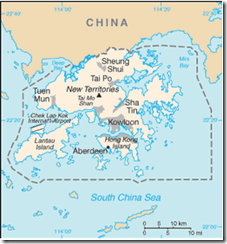
With more than 7 million residents crammed into just 426 sq miles, and more than 36 million visitors each year,  Hong Kong’s Centre For Health Protection takes infectious disease threats very seriously, a lesson well learned from the SARS epidemic of 2003 (see SARS And Remembrance). 


Today the CHP  launched their own Preparedness and Response plan for Ebola, which is patterned after similar plans previously drafted for Avian Flu and MERS-CoV (see Hong Kong Unveils Their MERS-CoV Preparedness Plan).


There have been no imported cases of Ebola detected in Hong Kong to date, either in humans or animals, and so currently, the Alert Response Level (low risk to the public) is activated.

20 August 2014

Preparedness and Response Plan for Ebola Virus Disease launched 

The Government today (August 20) announced the launch of the Preparedness and Response Plan for Ebola Virus Disease (EVD). The Plan sets out the Hong Kong Special Administrative Region Government's preparedness and response plan in case of an outbreak of EVD.

"The EVD Plan ensures that when EVD may have a significant public health impact on Hong Kong, the Hong Kong Special Administrative Region Government would be equipped with the core capacities to prevent, detect, characterise and respond quickly, efficiently and in a co-ordinated manner to the EVD threats in order to reduce mortality and morbidity," a spokesman for the Centre for Health Protection (CHP) of the Department of Health remarked.

In the EVD Plan, a three-tier response level, which is adopted for the preparedness plans of influenza pandemic and Middle East Respiratory Syndrome, is used. The three response levels, namely Alert, Serious and Emergency, are based on the risk assessment of the EVD that may affect Hong Kong and its health impact on the community.

The EVD Plan includes comprehensive response measures, clear command structures, and mechanisms for the activation and standing down of response levels. It also serves as a tool for clear communication of the level of risk with the public. Relevant agencies, companies and organisations should take note of this plan in devising their contingency plans and response measures.

In accordance with the EVD Plan, the Alert Response Level is activated with reference to the current epidemiological situation.

The EVD Plan has been uploaded to the CHP's EVD page (www.chp.gov.hk/en/view_content/34199.html).

Monday, September 23, 2013

NPM13: Radiological Emergencies

image

Photo Credit CDC PHE


Note: This is day 23 of National Preparedness Month.  Follow this year’s campaign on Twitter by searching for the #NPM or #NPM13 hash tag.

This month, as part of NPM13, I’ll be rerunning some updated  preparedness essays, along with some new ones (like this one).


# 7801


For most Americans, the idea that we might have to deal with a radiological emergency sounds like something out of the Cold War era (1950s to the1980s), when multiple Soviet warheads were targeted on every major American city and nuclear annihilation seemed all but unavoidable . Today, we’ve pulled back from that brink, have reduced our nuclear stockpiles by 80%, and a global thermonuclear war seems unlikely.


But radiological threats remain, both due to deliberate acts, and due to accidents and natural disasters.   One need look only as far as the Fukushima disaster of 2011 to see how quickly a radiological emergency can affect a large population. 

This from the CDC’s PHE website:


A radiological or nuclear incidents occurring within the U.S. homeland or elsewhere could take a number of forms, including: contamination of food or water with radioactive material; placement of radiation sources in public locations; detonation of radiological dispersal devices that scatter radioactive material over a populated area; an attack on a nuclear power plant or a high-level nuclear waste storage facility; or an improvised nuclear device.


The CDC, HHS, FEMA, and other agencies take these threats seriously, as is evidenced by a multi-million dollar contract let last week by the HHS to stockpile Thrombosomes freeze-dried platelets – used for the treatment of acute radiation sickness.


HHS funds development of freeze-dried platelets for disaster response

New product could improve care for Acute Radiation Syndrome and daily medical care

Date: September 20, 2013

Organization: Cellphire Inc. of Rockville, Md.

Funding: This contract is for $11 million in the first 18 months and can be extended if milestones are met for a total of up to five years and up to $56.7 million.

About this contract:  Cellphire will further develop Thrombosomes as a possible treatment for acute radiation syndrome. Thrombosomes is a novel freeze-dried blood product derived from human platelets.

Using a proprietary stabilization method, Cellphire can convert platelets into a powder that can be stored at room temperature for extended periods. When the product is needed, the powder can be reconstituted rapidly using sterile water and injected to restore normal clotting.

(Continue . . .)


The CDC’s Public Health Emergency Website lists six types of radiological threats, with links to tell you more about them.


Illustration of an IND

Nuclear Emergencies

  • A nuclear emergency involves the explosion of a nuclear weapon or improvised nuclear device (IND).
  • The explosion produces an intense pulse of heat, light, air pressure, and radiation.
  • Nuclear explosions produce fallout (radioactive materials that can be carried long distances by the wind).

Learn more about nuclear emergencies


Illustration of a dirty bomb

Dirty Bomb or Radiological Dispersal Device (RDD)

  • A dirty bomb (also known as a radiological dispersal device) is a mix of explosives such as dynamite, with radioactive powder or pellets.
  • A dirty bomb cannot create an atomic blast.
  • When the explosives are set off, the blast carries radioactive material into the surrounding area.

Learn more about dirty bombs


Illustration of a radiological exposure device

Radiological Exposure Device (RED)

  • A radiological exposure device (also called a hidden sealed source) is made of or contains radioactive material.
  • REDs are hidden from sight to expose people to radiation without their knowledge.

Learn more about radiological exposure devices


Illustration of an power plant accident

Nuclear Power Plant Accident

  • An accident at a nuclear power plant could release radiation over an area.
  • Nuclear power plants have many safety and security procedures in place and are closely monitored by the Nuclear Regulatory Commission (NRC) External Web Site Icon

Learn more about nuclear power plant accidents


Illustration of a transportation accident

Transportation Accidents

  • It is very unlikely that a transportation accident involving radiation would result in any radiation-related injuries or illnesses.
  • Shipments involving significant amounts of radioactive material are required to have documentation, labels, and placards identifying their cargo as radioactive.

Learn more about transportation accidents


Illustration of an occupational accident

Occupational Accidents

  • Radiation sources are found in a wide range of settings such as health care facilities, research institutions, and manufacturing operations.
  • Accidents can occur if the radiation source is used improperly, or if safety controls fail.

Learn more about occupational accidents


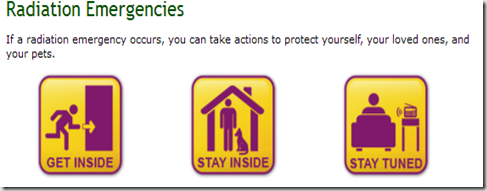
Preparing for a radiological emergency isn’t so very different from what you would do for any other type of disaster.  You want to be prepared to shelter-in-place, stay out of harm’s way, and keep up with advisories.  Steps that are explained on PHE’s  Radiation Emergencies - What should I do?  webpage.


image

Get Inside

Get Inside

In a radiation emergency you may be asked to get inside a building and take shelter for a period of time.

  • This action is called "sheltering in place."
  • Get to the middle of the building or a basement, away from doors and windows.
  • Bring pets inside.

Learn about sheltering options


Stay Inside

Stay Inside

Staying inside will reduce your exposure to radiation.

  • Close and lock windows and doors.
  • Take a shower or wipe exposed parts of your body with a damp cloth.
  • Drink bottled water and eat food in sealed containers.

Learn what to do while taking shelter


Stay Tuned

Stay Tuned

Emergency officials are trained to respond to disaster situations and will provide specific actions to help keep people safe.

  • Use radios, televisions, computers, mobile devices, and other tools to get the latest information.
  • Emergency officials will provide information on where to go to get screened for contamination.

Learn how to stay informed


The goal of NPM2013 is to foster a culture of national preparedness, and to encourage everyone to plan and be prepared to deal with any disaster where they can go at least 72 hours without electricity, running water, local services, or access to a supermarket.

image

These are, of course, minimum goals.


Disruptions that accompany hurricanes, floods, pandemics, and yes . . . even radiological disasters  . .  can potentially last for days or even weeks, and so – if you are able to do so - being prepared for 10 days to 2 weeks makes a good deal of sense (see When 72 Hours Isn’t Enough).


While a radiological hazard may be far down your list of `probable’ threats, the common sense steps you take to prepare for any disaster will serve you well, even in a radiation emergency.  For more on `all hazards’ preparedness, I’d invite you to visit:


FEMA http://www.fema.gov/index.shtm

READY.GOV http://www.ready.gov/

AMERICAN RED CROSS http://www.redcross.org/


And you can use this link to read earlier NPM preparedness posts on this blog.

Friday, June 07, 2013

MMWR: Heat-Related Deaths During an Extreme Heat Event

image

Severe weather reports from 2012 Derecho


# 7372


In late June of 2012 an unusually strong storm front, known as a Derecho, swept across parts of the Eastern United States – killing 15 people – and leaving millions without electrical power for more than a week (see Picking Up The Pieces)


Adding to the misery – and danger – the region remained under an EHE (Extreme Heat Event) advisory for two weeks.


Not surprisingly, given these difficult conditions, dozens of additional heat-related deaths were recorded during the two weeks following the storm. 


Yesterday, the CDC’s MMWR looked at these excess heat-related deaths in a report called:


Heat-Related Deaths After an Extreme Heat Event — Four States, 2012, and United States, 1999–2009

Weekly

June 7, 2013 / 62(22);433-436

On June 29, 2012, a rapidly moving line of intense thunderstorms with high winds swept across the midwestern and eastern United States, causing widespread damage and power outages. Afterward, the area experienced extreme heat, with maximum temperatures exceeding 100°F (37.8°C) (1). This report describes 32 heat-related deaths in Maryland, Ohio, Virginia, and West Virginia that occurred during the 2 weeks following the storms and power outages. Median age of the decedents was 65 years, and most of the excessive heat exposures occurred within homes. During 1999–2009, an annual average of 658 heat-related deaths occurred in the United States (2). Heat-related deaths are preventable, and heat response plans should be in place before an extreme heat event (EHE). Interventions should focus on identifying and limiting heat exposure among vulnerable populations.

(Continue . . .)


The entire report is worth reading, and the reader will discover that over the past 10 years, twice we’ve seen more than 1,000 heat related deaths in a year.

image


These numbers pale in comparison to the heat-related deaths that occurred during the prolonged drought and heat wave of 1980.  As many as 10,000 Americans are believed to have died from that 3-month long natural disaster. 


This from NOAA’s A Climatology of 1980-2003 Extreme Weather and Climate Events by Tom Ross and Neal Lott.


1980 Drought/Heat Wave  - June-September 1980. Central and eastern U.S.; estimated $20.0 (48.4) billion damage/costs to agriculture and related industries; estimated 10,000 deaths (includes heat stress-related).


Whether it comes as a result of a tornado, hurricane, earthquake, or other major disaster – prolonged power outages that occur during the extreme temperatures of summer or winter can be life threatening events.


Being prepared for an emergency means being able to deal with the aftermath of a disaster, and the ability to keep cool, or stay warm, should be part of everyone’s disaster plan.


You’ll find a detailed webpage on how to handle heat emergencies from the CDC’s Emergency Preparedness and Response  website:


Extreme Heat: A Prevention Guide to Promote Your Personal Health and Safety

image

(Continue . . . )


Ready.gov has some advice for preparing or heat emergencies.


Before Extreme Heat

To prepare for extreme heat, you should:

  • To begin preparing, you should build an emergency kit and make a family communications plan.
  • Install window air conditioners snugly; insulate if necessary.
  • Check air-conditioning ducts for proper insulation.

    Install temporary window reflectors (for use between windows and drapes), such as aluminum foil-covered cardboard, to reflect heat back outside.

  • Weather-strip doors and sills to keep cool air in.
  • Cover windows that receive morning or afternoon sun with drapes, shades, awnings, or louvers. (Outdoor awnings or louvers can reduce the heat that enters a home by up to 80 percent.)
  • Keep storm windows up all year.
  • Listen to local weather forecasts and stay aware of upcoming temperature changes.
  • Know those in your neighborhood who are elderly, young, sick or overweight. They are more likely to become victims of excessive heat and may need help.
  • Be aware that people living in urban areas may be at greater risk from the effects of a prolonged heat wave than are people living in rural areas.
  • Get trained in first aid to learn how to treat heat-related emergencies.


During a disaster like a hurricane or tornado the obvious threats – flying debris, storm surge, electrocution – are all easy to spot. But things like dehydration and heat stroke are often insidious, and can strike before anyone notices their threat.


Three summers ago, on a particularly hot Florida afternoon, we had a power outage that lasted more than 6 hours.  I wrote about it in Sweltering In Place.


While I was already set up with a 12 volt fan, my Sister and Father weren’t so lucky. . . . they ended up driving across town to sit in an air-conditioned restaurant for several hours.


The next day, I went out and bought them each a battery operated personal cooling fan, one that will run for nearly 24 hours on 4 D-Cells.


I paid about $12 each for them.

personal Fan


Of course, I’ve also got plenty of water stored, food, first aid supplies packets of rehydration solution, and at least four places within 150 miles of where I live where I could evacuate to if staying where I am became untenable.


image

Basic Preps: Emergency Weather Radio, First Aid Kit, Battery Lantern, Water storage


While preparedness may seem like a lot of work, it really isn’t. For more information on how to prepare, I would invite you  to visit:


FEMA http://www.fema.gov/index.shtm

READY.GOV http://www.ready.gov/

AMERICAN RED CROSS http://www.redcross.org/

Thursday, September 27, 2012

Japan’s Earthquake: Learning from Megadisasters


# 6588


We are a little more than 18 months since the Great Japan Earthquake and Tsunami of 2011 - and while much progress has been made - much work still remains ahead to safely secure the damaged nuclear reactors, and to rebuild shattered lives and communities.


The events of March 11th, 2011 were far more complex and devastating than any emergency plan had previously considered;  A 9.0 earthquake spawning a massive tsunami, that would not only demolish coastal towns killing thousands, but would heavily damage nuclear power facilities as well.


While the term megadisaster is often bandied about, in this instance, it is an appropriate description. 


Via Reliefweb, we’ve the first phase of a joint project by the GFDRR, the Government of Japan, and the World Bank that should be of particular interest to emergency management officials and planners around the world:


The Great East Japan Earthquake: Learning from Megadisasters

image

Report

Download PDF (661.78 KB) Knowledge Notes Executive Summary

Download PDF (374.64 KB) Brochure

<EXCERPT>

Learning from Megadisasters, a knowledge-sharing project sponsored by the Government of Japan and the World Bank, is collecting and analyzing information, data, and evaluations performed by academic and research institutions, nongovernmental organizations, government agencies, and the private sector—all with the objective of sharing Japan’s knowledge on disaster risk management (DRM) and postdisaster reconstruction with countries vulnerable to disasters.  The World Bank and the Japanese government hope that these findings will encourage countries to mainstream DRM in their development policies and planning.

(Continue . . . )

Saturday, September 08, 2012

NPM12: Preparedness For Kids

Note: This is day 8 of National Preparedness Month.  Follow this year’s campaign on Twitter by searching for the #NPM or #NPM12 hash tag.


This month, as part of NPM12, I’ll be rerunning some updated  preparedness essays (like this one) , along with some new ones.


# 6543


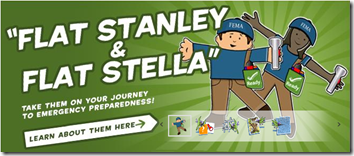
As any Boy or Girl Scout will tell you, emergency preparedness isn’t just for adults. And the Federal government obviously agrees since they maintain a website called Ready Kids as part of the Ready.gov program.


image


Here – with your guides Flat Stella & Flat Stanley- you’ll find a fun, interactive way to introduce young children to the concept of preparedness. You’ll also find an assortment of  Fun & Games, all with an emergency preparedness theme.


Comic Strip Comic Strip 

Crossword Puzzle Crossword Puzzle

Pack It Up Matching Game Pack It Up Matching Game

Hidden Treasures Activity Hidden Treasures Activity

Word Search Game Word Search Game

Coloring Pages Requires Acrobat Reader Plug-in Coloring Pages


For a somewhat older crowd (teenagers and young adults, mostly), in May of 2011 the CDC unleashed their  highly successful Zombie Preparedness blog - cleverly written by Rear Admiral Ali S. Khan - who told us (with tongue firmly implanted in cheek) that if we are prepared for a Zombie Apocalypse . . . we’re pretty much prepared for anything.


zombie

Photo Credit CDC


Once the news of a `zombie’ blog appearing on the CDC site went viral on Twitter, the number of visitors to the Public Health Matters Blog  temporarily overwhelmed their server.


Heartened by the huge response, six months later the CDC released a sequel to this highly effective campaign, with a 2-part Graphic Novel preaching preparedness, and a number of tie-in posters and even T-Shirts that you can purchase.


All are designed to drive home the importance of Getting a kit, Making a plan, and Being prepared

To learn how, go to the CDC’s  THE ZOMBIE PREPAREDNESS PAGE


Even with the addition of a mock zombie apocalypse, today’s preparedness messages are far kinder and gentler than the ones many of us were exposed to growing up during the height of the cold war.


My generation grew up indoctrinated by Bert the Turtle civil defense cartoons, incessant CONELRAD testing on the radio and TV, and the never-ending threat of nuclear annihilation. 


image image


"This was a test. Had this been a real emergency, you'd have been instructed to turn to your local CONELRAD broadcaster for more information. This was only a test".


During the Cuban Missile crisis, at the age of 8, I got the short course in radiation sickness, fallout shelters, `duck & cover’ drills, and emergency evacuations from my local elementary school. 


I recounted some of those experiences in a blog called NPM11: Creating A Family Communications Plan.


I certainly don’t advocate that preparedness lessons be taught to kids today in such a stark, disturbing, and traumatic fashion today


But the Ready Kids site shows that the subject can be approached in a child-friendly non-threatening manner.


When a disaster threatens, it threatens all of us – regardless of our age. Helping kids to understand more about emergency preparedness will undoubtedly help them cope (and perhaps, even help) in the event they, or their community, are caught up in a disaster.

Sunday, June 24, 2012

At The End Of My Rope


# 6402


I don’t generally include personal stories in this blog, but today a short exception, since it involved the use of some of my emergency preps, and I very nearly found myself in a bug-out situation.  


Friday night, at a quarter to ten, I heard a loud crack! followed by a loud crash shook my whole house.


Except for a light drizzle, the weather was fine with no wind to speak of. So I was more than a little surprised to find a 30 foot limb from an oak tree had landed on my roof.


image


Most of the weight was still being held off the roof by the remnants of the slowly cracking limb, but disaster appeared imminent, and unavoidable. 


I quickly gathered my bug out gear (moving it to a back entrance to the house, away from the impeding damage), then used my cell phone to arrange for some help at dawn’s early light.  


The next morning, with the assistance of several other people (two with experience taking down trees ), we used ropes (some of which came from my emergency preps) to secure the main limb as we began to carefully remove the debris on my roof, a process that took several hours.


My preps also yielded safety goggles, for use with the chain saw.


With the main limb continuing to fracture, the big moment came when the cut had to be made separating the mess on the roof from the limb that was threatening to swing down and take out my Florida room at any moment.


Using guide ropes, we managed to swing the big limb away from the house as it came crashing to the ground, just missing the house.


It was a very near thing. 


image


The best news is that no one was injured during this operation, but I had my first aid kit at the ready, just in case. Despite the ticking time bomb aspect of the continually cracking limb, we worked slowly, deliberately, and most importantly . . .  safely.


Thankfully, the massive limb was removed without incurring further damage to my home, which meant that the tarps in my emergency preps went unused.  


I obviously could not have done this alone, and so my thanks go to Don, Paul, and Craig who came to my rescue.


I also received several offers of a place to stay from my `Disaster Buddies’ (see In An Emergency, Who Has Your Back?), should things have gone pear-shaped and my house had become temporarily uninhabitable.


While we tend to think of emergency preparedness as something we do in the event of an earthquake, hurricane, or flood . . .  smaller, but none-the-less serious events can make you glad you were prepared.


In this case having preps (first aid kit, tarps, ropes, cell phone, safety goggles, etc.), a bug out bag at the ready, and a network of friends and disaster buddies I could rely on in times of need helped to avert what could have been a very nasty outcome.


September is National Preparedness Month, but as this example demonstrates, preparedness is something we all should strive for 365 days a year. Because you never know when your world will be suddenly turned upside down by an unexpected emergency.

Saturday, September 17, 2011

NPM11: Emergency Local Communications


Note: This is day 17 of National Preparedness Month.  Follow this year’s campaign on Twitter by searching for the #NPM11 hash tag.

image

This month, as part of NPM11, I’ll be rerunning some edited and updated older preparedness essays, along with some new ones.


# 5847


During a disaster, telephone service - whether via landline or cell phone - may be compromised. Even if the phone system remains intact, the service may overwhelmed by excessive traffic.


Note: Text messaging will sometimes work even when voice communications are down. 


Even if voice comms are available, during a crisis texting whenever possible is still preferable, because it places a lower burden on the phone system.


It can be advantageous, therefore, to have a backup form of short-range communications for when phones are either unavailable or are simply not the best solution.


As a liveaboard sailor, I spent several years without a telephone (or A/C, refrigeration, & running water for that matter). When we weren’t staying in a marina, cruising aboard a sailboat could be the ultimate in social isolation.


Sure, some days we'd gather on larger boats, or dockside, or on some isolated beach and kill some beers and tell some lies. But often we went days without direct human contact.


Of course, boaters just about all have a VHF radio aboard, and that was our link to one another.


Usually twice each day, in an anchorage of any size, we'd have a `radio roundup', where each boater would check in via the radio. If anyone needed anything, whether it was a recipe, a doctor, or a spare part, they could put out the call on the radio net.


Once `business' was taken care of, chit-chat ensued.


With multiple channels available, Boater A would often call upon Boater B to `meet me on Channel X', and they could depart and talk without cluttering main channel.


If a boater failed to check in, someone would usually row over and knock on their boat and make sure they were alright.


During an emergency - like an earthquake, flood, hurricane (or even a pandemic) - these same procedures could prove invaluable for just about any neighborhood or community.


While VHF radios are expensive, and overkill for most neighborhood settings, there is an easy alternative; FRS radio or Family Radio Service.


These are not your father's walkie-talkies.


They operate on a UHF band and are more reliable, and are less prone to static, than the old CB radio. And they are surprisingly inexpensive.


As regular readers are aware, I am a big proponent of the `disaster buddy’ concept - working with your friends and neighbors during an emergency (see In An Emergency, Who Has Your Back?).


Whether you live in a suburban neighborhood or an apartment complex, or a trailer park, these little radios can provide a ready way to communicate with your `disaster buddies’, even if your phone lines or cellular service are down.


For those walking a neighborhood watch patrol, they give an easy way to communicate with others patrolling the neighborhood, or with a home base.


For home security, they are hard to beat. One person can be watching a back door, while you monitor the front door, and you can communicate without shouting.


Or someone can go outside to check out a perceived threat, bring in supplies, or assist a neighbor and still remain in communications with the folks in the main house.


During a pandemic, earthquake, severe storm, search & rescue operation, or any other local or national emergency, they would be a valuable tool.


I own the Motorola T5000, and paid $28 for a pair. Other models are available from as little as $20 a pair. For $100, you could equip yourself, and 6 - 8 neighbors with transceivers. Not a bad bang for the buck.


These units can be purchased at WalMart, Best Buy, Radio Shack, Kmart, or practically any major department store. You can also order them online.


During a crisis, If you set up your own radio net meeting schedule (say 8am and 8pm), you can make sure everyone is safe and accounted for.


If power is available, and you elect to go with the rechargeable units, you can leave them on standby and in the charger 24/7, and anyone can holler if they have a problem.


While the claims of a 5 mile or 8 mile range should be taken with a large grain of salt (think boulder-sized), depending on terrain and man-made obstacles, they can be pretty effective for up to 1 mile.


As with most things, the more you pay, the more you get.


Tech Details (United States)

FRS radios do not require a license.

You may operate on up to 14 channels with an output of 1/2 watt. Some FRS radios (like mine) also give you an additional 8 channels of GMRS (General Mobile Radio Service) which may utilize up to 5 watts of power.


YOU DO NEED A LICENSE to operate on the GMRS bands. But the range of communication will be several time farther than FRS.


If you buy a hybrid unit, you do not need a license to use the lower 14 channels.

While 14 channels may not seem like a lot, each channel can incorporate up to 38 different `privacy codes', which can block the reception of others on your channel.


These CTCSS (Continuous Tone Coded Squelch System) codes effectively give you 532 channels of operation, if you desire. Just set up a common code for your radio net, and you won't hear other's and it is likely that other's won't hear you.


NOTE: This is not `secure-comms', because anyone with an FRS radio can turn off this feature and hear all traffic on any channel.


Most units also provide a channel scan feature, which will pick up traffic on all 14 channels. Other features (dependant on price) include built in GPS, battery indicators, backlighting of dial, VOX support, ear buds, and even vibrating alert.


You other big decision will be the power source. Most units come with rechargeable batteries and a a duel charging stand. You will need 110 volt power, or a battery/inverter setup to keep these charged.


You can also buy units that run off of AAA batteries, in which case you will need lots of replacement batteries. Talk time on disposable batteries is reportedly between 20 and 30 hours. Use the higher output GMRS bands, and that will go down.


As I have a solar panel/battery/inverter setup I elected to go with the charging stand. You can read about my system, and how you can make one for yourself at Preparedness: Solar Power On A Budget.


solar1


If you have neighbors you'd like to remain in contact with, or need a way for a family member to remain in contact while outside or on the other side of the house, these little gems will likely to the job.
Sunday, May 01, 2011

Tuscaloosa: Before And After


# 5532


NOAA has released some before & after photographs of neighborhoods struck by last week’s Tuscaloosa-to-Birmingham F4 tornado, which claimed at least 65 lives and injured roughly 1,000 people.


NOAA releases aerial imagery of Tuscaloosa, Ala. tornado damage

April 30, 2011

Before and after imagery depicting tornado damage in the vicinity of the intersection of 15th St. E. and McFarland Blvd. E. in southeast Tuscaloosa, AL.

Before and after imagery depicting tornado damage in the vicinity of the intersection of 15th St. E. and McFarland Blvd. E. in southeast Tuscaloosa, AL. The before imagery is courtesy of Google, the after imagery was acquired from an altitude of 5,000 feet above ground level by the NOAA King Air April 29, 2011.


Hi-Res images available online.


Download PDF here. (Credit: Google - before photo; NOAA - after photo)


NOAA's National Geodetic Survey dispatched the NOAA King Air 350CER aircraft, equipped with specialized remote sensing equipment, on a mission to collect aerial photography at 5,000 feet from Tuscaloosa to Birmingham, Ala.

These "before and after" shots (pdf to right), taken yesterday afternoon, show damage caused by last week's tornado near 15th Street and McFarland Boulevard in Tuscaloosa.

Photos will be used to assist federal and local officials in response and recovery efforts.

Hi-Res images available online.

For more information, contact: John Ewald, john.ewald@noaa.gov, 240-429-6127.

NOAA's mission is to understand and predict changes in the Earth's environment, from the depths of the ocean to the surface of the sun, and to conserve and manage our coastal and marine resources. Visit us on Facebook.


These photos not only show the destructive power of these storms, they serve as a stark reminder of why having a family emergency plan (FEP) is so vital.


Loved ones are apt to become separated (they may be sent to different hospitals or shelters) in the chaos and confusion following a disaster like this.  Some may be injured and unable to provide information about their families.


So it is important to set up a plan, including meeting places and out-of-state contacts, and individual wallet information cards -  before you need it.


To that end READY.GOV has some advice, and tools, to help you do just that.


Family Emergency Plan
  • Identify an out-of town contact. It may be easier to make a long-distance phone call than to call across town, so an out-of-town contact may be in a better position to communicate among separated family members.
  • Be sure every member of your family knows the phone number and has a cell phone, coins, or a prepaid phone card to call the emergency contact. If you have a cell phone, program that person(s) as "ICE" (In Case of Emergency) in your phone. If you are in an accident, emergency personnel will often check your ICE listings in order to get a hold of someone you know. Make sure to tell your family and friends that you’ve listed them as emergency contacts.
  • Teach family members how to use text messaging (also knows as SMS or Short Message Service). Text messages can often get around network disruptions when a phone call might not be able to get through.
  • Subscribe to alert services. Many communities now have systems that will send instant text alerts or e-mails to let you know about bad weather, road closings, local emergencies, etc. Sign up by visiting your local Office of Emergency Management web site.


You’ll find some handy toolkits, and an online planning tool, available as well.


NEW Online Family
Emergency Planning Tools

Create An Family Emergency Plan Wih Our New Online Tools

Try the Online Family Emergency Plan (FEP) Tool


No Time for Online Forms?
Download the Family Emergency Plan (FEP) PDF pages, print and fill them in Offline.

Download the Family Emergency Plan - Acrobat Reader, 512Kb

Download all pages of The Family Emergency Plan - Acrobat Version, 3 MbDownload All FEP Pages 3 Mb
Download Adult Wallet Card Page of The Family Emergency Plan - Acrobat Version, 1.7 MbDownload the FEP Adult Folding Wallet Card 1.7 Mb
Download Child's Wallet Card Page of The Family Emergency Plan - Acrobat Version, 1.7 MbDownload the FEP Child's Folding Wallet Card 1.7 Mb
Download Additional Family Members Page of The Family Emergency Plan - Acrobat Version, 500 KbDownload the FEP Additional Family Members List 500 Kb
Acrobat Reader Required, 516KbDownload the FEP - Web Version - active input fields to enter information. 516Kb
Download The Family Emergency Plan - Microsoft Excel Version, 400 KbDownload the MS Excel FEP 400 Kb


Today, while the sun is shining, is an excellent day to complete your family emergency plan.