Wednesday, May 31, 2017

China: Inner Mongolia Now Reporting An H7N9 Case

Credit Wikipedia


#12,502


Earlier today, we saw a report from Shaanxi Province: Yulin City Reports Imported H7N9 Case ex Inner Mongolia of what appeared to be Inner Mongolia's first H7N9 case - a female farmer from Ordos, Inner Mongolia, about 90 miles north of Yulin.
Now, thanks to a tip from a reader, I've run down what appears to be a second case, currently hospitalized in Beijing.
The following, somewhat cryptic translated report comes from the  Inner Mongolia Autonomous Region Health and Family Planning Commission website, and appears to describe a case from Bayan Nur City, Wuyuan County - which lies about 100 miles north of  today's other case - and involves a male patient.


The first case of H7N9 in Inner Mongolia was confirmed

Published: 2017-05-31 Editor: Wang Ruifang Font Size:

At 17:30 on May 30, the autonomous region Health and Social Health Commission received a report, Bayannaoer City Wuyuan County, a male patient by the Beijing CDC review results for human infection H7N9 avian influenza virus nucleic acid positive. According to the clinical manifestations of patients, epidemiological history and laboratory test results, determined the first case of human infection H7N9 avian influenza cases. According to the patient's epidemiological history, it is inferred that the source of the infection may be poultry. At present, patients in Beijing Ditan Hospital isolation treatment, vital signs stable, no life-threatening.

The main leaders of the autonomous region and the leaders in charge of the autonomous region to make important instructions on the matter, requiring the autonomous region Health and Health Committee on the next step prevention and control work to make a clear deployment. Autonomous Region Health Health Committee attaches great importance to coordinate the relevant departments to carry out prevention and control work, the disease control departments flow, close contact with no fever and other symptoms, is closely medical observation, the local animal husbandry department of the village where the patient poured Kill and harmless treatment, temporarily closed the live poultry market. May 31, the autonomous region prevention and treatment of major diseases, the Office of the Office of the Office of the meeting (autonomous regions Health and Health Commission) has formed a joint steering group to carry out supervision and guidance work.

Autonomous community disease prevention and control experts to remind the general public: people infected H7N9 can prevent, control, can rule, the public do not panic. In daily life, to develop healthy eating habits and lifestyles, do not buy live poultry consumption or feeding, to avoid contact with dead birds, fever and respiratory symptoms in a timely manner to the regular medical and health institutions. (Propaganda Department of Health, Health and Welfare)null
 
Inner Mongolia only recently reported their first outbreaks in poultry, and until today had never reported a human H7N9 infection.

OIE Confirms HPAI H5 In DRC


#12,502


Eleven days ago, in DRC: Large Bird Die Off Around Lake Albert - AI Suspected, we looked at a report of several large die offs of poultry (ducks, primarily) along near the border with Uganda.


Today the OIE has published the following notification, identifying the virus as HPAI H5 (no N-type specified).

http://www.oie.int/wahis_2/public/wahid.php/Reviewreport/Review?page_refer=MapFullEventReport&reportid=23872

Epidemiology

Source of the outbreak(s) or origin of infection    

    Unknown or inconclusive

Epidemiological comments    


 Ducks are mostly raised in these localities near Lake Albert. Mortality has been higher in ducks than in hens. Positive samples have been taken on 21 ducks and one hen. Quantitative information provided concerns the ducks. H5N8 avian influenza virus is present in the neighbouring country Uganda. Dense trade exchanges, mainly of poultry and poultry products, between the Democratic Republic of Congo and Uganda should not be overlooked. Duck mortality is high in Joo and Kafe. Surveillance has been reinforced in the containment zone to prevent the spread of the disease to the other Ituri territories. Other investigations are planned shortly in other territories of the province.


This is the first time the DRC has documented HPAI, although their eastern neighbor Uganda reported a large outbreak of HPAI H5N8 last January around Lake Victoria (see ESA: HPAI H5N8 in Africa).

Other reports of HPAI H5 (H5N1 and H5N8) have been received from several countries to their west this year, including Cameroon and Nigeria (see map below).

HK CHP Avian Flu Report Week 21


Credit HK CHP


#12,501


While it is far to early to pop any champagne corks, the number of H7N9 cases reported by China's NHFPC (see Friday's HK CHP Notified Of 9 New H7N9 Cases On The Mainland) is the lowest we've seen in months.
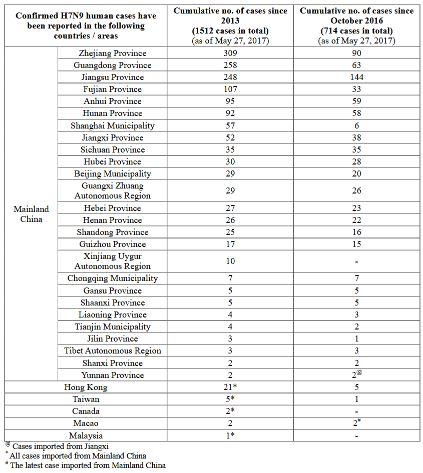
Today, Hong Kong's CHP released the following summary of those cases, which brings the total since October of 2016 to 706 cases on the Mainland, plus 5 from Kong Kong, 2 from Macao, and 1 from Taiwan.
All of this week's cases (n=9) were male, the youngest was 36, and thus far, none were fatal.  Follow the link below for the full 8-page report.

Avian Influenza Report

Avian Influenza Report is a weekly report produced by the Respiratory Disease Office, Centre for Health Protection of the Department of Health. This report highlights global avian influenza activity in humans and birds.


VOLUME 13, NUMBER 21
Reporting period: May 21, 2017 – May 27, 2017 (Week 21)
(Published on May 31, 2017)
         Summary
1. Since the previous issue of Avian Influenza Report (AIR), there were 9 new human cases of avian influenza A(H7N9) reported by the National Health and Family Planning Commission (NHFPC) from Sichuan (3 cases), Beijing (1 case), Hebei (1 case), Jiangsu (1 case), Shandong (1 case), Shanxi (1 case) and Zhejiang (1 case). Since March 2013 (as of May 27, 2017), there were a total of 1512 human cases of avian influenza A(H7N9) reported globally. Since October 2016 (as of May 27, 2017), 706 cases have been recorded in Mainland China.
2. Since the previous issue of AIR, there were no new human cases of avian influenza A(H5N6). Since 2014 (as of May 27, 2017), 16 human cases of avian influenza A(H5N6) were reported globally and all occurred in Mainland China. The latest case was reported on December 1, 2016.
3. Since the previous issue of AIR, there were no new human cases of avian influenza A(H5N1). From 2011 to 2016, 10 to 145 confirmed human cases of avian influenza A(H5N1) were reported to the World Health Organization (WHO) annually (according to onset date). In 2017, there have been so far three cases in Egypt.*

http://www.chp.gov.hk/files/pdf/2017_avian_influenza_report_vol13_wk21.pdf


Shaanxi Province: Yulin City Reports Imported H7N9 Case ex Inner Mongolia


#12,500


As H7N9 reports dry up in China's southern provinces, we continue to see scattered infections from the central and northern regions, with the latest coming today from Yulin City, which was the site of a major poultry die off last week (see Shaanxi Province Reports Large Poultry Die Off - H7N9 Suspected).
What makes this doubly interesting is this case apparently became infected last week while living in Ordos, Inner Mongolia, about 90 miles north of Yulin.
Inner Mongolia only recently reported their first outbreaks in poultry, and has never reported a human H7N9 infection. Ordos (aka Erdos) was not mentioned as a site of poultry infection in that report. 
According to the Yulin Health Departmentreport, the patient traveled to Yulin to seek medical help, and her husband (apparently still at home) was suffering from similar symptoms.

 A h/t to Tetano on FluTrackers, whose posting of a media report sent me in search of the official government statement.

The first case of imported human infection H7N9 cases

Index: 011931 Subject Classification: Municipal News Source: Yulin City, the Ministry of Public Security Bureau Published: 2017-05-31 Views: 1605

       May 31, 2017, the provincial CDC testing review, the city of Chinese medicine hospital admitted to Yang Moumou, was diagnosed with human infection H7N9 cases, for the infection later the city was diagnosed, the first city of imported human infection H7N9 cases.
The patient is in Inner Mongolia Wushenqi Tuke town farmers, female, 67 years old, before the onset of contact with dead birds history, then the patient and her husband have fever, cough and other symptoms, in the local village health room after treatment ineffective , At 9:00 pm on May 29 came to the city of Yuyang District Star Hospital, 22:30 or so suspected H7N9 cases into the city hospital hospital treatment of the southern suburbs.

       May 29, the hospital for patients to collect specimens sent to the city CDC detection, May 30 at noon City CDC reported that the patient's biological specimens H7N9 nucleic acid test results were positive. May 31 morning, the provincial CDC review report, confirmed that the patient H7N9 virus nucleic acid positive.

       Provincial medical treatment expert group has developed a treatment program, the patient actively isolation treatment, close contact with their observation and treatment. At the same time, the Municipal Health Bureau has informed the city of Erdos, Inner Mongolia, the local patients have had close contact with the patient to isolate medical observation.
       At present, the city has started H7N9 epidemic prevention and control contingency plan Ⅲ level response, all levels of government and relevant departments to strengthen joint defense control work, the prevention and control work is in an orderly manner.

       Experts suggest that people infected with H7N9 can prevent and control, the broad masses of people do not panic, do personal protection, to avoid contact with dead birds, try to avoid direct contact with live birds, birds or their feces; influenza epidemic period, less to the poultry market , Such as the emergence of high fever, cough, dyspnea and other symptoms, especially after exposure to birds after the above symptoms, such as the emergence of poultry, poultry eggs, eggs must be cooked cooked after cooking, Should seek medical attention as soon as possible, and take the initiative to inform the history of contact.null


Between this report, and the news that 20,000 birds died late last week at a Yulin poultry farm, local media is waxing hyperbolic overnight about H7N9. 
Up until the past couple of months, H7N9 was pretty much a threat to southern and central provinces of China.  But this spring H7N9 - in addition to adding an HPAI strain - has been moving inexorably north. 

Beijing, which in the first four epidemic waves only saw 9 cases, has added 20 over the past three months.  Shaanxi province, which had never seen a case before this year, now reports 6.

Now it appears we can add Inner Mongolia to the list.


Netherlands Finds 2 Dead Geese With HPAI H5N5


#12,499


Late last October a newly reassorted, and far more virulent (in birds), HPAI H5N8 virus arrived in Europe and over the next several months sparked their largest avian epizootic on record. Aside from its pathogenicity, it also became known for its promiscuity, reassorting on several occasions with local LPAI viruses, and churning out new subtypes.
In mid-December of 2016, we learned of the emergence of a newly reassorted HPAI H5N5 subtype, isolated from a duck collected the previous month in the Netherlands (see OIE Notification), apparently a spin off from the newly arrived H5N8 virus.

Slowly at first, we began to receive other reports (from Italy & Montenegro) of this HPAI H5N5 virus detected in wild birds, but by late January the virus was discovered in a commercial flock for the first time (see HPAI H5N5 Detected In German Poultry Operation).

Germany's Friedrich-Loeffler-Institut (FLI)  described this new virus as:

Since mid-December 2016 a further subtype, H5N5, has been circulating in wild birds, which now has first been introduced into a poultry holding. This virus is is likely to be a reassortant based on the original H5N8. Mixed viruses, so-called reassortants, of avian influenza viruses are generated, if several virus subtypes are present in one infected animal and exchange genetic material during replication. Generation of reassortants must be expected when different high and low pathogenic influenza viruses are circulating in one population.
A relatively minor player compared to H5N8, this newly emerged H5N5 virus was described as `highly aggressive' by Germany authorities, and began turning up in other European countries as well (Slovenia, Greece, Poland, The Czech Republic, Macedonia, etc.).

After a horrendous winter, avian flu reports have declined sharply across western Europe, prompting most countries to sound the `all clear' last in April, once again allowing poultry to leave the barn.
What few reports we've seen over the past 60 days have been almost exclusively H5N8.
But today we see a  break in that pattern, one that reminds us that avian flu viruses - while greatly reduced - continue  to circulate in the environment, with word from the government of the Netherlands that they've discovered two dead geese infected with H5N5 in the city of Utrecht. 

Bird flu in wild geese


In the city of Utrecht has been found in two dead wild geese bird flu of the highly pathogenic H5N5 type. Possibly this flu variant derived from a combination of the Influenza A virus subtype H5N8-type virus (which circulated in recent months in Europe) with another low pathogenic type. The H5N5 variant is recently more often found in wild birds.

The risk of contagion has lately decreased such that by April 19th. Were withdrawn almost all national measures. Although the risk has decreased, the virus is not completely gone. There are therefore still infected wild birds were found. Alertness in poultry remains offered. For example, good hygiene at the company still important.
Although the subtype has been identified, it isn't clear whether this is the same HPAI H5N5 that was previously reported, or perhaps a new reassortant. Hopefully over the summer we'll get additional information about the genetic evolution these H5N5 viruses.
This discovery does suggest that the H5N5 virus hasn't simply died out, and that it is still be circulating in wild birds (along with H5N8 and other AI subtypes), possibly even among wild birds in their summer roosting grounds in Russia and the Arctic.
After its big debut in 2014-2015, HPAI H5 was unexpectedly a no-show during the winter of 2015-16 in Europe and the United States, and while it invaded Europe this past winter, once again it did not appear in North America.
So trying to guess exactly what it will do next fall, and where, is probably a fool's errand.
But the general trend with HPAI H5 viruses (including H5N8, H5N6, H5N5, and H5N1) since late 2013 has been one of rapid geographic expansion, and increased virulence in birds.  Add in the wild card of a new HPAI H7N9 virus in China, and we should probably enjoy whatever lull in bird flu activity that this summer brings.

And hopefully use that time wisely, to improve farm biosecurity, and to bolster our public health agencies and organizations to deal with whatever comes down the pike.

Tuesday, May 30, 2017

Hong Kong: A ConFLUence Of Events


Credit HK CHP


#12,498


As we've been discussing the past couple of weeks, Hong Kong is in the midst of an unusual early summer flu epidemic (see Hong Kong's Flu Surge Continues, Taiwan Reporting Increased Activity). 
 
While Hong Kong often sees a second yearly flu season, it usually arrives in late July or August, not in early May. 

As of last Friday's Flu Express report, Hong Kong has reported 42 severe influenza cases, and 25 deaths since May 5th.  Over the weekend, Hong Kong authorities have reported a couple of new institutional outbreaks, along with two more severe pediatric cases.
Cluster of Influenza A cases at Siu Lam Hospital
CHP investigates case of severe paediatric influenza A infection
CHP investigates influenza-like illness outbreak at primary school in Wan Chai
CHP investigates case of severe paediatric influenza A infection

Complicating matters, all this week Hong Kong is celebrating Duanwu - or the Dragon Boat Festival - which will see large crowds of revelers gathered in close quarters to partake in parades, eating, drinking traditional Realgar wine, and watching the Dragon Boat races.

A pretty good venue to spread influenza. 

A point which is made in the following news article. 

The flu epidemic is late in the afternoon

2017-05-30 16:39 United Daily News reporter Huang Anqi / real-time report

In previous years, the flu to the end of May, one after another from the epidemic period, this year, the epidemic did not stop too late. According to the statistics of the Department of Health, the Dragon Boat Festival will be associated with more than the first two months of the outbreak, and the epidemic is more than the first two months, To remind people to have flu-like symptoms by physician assessment can use antiviral drugs, reduce the risk of concurrent and infection.
        (Continue . . . )

 
And as Hong Kong's Secretary of Food & Health Dr. Ko Wing-man reminds us, the effects of last year's flu shots are likely waning, and since the new flu shot hasn't arrived yet, the number of cases may well continue to rise.

Raise vigilance against summer flu

May 30, 2017

The Secretary for Food and Health, Mr Kwok Wing-wen, said that influenza cases have continued to rise and that the peak of influenza in summer has already begun. Members of the public should be vigilant and keep personal and public health at all times.

Speaking to the media today, Mr Kwong said that the influenza cases had risen and the number of serious cases had increased. The authorities would closely monitor high-risk groups, especially children, the elderly and chronic diseases.

He pointed out that the end of last year vaccination of winter influenza vaccine, may gradually fail, and this summer's influenza vaccination program has not yet started, during which the public should pay attention to personal and public health, to prevent infection.
 
How much of an impact this Dragon Boat Festival will have on this outbreak remains to be seen, but it would seem that the ingredients are there to make for a very interesting summer flu season.

And as an international city, what happens in Hong Kong isn't guaranteed to stay in Hong Kong.

Rosselkhoznador: HPAI H5 Confirmed In Nizhny Novgorod Oblast


#12,497


While HPAI bird flu reports continue to dwindle in Asia (particularly South Korea and Vietnam), and across all of Europe, the same can hardly be said for western Russia, where today the 11th administrative district this month - Nizhny Novgorod Oblast - has reported outbreaks of HPAI H5.
All of this activity comes amid a growing bird flu contaminated food scandal (see Rosselkhoznador Investigation Into HPAI Contaminated Meat Distribution & Sale), and growing concerns that H7N9 and/or H5N6 could be poised to enter the country from the south, where they circulate widely in China.
Possibly contributing to this May surge is the fact that temperatures in west central Russia have been running 10 to 15 degrees below normal over the past month (see Accuweather Link).  Highs have routinely been in the 50s, and lows in the 30s, despite the approach of summer.

Two (translated) reports from the Nizhny Novgorod Oblast's Federal Service for Veterinary and Phytosanitary Surveillance (Rosselkhoznador). 

About Avian Influenza registration on the territory of the Nizhny Novgorod Region

Office of Rosselkhoznadzor for the Nizhny Novgorod region and the Republic of Mary El announces bird flu registration on the territory of the Nizhny Novgorod region.

As a result of laboratory tests conducted FGBU "ARRIAH" May 27, 2017 in the pathological material taken from dead birds contained in private farms in s.Pikshen Bolsheboldinsky District Nizhny Novgorod Region, highlighted the genome of influenza A virus subtype avian H5.

Currently in disadvantaged locations State Veterinary Service of the region, under the supervision of the Office of Rosselkhoznadzor for the Nizhny Novgorod region and the Republic of Mari El, spends flu outbreak eradication activities of birds and to prevent the further spread of infection.

On the establishment of quarantine for avian influenza in Bolsheboldinsky District Nizhny Novgorod Region

The decision to impose restrictive measures in order to eliminate epizootic flu outbreak Bird was adopted by the Commission on the organization of the protection of the Nizhny Novgorod region of the animal infectious diseases introduction of foreign states and border areas, in the next meeting which was attended by employees of the department of veterinary supervision of the Office of Rosselkhoznadzor for the Nizhny Novgorod region and the Republic of Mari El.

The reason for the Commission's work were the positive results of the laboratory studies conducted GBU BUT "Regional Veterinary Laboratory" patmateriala obtained from dead poultry and tests confirmed FGBU "Federal Center for Animal Health" (FGBU "ARRIAH").

During the committee agreed to continue approved by the Decree of the Governor of the Nizhny Novgorod region on 29.5.2017 number 45 Action Plan for the Elimination of the avian influenza outbreak in the village Pikshen Bolsheboldinskogo municipal district of Nizhny Novgorod region, according to which the border epizootic outbreak identified within the personal subsidiary farms in the village Pikshen Bolsheboldinskogo municipal district of Nizhny Novgorod region, whose territory declared disadvantaged paragraph borders threatened zones are set in the pre- ah Permeevskogo administrative boundaries of the village council, village council Pikshenskogo, Bolsheboldinskogo village council Bolsheboldinskogo municipal district of the Nizhny Novgorod region. surveillance zone boundary established within the administrative boundaries Bolsheboldinskogo municipal district of the Nizhny Novgorod region.

Quarantine is set to May 29, 2017 until further notice.

On the quarantine period in the territory of a troubled item prohibited paddock or other use of the birds outside the epizootic outbreak, visiting other homes, where there is poultry export of live poultry and derived from it the product, removal (removal) of inventory, equipment, manure, trade bird. The endangered area is prohibited export of poultry for slaughter to slaughterhouses located outside the threatened area, removal of all types of animals susceptible to avian influenza, and received from their products.

bird flu fact is the first case registered in the territory of the Nizhny Novgorod region.

The good news is that all of the Russian reports which have identified the HPAI H5 this spring have come back as H5N8 - a virus subtype which has never been found to infect humans. 
The big concern is that during its travels in Russia, Mongolia and China last summer, HPAI H5N8 picked up a number of changes (via reassortment with other viruses) that made it far more pathogenic in birds (see EID Journal: Reassorted HPAI H5N8 Clade 2.3.4.4. - Germany 2016).

The more H5N8 spreads this summer, the more opportunities it could have to evolve further. So even though Russia's HPAI H5 outbreaks may seem small, scattered, and of little import today, they may well be setting the table for what gets served up to Europe next fall.

Monday, May 29, 2017

Saudi MOH Announces 1 Primary MERS Case In Madina

http://www.moh.gov.sa/en/CCC/PressReleases/Pages/Statistics-2017-05-29-001.aspx


#12,496


The holy month of Ramadan began on Friday, May 26th, a time when tens of thousands of religious pilgrims will descend upon Saudi Arabia's Holiest cities (mostly Mecca and Madina) to perform Umrah.

Today we learn of a primary MERS case in the city of Madina, involving a 60 year old Saudi male, with no listed risk exposure.

http://www.moh.gov.sa/en/CCC/PressReleases/Pages/Statistics-2017-05-29-001.aspx

Each year since MERS emerged we've seen concerns over the international spread of MERS by religious pilgrims returning from the Hajj or from performing Umrah during Ramadan, but so far, neither has sparked an outbreak.

Nevertheless, public health officials around the world will be alert for any signs of infection among returning travelers.

USGS: Preparing The Nation For Severe Space Weather

http://www.swpc.noaa.gov/


#12,495


Although there were few visible effects beyond some spectacular aurora sightings as far south as Arizona, Colorado, and Tennessee - over the weekend the earth took a a glancing blow from a small CME (Coronal Mass Ejection) from the sun.

The resultant G3 geomagnetic storm (see chart above) sparked the auroras, and likely caused some minor electrical and communications disruptions, particularly in the higher latitudes. NOAA describes the effects of a G3 storm as:
G 3     Strong
Power systems: Voltage corrections may be required, false alarms triggered on some protection devices.
Spacecraft operations: Surface charging may occur on satellite components, drag may increase on low-Earth-orbit satellites, and corrections may be needed for orientation problems.

Other systems: Intermittent satellite navigation and low-frequency radio navigation problems may occur, HF radio may be intermittent, and aurora has been seen as low as Illinois and Oregon (typically 50° geomagnetic lat.).

Nothing terrible, but a reminder that far more severe space weather (G4=Severe, G5=Extreme) is not only possible, it is virtually guaranteed.  We know that, because it has happened before. A few of many examples include:
  • In 2012 the earth narrowly missed being hit by a massive solar storm, one that - had it been earth-directed - could have caused extensive damage to our electrical grid and electronic infrastructure (see NASA: The Solar Super Storm Of 2012). 
  • In 1989  an earth-directed storm caused a major power outage in Quebec, and in 2003, power stations in Europe were affected by another solar event (see NASA's The Day the Sun Brought Darkness)
  • A large Solar storm hit in May of 1967, knocking out radar and high frequency radio communications, and briefly had the U.S. military on alert thinking the USSR was jamming the airwaves (see How a 1967 Solar Storm Nearly Led to Nuclear War)
  • And the Granddaddy of them all, the 1859 Carrington Event,  which sparked electrical fires in telegraph offices, sparked auroras as far south as Cuba, and if repeated today would cause massive failures of the grid. 
 These disruptions are caused by sunspots, solar flares, and CMEs.
Solar flares are rated as either C Class (minor), M Class (Moderate), or X Class (extreme), and while the electromagnetic radiation they release can reach earth in only about 8 minutes time, their effects are mostly limited to disrupting communications and potentially damaging satellites.
A CME (Coronal Mass Ejection) is the ejection of a massive amount of plasma (electrons and protons & small quantities of helium, oxygen, and iron) from the the sun that may last for hours. Some of this plasma falls back into the sun, but trillions of tons can escape and if aimed in their direction, impact surrounding planets.

While they pose little direct physical danger to us on the earth’s surface (we are protected by the earths magnetic field and atmosphere), a large CME can wreak havoc with electronics, power generation, and radio communications
As we become more dependent upon sensitive electronic equipment (think power grid, internet, communications, etc.) these storms increasingly threaten both our economy and our society.
In 2013 Lloyds issued a risk assessment for the insurance industry called Solar storm Risk to the north American electric grid which calls another `Carrington’ class event inevitable, and the effects likely catastrophic, but the timing was unknowable.  Some of my other blogs on this threat include: 
The UK’s Space Weather Preparedness Strategy
Solar Storms, CMEs & FEMA
NASA Braces For Solar Disruptions
In 2015, in USGS: Preparing The Nation For Severe Space Weather, we saw the OSTP (Office of Science & Technology Policy) warn of the risks of severe space weather. They released enhanced preparedness plans to deal with a direct hit by a major CME, which was published in a White House blog called Enhancing National Preparedness to Space-Weather Events. 
Last October, in Executive Order: Coordinating Efforts to Prepare the Nation for Space Weather Events, we saw the White House's response to this threatdirecting the government to prepare for severe space weather.
The stakes are very high, as a direct hit by a G5 storm could take out large portions of the electrical grid for days, weeks, or even months.  In January of this year, the AGU's journal Space Weather published a study that attempted to quantify the costs of such an event.
Quantifying the daily economic impact of extreme space weather due to failure in electricity transmission infrastructure
Edward J. Oughton1,*, Andrew Skelton1, Richard B. Horne2, Alan W. P. Thomson3 and Charles T. Gaunt4
Version of Record online: 17 JAN 2017

The accompanying press release from the American Geophysical Union summarizes:
Extreme space weather-induced electricity blackouts could cost U.S. more than $40 billion daily

New study finds more than half the loss occurs outside the blackout zone

18 January 2017
Joint Release

WASHINGTON, DC — The daily U.S. economic cost from solar storm-induced electricity blackouts could be in the tens of billions of dollars, with more than half the loss from indirect costs outside the blackout zone, according to a new study.


Previous studies have focused on direct economic costs within the blackout zone, failing to take into account indirect domestic and international supply chain loss from extreme space weather.

“On average the direct economic cost incurred from disruption to electricity represents only 49 percent of the total potential macroeconomic cost,” says the paper published in Space Weather, a journal of the American Geophysical Union. The paper was co-authored by researchers from the Cambridge Centre for Risk Studies at University of Cambridge Judge Business School; British Antarctic Survey; British Geological Survey and University of Cape Town.

Under the study’s most extreme blackout scenario, affecting 66 percent of the U.S. population, the daily domestic economic loss could total $41.5 billion plus an additional $7 billion loss through the international supply chain.


(Continue . . . )

All of which leads up to a recent report by the USGS on the the potential impacts of a CME, and how they, and the nation, are preparing for it.  I've only included some excerpts, follow the link to read it in its entirety.

Preparing the Nation for Intense Space Weather
Such events can be hazardous to the economy and national security
Release Date: May 1, 2017

While major geomagnetic storms are rare, with only a few recorded per century, there is significant potential for large-scale impacts when they do occur. Extreme space weather can be viewed as hazards for the economy and national security.


(SNIP)

When a large sunspot emerges, the likelihood of an abrupt emission of radiation and an intense solar wind becomes greater. When these winds reach the Earth, electrically charged particles enter the Earth’s magnetosphere, ionosphere, and interior, inducing a geomagnetic storm. The storm can interfere with utilities, infrastructure, and technologies essential to modern society, disrupting daily life, the economy, and national security.
Informing Utility Companies

The USGS monitors the Earth’s magnetic field at 14 ground-based observatories positioned across the United States and its territories. Scientists continuously monitor the geomagnetic field throughout the Nation and its territories, providing information on magnetic storm intensity. Some USGS observatories have operated continuously for over 100 years.

“USGS observatories help support infrastructure critical to keeping the electric grid running smoothly in crises,” Olson said.

Utility companies use recently published geoelectric hazard maps to assess the vulnerability of power-grid systems and mitigate the adverse effects of intense magnetic storms, which, Olson says, “have had a history of shutting down the electric grid.”

NERC recently released two reliability standards for utility companies: One requires North American utility companies to develop operating procedures for weathering potentially serious geomagnetic storms, and the other requires utilities to carefully assess their systems to ensure they are prepared for a magnetic storm.

“These standards are supported by historical, global data and real-time information from the USGS on forthcoming hazards so that electric utilities can be as prepared as possible,” Olson said.
         (Continue . . . )


While efforts are being made to harden the grid and our electronics infrastructure against severe space weather, for now at least, they remain extremely vulnerable.  
As a general rule I promote `all threats preparedness' - rather than planning for a specific event - but prolonged power outages are so often a big part of a wide range of disasters that being ready for one makes sense. 
While few of us can prepare for a months-long power outage - that envisions an absolute worst case scenario - which isn't the only (or even most likely) outcome.  As an added bonus, preparing for severe space weather will also help prepare us in the event of an EMP attack - or a cyber attack - on our electrical grid.

A more reasonable goal for most families would be the ability to deal with 10 days to two weeks without power.  A not-unheard of amount of time to restore power after a hurricane, blizzard, or earthquake.
So . . . if a disaster struck your region today, and the power went out, stores closed their doors, and water stopped flowing from your kitchen tap for the next 7 to 14 days  . . .  do you have: 
  • A battery operated NWS Emergency Radio to find out what was going on, and to get vital instructions from emergency officials?
  • A decent first-aid kit, so that you can treat injuries?
  • Enough non-perishable food and water on hand to feed and hydrate your family (including pets) for the duration?
  • A way to provide light (and in cold climates, heat) for your family without electricity?   And a way to cook?  And to do this safely?
  • A small supply of cash to use in case credit/debit machines are not working?
  • An emergency plan, including meeting places, emergency out-of-state contact numbers, a disaster buddy,  and in case you must evacuate, a bug-out bag?
  • Spare supply of essential prescription medicines that you or your family may need? 
If your answer is `no’, you have some work to do.  A good place to get started is by visiting Ready.gov.

Sunday, May 28, 2017

Shaanxi Province Reports Large Poultry Die Off - H7N9 Suspected


#12,494


Up until January of this year, and for the first four years of its existence, H7N9 has been exclusively a low pathogenic virus (in birds).  Unlike its HPAI H5 cousins, which are known to cause high mortality in poultry and some types of wild birds, LPAI H7N9 had produced few if any symptoms in poultry.
It was, however, extremely pathogenic in humans, and its ability to spread silently in poultry and other birds made it very difficult to track, with our first clue of an outbreak often coming only after humans in contact with birds fell ill. 
H5 and H7 LPAI viruses have the ability to mutate into HPAI viruses, and that is precisely what happened in January of this year in southern Guangdong Province, where at least three human infections, and several poultry outbreaks were caused by a newly emerged HPAI version of H7N9.

The big questions at the time were:
  • Just how `biologically fit' was this new HPAI variant?   
  • Would this virus spread via migratory birds beyond Guangdong Province?
  • How does it compare in human infectivity with the LPAI version?
Although there is still much we don't know about HPAI H7N9, slowly the answers to these questions have been emerging.  I say `slowly' because we don't know what we don't know.

After China announced two human infections with HPAI H7N9, and Taiwan announced one (imported) case, last January - we've heard of no additional human HPAI infections.
Either there haven't been any, or China simply isn't differentiating between LPAI and HPAI human infections in their reporting.
We have, however, continued to see reports of heavy poultry losses due to H7N9 - first in neighboring Hunan Province, then further north in April and May -  a pretty good sign that the HPAI version is spreading.
Some of these outbreaks have been confirmed as HPAI H7N9, while we await official word on others (see CHINA: HPAI H7N9 Expands Its Range).
As far as the biological `fitness' of the virus, three weeks ago in Eurosurveillance: Biological Characterisation Of (HPAI) A(H7N9) Viruses In Humans, we learned that  HPAI H7N9 virus retains the ability to infect both birds and humans, and in fact, appears to be potentially slightly more infectious in both than the LPAI version. The authors write:

Our data show that the HPAI H7N9 viruses retained dual receptor binding properties, with slightly increased binding preference for both receptors compared with LPAI H7N9 (AnH1) viruses. . . . .  The persisting preference for both avian- and human-type receptors of HPAI H7N9 viruses may result in their circulation in poultry and possible transmission among humans.

They also found that his HPAI H7N9 virus can quickly mutate into an antiviral resistant virus early during treatment.  This HPAI virus is also antigenically different from the older LPAI H7N9 virus, and so existing vaccines are unlikely to be effective.
On paper, at least, HPAI H7N9 looks very fit. 
It is not alone, of course.  It circulates concurrently across China with two distinct LPAI H7N9 lineages (Pearl River Delta and Yangtze River Delta), encompassing dozens of genotypes and variants, all of which are looking for an evolutionary advantage.  

And new genotypes and variants are formed practically on a daily bases.  Some will be evolutionary failures, while others may prove competitive enough to thrive. The point being, the H7N9 threat is constantly evolving. 

All of which brings us to one of many reports in the Chinese media this weekend of a very large and sudden die off in poultry in northern Shaanxi Province. Reportedly 22,000 birds died over a matter of a few days, and while test results are pending, H7N9 is suspected.

This (translated) report from Hong Kong's Oriental Daily

Shaanxi farm suspected H7 bird flu burst

WASHINGTON roundup both sides re-transmission of bird flu, Yuyang District, Yulin City, Shaanxi has a chicken farm suspected outbreak of H7 avian influenza, caused by a large number of chickens died.
Network file transfer Yulin City Animal Husbandry and Veterinary Bureau issued, referring to the local chicken farm located in the Green Cheung ecological cattle home town of the beam, since there are chickens on Sunday onset; as of last Thursday, a total of forty-five thousand chicken farm , there are more than twenty-two thousand chickens died; another report showed that chickens suspected of being infected H7 virus, authorities have sent samples of animal disease prevention and control center of the provincial tests and is awaiting test results.

Assuming this report - and last week's report from Tianjing - are confirmed as HPAI H7N9 (other HPAI viruses, including H5N6  and H5N8 are also possible), we'll have additional evidence that this HPAI virus is moving steadily north - likely carried by migratory birds.
Already, parts of Eastern Russia are on alert for the possible arrival this summer of H7N9 from China (see here), and other countries, from Vietnam to the south to Mongolia to the north are on watch as well.
While the good news remains that H7N9 (LPAI or HPAI) has yet to achieve the ability to spread easily from human-to-human, the virus continues to evolve, leaving many of the world's best bird flu experts seriously concerned (see NPR: A Pessimistic Guan Yi On H7N9's Evolution).

Saturday, May 27, 2017

CID Journal: Flu Vaccine Reduces Severe Outcomes in Hospitalized Patients


#12,493


Although far from perfect, most years the seasonal flu vaccine provides a moderate level of protection against currently circulating influenza viruses. Much depends, however, on how close of a match the vaccine is to those viruses, and on the individual immune response of the recipient. 
Flu vaccines have provided reasonably good protection against H1N1 and Influenza B viruses in recent years  - often reaching  VE (Vaccine Effectiveness) Ratings 50%-60%.
The H3N2 vaccine component over the past few years has been problematic (see Eurosurveillance: Interim Estimates Of Flu Vaccine Effectiveness Against A(H3N2) - Canada, January 2017 and Branswell: H3N2 Remains the `Weak Link’ In The Flu Vaccine),  often providing only half that level of protection.

Although the elderly (> 65) are considered to be at greatest risk from influenza infection, they - by virtue of having a less robust immune system and more comorbidities - are also the group most apt to see reduced protection from the seasonal flu vaccine (see PLoS One: Limited Effectiveness Of Flu Vaccines In The Elderly & Flu Shots And The Elderly).
Which is not to say they don't derive benefits, just not as much as we'd like, considering their overall risks from influenza infection.

In 2011,  NFID - the National Foundation for Infectious Diseases - convened a group of experts to address the issues of influenza and the elderly. From that panel a 5-page brief  emerged, called: Understanding the Challenges and Opportunities in Protecting Older Adults from Influenza.


This report pointed out that although the elderly generally see less protection from the flu vaccine, older individuals may still mount a robust immune response. In populations 65 and older, the brief points out that:
  • Hospitalization rates for influenza and pneumonia are lower in community-dwelling adults who received the seasonal influenza vaccine.
  • Immunization is associated with reduced hospitalization of older patients for cardiac, respiratory, and cerebrovascular diseases.
While the goal of vaccinating the younger population is to prevent infection, the authors point out that:
  • . . . the goal in older adults is to prevent severe illness, including exacerbation of underlying conditions, hospitalization, and mortality. 
Since then, we've seen a good deal of research suggesting that even a little protection can mean a lot, particularly for those with elevated risk factors, like the elderly. In 2014, a study from the CDC: Flu Shots Reduce Hospitalizations In The Elderly, appeared to support those goals.


This past week, a new study in the journal Clinical Infectious Diseases suggests that even among those hospitalized with influenza, having been vaccinated is associated with less severe illness, lower mortality, and shorter hospitalization stays.

Influenza vaccination modifies disease severity among community-dwelling adults hospitalized with influenza
Carmen Sofia Arriola, DVM, PhD, Shikha Garg, MD , Evan J Anderson, MD , Patricia A Ryan, MS , Andrea George, MPH , Shelley M Zansky, PhD , Nancy Bennett, MD, MS , Arthur Reingold, MD , Marisa Bargsten, MPH , Lisa Miller, MD, MSPH

Clin Infect Dis cix468.
DOI: https://doi.org/10.1093/cid/cix468
Published: 19 May 2017


Abstract
Background:

We investigated the effect of influenza vaccination on disease severity in adults hospitalized with laboratory-confirmed influenza during 2013−14, a season in which vaccine viruses were antigenically similar to those circulating.
Methods:

We analyzed data from the 2013−14 influenza season, and used propensity score matching to account for the probability of vaccination within age strata (18−49, 50−64 and ≥65 years). Death, intensive care unit (ICU) admission, and hospital and ICU lengths of stay (LOS) were outcome measures for severity. Multivariable logistic regression and competing risk models were used to compare disease severity between vaccinated and unvaccinated patients, adjusting for timing of antiviral treatment and time from illness onset to hospitalization.
Results:

Influenza vaccination was associated with a reduction in the odds of in-hospital death among patients aged 18−49 years (adjusted odds ratios [aOR] =0.21; 95% confidence interval [CI], 0.05 to 0.97), 50–64 years (aOR=0.48; 95% CI, 0.24 to 0.97), and ≥65 years (aOR=0.39; 95% CI, 0.17 to 0.66). Vaccination also reduced ICU admission among patients aged 18−49 years (aOR=0.63; 95% CI, 0.42 to 0.93) and ≥65 years (aOR=0.63; 95% CI, 0.48 to 0.81), and shortened ICU LOS among those 50−64 years (adjusted relative hazards [aRH]=1.36; 95% CI, 1.06 to 1.74) and ≥65 years (aRH=1.34; 95% CI, 1.06 to 1.73), and hospital LOS among 50−64 years (aRH=1.13; 95% CI, 1.02 to 1.26) and ≥65 years (aRH=1.24; 95% CI, 1.13 to 1.37).
Conclusions:

Influenza vaccination during 2013−14 influenza season attenuated adverse outcome among adults that were hospitalized with laboratory-confirmed influenza.
  The CDC published a summary of these results yesterday:

 New CDC Study Shows Flu Vaccine Reduces Severe Outcomes in Hospitalized Patients

 May 25, 2017 – A new study in the journal Clinical Infectious Diseases (CID) showed that flu vaccination reduced deaths, intensive care unit (ICU) admissions, ICU length of stay, and overall duration of hospitalization among hospitalized flu patients. This study is an important first step in better understanding whether flu vaccines can reduce severe flu outcomes even if they fail to protect against infection.

The study looked at hospitalized flu patients during 2013-2014 and compared patients who had been vaccinated to those who had not. The observed benefits were greatest among people 65 years of age and older, which is notable because people in this age group are at increased risk of serious flu complications and have the highest hospitalization rate among all age groups.

The study found that vaccinated adults were 52-79% less likely to die than unvaccinated flu-hospitalized patients. In other words, an unvaccinated hospitalized flu patient was 2 to 5 times more likely to die than someone who had been vaccinated.
(Continue . . . )

While influenza is hardly a trivial illness, for those of us over a certain (ahem) age, influenza increasingly becomes a threat to life. Just 10 days ago, in Int. Med. J.: Triggering Of Acute M.I. By Respiratory Infection, we saw additional evidence that a variety of respiratory infections - including influenza - can trigger heart attacks in the elderly.

While it doesn't protect against all respiratory infections - two years ago, in UNSW: Flu Vaccine Provides Significant Protection Against Heart Attacks, we saw a study that found that if you are over 50 - getting the flu vaccine can cut your risk of a heart attack by up to 45%
Which is one of the big reasons why I elect to get the vaccine every year (see  #NatlPrep: Giving Preparedness A Shot In The Arm).

While no drug or vaccine can claim to be 100% safe or benign, flu vaccines are among the safest drugs available - and given the mounting evidence influenza's toll - the rewards for me far exceed the risks.

Hopefully - after considering the pros and cons - they will for you, too.

A Reminder About Naegleria Season

http://www.cdc.gov/parasites/naegleria/pdf/naegleria-state-map-2015.pdf


#12,492


The Memorial Day Weekend traditionally signals the start of the long awaited summer swimming season - but with that comes risks - including the dangers of rip currents (see How Not To Be Swept Away This Summer), potentially serious salt water skin infections (see Vulnerable To Vibrio), and an extraordinarily rare, but often fatal, brain infection from an amoebic parasite called Naegleria fowleri
Dubbed the `brain eating amoeba' by the press - this infection is called PAM (Primary amebic meningoencephalitis) - and occurs when the amoeba enters the brain through the nasal passages, usually due to the forceful aspiration of contaminated water into the nose.  
Until a few years ago, nearly all of the Naegleria infections reported in the United States were linked to swimming in warm, stagnant freshwater ponds and lakes (see Naegleria: Rare, 99% Fatal & Preventable), making this pretty much a summer time threat.

In 2011, however,  we saw two cases reported in Neti pot users from Louisiana, prompting the Louisiana Health Department to recommend that people `use distilled, sterile or previously boiled water to make up the irrigation solution’ (see Neti Pots & Naegleria Fowleri).

While extraordinarily rare in the United States, every year Pakistan reports a dozen or more infections from this `killer amoeba’, as chlorination of their water supplies is often inadequate, and for many, nasal ablutions are part of their daily ritual. 


Last year we looked at an MMWR: Epidemiological Investigation Into A Case Of Primary Amebic Meningoencephalitis  in California which suggested a poorly chlorinated spring-fed swimming pool was the likely source of infection and death of a 21 year old woman.  
This was also an unusual finding, and furthers the recent pattern of seeing PAM cases arise from atypical settings (Northern states, via neti pots and municipal water supplies, etc.) in the United States.
Up until a recently, infection with Naegleria fowleri was universally fatal, but in 2013 an investigational drug called miltefosine was used successfully for the first time to treat the infection.  Early diagnosis, and administration of this drug, are crucial however.

Even with this new drug, prevention is the key to saving lives, and leading the charge in educating the public is http://amoeba-season.com/, a USF Philip T. Gompf Memorial Fund project, which was set up by a pair of Florida doctors who tragically lost their 10 year-old son to this parasite in 2009.  

As a thermophilic (heat-loving), free-living amoeba, it is hardly surprising to see that Florida and Texas lead the nation in cases over the past three decades, although infections have occurred as far north as Minnesota. 

Credit Florida DOH
 
The State of Florida's Primary Amebic Meningoencephalitis (PAM) website recommends:
The only known way to prevent Naegleria fowleri infections is to refrain from water-related activities. However, some common-sense measures that might reduce risk by limiting the chance of contaminated water going up the nose include:
  • Avoiding water-related activities in bodies of warm freshwater, hot springs, and thermally-polluted water such as water around power plants.
  • Avoiding water-related activities in warm freshwater during periods of high water temperature and low water levels.
  • Holding the nose shut or using nose clips when taking part in water-related activities in bodies of warm freshwater such as lakes, rivers, or hot springs. 
  • Avoiding digging or stirring up sediment while taking part in water-related activities in shallow, warm freshwater areas. 
Recreational water users should assume that there is always a low-level of risk associated with entering all warm fresh water in southern tier states. Because the location and number of ameba in the water can vary a lot over time, posting signs is unlikely to be an effective way to prevent infections. In addition, posting signs on only some fresh water bodies might create a misconception that bodies of water that are not posted are Naegleria-free.
Information about the risks associated with Naegleria fowleri infection should be included in public health messages discussing general issues of recreational water safety and risk.
When preparing solutions of tap water for sinus irrigation, the user should use tap water previously boiled for 1 minute (at elevations above 6,500 feet, boil for 3 minutes) and left to cool, use water filtered with an absolute filter pore size of 1 micron or smaller, or use clearly marked distilled or sterile water in the irrigation device. Rinse the irrigation device after each use with water that has been previously boiled, filtered, distilled, or sterilized and leave the device open to air dry completely.
For some of my earlier blogs on Naegleria you may wish to revisit:

A Reminder About Naegleria
Reminder: COCA Call Today On Naegleria Fowleri & Cryptosporidium
MMWR: CDC Imports Investigational Drug For Amoebic Infections

Friday, May 26, 2017

Rosselkhoznadzor: Avian Flu Outbreaks In Udmurt Republic - Russia

Udmurt Republic - Credit Wikipedia


#12,491


For the past month we've been following two different, but connected, HPAI H5N8 bird flu stories out of Russia.  

While HPAI H5N8 is considered to present a very low human health risk, there are concerns that bird flu contaminated products might help spread the virus to poultry in currently unaffected regions.
A week ago, we learned about the detection of infected poultry products in the Kirov Region and the Udmurt Republic.
While it may or may not be related to the spread of contaminated food products, today the Udmurt Republic is reporting outbreaks of avian flu on two private farms in Malopurginskiy area.

Bird flu has reached the Udmurt Republic

May 25, 2017 in Malopurginskiy area of ​​the Udmurt Republic in two private farms registered avian influenza type A. In the study in the Udmurt veterinary diagnostic center in Izhevsk pathological material from dead birds isolated the genetic material of the virus of influenza A. To confirm the diagnosis and typing of the 05/25/2017 virus material sent to the State Organization "ARRIAH" in Vladimir. 

State Veterinary Service of the Republic of Udmurtia measures are taken in accordance with the Order of the Ministry of Agriculture of 27.03.2006 number 90 "On approval of rules for combating avian influenza." 

We kindly ask the population to adhere to the following rules:
- Avoid contact of poultry with wild and synanthropic birds: to provide watering of birds, preventing them to open bodies of water; provide under confinement birds build fences mesh with awnings; prohibited catch wild waterfowl for the content of individual farms; not to carry out evisceration of game hunting in the territory of households and not to feed the waste pet; isolated storage to provide feed indoors; organize isolated storage equipment for care of poultry, keep it clean; produce timely cleaning yards and paddocks of debris and bird waste products; to carry out feeding birds in the area.
- Ensure the separation of the different species of birds.
- Acquire the young birds and hatching eggs from safe sources, refraining from buying live birds at markets and trade in unauthorized places.
- Do not allow unauthorized persons to domestic poultry.
- Avoid eating and feeding of animals in suspect poultry disease.
- Use feathers in life after the heat treatment (scalding).
- Daily inspect all the birds in the yard.
- Prepare stock disinfectants (chloramine, bleach) and to disinfect poultry houses and equipment after their complete purification.
- Provide disinfection manure and litter by incineration or biothermal method.
- Observe good personal hygiene: care for the bird to carry out in special clothing, wash hands with soap and water after leaving, evisceration with gloves, etc.
- At the first signs of the disease and the anomalous behavior of the birds, and in case of sudden mass death should immediately contact the local veterinary service to identify the causes of the disease and to prevent epizootic.
Remember that mortality in poultry bird flu can reach 100%.

While avian flu reports continue to dwindle in Western Europe, we've now seen reports of HPAI H5 outbreaks in poultry from at least 10 regions of Russia over the past 30 days.
If that weren't concerning enough, Russia is also watching the northward drift of H7N9 in China - recently reported in poultry in Inner Mongolia - as a threat to their southern border (see China MOA: Suspected HPAI H7N9 Outbreak In Tianjin).
And it isn't lost on the rest of the world - but particularly in Europe - that the changes to the H5N8 virus that made it more virulent in birds this past winter, appear to have occurred over last summer in migratory birds in Russia,China, and Mongolia (see EID Journal: Reassorted HPAI H5N8 Clade 2.3.4.4. - Germany 2016).

All of which means that increased bird flu activity across these same regions again this summer is far from a welcome sign.

Hong Kong's Flu Surge Continues, Taiwan Reporting Increased Activity


#12,490


Often Hong Kong experiences a second flu season each year - but that usually occurs in late summer - not hot on the heels of the last flu season, which appeared to be over in mid April.
But on May 4th, barely three weeks after declaring the winter epidemic ended,  Hong Kong's CHP Reported A Late Season Flu Surge, and reinstated their enhanced surveillance for severe seasonal influenza.
Since then we've watched the number of severe flu cases, and deaths, continue to rise (see here and here), due to a mixture of H3N2, H1N1, and influenza B viruses. While they are undoubtedly looking closely at their genetics, we've not seen anything yet to suggest there is anything unusual about these viruses.
The latest Flu Express report from Hong Kong's CHP indicates the number of flu cases continues to increase, and now Taiwan's CDC reports they are seeing a surge in influenza activity as well.
First stop, Hong Kong. Then we'll look in on Taiwan.
FLU EXPRESS 

VOLUME 14, NUMBER 20 (PUBLISHED ON May 25, 2017)

Flu Express is a weekly report produced by the Respiratory Disease Office of the Centre for Health Protection. It monitors and summarizes the latest local and global influenza activities.
Local Situation of Influenza Activity (as of May 24, 2017)

Reporting period: May 14 – 20, 2017 (Week 20)

  • The latest surveillance data showed that the local influenza activity continued to increase.
  • The Centre for Health Protection (CHP) has collaborated with the Hospital Authority (HA) and private hospitals to reactivate the enhanced surveillance for severe seasonal influenza cases (i.e. influenza-associated admissions to intensive care unit or deaths) among patients aged 18 or above since May 5, 2017. As of May 24, 39 severe cases (including 24 deaths) were recorded. Separately, three cases of severe paediatric influenza-associated complication/death (including one death) (aged below 18 years) were recorded in the same period.
(SNIP)

Surveillance of severe influenza cases
 
(Note: The data reported are provisional figures and subject to further revision)
Since the activation of the enhanced surveillance for severe influenza infection on May 5, 2017, a total of 42 severe cases (including 25 deaths) were recorded cumulatively (as of May 24) (Figure 9). These included:

  • 39 cases (including 24 deaths) among adult patients aged 18 years or above. Among them, 21 patients had infection with influenza A(H3N2), 10 patients with influenza A(H1N1)pdm09, four patients with influenza B and four patients with influenza A with subtype pending. Six (15.4%) were known to have received the influenza vaccine for the 2016/17 season. Among the 24 fatal cases, six (25.0%) were known to have received the influenza vaccine. In the winter season in early 2017, 66 adult severe cases (including 41 deaths) were filed.
  • Three cases (including one death) of severe paediatric influenza-associated complication/ death. All of them did not receive the influenza vaccine for the 2016/17 season. To date in 2017, 11 paediatric cases (including one death) were filed.
  • Enhanced surveillance for severe seasonal influenza (Aged 18 years or above)
  • In week 20, 14 cases of influenza associated ICU admission/death were recorded, in which nine of them were fatal. In the first 4 days of week 21 (May 21 to 24), eight cases of influenza associated ICU admission/death were recorded, in which six of them were fatal.
  • Surveillance of severe paediatric influenza-associated complication/death (Aged below 18 years)
  • In week 20, there were two cases of severe paediatric influenza-associated complication/ death. In the first 4 days of week 21 (May 21 to 24), no cases of severe paediatric influenza-associated complication/ death were reported. 
          (Continue . . . )


While apparently not as severe, Taiwan - whose flu season seemed to have peaked two months ago - is reporting a May increase in influenza activity as well.  The chart below comes from the Taiwan CDC Influenza Surveillance page, and shows the recent increase in influenza positive isolates.


The following press release comes from Taiwan's CDC:

In response to ongoing influenza activity in Taiwan, Taiwan CDC expands target population for government-funded influenza antiviral drugs from May 25 to June 30, 2017( 2017-05-25 )

 
In light of the increasing influenza activity in Taiwan, a slight decrease in temperatures due to recent cold fronts, the approaching Dragon Boat Festival that falls on a long weekend, and increased holiday travel, the Taiwan Centers for Disease Control (Taiwan CDC) expects outbreaks of mild influenza to persist.
To mitigate the impact of influenza outbreaks, Taiwan CDC decided to expand the target population for the government-funded influenza antiviral drug use to include family members/coworkers/classmates of confirmed influenza cases who display influenza-like illness (ILI) from May 25 to June 20, 2017. Individuals experiencing influenza symptoms may visit one of the over 3,000 contracted healthcare facilities that carry government-funded antivirals in the nation for medical treatment. Physicians are urged to heighten vigilance for patients with influenza and timely prescribe government-funded influenza antiviral drugs to eligible patients without the use of a rapid influenza diagnostic test in order to ensure prompt treatment, prevent further transmission of the disease, and reduce the occurrence of severe cases and deaths.

According to the surveillance data compiled by Taiwan CDC, during May 14 and 20, 2017, the number of people seeking ER and outpatient consultation rates for influenza-like illness was 65,116, which is 2,636 more than that the previous week (62,480). During this influenza season that began on July 1, 2016, a cumulative total of 495 complicated influenza cases, including 62 deaths, have been confirmed in Taiwan and the majority of the infections have been caused by H3N2. 
         (Continue . . . )


It isn't clear what is behind these late season surges in flu activity in Taiwan and Hong Kong (and presumably, Mainland China), but with the Southern Hemisphere's flu season ramping up - and it sometimes being a harbinger of what the Northern Hemisphere might see in the fall - we'll be keeping a close eye on both regions.

Stay tuned.