Showing posts with label America's PrepareAthon. Show all posts

Tuesday, April 28, 2015

Reminder: America’s PrepareAthon! On Thursday April 30th

image


# 9986


Last week’s devastating M7.8 Earthquake in Nepal, and its many aftershocks, are a grim reminder of just quickly disaster can strike anywhere in the world. 


One minute everything is normal, and the next . . .   lives are altered, and normalcy and stability may be months or even years away. 


For years the American Red Cross, FEMA, Ready.gov, and just about everyone else in emergency services has urged that individuals and families be prepared to deal for at least 72 hours after a major disaster.


The operative words being, `at least’.  Being able to go a week, or even 10 days would be even better (see When 72 hrs Isn’t Enough ), and with good reason


The logistics of delivering emergency assistance to millions of people - while hampered by bad weather, crippled communications, damaged infrastructure, and stressed supply chains - all within the first three days of a major disaster, are daunting, and in some cases impossible. 


The popularity of Doomsday Preppers on the National Geographic Channel  has a lot of people believing that preparedness is all about getting ready for the perpetually impending apocalyptic collapse of society.  But for the vast majority of us who embrace the preparedness lifestyle - it is the far more common localized disaster that spurs us on:


. .. hurricanes, tornadoes, ice storms, blizzards, earthquakes, floods (and yes, even a pandemic)  . . . along with even more limited emergencies like house fires, car accidents, or personal accident and injury.


While we can’t pick and choose what emergencies will befall us – we can elect whether or not to be prepared to deal with them –  which is why federal agencies like FEMA and READY.GOV work year-round to encourage Americans to think about their risks, and to prepare for them.


To that end, last year FEMA and READY.GOV introduced National PrepareAthon! Day, which is actually part of a two-season campaign for better preparedness.  The spring National PrepareAthon! Day occurs on April 30th, while the fall component comes on September 30th at the close of National Preparedness Month.


To learn how you can take part, go to America's PrepareAthon!


About America's PrepareAthon!

60_second_video_message_introducing_Americas_PrepareAthon

America's PrepareAthon! is an opportunity for individuals, organizations, and communities to prepare for specific hazards through drills, group discussions, and exercises.

National PrepareAthon! Day is April 30, 2015 and will revolve around taking the actions to prepare for these six specific hazards:

Campaign Goals

The goal of this campaign is to increase the number of individuals who:

  • Understand which disasters could happen in their community
  • Know what to do to be safe and mitigate damage
  • Take action to increase their preparedness
  • Participate in community resilience planning
What can I do?
  • Register to participate in America’s PrepareAthon! and provide details about the activities you’re planning.
  • Plan your own local community or organizational preparedness event
  • Participate in discussion forums online with like-minded community members
  • Learn the actions to take for disaster preparedness and practice them!
Where can I find more information?
  • For more information about disasters, preparedness, and ways to get involved in America's PrepareAthon!, click here to access the America's PrepareAthon! Fact Sheet and Frequently Asked Questions.

(Continue . . . )


As a former paramedic, I can’t stress enough the importance of being prepared to deal with the unexpected, and having the basic resources on hand to get through an emergency. 


Ready.gov recommends that first and foremost, you need to Make a Plan, then you can go about Building A Kit.


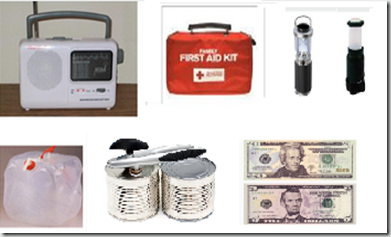
Things like having a good first aid kit at home, and another one in your car.  And just as importantly, learning how to properly use one. Taking a first-aid course, and CPR training, are both investments that could pay off big someday, for you, and for your loved ones. 
image


Having enough stored water for at least 3 days (1 gal/day per person + pets), a reasonable supply of non-perishable food, a NWS Emergency weather radio, a little cash in case the ATMs and Credit Card readers are down, and a safe form of emergency lighting (not candles) are all things every household should have on hand. 


And for my money, perhaps most importantly, having – and being – a `disaster buddy’. 


In NPM14: In an Emergency, Who Are You Going To Call?, I wrote that a `Disaster Buddy’ is simply someone you have prearranged that you can call on during a crisis, and who in turn, can call on you if they need help.  And the more `disaster buddies’  you have in your personal network, the more options you will have in an emergency.


And for more on emergency preparedness, you may wish to revisit some of these earlier blogs.


Wednesday, April 15, 2015

America’s PrepareAthon! 2015

image 


# 9943


The overriding lesson I’ve learned after six decades on this planet – a good deal of which was spent either living aboard a sailboat, or as a paramedic -  is that things can go from good to exceedingly bad in a heartbeat, and often without warning.  


A tornado, an earthquake, a house fire, a heart attack, or an auto accident  . . . they can all change your life in an instant. 


While we can’t pick and choose what emergencies will befall us – we can elect whether or not to be prepared to deal with them – and so federal agencies like FEMA and READY.GOV work year-round to encourage Americans to think about their risks, and to prepare for them.


Although we’ve seen a dramatic drop in natural disasters in the United States over the past few years, Emergency Managers know that lucky streak won’t last forever.  And the longer we go between severe hurricanes, a major earthquake, or some other big natural disaster  . . . the more complacent, and unprepared . .  our population becomes.


Between seeing September declared National Preparedness Month each year since 2004, a strong push for hurricane preparedness in late May each year (see Hurricane Preparedness Week 2014), and numerous Shakeout.org  earthquake drills (see NPM14: The Advantages Of Having A Shaky Preparedness Plan) each year, progress is being made.


Still, a 2013 Red Cross Hurricane Preparedness poll  found only about half who responded had an evacuation plan, 1/3rd had no home disaster supplies, and only about half reported having a family communications plan.


So there remains considerable room for improvement.  


To that end, last year FEMA and READY.GOV introduced National PrepareAthon! Day, which is actually part of a two-season campaign for better preparedness.  The spring National PrepareAthon! Day occurs on April 30th, while the fall component comes on September 30th at the close of National Preparedness Month. 


To learn how you can take part, go to America's PrepareAthon!


 About America's PrepareAthon!

60_second_video_message_introducing_Americas_PrepareAthon

America's PrepareAthon! is an opportunity for individuals, organizations, and communities to prepare for specific hazards through drills, group discussions, and exercises.

National PrepareAthon! Day is April 30, 2015 and will revolve around taking the actions to prepare for these six specific hazards:

Campaign Goals

The goal of this campaign is to increase the number of individuals who:

  • Understand which disasters could happen in their community
  • Know what to do to be safe and mitigate damage
  • Take action to increase their preparedness
  • Participate in community resilience planning

What can I do?

  • Register to participate in America’s PrepareAthon! and provide details about the activities you’re planning.
  • Plan your own local community or organizational preparedness event
  • Participate in discussion forums online with like-minded community members
  • Learn the actions to take for disaster preparedness and practice them!

Where can I find more information?

  • For more information about disasters, preparedness, and ways to get involved in America's PrepareAthon!, click here to access the America's PrepareAthon! Fact Sheet and Frequently Asked Questions.

Webinar: “Building a More Resilient Nation: National Preparedness Month and America's PrepareAthon!”

Stay in Touch

Email: prepareathon@fema.gov

Twitter: @PrepareAthon follow the conversation #PrepareAthon

To move people to action, the President, through Presidential Policy Directive (PPD-8), has directed all federal agencies to work with their stakeholders across the country to “coordinate a comprehensive campaign to build and sustain national preparedness, including public outreach and community-based and private-sector programs to enhance national resilience…”


Although this is primarily an infectious disease blog, its secondary focus is on reasonable, practical, and achievable personal, corporate, and community preparedness.    

A search on `preparedness’ or `NPM’  will return scores of earlier blogs, but a few recent examples include:


UK: 2015 Civil Risks Register
Tsunami Preparedness Week - 2015
Are You Ready For Tornado Season 2015?
Do You Still Have A CPO?

Tuesday, April 22, 2014

Reminder: America's PrepareAthon! – April 30th

image


# 8509


While our attentions have been understandably focused on the evolving MERS outbreak in the Middle East, I’d be remiss if I didn’t remind my readers that this year, Ready.gov & FEMA are introducing a new initiative to get communities and individuals to take concrete steps towards better preparedness.


The focus for this first PrepareAthon is on some of the more common disaster themes; Tornadoes, Wildfires, Floods, and Hurricanes.


The thinking is, if you are prepared for these events, you are probably in pretty good stead to deal with anything else. And while the odds are far greater you may have to deal with one of these scenarios, with the MERS virus spreading in the Middle East, it wouldn’t be an altogether bad idea to put a little thought towards pandemic preparedness as well (just in case).


This description is from FEMA’s Facebook Page:

FEMA Federal Emergency Management Agency

April 14 at 2:34pm ·

Save the Date: Join us on April 30, 2014 for America's PrepareAthon! National Day of Action. America's PrepareAthon! is an opportunity for individuals, organizations, and communities to prepare for specific hazards through drills, group discussions, and exercises. The first National Day of Action will revolve around taking the actions to prepare for tornadoes, wildfires, floods and hurricanes.

Interested in participating? There are several ways you can take part:

-Register to participate in America’s PrepareAthon! and provide details about the activities you’re planning.
-Plan your own local community or organizational preparedness event.
-Participate in discussion forums online with like-minded community members.
-Learn the actions to take for disaster preparedness and practice them!

More information available at: http://1.usa.gov/1fM5Oai

America's PrepareAthon!

America’s PrepareAthon! is a nationwide, community-based campaign for action to increase emergency preparedness and resilience through hazard-specific drills, group discussions and exercises conducted at the national level every fall and spring.


For more on emergency preparedness, you may wish to revisit some of these earlier blogs.


Saturday, March 15, 2014

America's PrepareAthon! – April 30th

image


# 8377


The `nightmare scenario’ for most emergency planners is not so much that a disaster will strike, but that it will end up being far worse than it could have been, simply because the public was not adequately prepared.


Between having a limited number of responders, a likely degradation of local infrastructure, finite resources, and the widespread impact of many events, officials know that it could take several days to get even limited help to some of those impacted by a major disaster.


Hence the ongoing appeals by FEMA, Ready.gov, local offices of emergency operations, and organizations like the American Red Cross and the APHA  for communities, businesses, and families to become better prepared for, and more resilient in the face of, a major emergency.


Between seeing September declared National Preparedness Month each year, a strong push for hurricane preparedness in late May, and numerous earthquake drills (see The Great Shakeout Drill Today) in October of each year, we’ve seen genuine improvement in the nations’ level of preparedness.


Still, a recent Red Cross Hurricane Preparedness poll  found only about half who responded had an evacuation plan, 1/3rd had no home disaster supplies, and only about half reported having a family communications plan..


So there remains considerable room for improvement.

 
This year, Ready.gov & FEMA are introducing a new initiative to get communities and individuals to take concrete steps towards better preparedness. This year, the focus is on some of the more common disaster scenarios; Tornadoes, Wildfires, Floods, and Hurricanes.


The thinking is, if you are prepared for these events, you are probably in pretty good stead to deal with anything.


You can learn how you, your organization, or business can take part in America’s PrepareAthon! below.


image

America's Prepareathon!

America's PrepareAthon! is a an opportunity for individuals, organizations, and communities to prepare for specific hazards through drills, group discussions, and exercises.

The first National Day of Action is scheduled for April 30, 2014 and will revolve around taking the actions to prepare for these four specific hazards:

Campaign Goals

The goal of this campaign is to increase the number of individuals who:

  • Understand which disasters could happen in their community
  • Know what to do to be safe and mitigate damage
  • Take action to increase their preparedness
  • Participate in community resilience planning
What can I do?
  • On March 31st, 2014 register to participate in America’s PrepareAthon! and provide details about the activities you’re planning. 
  • Plan your own local community or organizational preparedness event
  • Participate in discussion forums online with like-minded community members
  • Learn the actions to take for disaster preparedness and practice them!
Where can I find more information?
Stay in Touch

Email: PrepareAthon@fema.dhs.gov

Twitter: @PrepareAthon  follow the conversation #PrepareAthon

To move people to action, the President, through Presidential Policy Directive (PPD-8), has directed all federal agencies to work with their stakeholders across the country to “coordinate a comprehensive campaign to build and sustain national preparedness, including public outreach and community-based and private-sector programs to enhance national resilience…”

Last updated: 03/11/2014 - 12:13 PM


For more on emergency preparedness, you may wish to revisit some of these earlier blogs.