Showing posts with label FEMA. Show all posts

Wednesday, March 04, 2015

Are You Ready For Tornado Season 2015?

image


# 9782


With another winter storm dumping snow and ice across the southland this week it may seem a bit early to be thinking about tornado season, but the spring thaw is only a few weeks away and with it will come the storms of spring.


We’ve actually been pretty lucky the past three years, as tornado activity has run  below average - but nothing guarantees that streak will continue.


During a three day period (Apr 25th-28th) of 2011 a storm system of epic proportions spawned 351 confirmed tornadoes across five southern states, killing 338 persons in Alabama, Arkansas, Georgia, Mississippi, and Tennessee.  This was the the third deadliest tornado outbreak in U.S. History. More than a dozen of these twisters reached intensities of 4 or 5 on the Enhanced Fujita [EF] scale, which can produce near total devastation.

Before and after imagery depicting tornado damage in the vicinity of the intersection of 15th St. E. and McFarland Blvd. E. in southeast Tuscaloosa, AL.

Before and after imagery depicting tornado damage in the vicinity of the intersection of 15th St. E. and McFarland Blvd. E. in southeast Tuscaloosa, AL. The before imagery is courtesy of Google, the after imagery was acquired from an altitude of 5,000 feet above ground level by the NOAA King Air April 29, 2011.


All but a small part of the United States is vulnerable to these storms, but the strongest generally occur in an area we call Tornado Alley (below Left), which runs from middle Texas north though Oklahoma, Kansas, Nebraska and South Dakota.


This is the area where you will generally find the largest and most powerful tornadoes; the F5 wedge type. 

image

TORNADO ALLEY                       DIXIE ALLEY

Fortunately, much of the mid-west is sparsely populated, and so the number of tornado deaths that occur here are actually less than in other areas of the country.   


DIXIE ALLEY (above right) sees more frequent, albeit usually less severe tornadoes.  Due to a higher population density, more deaths occur in Dixie Alley than in Tornado Alley most years.


Which is why every home and office should have a NOAA weather radio. Once thought of as mainly a source of local weather information, it has now become an `All-Hazards' alert system as well.


No one can say with any confidence how many destructive storms 2015 will bring - but when it comes to tornados - you only have to be hit by one to ruin your whole day.

image


NOAA’s Are You Weather-Ready? Severe Weather Preparedness has a lot of good information, and three tornado specific videos.

Get Weather-Ready: Before a Tornado

Get Weather-Ready: During a Tornado


GGet Weather-Ready: After a Tornado


In 2012 the CDC’s MMWR issued an analysis of the 2011 massive tornado outbreak, that stressed the importance of safe rooms.  Due to the length of the report, I’ve only reproduced a few excerpts. 

Follow the link to read:

Tornado-Related Fatalities — Five States, Southeastern United States, April 25–28, 2011

Weekly

July 20, 2012 / 61(28);529-533

(Media Synopsis)

Individuals who work or live in a tornado-prone area should develop a tornado safety plan prior to severe weather.

During April 25–28, 2011, the third deadliest tornado disaster occurred in the southeastern U.S. despite modern advances in tornado forecasting, advanced warning times, and media coverage.  CDC reviewed data from the American Red Cross, death certificates and the National Weather Service to describe the fatalities by demographic characteristics, shelter used, cause of death, and tornado severity in the affected states of Alabama, Arkansas, Georgia, Mississippi and Tennessee. Of the 338 deaths, approximately one-third were older adults, almost half occurred in single-family homes, and a quarter happened in mobile homes.  One-half of the 27 tornadoes were rated powerful (EF-4 or EF-5) and were responsible for almost 90 percent of the deaths. The use of safe rooms is crucial to preventing tornado-related deaths.

(Continue . . . .)


FEMA has a good deal of advice on exactly how to construct a safe room – either above or below ground.

Residential Safe Rooms


The information below will help you understand how having a safe room in your home can protect your family and save the lives of those you care about.

Find answers to your Questions about Building a Safe Room, including:

  • What is the cost of installing a safe room?
  • Can I install a safe room in an existing home?
  • Can I build the safe room myself?
  • Where is the best location for the safe room?
  • Where can I find plans for safe room construction?

And more....

Building a Safe Room in Your House

For more details about how you can build a safe room in your home, go to the FEMA P- 320, Taking Shelter from the Storm: Building a Safe Room for Your Home or Small Business page before downloading it from the FEMA Library.   

image


Having a good (and well rehearsed) family emergency plan is essential for any emergency. Even with a safe room, family members could become separated (they may be sent to different hospitals or shelters) in the post-disaster chaos.


Some may be injured and unable to provide information about their families.


So it is important to set up a plan, including meeting places and out-of-state contacts, and individual wallet information cards -  before you need it. To that end READY.GOV has some advice, and tools, to help you do just that.

Plan to Protect Yourself & Your Family

Family Emergency Plan

(PDF - 3Mb)

Prepare yourself and your family for a disaster by making an emergency plan.

Download the Family Emergency Plan (FEP) (PDF - 750Kb), print the pages and fill them in offline.

Your emergency planning should also address the care of pets, aiding family members with access and functional needs and safely shutting off utilities.

You may also want to inquire about emergency plans at work, daycare and school. If no plans exist, consider volunteering to help create one. Read more about school and workplace plans.

Once you’ve collected this important information, gather your family members and discuss the information to put in the plan. Practice your plan at least twice a year and update it according to any issues that arise.

Together with adequate emergency supplies, a solid first aid kit, and an emergency battery operated NWS Weather Radio, these steps will go a long ways to protecting you, and your family, from a wide variety of potential disasters.
image

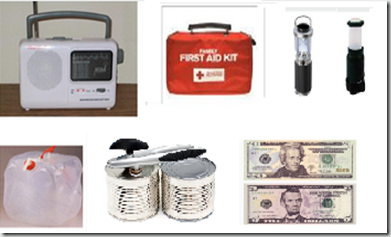
Basic kit : NWS radio, First Aid Kit, Lanterns, Water & Food & cash


This weekend, when we `spring ahead’ into Daylight Savings Time, is the perfect time to take a good hard look at your emergency plans, and supplies, and make any adjustments necessary.


For more on all of this, a partial list of some of my preparedness blogs include:

When 72 Hours Isn’t Enough

In An Emergency, Who Has Your Back?

An Appropriate Level Of Preparedness

The Gift Of Preparedness – 2014 Edition

Tuesday, April 22, 2014

Reminder: America's PrepareAthon! – April 30th

image


# 8509


While our attentions have been understandably focused on the evolving MERS outbreak in the Middle East, I’d be remiss if I didn’t remind my readers that this year, Ready.gov & FEMA are introducing a new initiative to get communities and individuals to take concrete steps towards better preparedness.


The focus for this first PrepareAthon is on some of the more common disaster themes; Tornadoes, Wildfires, Floods, and Hurricanes.


The thinking is, if you are prepared for these events, you are probably in pretty good stead to deal with anything else. And while the odds are far greater you may have to deal with one of these scenarios, with the MERS virus spreading in the Middle East, it wouldn’t be an altogether bad idea to put a little thought towards pandemic preparedness as well (just in case).


This description is from FEMA’s Facebook Page:

FEMA Federal Emergency Management Agency

April 14 at 2:34pm ·

Save the Date: Join us on April 30, 2014 for America's PrepareAthon! National Day of Action. America's PrepareAthon! is an opportunity for individuals, organizations, and communities to prepare for specific hazards through drills, group discussions, and exercises. The first National Day of Action will revolve around taking the actions to prepare for tornadoes, wildfires, floods and hurricanes.

Interested in participating? There are several ways you can take part:

-Register to participate in America’s PrepareAthon! and provide details about the activities you’re planning.
-Plan your own local community or organizational preparedness event.
-Participate in discussion forums online with like-minded community members.
-Learn the actions to take for disaster preparedness and practice them!

More information available at: http://1.usa.gov/1fM5Oai

America's PrepareAthon!

America’s PrepareAthon! is a nationwide, community-based campaign for action to increase emergency preparedness and resilience through hazard-specific drills, group discussions and exercises conducted at the national level every fall and spring.


For more on emergency preparedness, you may wish to revisit some of these earlier blogs.


Saturday, March 15, 2014

America's PrepareAthon! – April 30th

image


# 8377


The `nightmare scenario’ for most emergency planners is not so much that a disaster will strike, but that it will end up being far worse than it could have been, simply because the public was not adequately prepared.


Between having a limited number of responders, a likely degradation of local infrastructure, finite resources, and the widespread impact of many events, officials know that it could take several days to get even limited help to some of those impacted by a major disaster.


Hence the ongoing appeals by FEMA, Ready.gov, local offices of emergency operations, and organizations like the American Red Cross and the APHA  for communities, businesses, and families to become better prepared for, and more resilient in the face of, a major emergency.


Between seeing September declared National Preparedness Month each year, a strong push for hurricane preparedness in late May, and numerous earthquake drills (see The Great Shakeout Drill Today) in October of each year, we’ve seen genuine improvement in the nations’ level of preparedness.


Still, a recent Red Cross Hurricane Preparedness poll  found only about half who responded had an evacuation plan, 1/3rd had no home disaster supplies, and only about half reported having a family communications plan..


So there remains considerable room for improvement.

 
This year, Ready.gov & FEMA are introducing a new initiative to get communities and individuals to take concrete steps towards better preparedness. This year, the focus is on some of the more common disaster scenarios; Tornadoes, Wildfires, Floods, and Hurricanes.


The thinking is, if you are prepared for these events, you are probably in pretty good stead to deal with anything.


You can learn how you, your organization, or business can take part in America’s PrepareAthon! below.


image

America's Prepareathon!

America's PrepareAthon! is a an opportunity for individuals, organizations, and communities to prepare for specific hazards through drills, group discussions, and exercises.

The first National Day of Action is scheduled for April 30, 2014 and will revolve around taking the actions to prepare for these four specific hazards:

Campaign Goals

The goal of this campaign is to increase the number of individuals who:

  • Understand which disasters could happen in their community
  • Know what to do to be safe and mitigate damage
  • Take action to increase their preparedness
  • Participate in community resilience planning
What can I do?
  • On March 31st, 2014 register to participate in America’s PrepareAthon! and provide details about the activities you’re planning. 
  • Plan your own local community or organizational preparedness event
  • Participate in discussion forums online with like-minded community members
  • Learn the actions to take for disaster preparedness and practice them!
Where can I find more information?
Stay in Touch

Email: PrepareAthon@fema.dhs.gov

Twitter: @PrepareAthon  follow the conversation #PrepareAthon

To move people to action, the President, through Presidential Policy Directive (PPD-8), has directed all federal agencies to work with their stakeholders across the country to “coordinate a comprehensive campaign to build and sustain national preparedness, including public outreach and community-based and private-sector programs to enhance national resilience…”

Last updated: 03/11/2014 - 12:13 PM


For more on emergency preparedness, you may wish to revisit some of these earlier blogs.

Saturday, March 08, 2014

Spring Forward Into Preparedness


image

Credit APHA 

# 8360


Each year in the U.S. most of the country switches to Daylight Savings Time (DST) in the Spring, and back to Standard Time in the Fall.   Tonight (well, 2am tomorrow morning to be precise),  we `spring forward’  into DST, which is used as a handy reminder by FEMA , READY.GOV,  the APHA and others for the public to the check batteries in smoke alarms, and to check their emergency supplies.

image


I also use this twice-a-year time change as a reminder to go through and check my stash of emergency food storage, discarding any foods that are out of date (and either using - or donating to the needy - those that are still good, but will expire in the next 6 months).


For some quick and easy advice on how to stock up and prepare,  American Public Health Association has a set of free guides available at:

     Get Ready: Set Your Clocks, Check Your Stocks


Agencies like FEMA, READY.GOV and the HHS are constantly trying to get the preparedness message out, so that when (not `if') a disaster does occur, human losses can be minimized. At a bare minimum, every household should have a disaster plan, a good first aid kit (and the knowledge to use it), and emergency supplies to last a minimum of 72 hours during a disaster. 


For more information on how to prepare for emergencies, up to and including a pandemic, the following sites should be of assistance.

FEMA http://www.fema.gov/index.shtm

READY.GOV http://www.ready.gov/

AMERICAN RED CROSS http://www.redcross.org/

APHA Get Ready : http://getreadyforflu.org/newsite.htm


A few of my (many) blogs on this subject include:

  • In An Emergency, Who Has Your Back?
  • When 72 Hours Isn’t Enough
  • When Evacuation Is The Better Part Of Valor
  • While it takes more than a few minutes to become prepared, once you’ve laid that foundation, a few minutes twice-a-year may be all it takes to maintain it.

    Wednesday, January 01, 2014

    Preparing For An Unpredictable New Year

    image


    # 8119


    When it comes to making forecasts for the coming year, I generally default to the late Baltimore Sun columnist Jack Germond’s incredibly droll (and 100% safe) New Year’s Eve prediction he issued a couple of decades ago that, `There will be a flood somewhere.’


    Not being afraid to go out on a limb, I go a little further, saying:


    There will be a flood – or some other disaster - and some people will suffer unnecessarily because they weren’t adequately prepared.


    Shocking, I know.  


    But despite a nearly constant barrage of preparedness messaging from governments, organizations, and humble bloggers like myself, half of all American families haven’t even taken the most basic of disaster preparedness steps, and I’d guess fewer than 10% are really well prepared for a serious event.


    Last year, an American Red Cross poll (Coastal Hurricane Preparedness May 2013), found only about half the respondents had an evacuation plan, 1/3rd have no home disaster supplies, and only about half reported having a family communications plan.


    During the first decade of promoting their National Preparedness Month (NPM), FEMA and READY.Gov have seen some signs of progress (see graphic below).

    image

    The goal of this yearly campaign is to foster a culture of national preparedness, and to encourage everyone to plan and be prepared to deal with an event where they can go at least 72 hours without electricity, running water, local services, or access to a supermarket.


    Still,  far too many American families and businesses remain poorly equipped to deal with a major disaster. And that knowledge keeps emergency planners up at night.


    For those who equate prepping with sensationalized cable TV and Internet `Doomsday-type’ preppers, rest assured we aren’t talking about digging a bunker, laying in a 10-year supply of freeze dried foods, or stockpiling guns and ammo.


    But disruptions that follow hurricanes, tornado outbreaks, floods, and other natural disasters can potentially last for days or even weeks, and so – if you are able to do so - being prepared for 10 days to 2 weeks makes a good deal of sense (see When 72 Hours Isn’t Enough).


    In 2012, in Making The Most Of The Day Before Tomorrow, I highlighted a very effective graphic from  Ready.gov that shows the `day before disaster’ for all 50 states. The date when it was still not too late to prepare.


    Click through to the interactive map, to see each state’s date with destiny.


    image


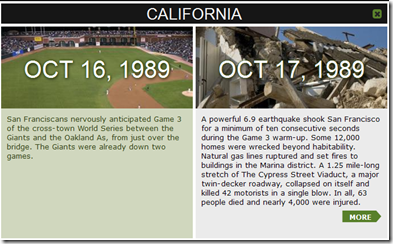
    If you click on California, for example, you’ll get:

    image

    You get the idea. 

    The takeaway point is, you never know whether today is the day before your disaster . . .


    We’ll be covering a lot of preparedness topics during 2014 – along with our regular litany of emerging infectious diseases – because in a world as crowded, complex, and interconnected as ours, bad things are sure to happen.


    And among those `bad things’ is the potential for seeing epidemics or even a pandemic.


    But the smart money says, you shouldn’t prepare for a specific emergency or disaster, but instead create an `All Hazards approach’  to preparedness, one that  will leave you in good stead no matter what comes down the pike.


    To get you started, I would invite you to visit:


    FEMA http://www.fema.gov/index.shtm

    READY.GOV http://www.ready.gov/

    AMERICAN RED CROSS http://www.redcross.org/


    If you are on Twitter, I would recommend you follow @FEMA, @CraigatFEMA, @NHC_Atlantic, @NHC_Pacific and @ReadyGov.


    And lastly, in NPM13: The Greatest Prep Of All,  I wrote about what I consider to be the most important preparedness step you can take – having, and being,  a disaster buddy.  Cultivating a network of family and friends to whom you can turn for help in a disaster, to who can turn to you for aid,  if they need it.


    Because - while I can’t predict what disaster will happen, or when, or even where – its a safe bet that in 2014 hundreds of thousands of people around the world will find themselves wishing  they were better prepared in the midst of a crisis.


    With a little bit of pre-planning and effort, you needn’t be one of them.


    You can use this link to read earlier NPM preparedness posts on this blog.

    Thursday, September 19, 2013

    NPM13: Kids & Disaster Preparedness

    image

    Note: This is day 19 of National Preparedness Month.  Follow this year’s campaign on Twitter by searching for the #NPM or #NPM13 hash tag.

    This month, as part of NPM13, I’ll be rerunning some updated  preparedness essays (like this one) , along with some new ones.


    # 7790


    Disaster preparedness messaging for youngsters has come a long way since I was kid, as evidenced by the Ready.gov/Kids website in the graphic at the top of this page.   In the `bad old days’ of the 1950s and 1960s, preparedness meant `duck & cover’ drills, and a likely futile attempts to survive an atomic attack.


    One of the more famous (and least graphic) of these early preparedness PSAs was Bert The Turtle telling kids how to `Duck & Cover’.  


    Starker messaging included PSAs like  TARGET YOU, and the equally bleak Survival Under Atomic Attack. If it seems unlikely to you that these sorts of films were routinely presented to school children, I can assure you they were – the fear of imminent nuclear annihilation was rampant back then. 


    Today, our concerns are focused on natural disasters, like floods, hurricanes, and earthquakes.  Scenarios that are far more survivable than an all-out nuclear attack, and that can be approached in a more `kid-friendly’ fashion.


    But the core message – that disasters happen, and we should all be prepared – hasn’t changed.


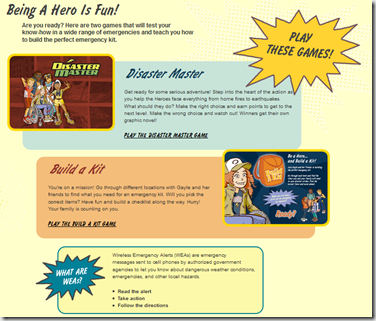
    Ready.gov’s kid friendly preparedness page contains games and activities for kids along with  information for parents and educators on how to teach simple, but effective preparedness lessons.  

    image


    Many states have their own preparedness site for kids, such as Florida Division of Emergency Management’s Kids Get A Plan page, which provides an excellent interactive introduction to preparedness for children. 


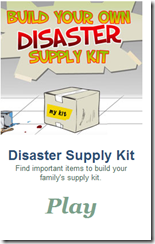
    You’ll find audio-stories on topics like lightning safety, wildfires, and hurricanes along with interactive games like the one below, that teaches kids what items are needed for a disaster supply kit.

    image

    And to go along with these activities for kids, the site provides guides for parents and teachers to help them discuss these issues with kids.


    Some of these stories and activities are geared for kids as young as 5 or 6, while others are aimed at slightly older children.


    If you’ve got kids, or grandkids – and would like to introduce them to preparedness concepts without inducing undue trauma - this site is very much worth while checking out.


    And for even more disaster preparedness for kids, you will also want to check out FEMA/Ready.gov’s  preparedness for kids website which I highlighted last September in NPM12: Preparedness For Kids

    image

    Tuesday, August 20, 2013

    NIFC Raises Wildfire Preparedness Level To 5 (Maximum)


    image


    # 7582


    The NIFC (National Interagency Fire Center) in Boise, Idaho raised their national fire preparedness level (PL) to its highest rating (5) today, the first time this PL level has been declared since 2008.


    A PL5 is declared when:

    Preparedness Level 5

    Geographic Areas are experiencing major incidents which have the potential to exhaust all agency fire resources. Eighty percent (80%) of Type 1 and Type 2 Incident Management Teams and crews are committed, as well as the majority of other National Resources


    The Associated Press is reporting today that in Idaho, `1,850 homes remain evacuated in the resort area of Ketchum and Sun Valley due to the 160-square-mile Beaver Creek Fire’  and that the remote mountain town of Atlanta, 50 miles to the west, is under an evacuation order.


    Today’s status report indicates there are 42 large, uncontained fires, spread across multiple western states.

    image


    The following statement was released earlier today by the NIFC:


    For Release:  August 20, 2013

    Contact:  Don Smurthwaite, 208-387-5458
                        or Mike Ferris, 208-387-5437

     
    National Wildfire Preparedness Moves to Highest Level

     
    Boise – The National Multi-Agency Coordinating Group (NMAC) today increased the national fire Preparedness Level (PL) to its highest point, PL-5.

     
    The PL ranges from one, indicating minimal activity, to five, which signals very high activity.

    NMAC, which consists of top federal and state fire managers, sets the national PL.  The raised level reflects a high degree of wildfire activity, a major commitment of fire resources, and the probability that severe conditions will continue for at least a few days. 


    To date, 31,986 wildfires have burned 3.4 million acres in the United States this year.  While both of those figures roughly represent only about 60% of the ten-year average, wildfire activity has escalated in recent days after thunderstorms, many with little or no moisture, moved across parts of California, Oregon, Idaho and Montana, sparking hundreds of new fires.


    “The decision to move to Preparedness Level 5 reflects the complexity facing our federal and non-federal fire managers,” said Department of the Interior Secretary Sally Jewell.  “This has been a difficult and tragic season, including the loss of 30 of our nation’s firefighters.  We have an experienced and skilled group of national, regional and local fire managers who will make the tough decisions necessary to respond to the
    current workload.  We depend on everyone to do their part to make our communities and homes defensible against fire and to follow the instructions of local authorities.”

    This is the fifth time that PL-5 has been reached in the last ten years. PL-5 indicates fire suppression
    resources are becoming scarce, but Department of Agriculture Secretary Tom Vilsack said cooperation among agencies helps ease the strain.


    “During periods of high wildfire activity, when assets are stretched thin, federal, tribal, state and local partners work together to prioritize wildfires so that those threatening life, property and valuable natural and cultural resources receive assets as quickly as possible,” he said. “Professional wildfire managers adapt their strategies and tactics based on the assets that they receive and do the very best they can to suppress unwanted wildfires effectively and efficiently.”

    During PL-5, further assistance from the military, beyond what is already in use, and international resources may be considered and requested, but no decisions have been made concerning those steps.


    The fire forecast for most of the West shows a general continuation of hot and dry weather into the fall.


    Just last week, the CDC’s Public Health Matters Blog carried a report on Colorado’s Wildfires earlier this summer, and public health communications issues.


    On the Scene: Wildfire Communication in Colorado

    August 14th, 2013 12:38 pm ET  -  Blog Administrator

    By Nicole Hawk

    An estimated 75,000 wildfires occur in the United States each year, and each one has potential public health concerns including evacuating safely, dealing with smoke, or cleaning up spoiled food after a power outage.  In June 2013, Colorado faced multiple devastating wildfires, including the Royal Gorge FireExternal Web Site Icon in Cañon City, which required the evacuation of a state prison, and the Black Forest FireExternal Web Site Icon in Colorado Springs, which became the most destructive in Colorado history.  The 14,000-acre fire forced 38,000 people to evacuate and destroyed almost 500 homes.  Before, during, and after the wildfires, local, state, and federal public information officers (PIOs) worked together to quickly share emergency information via traditional media, social media, and websites such as InciwebExternal Web Site Icon.

    (Continue . . .)


    Wildfires can move with astonishing speed, can jump firebreaks, highways, and other natural barriers, and can threaten new areas very quickly.  


    Hence the recommendation to develop a network of trusted disaster buddies to whom you can turn in an emergency (as can they to you), several pre-arranged evacuation destinations should you need to `get out of Dodge’ in a hurry, and a 72-hour bug-out bag  you can grab at a moment’s notice.


    bob 001a

    My Bug-out-bag, Canteen, & Toiletry kit

    I also keep an overnight bag, and a fully equipped first aid kit, in the trunk of my car . . .  just in case (see Inside My Auto First Aid Kit).


    FEMA, along with the U.S. Fire Administration, has some advice on how to protect your home against wildfires, and what to do should you, and your home, find yourself in the path of one of these destructive forces of nature.


    As with hurricane, earthquakes, and tornadoes . . . the time to prepare for a wildfire is before one threatens.


    Wildfire - Are You Prepared?

    image


    September is National Preparedness Month, and we’ll be talking about preparedness a lot next month. But disasters don’t follow the calendar, and so you should work towards being better prepared all year round.

    Thursday, August 15, 2013

    NPM13: A Tropical Wake Up Call

    image


    # 7574


    Ten weeks into the 2013 Atlantic Tropical season and we are starting to see signs of increased activity, with a new tropical storm (Erin) far out in the Atlantic, and an area of disturbed weather with a high probability of development closer to home.


    Last week both NOAA and Dr. William Gray reiterated their forecasts for a busy remainder of the tropical season (see NOAA: Above Average Atlantic Hurricane Season Still Expected).


    Erin, a Cape Verde storm, is forecast to maintain its westerly motion for the next five days, and could pose a threat to the Caribbean late next week.

    image


    The disturbance in the western Caribbean is expected to move into the southern Gulf of Mexico, and has a greater than 50/50 chance of becoming a tropical storm over the next few days.


    Regardless of how these two systems play out, we’ve still got 3-1/2 months of Hurricane season ahead of us.


    Which is why, in a little over two weeks – AFD - along with thousands of other coalition members, will devote a good deal of time and attention to Ready.gov & Fema’s annual National Preparedness Month; urging individual, family, community and business preparedness efforts.


    image_thumb1


    As you can see by the chart above, the number of coalition members has quadrupled since 2010.


    Members consist of individuals, organizations, and businesses . . . and you are encouraged to join as well.


    For those who equate prepping with sensationalized cable TV `Doomsday-type’ preppers, allow me to reassure you that you needn’t dig a bunker, accumulate a small armory, or lay in a 20 year’s worth of freeze-dried food in order to be prepared.


    image

    Basic Preps: Emergency Weather Radio, First Aid Kit, Battery Lantern, Water storage – Add some food (3-10 day supply), and an emergency plan, and you are well on your way to being prepared. 


    The goal of NPM2013 is to foster a culture of national preparedness, and to encourage everyone to plan and be prepared to deal with an event where they can go at least three days without electricity, running water, local services, or access to a supermarket.


    These are, of course, minimum goals.


    The disruptions following hurricanes, tornado outbreaks, floods, and other natural disasters can potentially last for days or even weeks, and so – if you are able to do so - being prepared for 10 days to 2 weeks makes a good deal of sense (see When 72 Hours Isn’t Enough).


    As a Floridian, my preparedness plans are somewhat hurricane-centric, as these massive storms provide the most likely disaster scenario for my area.  But my disaster plans are appropriate for other disaster scenarios as well.


    In addition to being prepared to shelter-in-place for up to two weeks, I have a network of trusted disaster buddies to whom I can turn in an emergency (as can they to me), several pre-arranged evacuation destinations should I need to `get out of Dodge’, and a 72-hour bug-out bag I can grab at a moment’s notice.

    bob 001a

    My Bug-out-bag, Canteen, & Toiletry kit

    I also keep an overnight bag, and a fully equipped first aid kit, in the trunk of my car . . .  just in case (see Inside My Auto First Aid Kit).


    While the federal government will respond during any major disaster, they know it may take days or longer to reach everyone and to restore essential services. Which is why they encourage all individuals, families, business owners, and communities to become better prepared to deal with all types of disasters.


    I would invite you visit the following preparedness sites.


    FEMA http://www.fema.gov/index.shtm

    READY.GOV http://www.ready.gov/

    AMERICAN RED CROSS http://www.redcross.org/


    If you are on Twitter, I would recommend you follow @FEMA, @CraigatFEMA, @NHC_Atlantic, @NHC_Pacific and @ReadyGov.

    And finally, a few of my own preparedness articles include:


    In An Emergency, Who Has Your Back?

    An Appropriate Level Of Preparedness

    The Gift of Preparedness 2012

    Sunday, August 04, 2013

    More Preparedness For Kids

    image

    Credit Florida Disaster.org


    # 7540


    Although I probably would have embraced preparedness had I been raised somewhere else, I’m certain growing up in Florida with early encounters with hurricanes and the Cuban Missile Crisis, along with spending 15 years of my life living aboard boats, had more than a little to do with my mindset.


    Growing up on the water I learned to swim, fish, row a boat, throw a cast net, read a map, basic first aid, and (somewhat paradoxically as a boy scout) my way around the `woods’ at a very early age.


    In 1962 the Cuban Missile Crisis had the schools handing out graphic pamphlets on radiation poisoning and nuclear war survival to elementary school children, students practicing duck & cover drills each day, and twice-a-week evacuation drills.


    Admittedly, not the ideal way for an 8 year-old to learn about preparedness.


    Thankfully today preparedness messaging – particularly for kids – is `kinder-and-gentler’ (and far less graphic) than during the `bad-old-days’ of the cold war.


    But the core message – that disasters happen, and we should all be prepared – hasn’t changed.


    Florida Division of Emergency Management’s Kids Get A Plan page provides an excellent interactive introduction to preparedness for children. 


    You’ll find audio-stories on topics like lightning safety, wildfires, and hurricanes along with interactive games like the one below, that teaches kids what items are needed for a disaster supply kit.


    image


    And to go along with these activities for kids, the site provides guides for parents and teachers to help them discuss these issues with kids.


    Some of these stories and activities are geared for kids as young as 5 or 6, while others are aimed at slightly older children.


    If you’ve got kids, or grandkids – and would like to introduce them to preparedness concepts without inducing undue trauma - this site is very much worth while checking out.


    And for even more disaster preparedness for kids, you will also want to check out FEMA/Ready.gov’s  preparedness for kids website which I highlighted last September in NPM12: Preparedness For Kids


    image

    Sunday, June 30, 2013

    Pledge To Prepare

    image


    # 7436


    National Preparedness Month (September) is just 60 days away, and along with thousands of others across the country, AFD blog is once again proud to be part of this year’s NPM coalition.


    As you can see by the chart above, the number of coalition members has quadrupled since 2010.


    Members consist of individuals, organizations, and businesses . . . and you are encouraged to join as well.


    image

    Interested in preparedness throughout the year? If so, continue here to Pledge to Prepare.  By Pledging you will become part of the National Preparedness Coalition.  There is no cost or obligation in doing so.  As a Coalition Member, you will have access to exclusive resources and be able to collaborate with thousands of fellow members across the country on ways to participate and get your community involved.


    While I promote preparedness year-round, twice each year this blog makes a concerted `preparedness push’; first in late May to kick off Hurricane season, and again in September for National Preparedness Month. 


    The goal of NPM2013 is to foster a culture of national preparedness, and to encourage everyone to plan and be prepared to deal with an event where they can go at least three days without electricity, running water, local services, or access to a supermarket.


    These are, of course, minimum goals.


    The disruptions following hurricanes, tornado outbreaks, floods, and other natural disasters often run for days or even weeks, and so – if you are able to do so - being prepared for 10 days to 2 weeks makes a good deal of sense (see When 72 Hours Isn’t Enough).


    As a Floridian, my preparedness plans are somewhat hurricane-centric, as these massive storms provide the most likely disaster scenario for my area.  But my disaster plans are appropriate for other disaster scenarios as well.


    In addition to being prepared to shelter-in-place for up to two weeks, I have a network of trusted disaster buddies to whom I can turn in an emergency (as can they to me), several pre-arranged evacuation destinations should I need to `get out of Dodge’, and a 72-hour bug-out bag I can grab at a moment’s notice.


    bob 001a

    My Bug-out-bag, Canteen, & Toiletry kit


    I also keep an overnight bag, and a fully equipped first aid kit, in the trunk of my car . . .  just in case (see Inside My Auto First Aid Kit).


    My investment in preparedness is relatively small – only a few hundred dollars – which I consider cheap insurance. But if a hurricane, a pandemic, or some other disaster strikes, I’ll be in a much better position to cope.


    As I tell people, preparing is easy.  It’s worrying that’s hard.


    While the federal government will respond during any major disaster, they know it may take days or longer to reach everyone and to restore essential services. Which is why they encourage all individuals, families, business owners, and communities to become better prepared to deal with all types of disasters.


    I would invite you visit the following preparedness sites.

    FEMA http://www.fema.gov/index.shtm

    READY.GOV http://www.ready.gov/

    AMERICAN RED CROSS http://www.redcross.org/


    If you are on Twitter, I would suggest you follow @FEMA, @CraigatFEMA, and @ReadyGov.


    And finally, a few of my own preparedness articles include:


    In An Emergency, Who Has Your Back?

    An Appropriate Level Of Preparedness

    The Gift of Preparedness 2012

    Saturday, June 01, 2013

    Hurricane Preparedness Week: Day 6 & 7

    image


    # 7347


    Today is day 7 of Hurricane Preparedness Week, but as the folks living in Oklahoma City can tell you after last night’s round by tornadoes, you don’t have to live within reach of one of these tropical storm systems to find yourselves dealing with severe, life-threatening weather conditions.


    So while we talk about Hurricane Preparedness this week, everyone should take this yearly reminder to beef up their individual, family, and business emergency plans.


    Yesterday and today, Hurricane Preparedness Week has focused on Getting Ready, and Taking Action.  So first, a pair of short videos from NOAA on both of these tasks.


    Ready.gov has an extensive Hurricane preparedness website, with information on what to do before, during, and after the storm.


    image


    Far too many people mistakenly believe they’ve seen the worst that a hurricane can deliver because they’ve been on the periphery of one of the large storms we’ve seen over the past 20 years. 


    The truth is, we’ve not had a Category 5 storm strike the U.S. mainland since 1992, when Andrew took out a large portion of Homestead, Florida.


    Before that you have to go back to 1969, and Hurricane Camille in Mississippi. 


    The modern benchmark for hurricane disasters is Hurricane Katrina, that devastated New Orleans in 2005.  But that storm was barely a Category 3 storm when it hit land. 


    As horrific as it was, it could have been worse. . .


    The lessons of Katrina, Wilma, Ike, Irene and Sandy are that it doesn’t take a category 5 storm to cause major devastation, disruptions, and deaths.  Even tropical storms – such as Allison in 2001 – can prove deadly (55 fatalities, $9 billion in damage).


    While the storm may last 12 to 24 hours, the aftermath – where power may be out, businesses may be closed, and services may curtailed -  can drag on for weeks.


    image

    Basic Preps: Emergency Weather Radio, First Aid Kit, Battery Lantern, Water storage

    Which makes the `standard advice’ of having at least 3 days worth of supplies less than ideal.  Today, most emergency officials recommend you prepare for `at least a week’ (see When 72 Hours Isn’t Enough).


    While having food, water, and prescription medicines to last a week or more is vital, sometimes your best option is to get get out of harm’s way.


    The following photo taken in Crystal Beach after Hurricane Ike in 2008 proves that staying home in the face of a flood, a hurricane, or other natural disaster can have deadly consequences.

    image

    If you live in an evacuation zone, you should obviously be prepared to leave immediately when ordered, but everyone should have a bug-out bag they can grab in the event they must quickly abandon their home (see  When Evacuation Is The Better Part Of Valor).


    bob 001a

    My Bug-out-bag, Canteen, & Toiletry kit


    Another important aspect of preparedness for millions of families is anticipating the disaster needs of the non-human members of the family (see Prepping For Pets).


    We don’t know where, or even if, a hurricane will make landfall this year. But last month we saw that NOAA predicts active 2013 Atlantic hurricane season.


    If you haven’t already downloaded the updated Tropical Cyclone Preparedness Guide, now would be an excellent time to do so.


    image


    All this week we’ve focused on hurricane preparedness, but you’ll find dozens of other preparedness articles in the blog by searching this link.


    And if you missed any of my earlier blogs this week on hurricane preparedness, you can visit them at the links below:


    Grady Norton: The First Hurricane Forecaster

    Hurricane Preparedness Week: Inland Flooding

    Hurricane Preparedness Week & The Tale Of The Tape

    Storm Surge Monday

    National Hurricane Preparedness Week – Day 1