Showing posts with label CHKV. Show all posts

Thursday, August 07, 2014

Updating West Nile, CHKV & Dengue

image


# 8926


While Ebola dominates the daily news cycle, there are plenty of other public health concerns out there that are far more likely to threaten the average North American than imported cases of hemorrhagic fever.  Among those are mosquito-borne diseases like WNV, dengue, EEE, and Chikungunya.


Yesterday, the California Department of Public Health  announced two recent deaths from West Nile Virus, adding to a handful of deaths already reported this year in Arizona, Louisiana & Missouri.


CDPH Reports First Human West Nile Virus Fatalities This Summer

Date: 8/6/2014

Number: 14-069

Contact: Anita Gore - (916) 440-7259

SACRAMENTO

The first two deaths this summer due to West Nile virus infection have been confirmed by the California Department of Public Health (CDPH) it was announced today by Dr. Ron Chapman, CDPH Director and state public health officer. The first was a senior citizen from Sacramento County. The second was an adult from Shasta County.

“These unfortunate deaths remind us that we must protect ourselves from mosquito bites to prevent West Nile virus and other mosquito born infections,” said Chapman. “West Nile virus activity is greatest during the summertime.”

West Nile virus is transmitted to humans and animals by the bite of an infected mosquito. The risk of serious illness to most people is low. However, some individuals – less than one percent – can develop a serious neurologic illness such as encephalitis or meningitis. People 50 years of age and older have a higher chance of getting sick and are more likely to develop complications. Recent data also indicate that those with diabetes and/or hypertension are at greatest risk for serious illness.

To date in 2014, West Nile virus has been detected in 36 California counties.

(Continue . . . )


The least severe form of the disease – West Nile Fever - probably infects more than 100,000 Americans every year, although most are so mildly affected they have no idea the are infected.


Neuroinvasive cases (which present with meningitis, encephalitis, or flaccid Paralysis), while less common, are severe enough that they nearly always result in hospitalization and diagnosis, and so they are considered the best indicator of the scope of each year’s epidemic. 


Right now, California and Arizona lead the nation in reporting neuroinvasive cases of WNV, with a combined total of 24.

image

The amount of WNV activity varies considerable from year-to-year, and this year (so far, anyway) we haven’t seen a huge number of cases.  Surveillance and reporting, however, often lags several weeks behind actual events, and so we may still see a substantial number of cases this year.


This year we are also monitoring the arrival of locally transmitted Chikungunya in the United States, and while only 4 cases have been reported (all in Florida), we continue to see large numbers of imported cases being reported across the nation. 

Each imported case provides an opportunity for local mosquitoes to pick up, and transmit, the disease.

image


Florida and New York lead the nation with the number of imported CHKV cases, but as Chikungunya is not a nationally notifiable disease, surveillance is likely to under report cases. 


Chikungunya – while rarely fatal - can cause prolonged fever and polyarthralgias (joint pain), which in some cases can lead to permanent disability. 


With PAHO reporting more than 500,000 CHKV cases across the Caribbean over the past 7 months, it isn’t surprising that we are beginning to see locally transmitted cases in both Puerto Rico and the U.S. Virgin Islands.

image


Despite its rapid spread across the islands of the Caribbean, and into Central and South America, there are reasons to hope that CHKV won’t spread as rapidly as WNV has in the United States.


Unlike WNV, which resides in birds, CHKV doesn’t have an animal host other than humans which can aid in its spread (see WNV vs CHIKV: A Host Of Differences).  And studies have suggested that lifestyle and economic factors (ie. air conditioning, window screens, mosquito control programs) may further reduce transmission. 


Thus far, we haven’t seen much reporting on locally acquired Dengue this summer, with only one case reported in the Miami-Dade region of south Florida (see Florida: Miami Reports 1st Locally Acquired Dengue Case Of 2014). 


While now the most common mosquito-borne virus in the world (causing up to 100 million infections a year), Dengue has managed to do little more than spark a few limited outbreaks in North America, despite an abundance of the right mosquito vectors.


Whether our relative good luck will continue to hold with Dengue, and CHKV, remains to be seen. 


While the overall risk of contracting a mosquito-borne illness anywhere in the United States remains very small, with no vaccines available, and scattered cases of Dengue, West Nile Virus, EEE, SLEV, and the recent arrival of Chikungunya  - Florida’s Health departments urge people to always follow the `5 D’s’:

image

Saturday, December 14, 2013

CDC HAN Advisory On Recognizing & Treating Chikungunya Infection

image


# 8070


A recurring topic in this blog has been the growing dangers of `exotic’ diseases being spread to new regions of the globe due to ever-increasing international travel. 


Some recent examples include the introduction of dengue to parts of Australia and Southern Florida in recent years (see Florida: Dengue Forces Suspension Of Blood Donations In Two Counties)  and our yearly national battle against West Nile Virus, which first arrived in the United States in 1997 (see DVBID: West Nile Virus Update).


Given the incubation period of many of these diseases, it is perfectly plausible that a traveler can become infected in India, or Africa, or the Caribbean and continue to travel for several days without becoming symptomatic.


Indeed, each year the CDC records hundreds of  recent arrivals to the United States who are subsequently diagnosed with with a wide range of infectious diseases, including Cholera, Typhoid, Dengue, Malaria, and (so far, rarely) Chikungunya.


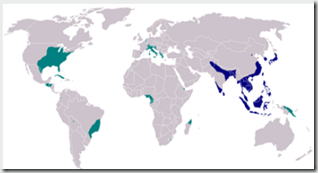
Mosquito-borne diseases are a particular concern because humans can often act as an amplifying host, and the United States is home to two particularly good mosquito species (Aedes aegypti, Ae. albopictus) for transmitting diseases.  The relatively recent introduction and growing geographic range of the Aedes Albopictus mosquito (see below) in the United States has raised new concerns that once eradicated tropical diseases could become endemic once more.

image

Map showing the native habitat (blue) and recent spread (green) of the Aedes albopictus mosquito.

Complicating matters, as these species continue to encroach on new populations, many are developing signs of resistance to insecticides and insect repellants (see Declan Butler On Growing Mosquito Insecticide Resistance & From the `Nature Bats Last’ Dept).


While long predicted (see CDC/PAHO document  Preparedness and Response for Chikungunya Virus Introduction in the Americas) this week we learned that CHKV (Chikungunya) – traditionally only seen in Africa, India, and the Indian Ocean – has  finally made its way into the Caribbean (see WHO: Chikungunya In Caribbean – French Part of St. Martins).


Although we’ve seen sporadic cases of viremic CHKV infected travelers to the United States in the past (see 2011 CID Journal report Chikungunya Fever in the United States: A Fifteen Year Review of Cases), those numbers have been small (109 between 1995- 2009), and so far (unlike dengue and WNV), we haven’t seen any evidence of local transmission.


But with CHKV now in the Americas, the number of CHKV infected travelers to the United States may well increase,  and any who are viremic (producing large quantities virus in their blood) while visiting regions where suitable mosquito vectors are present, could potentially introduce the virus to the local mosquito population.


Given that CHKV is an exotic and unfamiliar disease to most American doctors, the CDC issued a HAN Advisory late yesterday to help doctors identify and treat cases.


Notice to Public Health Officials and Clinicians: Recognizing, Managing, and Reporting Chikungunya Virus Infections in Travelers Returning from the Caribbean

Summary

On December 7, 2013, the World Health Organization (WHO) reported the first local (autochthonous) transmission of chikungunya virus in the Americas. As of December 12th, 10 cases of chikungunya have been confirmed in patients who reside on the French side of St. Martin in the Caribbean. Laboratory testing is pending on additional suspected cases. Onset of illness for confirmed cases was between October 15 and December 4. At this time, there are no reports of other suspected chikungunya cases outside St. Martin. However, further spread to other countries in the region is possible.

Chikungunya virus infection should be considered in patients with acute onset of fever and polyarthralgia, especially those who have recently traveled to the Caribbean. Healthcare providers are encouraged to report suspected chikungunya cases to their state or local health department to facilitate diagnosis and to mitigate the risk of local transmission.

Background

Chikungunya virus is a mosquito-borne alphavirus transmitted primarily by Aedes aegypti and Aedes albopictus mosquitoes. Humans are the primary reservoir during epidemics. Outbreaks have been documented in Africa, Southern Europe, Southeast Asia, the Indian subcontinent, and islands in the Indian and Pacific Oceans. Prior to the cases on St. Martin, the only chikungunya cases identified in the Americas were in travelers returning from endemic areas.

Clinical Disease

A majority of people infected with chikungunya virus become symptomatic. The incubation period is typically 3–7 days (range, 2–12 days). The most common clinical findings are acute onset of fever and polyarthralgia. Joint pains are often severe and debilitating. Other symptoms may include headache, myalgia, arthritis, or rash. Persons at risk for more severe disease include neonates (aged <1 month) exposed intrapartum, older adults (e.g., ≥ 65 years), and persons with underlying medical conditions (e.g., hypertension, diabetes, or cardiovascular disease).

Diagnosis

Chikungunya virus infection should be considered in patients with acute onset of fever and polyarthralgia who recently returned from the Caribbean. Laboratory diagnosis is generally accomplished by testing serum to detect virus, viral nucleic acid, or virus-specific immunoglobulin M (IgM) and neutralizing antibodies. During the first week of illness, chikungunya virus infection can often be diagnosed by using viral culture or nucleic acid amplification on serum. Virus-specific IgM and neutralizing antibodies normally develop toward the end of the first week of illness. To definitively rule out the diagnosis, convalescent-phase samples should be obtained from patients whose acute-phase samples test negative.

Chikungunya virus diagnostic testing is performed at CDC, two state health departments (California and New York), and one commercial laboratory (Focus Diagnostics). Healthcare providers should contact their state or local health department to facilitate testing.

Treatment

No specific antiviral treatment is available for chikungunya fever. Treatment is generally palliative and can include rest, fluids, and use of analgesics and antipyretics. Because of similar geographic distribution and symptoms, patients with suspected chikungunya virus infections also should be evaluated and managed for possible dengue virus infection. People infected with chikungunya or dengue virus should be protected from further mosquito exposure during the first few days of illness to prevent other mosquitoes from becoming infected and reduce the risk of local transmission.

Prevention

No vaccine or preventive drug is available. The best way to prevent chikungunya virus infection is to avoid mosquito bites. Use air conditioning or screens when indoors. Use insect repellents and wear long sleeves and pants when outdoors. People at increased risk for severe disease should consider not traveling to areas with ongoing chikungunya outbreaks.

Recommendations for Health Care Providers and Public Health Practitioners

  • Chikungunya virus infection should be considered in patients with acute onset of fever and polyarthralgia, especially those who have recently traveled to the Caribbean.
  • Healthcare providers are encouraged to report suspected chikungunya cases to their state or local health department to facilitate diagnosis and to mitigate the risk of local transmission.
  • Health departments should perform surveillance for chikungunya cases in returning travelers and be aware of the risk of possible local transmission in areas where Aedes species mosquitoes are currently active.
  • State health departments are encouraged to report laboratory-confirmed chikungunya virus infections to ArboNET, the national surveillance system for arthropod-borne viruses.


                                  The good news is that with winter upon us, there are relatively few places in the United States where mosquitoes are active right now, limiting the chances of local transmission. 


                                  But as we’ve seen with WNV, when the right combination of multiple virus introductions, competent vectors, and favorable environmental conditions come together, formerly exotic diseases can get a foothold and even thrive here in the United States.