Showing posts with label WNV. Show all posts

Thursday, August 07, 2014

Updating West Nile, CHKV & Dengue

image


# 8926


While Ebola dominates the daily news cycle, there are plenty of other public health concerns out there that are far more likely to threaten the average North American than imported cases of hemorrhagic fever.  Among those are mosquito-borne diseases like WNV, dengue, EEE, and Chikungunya.


Yesterday, the California Department of Public Health  announced two recent deaths from West Nile Virus, adding to a handful of deaths already reported this year in Arizona, Louisiana & Missouri.


CDPH Reports First Human West Nile Virus Fatalities This Summer

Date: 8/6/2014

Number: 14-069

Contact: Anita Gore - (916) 440-7259

SACRAMENTO

The first two deaths this summer due to West Nile virus infection have been confirmed by the California Department of Public Health (CDPH) it was announced today by Dr. Ron Chapman, CDPH Director and state public health officer. The first was a senior citizen from Sacramento County. The second was an adult from Shasta County.

“These unfortunate deaths remind us that we must protect ourselves from mosquito bites to prevent West Nile virus and other mosquito born infections,” said Chapman. “West Nile virus activity is greatest during the summertime.”

West Nile virus is transmitted to humans and animals by the bite of an infected mosquito. The risk of serious illness to most people is low. However, some individuals – less than one percent – can develop a serious neurologic illness such as encephalitis or meningitis. People 50 years of age and older have a higher chance of getting sick and are more likely to develop complications. Recent data also indicate that those with diabetes and/or hypertension are at greatest risk for serious illness.

To date in 2014, West Nile virus has been detected in 36 California counties.

(Continue . . . )


The least severe form of the disease – West Nile Fever - probably infects more than 100,000 Americans every year, although most are so mildly affected they have no idea the are infected.


Neuroinvasive cases (which present with meningitis, encephalitis, or flaccid Paralysis), while less common, are severe enough that they nearly always result in hospitalization and diagnosis, and so they are considered the best indicator of the scope of each year’s epidemic. 


Right now, California and Arizona lead the nation in reporting neuroinvasive cases of WNV, with a combined total of 24.

image

The amount of WNV activity varies considerable from year-to-year, and this year (so far, anyway) we haven’t seen a huge number of cases.  Surveillance and reporting, however, often lags several weeks behind actual events, and so we may still see a substantial number of cases this year.


This year we are also monitoring the arrival of locally transmitted Chikungunya in the United States, and while only 4 cases have been reported (all in Florida), we continue to see large numbers of imported cases being reported across the nation. 

Each imported case provides an opportunity for local mosquitoes to pick up, and transmit, the disease.

image


Florida and New York lead the nation with the number of imported CHKV cases, but as Chikungunya is not a nationally notifiable disease, surveillance is likely to under report cases. 


Chikungunya – while rarely fatal - can cause prolonged fever and polyarthralgias (joint pain), which in some cases can lead to permanent disability. 


With PAHO reporting more than 500,000 CHKV cases across the Caribbean over the past 7 months, it isn’t surprising that we are beginning to see locally transmitted cases in both Puerto Rico and the U.S. Virgin Islands.

image


Despite its rapid spread across the islands of the Caribbean, and into Central and South America, there are reasons to hope that CHKV won’t spread as rapidly as WNV has in the United States.


Unlike WNV, which resides in birds, CHKV doesn’t have an animal host other than humans which can aid in its spread (see WNV vs CHIKV: A Host Of Differences).  And studies have suggested that lifestyle and economic factors (ie. air conditioning, window screens, mosquito control programs) may further reduce transmission. 


Thus far, we haven’t seen much reporting on locally acquired Dengue this summer, with only one case reported in the Miami-Dade region of south Florida (see Florida: Miami Reports 1st Locally Acquired Dengue Case Of 2014). 


While now the most common mosquito-borne virus in the world (causing up to 100 million infections a year), Dengue has managed to do little more than spark a few limited outbreaks in North America, despite an abundance of the right mosquito vectors.


Whether our relative good luck will continue to hold with Dengue, and CHKV, remains to be seen. 


While the overall risk of contracting a mosquito-borne illness anywhere in the United States remains very small, with no vaccines available, and scattered cases of Dengue, West Nile Virus, EEE, SLEV, and the recent arrival of Chikungunya  - Florida’s Health departments urge people to always follow the `5 D’s’:

image

Wednesday, July 23, 2014

West Nile Virus, Dengue & Chikungunya Update

image

Credit CDC


# 8858


With MERS cases dwindling, and H7N9 and H5N1 basically in hibernation until fall, our attentions this summer have been focused largely on vector borne diseases that tend to flourish during warm weather months.   And three we are watching closely – WNV, Dengue & Chikungunya – are all relatively recent arrivals to the United States.


Over just a few years, WNV was able to spread from New York City, to every state in the lower 48.  In 2012, it caused nearly 3,000 cases of neuroinvasive WNV, and 286 deaths (see DVBID: 2012 Record Number Of West Nile Fatalities) – while the number of milder West Nile Fever cases probably exceeded 100,000.

image

From the USGS Factsheet on West Nile Virus


Each summer the CDC produces weekly surveillance reports on WNV activity (in humans, birds, and animals). And while these reports tend to lag behind actual events by a week or so (fatalities even more so, since some cases may be hospitalized for weeks before succumbing), they give us an excellent idea of how the WN season is progressing around the country.


While each WNV season varies as to its intensity and outbreak timing, so far we’ve not seen huge numbers of cases reported.  It is, however, usually the months of August and September that tells the tale.

image

Neuroinvasive cases (which present with meningitis, encephalitis, or flaccid Paralysis), while less common, are severe enough that they nearly always result in hospitalization and diagnosis, and so they are considered the best indicator of the scope of each year’s epidemic.  The number of `non-neuroinvasive’ cases counted is considered to represent only 1%-3% of the total.


Unlike Unlike Chikungunya and Dengue,  which primarily affect humans and non-human primates – WNV is mainly a disease of birds – which gives the virus a large natural reservoir to over winter in.  Humans and horses are considered `incidental’ infections (see WNV vs CHIKV: A Host Of Differences).

Dengue – which has increased tremendously around the world over the past 5 decades – has literally exploded in the Western Hemisphere since the year 2000 (see PAHO Five-fold increase in dengue cases in the Americas over the past decade), but thus far, has only made small inroads into North America.


In 2009 the Natural Resources Defense Council (NRDC) released a report outlining the risks that Dengue could re-establish itself in North America, that included this map showing the areas of the United States that are vulnerable to the introduction of Dengue.

image

Northern climes are far less likely to see dengue take hold than say, Florida or Southern Texas. Still, in the 18th and 19th century, both Malaria and Yellow Fever were endemic up and down the mid-Atlantic coast.


While we see hundreds of imported cases of dengue in the United States each year – each with at least the potential to seed local mosquito populations with the virus – so far locally acquired cases have remained rare.  The lack of an abundant non-human animal reservoir for the virus is likely partly responsible.


In 2003, a CDC EID study also found that economics and lifestyle may have a lot to do to with our lack of locally transmitted Dengue (see Texas Lifestyle Limits Transmission of Dengue Virus).


But given the availability of two competent mosquito vectors (Aedes Aegypti & Aedes Albopictus), and repeated introductions of the virus from travelers coming from regions where the virus is endemic, our luck in this matter may not last forever.


With well over 80 million visitors each year, many coming from regions where dengue, malaria, and chikungunya are endemic, Florida is the ideal place to monitor mosquito-borne diseases coming into the United States. The most recent Florida Arbovirus Surveillance Report (week 29) illustrates these repeated introductions:


International Travel-Associated Dengue Fever Cases: One case of dengue fever was reported this week in a person that had international travel: Brevard County. In 2014, 27 travel-associated cases have been reported.


Dengue Fever Cases Acquired in Florida:No cases of locally acquired dengue fever were reported this week. In 2014, a total of one case of locally acquired dengue fever has been reported.


International Travel-Associated Chikungunya Fever Cases: Six cases of chikungunya fever were reported this week in persons that had international travel. In 2014, 87 travel-associated cases have been reported.


Chikungunya Fever Cases Acquired in Florida:Two case of locally acquired chikungunya fever were reported this week in residents of Miami-Dade and Palm Beach Counties. In 2014, a total of two cases of locally acquired chikungunya fever have been reported.


Additionally, 28 cases of International Travel-Associated Malaria have been reported in Florida in 2014.  Over the past decade there have only been about a dozen locally acquired cases of Malaria in Florida.The only clusters were reported in 1996 (2 cases) and again in 2003 (8 cases) of locally acquired P. vivax malaria detected in Palm Beach County (see  Multifocal Autochthonous Transmission of Malaria --- Florida, 2003).


The new kid on the block is Chikungunya, and as with Dengue before it, it is now exploding across the Caribbean. The latest PAHO numbers show 436,586 cases since the outbreak began in December, but that is likely an undercount. Hardest hit has been the Dominican Republic, accounting for more than half of the total cases reported.

image


As with Dengue, the virus is maintained in the human population, and spread by mosquitoes – giving hope that the same environmental and economic factors that limit the spread of Dengue in the United States may also help suppress the spread of Chikungunya.


But the unknown factor is the Aedes Albopictus mosquito – aka the `Asian Tiger’ mosquito – which ironically also only recently arrived in North America.   First seen in Texas in the early 1980s (believed to have been imported on cargo ships from S.E. Asia), this aggressive biter can now be found from Florida to Maine, and swarms well into the Midwest.

image


In 2005 a mutation in the envelope protein gene (E1-A226V) of the Chikungunya virus was credited with allowing Aedes Albopictus or `Asian tiger’ mosquito to transmit the virus more efficiently (see A Single Mutation in Chikungunya Virus Affects Vector Specificity and Epidemic Potential), and has led to its rapid expansion across the globe.


It remains to be seen whether Chikungunya will act more like West Nile Virus – and become entrenched across large swaths of the United States – or act more like Dengue, and require constant reseeding from international travelers, only causing small localized clusters of infection.


The good news is that these mosquito-borne illnesses (and others, including SLEV, EEE, etc.) are largely preventable.


Florida’s Health department reminds people to always follow the `5 D’s’:

image

Wednesday, July 02, 2014

CDC West Nile Virus Update – July 1st

image


# 8801


The West Nile Virus season is really only just getting started, but so far in 2014 the CDC has been notified of human infections in six states:  Arizona, California, Mississippi, Missouri, South Dakota, and Tennessee.


WNV infections in mosquitoes, birds, sentinel animals, or veterinary animals have been reported to CDC’s ArboNET from sixteen additional  states: Alabama, Colorado, Florida, Idaho, Illinois, Indiana, Louisiana, Michigan, Nebraska, New Jersey, New York, Pennsylvania, Tennessee, Texas, Utah, Wisconsin, and Wyoming.


Unlike Chikungunya – which primarily affects humans and non-human primates – WNV is primarily a disease of birds.  Humans and horses are considered `incidental’ infections (see WNV vs CHIKV: A Host Of Differences).


The least severe form of the disease – West Nile Fever -  probably infects more than 100,000 Americans every year, although most are so mildly affected they have no idea the are infected.


Neuroinvasive cases (which present with meningitis, encephalitis, or flaccid Paralysis), while less common, are severe enough that they nearly always result in hospitalization and diagnosis, and so they are considered the best indicator of the scope of each year’s epidemic. 


The number of cases varies widely each, with a record of nearly 3,000 cases of neuroinvasive WNV, and 286 deaths reported in 2012.  Last year saw more than a 50% reduction, down to 1247 neuroinvasive cases and 119 deaths. 


So far, in 2014 just 6 neuroinvasive cases have been reported, but case reporting tend to lag behind actual events by a week or two, so it is too soon to know what kind of WNV season we will see this year.

image


West Nile isn’t the only arbovirus we keep track of.  Last year – excluding Dengue – the United States also recorded (see West Nile Virus and Other Arboviral Diseases — United States, 2013):

  • 2,469 cases of WNV disease
  • 85 cases of La Crosse virus (LACV)
  • 22 cases of Jamestown Canyon virus (JCV
  • 15 cases of Powassan virus (POWV)
  • 8 cases of eastern equine encephalitis virus (EEEV)

To this mix we can add a smattering of locally acquired Dengue in Florida and Texas, with the added threat that this year (or next) Chikungunya will likely make its way into the local mosquito population as well (see Study: Chikungunya’s Growing Threat To The Americas).

.  

While the odds of contracting a serious illness from mosquito bites in the United States remains very low – they are increasing with the addition of new arboviral threats – so if you visit or live in mosquito territory – it is worth remembering Florida Department of Health’s, (FDOH) recommendation that individuals protect themselves by following the “5 D’s”.

5 Ds

Monday, June 09, 2014

WNV vs CHIKV: A Host Of Differences

image

Credit CDC


# 8720


Despite the considerable public health problems that West Nile Fever causes in this country, and around the world, humans (and horses) are essentially a dead-end for the virus.  We are `incidental’ hosts, as we don’t produce enough of the virus in our bloodstream to allow another mosquito to transfer it on to others.


West Nile virus is actually a disease of birds, which serve as amplifying hosts for the virus, and human infection is basically a case of unintended collateral damage (see graphic below).

image

Photo Credit CDC


The vast majority of people infected by WNV are asymptomatic, or end up with mild nonspecific symptoms reminiscent of a summer `cold’.  The mild form of the disease is called West Nile Fever, and only 1%-3% who experience it are ever diagnosed, although estimates are 100,000 Americans or more are infected each year.


Neuroinvasive cases (which present with meningitis, encephalitis, or flaccid Paralysis) are severe enough that they nearly always result in hospitalization and diagnosis, and so they are considered the best indicator of the scope of each year’s epidemic. 


In 2012, the United States saw nearly 3,000 cases of neuroinvasive WNV, and 286 deaths (see DVBID: 2012 Record Number Of West Nile Fatalities).  


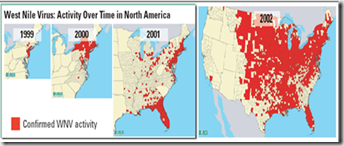
An impressive tally for a disease that infects humans – strictly speaking – only by virtue of happenstance. As you can see by the maps below, after its introduction in 1999, WNV spread across much of the United States in a matter of a few short years.  Today is is found in all 48 contiguous states.

image

From the USGS Factsheet on West Nile Virus


Chikungunya, on the other hand, has evolved to become a `humanized’ virus.  Outside of Africa (where it also resides in non-human primates), humans are the primary host for the virus, and once infected, can `amplify’  the virus efficiently for days.


According to the CDC: The risk of a person transmitting the virus to a biting mosquito or through blood is highest when the patient is viremic during the first 2–6 days of illness. 

image


Unlike with WNV, the majority of people infected with Chikungunya will become symptomatic. In their information for healthcare providers, the CDC lists:


Clinical findings

  • Majority of infected people become symptomatic
  • Incubation period usually 3–7 days (range 1–12 days)
  • Acute onset of fever and polyarthralgia are the primary clinical findings
  • Joint symptoms usually symmetric and often occur in hands and feet; they can be severe and debilitating
  • Other symptoms: Headache, myalgia, arthritis, conjunctivitis, nausea/vomiting, maculopapular rash
  • Lymphopenia, thrombocytopenia, elevated creatinine, and elevated hepatic transaminases are the most common clinical laboratory findings

Clinical course and outcomes

  • Acute symptoms typically resolve within 7–10 days
  • Rare complications include uveitis, retinitis, myocarditis, hepatitis, nephritis, bullous skin lesions, hemorrhage, meningoencephalitis, myelitis, Guillain-Barré syndrome, and cranial nerve palsies
  • Persons at risk for severe disease include neonates exposed intrapartum, older adults (e.g., > 65 years), and persons with underlying medical conditions (e.g., hypertension, diabetes, or cardiovascular disease)
  • Some patients might have relapse of rheumatologic symptoms (e.g., polyarthralgia, polyarthritis, tenosynovitis) in the months following acute illness
  • Studies report variable proportions of patients with persistent joint pains for months to years
  • Mortality is rare and occurs mostly in older adults


Treatment

  • No specific antiviral therapy
  • Supportive care with rest and fluids
  • Non-steroidal anti-inflammatory drugs (NSAIDs) to relieve acute pain and fever
  • Persistent joint pain may benefit from use of NSAIDs, corticosteroids, or physiotherapy

                        Over the past six months we’ve watched as Chikungunya  has spread across much of the Caribbean, infecting well over 100,000 people. While seemingly better equipped to spread across the United States than West Nile Virus – which, despite its limitations, has done a pretty good job – we really don’t know how much of a problem Chikungunya will pose to Americans this summer.  


                        We’ve had similar concerns with the expansion of Dengue – another `humanized’ arbovirus  that has made great strides around the globe – and has seen recent introductions into the United States (see MMWR: Dengue Fever In Key West).


                        While now the most common mosquito-borne virus in the world (causing up to 100 million infections a year), Dengue has managed to do little more than spark a few limited outbreaks in North America, despite an abundance of the right mosquito vectors.


                        In 2003, a CDC EID study looked at this paradox, and found that economics and lifestyle, may have more do to with our success against Dengue, than anything else.

                        Texas Lifestyle Limits Transmission of Dengue Virus

                        Paul Reiter* , Sarah Lathrop*, Michel L. Bunning*, Brad J. Biggerstaff*, Daniel Singer*, Tejpratap Tiwari*, Laura Baber†, Manuel Amador*, Jaime Thirion‡, Jack Hayes§, Calixto Seca¶, Jorge Mendez‡, Bernardo Ramirez#, Jerome Robinson†, Julie Rawlings¶, Vance Vorndam*, Stephen Waterman*, Duane Gubler*, Gary Clark*, and Edward Hayes*
                        Abstract

                        Urban dengue is common in most countries of the Americas, but has been rare in the United States for more than half a century. In 1999 we investigated an outbreak of the disease that affected Nuevo Laredo, Tamaulipas, Mexico, and Laredo, Texas, United States, contiguous cities that straddle the international border. The incidence of recent cases, indicated by immunoglobulin M antibody serosurvey, was higher in Nuevo Laredo, although the vector, Aedes aegypti, was more abundant in Laredo. Environmental factors that affect contact with mosquitoes, such as air-conditioning and human behavior, appear to account for this paradox. We conclude that the low prevalence of dengue in the United States is primarily due to economic, rather than climatic, factors.

                        Whether our luck will hold with Chikungunya (or continue to hold with Dengue) is anyone’s guess.  The global track record with both of these diseases has been impressive to date, and so one is not inclined to bet against their future success.


                        The overall risk of contracting a mosquito-borne illness anywhere in the United States remains very small, but it has increased in recent years, with the emergence of new threats like WNV, Dengue, and Chikungunya.


                        While there are no vaccines available for these viruses, these are still largely preventable diseases.  Local Health departments urge people to always follow the `5 D’s’ of prevention:

                        image

                        Tuesday, February 11, 2014

                        WNV: The Economic Costs Of An Invasive Arbovirus

                        image


                        # 8288


                        In 1999 the West Nile Virus (WNV) - which is enzootic throughout much of Africa, parts of Europe, Asia and Australia -suddenly, and quite unexpectedly, appeared in New York City.  Over the next few years it spread rapidly across the United States.


                        From the USGS Factsheet on West Nile Virus

                        image

                        In 2002, however, the virus really exploded across the nation’s landscape.

                        image


                        Today, WNV is routinely detected across much of the lower 48 and into Canada, and while the impact varies from year to year (2012 was much more severe than 2013), it is responsible for hundreds of thousands of human infections annually.


                        Most people infected with WNV experience only mild, or sub-clinical symptoms, but  very small percentage develop WNV neuroinvasive disease (WNND), a form of encephalitis. For every serious presentation, there are probably 100 mild, or asymptomatic cases.


                        Yesterday researchers with the Arboviral Diseases Branch, Centers for Disease Control and Prevention, published the first estimate of the economic impact of this recently introduced mosquito-borne diseases in the United States, and found the virus has likely cost the nation nearly 800 million dollars.


                        Their estimates come from tracking the medical and lost-productivity costs of 38 WNV cases from Colorado, and extrapolating their costs across the larger case count reported in the United States.  They write:


                        Less than 1% of infected persons develop neuroinvasive disease, which typically manifests as encephalitis, meningitis, or acute flaccid paralysis (AFP). 5  Most patients with WNV meningitis or non-neuroinvasive disease recover completely, but fatigue and malaise can linger for weeks or months.6–8  Patients who recover from WNV encephalitis or AFP often have residual neurologic deficits. 9 Among patients with neuroinvasive disease, the overall case-fatality ratio is 10%, but it is notably higher for patients with WNV encephalitis and AFP.1


                        From 1999 to 2012, over 36,000 cases and 1,500 deaths caused by WNV disease were reported to the Centers for Disease Control and Prevention (CDC).1,10–12


                        The study, which appears in the American Journal of Tropical Medicine & Hygiene, may be read at the link below:


                        Initial and Long-Term Costs of Patients Hospitalized with West Nile Virus Disease

                        J. Erin Staples*, Manjunath Shankar, James J. Sejvar, Martin I. Meltzer and Marc Fischer

                        Abstract

                        There are no published data on the economic burden for specific West Nile virus (WNV) clinical syndromes (i.e., fever, meningitis, encephalitis, and acute flaccid paralysis [AFP]). We estimated initial hospital and lost-productivity costs from 80 patients hospitalized with WNV disease in Colorado during 2003; 38 of these patients were followed for 5 years to determine long-term medical and lost-productivity costs. Initial costs were highest for patients with AFP (median $25,117; range $5,385–$283,381) and encephalitis (median $20,105; range $3,965–$324,167). Long-term costs were highest for patients with AFP (median $22,628; range $624–$439,945) and meningitis (median $10,556; range $0–$260,748).

                        Extrapolating from this small cohort to national surveillance data, we estimated the total cumulative costs of reported WNV hospitalized cases from 1999 to 2012 to be $778 million (95% confidence interval $673 million–$1.01 billion). These estimates can be used in assessing the cost-effectiveness of interventions to prevent WNV disease.


                        The authors grant that this study has a number of limitations, including potential recall bias by the patients, differences in medical costs and procedures around the nation, and a small and non-random cohort of cases.  They believe their estimate of costs to be conservative, however, as it did not attempt to estimate costs incurred by non-hospitalized cases, or un-reported disease.


                        The rapid spread of WNV across North America is considered by many as a warning of what could happen in the future with other mosquito-borne illnesses that are spreading around the globe.


                        Two in particular – Dengue and Chikungunya (CHKV) – are viewed as imminent threats.


                        In December, in response to the first Chikungunya outbreak in the New World, we saw a CDC HAN Advisory On Recognizing & Treating Chikungunya Infection, and in 2012 the CDC, along with PAHO, produced a document  Preparedness and Response for Chikungunya Virus Introduction in the Americas in anticipation of its arrival.


                        Last November, in Locally Acquired Dengue In New York City, we saw yet another (still rare) example of local transmission of Dengue in the United States, but with reports from both Texas and Florida increasing each year (see Florida: Dengue Forces Suspension Of Blood Donations In Two Counties) concerns are this will only become more common as time goes by.


                        In 2009 the Natural Resources Defense Council (NRDC) released a report outlining the risks that Dengue could re-establish itself in North America, that included this map showing the areas of the United States that are vulnerable to the introduction of Dengue.

                        image

                        Northern climes are far less likely to see dengue take hold than say, Florida or Southern Texas. Still, in the 18th and 19th century, both Malaria and Yellow Fever were endemic up and down the mid-Atlantic coast.


                        It’s a not-so-subtle reminder that the barriers we erect against infectious diseases – like mosquito control programs, vaccinations, and public health departments – are as tenuous as they are vital, and can fail us if we do not maintain and support them. 


                        Of course the true burden of these diseases in measured in lives and health lost to or diminished by infection, and is not something we can readily put a dollar sign on.


                        But for the purposes of allocating funds to fight these diseases, develop vaccines and/or treatments, and prevent future entry of new viruses, having an idea of the economic burden of  the disease can greatly assist in making policy decisions.

                        Wednesday, September 25, 2013

                        DVBID: West Nile Virus Update

                        image


                        # 7810


                        The CDC’s DVBID (Division of Vector Borne Infectious Diseases) has updated their West Nile numbers as reported to them through September 24th, and while these numbers continue to climb, they are far below where we were this time last year. The latest summary reads:


                        As of September 24, 2013, 48 states and the District of Columbia have reported West Nile virus infections in people, birds, or mosquitoes. A total of 1,135 cases of West Nile virus disease in people, including 44 deaths, have been reported to CDC. Of these, 529 (47%) were classified as neuroinvasive disease (such as meningitis or encephalitis) and 606 (53%) were classified as non-neuroinvasive disease.


                        Mild cases – called West Nile Fever – often go undiagnosed, with probably only 2%-3% being identified, whereas neuroinvasive cases (which present with meningitis, encephalitis, or flaccid Paralysis) are severe enough that they almost always result in hospitalization and diagnosis.


                        Neuroinvasive cases are considered a better indicator of the scope of each year’s epidemic, and the map below shows the states hardest hit this year by this more severe form of the illness.


                        image


                        As it can take several weeks after a person becomes infected before they are diagnosed and reported to the CDC – and deaths may occur months after infection - the numbers reported as of today are considered `lagging indicators’.  Still, this time last year, the numbers were roughly triple what has been reported to date (see 9/25/12 DVBID Update On West Nile Virus).


                        Texas. which bore the brunt of last year’s WNV activity (1868 cases, 89 deaths) has only reported 66 cases this summer, and 4 fatalities.


                        Comparatively speaking, we are seeing a milder season, and with October just a week away, the peak season for West Nile Virus is about over.


                        But infected mosquitoes are still out there, and so the risk of infection has not gone away entirely. A good reason to heed the advice of our local health departments to  follow the `5 D’s’ of mosquito protection.

                        image