Showing posts with label Candidate vaccine. Show all posts

Wednesday, March 25, 2015

WER: Development Of Candidate Vaccine Viruses For Pandemic Preparedness

image

H5 Clade Diversity Around the Globe – Credit WHO


# 9860


From time to time, the World Health Organization makes recommendations on new candidate influenza vaccine viruses (CVVs) for investigation and consideration, in case one of these emerging viruses begins to show pandemic potential.  The last time we looked at this was early in the Winter of 2014 (see Moving Viral Targets), where the WHO proposed that 2 new (H5N1 & H9N2) candidate vaccine viruses be developed.


Influenza A viruses are categorized by two proteins they carry on their surface; their HA (hemagglutinin) and NA (neuraminidase), resulting in subtypes like  H5N1, H7N9, or H3N2. 


While the list continues to expand, currently we know of 18 different HA proteins and 11 different NA proteins, making many different subtype combinations possible, although many of these combinations have yet to be observed in nature.


Within each strain, there are often genetic groupings called clades, and within each clade- subclades – and within each of these, many variants may exist.   And over time these clades, subclades, and variants may evolve antigenically enough away from its predecessors to require a reformulated vaccine.


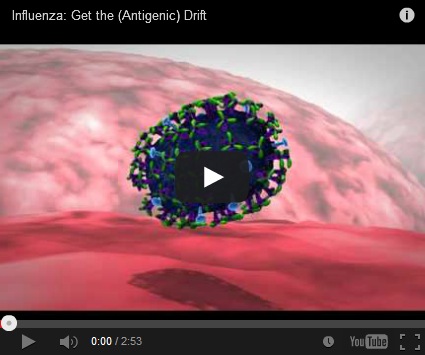
This constant evolution of influenza viruses is illustrated quite nicely in the NIAID video Influenza: Get the (Antigenic) Drift.


Over the past decade more than two dozen H5N1 candidate influenza vaccine viruses have either been developed or proposed, and with the recent emergence of H5N8, H5N2, H5N3 and H5N6 and the continued evolution of H5N1, that roster continues to grow.

This week, the WHO’s Weekly Epidemiological Record (WER) published  a new review of currently circulating zoonotic influenza viruses, and their recommendations for two new vaccine virus candidates (both H5’s), one based on the recent changes observed in Egypt’s H5N1 virus, and the other based on the recent introduction of H5N8 into North America. 


Antigenic and genetic characteristics of zoonotic influenza viruses and  development of candidate vaccine viruses for pandemic preparedness


February 2015


The development of representative candidate influenza vaccine viruses CVVs, coordinated by WHO, remains an essential component of the overall global strategy for pandemic preparedness.


Zoonotic influenza viruses continue to be identified and often evolve both genetically and antigenically, leading to the need to update CVVs for pandemic preparedness purposes. Changes in the genetic and antigenic characteristics of these viruses, their relationship to existing CVVs, and the associated potential risks for public health, justify the need to select and develop new CVVs.


Selection and development of CVVs are the first steps towards timely vaccine production and do not imply a recommendation for initiating manufacture. National authorities may consider the use of one or more of these CVVs for pilot lot vaccine production, clinical trials and other pandemic preparedness purposes based on their assessment of public health risk and need.

This document summarizes the genetic and antigenic characteristics of recent zoonotic influenza viruses and related viruses circulating in animals, and updates information on the availability of CVVs. Institutions that wish to receive these CVVs should contact WHO at gisrswhohq@who.int or the institutions  listed in announcements published on the WHO website

<SNIP>

Influenza A(H5) candidate vaccine viruses


Based on the available antigenic, genetic and epidemiologic data, A/Egypt/N04915/2014-like (clade 2.2.1) and A/gyrfalcon/Washington/41088-6/2014-like (clade 2.3.4.4) CVVs are proposed. The available and pending A(H5) CVVs are listed in Table 5. National authorities may consider the use of one or more of these A(H5) CVVs for pilot lot vaccine production, clinical trials and other pandemic preparedness purposes based on their assessment of public health risk and need. As the  viruses continue to evolve, new A(H5) CVVs may be developed.

(Continue . . . )


This document also reviews H7N9, H9N2, H5N6, and various swine variant (H1N1v, H3N2v) activity around the globe, and determines that no additional CVVs are required for these viruses at this time.

Friday, February 21, 2014

Moving Viral Targets

image

Diversity of circulating H5N1 Clades – Credit WHO


# 8319


Influenza A viruses are categorized by two proteins they carry on their surface; their HA (hemagglutinin) and NA (neuraminidase), resulting in subtypes like  H5N1, H7N9, or H3N2.  While the list continues to expand, currently we know of 18 different HA proteins and 11 different NA proteins, making many different subtype combinations possible, although many of these combinations have yet to be observed in nature.


And it gets more complicated, as within each subtype, multiple strains may appear.   A recent example came within the H1N1 subtype, which was the backbone of our seasonal flu for 90 years (1918-2008), but was supplanted by a radically different H1N1 virus in 2009. 


Within each strain, there are often genetic groupings called clades, and within each clade- subclades – and within each of these, many variants may exist.  This constant evolution of influenza viruses is illustrated quite nicely in the NIAID video Influenza: Get the (Antigenic) Drift.


Many of these variants (even entire clades) die off over time, unable to compete successfully with other – more biologically `fit’ – entrants in this evolutionary race.  But many of those that can infect humans – and persist and thrive in the wild – are perceived as posing a potential public health threat.


So from time to time, the World Health Organization makes recommendations on new candidate influenza vaccine viruses for investigation and consideration, in case one of these emerging viruses takes off.  The last time was early in the fall of 2013 (see WER: Antigenic & Genetic Comparisons Of Zoonotic Flu Viruses And Development Of Vaccine Candidates), where the WHO proposed that 4 new H5N1 candidate vaccine viruses be developed.


Yesterday, the WHO released a new review of currently circulating zoonotic influenza viruses, and their recommendations for two new vaccine virus candidates (H5N1 & H7N9).  No new vaccine virus candidates for H7N9 are announced, and investigative work has just begun on the recently observed H10N8 virus.


Antigenic and genetic characteristics of zoonotic influenza viruses and development of candidate vaccine viruses for pandemic preparedness


February 2014 


The development of representative candidate influenza vaccine viruses, coordinated by the World Health Organization (WHO), remains an essential component of the overall global strategy for pandemic preparedness.

Zoonotic influenza viruses continue to be identified and evolve both genetically and antigenically, leading to the need for update of candidate vaccine viruses for pandemic preparedness purposes. Evaluation of the genetic and antigenic characteristics of these viruses,  their  relationship to existing candidate vaccine viruses, and their potential risks to public health,  justify the  need to  select and  develop new candidate vaccine viruses.

Selection and development of a candidate vaccine virus represents a first step only towards timely vaccine production and does not  imply a recommendation for initiating manufacture. National  authorities may consider the use of one or more of these candidate vaccine viruses for pilot lot vaccine production, clinical trials and other pandemic preparedness purposes based on  their assessment of public health risk and need.

This document summarizes the genetic and antigenic characteristics of recent zoonotic influenza viruses from humans and related viruses circulating in animals and updates the availability of candidate vaccine viruses.  Institutions that wish to receive these candidate vaccine viruses should contact WHO at gisrs-whohq@who.int or the institutions listed in announcements published on the WHO website1.

<SNIP>

Influenza A(H5N1) candidate vaccine viruses 

Based on the available antigenic, genetic and epidemiologic data, an A/environment/Hubei/950/2013-like (clade 7.2) candidate vaccine virus is proposed. The available and proposed candidate A(H5N1) vaccine viruses are listed in Table 3. National authorities may consider the use of one or more of these candidate A(H5N1) vaccine viruses for pilot lot vaccine production, clinical trials and other pandemic preparedness purposes based on their assessment of public health risk and need.

As the viruses continue to evolve, new A(H5N1) candidate vaccine viruses may be developed. 

<SNIP>

Influenza A(H9N2) candidate vaccine viruses 


Based on the current antigenic, genetic and epidemiologic data, an A/Hong Kong/308/2014-like candidate vaccine virus is proposed. The available A(H9N2) candidate vaccine viruses are listed in Table  7. National authorities may consider the use of one or more of these candidate A(H9N2) vaccine viruses for pilot lot vaccine production, clinical trials and other pandemic preparedness purposes  based on their assessment of public health risk and need.

As the viruses continue to evolve, new A(H9N2) candidate vaccine viruses may be developed.


<SNIP>

Influenza A(H10N8)

Three  cases of  human  infection with avian influenza A(H10N8) viruses were reported from Jiangxi Province, China, with onset dates  from December 2013 to February 2014. All of these individuals had severe disease and two have died. All had reported contact with poultry or contaminated environments. To date, genetic information from one virus isolate is available, which showed all genes to be of avian origin and the internal genes to be derived from A(H9N2) viruses currently circulating widely in poultry in China.

This virus is susceptible to the neuraminidase inhibitor class of antiviral drugs. Information on the prevalence and distribution of  A(H10N8)  viruses in poultry in the  region  is limited, thus the assessment of its impact on public health is difficult.  At this time, the virus is being evaluated for its growth and antigenic properties and diagnostic reagents are being prepared. WHO is monitoring the situation closely.


Having updated candidate influenza vaccine viruses on hand can shave weeks (or even months) off the vaccine development timetable, should one of these clades suddenly take off.


But with so many clades in play – and the likelihood that older candidate viruses would produce an ineffective vaccine against newer strains – it doesn’t make sense to try to make a huge stockpile of any of these vaccines. 


Influenza viruses are constantly moving targets, and until an effective universal vaccine can be developed, the reality is we are always going to be playing catch-up with a very nimble foe.

Friday, October 18, 2013

WER: Antigenic & Genetic Comparisons Of Zoonotic Flu Viruses And Development Of Vaccine Candidates

image

Credit NIAID


# 7873


Influenza viruses are constantly changing, which is why seasonal flu vaccines must be adjusted nearly every year in an attempt to keep up with their evolution.  NIAID, part of the NIH, has a short (3 minute) video on Youtube that nicely illustrates how flu viruses change antigenically over time, and eventually mutate so that the current flu vaccine is no longer effective.


As you would expect, in the wild, avian and swine influenza viruses undergo similar changes.   


Small, incremental changes are called antigenic drift, and they occur more or less all of the time.   Most of these changes don’t convey any evolutionary advantage, and quickly disappear.  Occasionally, a `more biologically fit’  virus emerges, and blows away the competition.


More drastic changes can come by way of antigenic shift, also called reassortment. Shift occurs when one virus swap out chunks of their genetic code with gene segments from another virus.  While less common than drift, antigenic shift can quickly create a brand new `hybrid virus’.  One that can sometimes have pandemic potential.


For shift to happen, a host (human, swine, bird) must be infected by two influenza different viruses at the same time. 

reshuffle  

While successful reassortment is relatively rare, as any virologist will tell you . . . Shift happens.


H5N1 (aka `bird flu’) is not a single strain of influenza, but rather, a group of similar viruses sharing the same HA (hemagglutinin) and NA (neuraminidase) genes segments, that has continually evolved and mutated since its emergence in 1996.

You can see the evolution of the virus through 2011 in the chart below, starting with Clade 0, first detected in 1996.

image

Over the years more than 20 genetically separate clades of the virus have emerged (not all continue to circulate), with many minor variants of each clade thrown in the mix. 


Different areas of the world have seen different clades set up residence, with clade 2.3.2 (and now 2.3.2.1) very common in South East Asia, clades 2.2.1 and 2.2 endemic in Egypt and clades 2.1.1, 2.1.2. and 2.1.3 circulating in Indonesia.


The problem is, vaccines based on older clades may not provide significant protection against infection with one of the newer clades.  So the World Health Organization, NIH,  CDC, the Vaccine Manufacturing community, and others are pitted in an ongoing `arms race’ against a constantly changing set of viruses.


And we now have more than just H5N1 to concern ourselves with.  There are multiple clades or variants of zoonotic H7N9, H9N2, H7N7, H3N2v, et. al. circulating around the world.  


The list is long, and it grows longer each year.


Which brings us to a long report today, that appears in the World Health Organization’s  Weekly Epidemiological Record (h/t @Ironorehopper)  One that looks at the strains of these zoonotic viruses that are currently circulating, and the development of candidate vaccine viruses against them.


Although I’ve posted some small excerpts below, I would recommend that you follow the link to read the report and its accompanying charts in their entirety:


Antigenic and genetic characteristics of zoonotic influenza viruses and development of candidate vaccine viruses for pandemic preparedness, September 2013


The development of representative candidate influenza vaccine viruses, coordinated by WHO, remains an essential component of the overall global strategy for pandemic preparedness. Comparisons of the candidate vaccine viruses with respect to antigenicity and their relationship to newly emerging viruses are ongoing and will be reported periodically by WHO.

(1) Influenza A(H5N1)

Since their re-emergence in 2003, highly pathogenic avian influenza A(H5N1) viruses have become enzootic in some countries and continue to cause outbreaks in poultry as well as sporadic human infections. The A(H5N1) viruses have diversified both genetically and antigenically leading to the need for multiple candidate vaccine viruses for pandemic preparedness purposes. This summary provides updates on the characterization of A(H5N1) viruses isolated from birds and humans, and the current status of the development of influenza A(H5N1) candidate vaccine viruses.

(Continue . . . )


Given its duration, and continued evolution, not surprisingly the WHO is proposing that 4 new H5N1 candidate vaccine viruses be developed.


Based on the available antigenic, genetic and epidemiologic data, A/duck/Bangladesh/19097/2013-like (clade 2.3.2.1), A/duck/Viet Nam/NCVD-1584/2012-like (clade 2.3.2.1) and A/Cambodia/W0526301/2012-like (clade 1.1) candidate vaccine viruses are proposed.


The WHO has previously selected candidate vaccine viruses for H3N2v, H9N2, H7N7, H7N3, and H7N9, and have not proposed work on any new vaccine strains for these flu types in this latest report.

Friday, September 30, 2011

WHO Report : Antigenic & Genetic Characteristics of H5N1 & H9N2 Viruses


# 5874


The World Health Organization has published a 12-page document (dated 9/29) – that summarizes recent global activity of A(H5N1) and A(H9N2) avian influenza viruses and describes the current status of candidate vaccines under development.


Similar reports have been issued twice each year since 2006.


This latest report may be read, and downloaded at:


Antigenic and genetic characteristics of influenza A(H5N1) and influenza A(H9N2) viruses and candidate vaccine viruses developed for potential use in human vaccines

September 2011

This summary provides a review on the influenza A(H5N1) and A(H9N2) virus activity and virus characterization, and describes the current status of the development of new A(H5N1) and A(H9N2) candidate vaccine viruses. It is meant to provide guidance for national authorities and vaccine companies on the selection of candidate viruses for use in vaccine development.

image

As you can tell by the above chart, the H5N1 virus continues to diversify into additional clades - and there  remain substantial gaps in our knowledge of the virus – particularly among strains circulating in Indonesia.


The spread of the 2.3.2.1 clade of the virus – which was the subject of an FAO announcement (see FAO Warns On Bird Flu) a month ago – is particularly  pronounced in this report with detections in Bangladesh, China Hong Kong SAR, India, Japan, the Republic of Korea, Myanmar, and Vietnam.


This `new’ clade differs antigenically from the poultry vaccines currently being used in many Asian countries, and the concern is that a new wave of bird flu may spread through poultry this winter.


This document summaries this new clade by saying:


Clade 2.3.2.1 (previously part of clade 2.3.2) viruses were detected in wild birds in Bangladesh, Japan and  the  Republic of Korea, and  also  in poultry in  Bangladesh,  China  Hong Kong Special
Administrative Region (China Hong Kong SAR), India, Japan, Myanmar, Republic of Korea and Viet
Nam.

Although  there is some genetic  (Figure 3) and antigenic heterogeneity  among  viruses of this
clade, recently  isolated viruses reacted well with post-infection ferret antisera against either A/Hong
Kong/6841/2010  (an  A/Hubei/1/2010-like virus)  or  A/barn swallow/Hong Kong/D10-1161/2010
(Tables 2 and 3), from which candidate vaccine viruses have been developed (Table 5). 


While newer 2.3.2.1 clade samples reacted well against a couple of candidate vaccines already selected, the 2.3.4.2 clade out of Bangladesh does not. Therefore, the development of a new clade 2.3.4.2 candidate vaccine virus is proposed.


Similarly, after the detection of a human infection by the avian H9N2 virus in Bangladesh earlier this year, a proposal has been made to develop a candidate vaccine for that strain as well.


And lastly, the document addresses the detection of several SOIV (Swine Origin Influenza Virus) infections this year in Indiana, and Pennsylvania.


Swine-Origin Influenza A(H3N2) 

Swine influenza A(H3N2) viruses are enzootic in swine herds of North America and other parts of the
world. Characterisation of recent A(H3N2) viruses from swine in North America indicates that their HA genes have evolved from the human virus precursors that circulated in the mid-1990s. Isolation of swine-origin influenza viruses (SOIV) A(H3N2) from humans has been reported infrequently.  The United States of America reported eight infections due to A(H3N2) SOIV between January 2005 and 15 February 2011. 


A(H3N2) SOIV infections from 16 February 2011 to 19 September  2011

There have been four human infections  with A(H3N2) SOIV  in the states of Indiana (1) and Pennsylvania (3), United States of America, in this period. The HA and neuraminidase genes of these four viruses were similar to those  of swine viruses that circulate  in the United States  of America.


Sequencing data indicated that the  matrix  genes of these viruses were acquired  from an A(H1N1)pdm09 virus, unlike SOIV isolates from previous human cases.

Antigenic analysis indicated that these viruses were distinct from currently circulating human  A(H3N2)  viruses  but  similar to  swine A(H3N2) viruses from previous years as well as to A/Minnesota/11/2010 (H3N2) SOIV (Table 7), from which a candidate vaccine virus is under development.


Avian viruses, like all influenza A viruses, are constantly under pressure to change and mutate, looking for a biological advantage. Most of these mutations, thankfully, are evolutionary dead ends and fail to spread and thrive.


But in this viral version of king-of-the-hill, nature occasionally produces a more `fit’ and competitive virus, and it begins to dominate and spread.


Which is why continual monitoring of the genetic and antigenic changes in these viruses is so crucial.  As avian viruses evolve, new candidate vaccines must be developed, else we could be caught flat footed if a pandemic suddenly began.


Having a candidate vaccine already in hand could save weeks in the time it would take to produce and deploy an emergency vaccine. 


And during a severe pandemic, a few weeks delay could translate into the loss of thousands of lives.