Showing posts with label Cryptosporidium. Show all posts

Thursday, June 19, 2014

Reminder: COCA Call Today On Naegleria Fowleri & Cryptosporidium

image

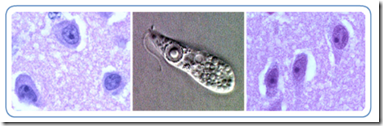
L & R: Trophozoites of N. fowleri in brain tissue, stained with H&E. Center: Ameboflagellate trophozoite of N. fowleri. Credit: DPDx


#8760


A reminder that later today (June 19th) at 2pm EDT, the CDC will conduct an online COCA call on two important waterborne pathogens;  Naegleria Fowleri – which, while rare, can cause an almost always fatal brain infection - and Cryptosporidium.


This call is particularly important for clinicians, as last year, for the first time – two children who received an investigational drug called miltefosine  - survived. (see MMWR: CDC Imports Investigational Drug For Amoebic Infections).


But to be effective, this infection must be recognized early, and treatment initiated as soon a possible.  Hence the need to get the world out to clinicians on this important development.


Healthy Swimming: Prevent and Treat Infections Caused by Brain-Eating Amebas and Chlorine-Tolerant Parasites

Image of Continuing Education Credits abbreviation. = Free Continuing Education

Date:Thursday, June 19, 2014

Time:2:00 – 3:00 PM (Eastern Time)

Dial:888-233-9077 (U.S. Callers)
             773-799-3915 (International Callers)

Passcode:4972213

Webinar:https://www.mymeetings.com/nc/join.php?i=PW2017964&p=4972213&t=c

Presenter(s)

Jennifer Cope, MD, MPH
Medical Epidemiologist
Waterborne Disease Prevention Branch
National Center for Emerging and Zoonotic Infectious Diseases ─ CDC

Michele Hlavsa, RN, MPH
Epidemiologist
Waterborne Disease Prevention Branch
National Center for Emerging and Zoonotic Infectious Diseases ─ CDC

Overview

Swimming and other water-related activities are popular during the summer. However, Naegleria fowleri, known as the brain-eating ameba, may be present in warm freshwater and can result in primary amebic meningoencephalitis (PAM) – a rare disease that is almost always fatal. Additionally, the chlorine-tolerant parasite Cryptosporidium, is one of the most frequent causes of waterborne disease among humans in the United States. During this COCA call, clinicians will learn about PAM and diarrhea resulting from Cryptosporidium, how to prevent these diseases, and what to do if you suspect your patient has one of them.

(Continue . . . )


For some of my earlier blogs on Naegleria Fowleri, you may wish to check out:


Naegleria Fowleri: Rare, Deadly & Avoidable

Louisiana: St. Bernard Parish Water Supply Tests Positive For Naegleria Fowleri

Florida Reports Naegleria fowleri Infection


And for more on Cryptosporidium, you may wish to revisit these blogs:

Eurosurveillance: More Tales From The Crypto

More Tales From The Crypto

UK: Return To The Crypto

Friday, June 13, 2014

Upcoming COCA Call: Naegleria Fowleri & Cryptosporidium Prevention And Treatment

image

L & R: Trophozoites of N. fowleri in brain tissue, stained with H&E. Center: Ameboflagellate trophozoite of N. fowleri. Credit: DPDx


# 8738


Two serious summer-time related infections are often linked to recreational swimming; Cryptosporidium and PAM (Primary Amoebic Meningoencephalitis) associated with Naegleria fowleri infection.  Of the two, Cryptosporidium is by far the most common, but PAM (until recently) has been considered almost invariably fatal.


Nearly every summer we follow sporadic cases of both (see Naegleria Fowleri: Rare, Deadly & Avoidable & Tales From The Crypto), but this year, there is important news regarding the treatment of PAM.


Last year, for the first time in 3 decades, we saw survivors of PAM in the United States – two children – who had received an investigational drug called miltefosine. Last year the CDC announced:

Clinicians: CDC now has an investigational drug called miltefosine available for treatment of free-living ameba (FLA) infections caused by Naegleria fowleri, Balamuthia mandrillaris, and Acanthamoeba species. If you have a patient with suspected FLA infection, please contact the CDC Emergency Operations Center at 770-488-7100 to consult with a CDC expert regarding the use of this drug.


But to be effective, this infection must be recognized early, and treatment initiated as soon a possible.  Hence the need to get the world out to clinicians on this important development.


Next week the CDC will hold a COCA (Clinician Outreach Communication Activity) call for clinicians on both Cryptosporidium and Naegleria.  While primarily of interest to clinicians, others in health-related fields may find these web events of interest as well.  Details follow:


Healthy Swimming: Prevent and Treat Infections Caused by Brain-Eating Amebas and Chlorine-Tolerant Parasites

Image of Continuing Education Credits abbreviation. = Free Continuing Education

Date:Thursday, June 19, 2014

Time:2:00 – 3:00 PM (Eastern Time)

Dial:888-233-9077 (U.S. Callers)
             773-799-3915 (International Callers)

Passcode:4972213

Webinar:https://www.mymeetings.com/nc/join.php?i=PW2017964&p=4972213&t=c

Presenter(s)

Jennifer Cope, MD, MPH
Medical Epidemiologist
Waterborne Disease Prevention Branch
National Center for Emerging and Zoonotic Infectious Diseases ─ CDC

Michele Hlavsa, RN, MPH
Epidemiologist
Waterborne Disease Prevention Branch
National Center for Emerging and Zoonotic Infectious Diseases ─ CDC

Overview

Swimming and other water-related activities are popular during the summer. However, Naegleria fowleri, known as the brain-eating ameba, may be present in warm freshwater and can result in primary amebic meningoencephalitis (PAM) – a rare disease that is almost always fatal. Additionally, the chlorine-tolerant parasite Cryptosporidium, is one of the most frequent causes of waterborne disease among humans in the United States. During this COCA call, clinicians will learn about PAM and diarrhea resulting from Cryptosporidium, how to prevent these diseases, and what to do if you suspect your patient has one of them.

Objectives

At the conclusion of the session, the participant will be able to accomplish the following:

  • Describe the epidemiology, clinical features, diagnostic testing, and treatments available
  • Discuss the steps that can be taken to prevent PAM and cryptosporidiosis
  • State the protocol for contacting CDC to obtain clinical consultation, diagnostic testing, and the investigative drug miltefosine for treatment of PAM caused by Naegleria fowleri

Additional Resources


And for more on Cryptosporidium, you may wish to revisit these blogs:


Eurosurveillance: More Tales From The Crypto
More Tales From The Crypto
UK: Return To The Crypto

Wednesday, March 20, 2013

UK: Return To The Crypto

image

Credit CDC PHIL


# 7016


Like murders, not every disease outbreak ends up being solved, and sometimes success only comes after months of dogged detective work, when the identity, source, and route of an outbreak are at last revealed.


Last summer the UK reported a sharp spike in Cryptosporidium (aka `Crypto’) cases during the month of May, which I covered in a pair of blogs (see Tales From The Crypto & More Tales From The Crypto). 


At the time, no source of infection was immediately apparent, and so general precautions were offered to the public as the `usual suspects’ were investigated.


In June, the HPA released a statement:


Update 8 June: Increase in cases of cryptosporidiosis

(EXCERPT)

The Health Protection Agency (HPA) continues to lead a multi-agency investigation to determine whether recent cases of cryptosporidiosis are linked to a common source.


<SNIP>


So far investigations have not identified a likely source of infection. The Drinking Water Inspectorate has confirmed that there is currently no evidence that public water supplies are implicated.


Cryptosporidiosis is caused by an organism called Cryptosporidium, which is found in soil, food, water or surfaces that have been contaminated with infected human or animal droppings. People can become infected by consuming contaminated water or food, by swimming in contaminated water, for example in lakes or rivers, or through contact with infected animals. The most common symptom is diarrhoea, which can range from mild to severe.

(Continue . . .)


In January of 2013, in Eurosurveillance: More Tales From The Crypto, we saw a report indicating that in addition to the UK, the Netherlands and Germany also saw unusual spikes in Cryptosporidium infections last summer.


Again, no immediate cause, or causes, was identified.  This from the Eurosurveillance report:


Because the number of Cryptosporidium-positive samples in the Netherlands, the UK and Germany increased during the same period, common exposures or influencing factors might be expected. However, no single source has been found that could explain the increase of cryptosporidiosis seen in these countries. Foreign travel has been an important risk in the UK and bottled mineral water raised as a hypothesis in the Netherlands.


However, plausible factors might include multiple sources, extreme weather conditions, person-to-person transmission and other, still unidentified risk factors. Alternatively, the increase in different countries may have developed independently which could explain the difference in age distribution compared to previous years in the Netherlands but not in the UK and Germany.


Yesterday, the HPA announced that – at least in the UK – they’ve identified the likely culprit of last summer’s outbreak, albeit through the use of circumstantial evidence.


Investigation into an outbreak of Cryptosporidium infection in spring 2012

19 March 2013

The Health Protection Agency (HPA) can confirm that findings of an investigation into an outbreak of Cryptosporidium infection that affected around 300 people in England and Scotland in May 2012 showed strong evidence of an association with eating pre-cut bagged salad products which are likely to have been labelled as ‘ready-to-eat’. The outbreak was short lived and the numbers of cases returned to expected seasonal levels within a month of the first cases being reported. Most of those affected had a mild to moderate form of illness and there were no deaths associated with the outbreak.


The HPA conducted an extensive investigation which involved interviewing people who became unwell about their food history and shopping habits and comparing these with a similar number of people who were not unwell.


In the analysis of the exposure to different salad vegetables (irrespective of retailer) a significant statistical association was found between infection and the consumption of pre-cut spinach. When specific retailers were included in the analysis, the strongest association with infection was found to be with consumption of ready to eat pre-cut mixed salad leaves from a major supermarket chain. In this analysis, exposure to pre-cut spinach only reached conventional levels of significance for one retailer - a second major supermarket chain. A link to spinach from a number of other retailers was also suggested but these were not statistically significant. Together these findings suggest that one or more types of salad vegetables could have been contaminated.


The Food Standards Agency (FSA), who were part of the outbreak control team led by the HPA, gathered information on the production and distribution of salad vegetables to try to identify the likely source of the outbreak. Investigation of the food chain including practice and procedures throughout each stage of growing, processing, packing and distribution of salad vegetables has not identified a source of contamination. Bagged salad on sale in supermarkets is often sourced from the same suppliers for most leaf types, often with common production lines packing product for several retailers at the same time. This was the situation in this case.


Dr Stephen Morton, regional director of the HPA’s Yorkshire and the Humber region and head of the multi-agency Outbreak Control Team, said: “This outbreak was fortunately short lived but it was important to see if we could find the source. Our findings suggest that eating mixed leaf bagged salad was the most likely cause of illness.


“It is however often difficult to identify the source of short lived outbreaks of this type as by the time that the outbreak can be investigated, the affected food and much of the microbiological evidence may no longer be available.

(Continue . . . )


The deduction that mixed leaf bagged salad was behind the UK outbreak is not terribly surprising, as Crypto is often a foodborne illness.


According to an EID Journal study published in 2011, there are estimated to be nearly 750,000 Crypto infections in the United States alone each year (see Foodborne Illness Acquired in the United States—Major Pathogens).


For most healthy individuals, a Crypto infection is an unpleasant, but not life threatening illness.  The most common symptoms (which generally last 1 to 2 weeks) are:


  • Watery Diarrhea
  • Stomach cramps or pain
  • Dehydration
  • Nausea
  • Vomiting
  • Fever
  • Weight loss


Although rarely fatal in healthy individuals, `Crypto’ can be deadly for the very young, the very old, and those with compromised immune systems.


Given its prevalence in the environment, and the number of human infections each year, prevention is key. The CDC maintains an extensive webpage devoted to Prevention & Control of Cryptosporidiosis.

Thursday, January 10, 2013

Eurosurveillance: More Tales From The Crypto

image

Photo Credit CDC PHIL 

While generally thought of a waterborne illness, Crypto may be found in soil, food, water, or on surfaces that have been contaminated with the feces from infected humans or animals.


# 6844


Last summer in a pair of blogs (see Tales From The Crypto & More Tales From The Crypto) I wrote about an unusual spike in gastrointestinal illnesses reported across England due to the Cryptosporidium parasite, or as it is commonly known, “Crypto”.


Today the journal EuroSurveillance carries a rapid communications that indicates that in addition to the UK, The Netherlands and Germany also experienced unusual spikes in Cryptosporidium infections last summer.


Eurosurveillance, Volume 18, Issue 2, 10 January 2013

Rapid communications

Simultaneous increase of Cryptosporidium infections in the Netherlands, the United Kingdom and Germany in late summer season, 2012

N Fournet, M P Deege, A T Urbanus, G Nichols, B M Rosner, R M Chalmers, R Gorton, K G Pollock, J W B van der Giessen, P C Wever, J W Dorigo-Zetsma, B Mulder, T G Mank, I Overdevest, J G Kusters, W van Pelt, L M Kortbeek


Date of submission: 12 December 2012


Starting August 2012, an increase in Cryptosporidium infections was reported in the Netherlands, the United Kingdom and Germany. It represented a 1.8 to 4.9-fold increase compared to previous years. Most samples were C. hominis IbA10G2. A case–control study was performed in the Netherlands but did not identify an endemic source. A case–case study in the north of England found travel abroad to be the most common risk factor.


A good deal of data is presented, and several theories as to what may have contributed to this simultaneous spike in Crypto cases, but as the following passage indicates, no specific cause has been determined.


Because the number of Cryptosporidium-positive samples in the Netherlands, the UK and Germany increased during the same period, common exposures or influencing factors might be expected. However, no single source has been found that could explain the increase of cryptosporidiosis seen in these countries. Foreign travel has been an important risk in the UK and bottled mineral water raised as a hypothesis in the Netherlands.


However, plausible factors might include multiple sources, extreme weather conditions, person-to-person transmission and other, still unidentified risk factors. Alternatively, the increase in different countries may have developed independently which could explain the difference in age distribution compared to previous years in the Netherlands but not in the UK and Germany.


This increase in cryptosporidiosis across a wider geographic area highlights the need for wider surveillance, development of better subtyping methods, the inadequacy of controls for travel-related infections and a need for further work on bottled waters [18] and foods as potential Cryptosporidium risks.


Although rarely fatal in healthy individuals, `Crypto’ can prove deadly for the very young, the very old, and those with compromised immune systems. For most healthy individuals, a Crypto infection is an unpleasant, but not life threatening illness.  The most common symptoms (which generally last 1 to 2 weeks) are:

  • Watery Diarrhea
  • Stomach cramps or pain
  • Dehydration
  • Nausea
  • Vomiting
  • Fever
  • Weight loss


According to an EID Journal study published in early 2011, Americans are estimated to get 750,000 Crypto infections each year (see Foodborne Illness Acquired in the United States—Major Pathogens), although only about 8,000 are laboratory confirmed.


Occasionally campers, swimmers, or those drawing water from untreated wells will contract Crypto here in the United States.  The largest outbreak occurred in Milwaukee in 1993, when Cryptosporidium entered the public water supply (exactly how, remains a mystery), and sickened 400,000 people and killed more than 100 who were immunocompromised.


Cryptosporidium is an extremely chlorine-tolerant parasite, making it particularly difficult to eliminate from swimming pools, fountains, and public water sources. 


The Milwaukee incident has led to increased water testing, and the use of ozone, filters, and other interventions across the nation to help make our water supply safer.


Given its prevalence in the environment, and the number of human infections each year, prevention is key. The CDC maintains an extensive webpage devoted to Prevention & Control of Cryptosporidiosis.


The following recommendations are intended to help prevent and control cryptosporidiosis.
Practice Good Hygiene
Everywhere
  • Wash hands with soap and water for at least 20 seconds, rubbing hands together vigorously and scrubbing all surfaces:
    • Before preparing or eating food
    • After using the toilet
    • After changing diapers or cleaning up a child who has used the toilet
    • Before and after tending to someone who is ill with diarrhea
    • After handling an animal or animal waste
At child care facilities
  • To reduce the risk of disease transmission, children with diarrhea should be excluded from child care settings until the diarrhea has stopped.
At recreational water venues (pools, interactive fountains, lakes, ocean)
  • Protect others by not swimming if you are experiencing diarrhea (this is essential for children in diapers). If diagnosed with cryptosporidiosis, do not swim for at least 2 weeks after diarrhea stops.
  • Shower before entering the water.
  • Wash children thoroughly (especially their bottoms) with soap and water after they use the toilet or their diapers are changed and before they enter the water.
  • Take children on frequent bathroom breaks and check their diapers often.
  • Change diapers in the bathroom, not at the poolside.
Around animals
  • Minimize contact with the feces of all animals, particularly young animals.
  • When cleaning up animal feces, wear disposable gloves, and always wash hands when finished.
  • Wash hands after any contact with animals or their living areas.
Outside
  • Wash hands after gardening, even if wearing gloves.
Immunocompromised persons
  • Avoid close contact with any person or animal that has cryptosporidiosis. Cryptosporidiosis can become a life threatening disease for immunocompromised persons.
  • Do not handle animal feces because infection can be life threatening for immunocompromised persons.
Saturday, June 09, 2012

More Tales From The Crypto


# 6375


A little more than a week ago, in Tales From The Crypto, I wrote about an HPA (Health Protection Agency) investigation into an unusually large number of gastrointestinal illnesses being reported across England due to the Cryptosporidium parasite, or as it is commonly called, “Crypto”.


Over the past 7 days another 60 people have been diagnosed with this (generally) waterborne illness from the four regions of the North East, Yorkshire, West Midlands and East Midlands, bringing the total since early May to 327 (compared to 82 during the same period in 2011).


While still elevated above normal, the number of new cases over the past week is less than was seen during the previous two weeks, and not all of these may be attributed to this outbreak.


It is too soon to know if this outbreak has peaked.


The source of infection has yet to be identified. Local water authorities reassure that there is no evidence of contamination of the public water supply.


While generally thought of a waterborne illness, Crypto may be found in soil, food, water, or on surfaces that have been contaminated with the feces from infected humans or animals.


image

Photo Credit CDC PHIL


Here is the latest Health Protection Agency update on the Crypto outbreak, followed by some prevention advice from the CDC.


Update 8 June: Increase in cases of cryptosporidiosis

8 June 2012

The Health Protection Agency (HPA) continues to lead a multi-agency investigation to determine whether recent cases of cryptosporidiosis are linked to a common source.


The English regions most affected by the increase in cases continue to be the North East, Yorkshire, West Midlands and East Midlands. An additional 60 cases of cryptosporidiosis have been confirmed across the four regions between 01 June and 07 June 2012, taking the total number of cases confirmed in these regions since 11 May 2012 to 327. This compares to 82 cases of the infection confirmed across the four regions within the same period the previous year (11 May 2011 to 07 June 2011).


Most people affected had a mild to moderate form of illness and the HPA is not aware that any cases reported in the past week (since 1 June) have been hospitalised.


So far investigations have not identified a likely source of infection. The Drinking Water Inspectorate has confirmed that there is currently no evidence that public water supplies are implicated.


Cryptosporidiosis is caused by an organism called Cryptosporidium, which is found in soil, food, water or surfaces that have been contaminated with infected human or animal droppings. People can become infected by consuming contaminated water or food, by swimming in contaminated water, for example in lakes or rivers, or through contact with infected animals. The most common symptom is diarrhoea, which can range from mild to severe.


Dr Stephen Morton, who is leading the investigation for the HPA, said: “The latest figures show that the sudden upturn in cases seen in May 2012 has not continued into the first week of June. The majority of cases became ill between 11 and 18 May. Whilst the increase is higher than we might expect at this time of year, it is not unusual to see an increase in cryptosporidiosis cases in the early summer and not all of the cases reported since 11 May are likely to be linked.

(Continue . . . )


Crypto infections occur around the globe, and according to an EID Journal study published last year, there are estimated to be nearly 750,000 Crypto infections in the United States each year (see Foodborne Illness Acquired in the United States—Major Pathogens).


For most healthy individuals, a Crypto infection is an unpleasant, but not life threatening illness.  The most common symptoms (which generally last 1 to 2 weeks) are:


  • Watery Diarrhea
  • Stomach cramps or pain
  • Dehydration
  • Nausea
  • Vomiting
  • Fever
  • Weight loss


Although rarely fatal in healthy individuals, `Crypto’ can be deadly for the very young, the very old, and those with compromised immune systems.


All of which makes prevention key.  The CDC gives the following advice to reduce exposure to Crypto.


Practice Good Hygiene
Everywhere
  • Wash hands with soap and water for at least 20 seconds, rubbing hands together vigorously and scrubbing all surfaces:
    • Before preparing or eating food
    • After using the toilet
    • After changing diapers or cleaning up a child who has used the toilet
    • Before and after tending to someone who is ill with diarrhea
    • After handling an animal or animal waste
At child care facilities
  • To reduce the risk of disease transmission, children with diarrhea should be excluded from child care settings until the diarrhea has stopped.
At recreational water venues (pools, interactive fountains, lakes, ocean)
  • Protect others by not swimming if you are experiencing diarrhea (this is essential for children in diapers). If diagnosed with cryptosporidiosis, do not swim for at least 2 weeks after diarrhea stops.
  • Shower before entering the water.
  • Wash children thoroughly (especially their bottoms) with soap and water after they use the toilet or their diapers are changed and before they enter the water.
  • Take children on frequent bathroom breaks and check their diapers often.
  • Change diapers in the bathroom, not at the poolside.
Around animals
  • Minimize contact with the feces of all animals, particularly young animals.
  • When cleaning up animal feces, wear disposable gloves, and always wash hands when finished.
  • Wash hands after any contact with animals or their living areas.
Outside
  • Wash hands after gardening, even if wearing gloves.

Friday, June 01, 2012

Tales From The Crypto


# 6359


Earlier today (June 1st), the UK’s Health Protection Agency  issued a statement on their investigation into an unusually large number of gastrointestinal illnesses being reported across England due to the Cryptosporidium parasite, or as it is commonly called, “Crypto”.


Since this little nasty is one of the most common causes of waterborne diseases among humans (even in developed countries), and it is often acquired during the summer swimming season, today seemed like a good day to take a look at this hardy little parasite.


First, the HPA announcement, which has as yet been unable to locate a common source for the outbreaks reported across England over the past 3 weeks.


Increase in cases of cryptosporidiosis

1 June 2012

The Health Protection Agency (HPA) can confirm it is investigating a recent increase in cases of the gastrointestinal infection, cryptosporidiosis, across four regions in England – the North East, Yorkshire, West Midlands and East Midlands.


To date, 267 cases of cryptosporidiosis have been confirmed in the affected areas since 11 May 2012, compared to 73 cases across the four regions for the whole of May 2011.


The HPA is leading a multi-agency investigation to determine whether these recent cases are linked. So far investigations have not identified a possible source of infection and the distribution of cases suggests it is unlikely that public water supplies are implicated.


Cryptosporidiosis is caused by a tiny organism called Cryptosporidium, which is found in soil, food, water, or surfaces that have been contaminated with infected human or animal droppings. People can become infected by consuming contaminated water or food, by swimming in contaminated water, for example in lakes or rivers, or through contact with infected animals. The most common symptom is diarrhoea, which can range from mild to severe.

(Continue . . . )


image

Photo Credit CDC PHIL 


Although rarely fatal in healthy individuals, `Crypto’ can be deadly for the very young, the very old, and those with compromised immune systems


Occasionally campers, swimmers, or those drawing water from untreated wells will contract Crypto here in the United States.  The largest outbreak occurred in Milwaukee in 1993, when Cryptosporidium entered the public water supply (exactly how, remains a mystery), and sickened 400,000 people and killed more than 100 who were immunocompromised.


Cryptosporidium is chlorine resistant, making it particularly difficult to eliminate from water sources.  The Milwaukee incident has led to increased water testing, and the use of ozone, filters, and other interventions across the nation to help make our water supply safer.


Measures that are pretty much unavailable for most of the developing world.


According to an EID Journal study published in early 2011, there are estimated to be nearly 750,000 Crypto infections in the United States each year (see Foodborne Illness Acquired in the United States—Major Pathogens), although fewer than 8,000 are usually laboratory confirmed.


For most healthy individuals, a Crypto infection is an unpleasant, but not life threatening illness.  The most common symptoms (which generally last 1 to 2 weeks) are:


  • Watery Diarrhea
  • Stomach cramps or pain
  • Dehydration
  • Nausea
  • Vomiting
  • Fever
  • Weight loss


And some people (the lucky ones) will have no symptoms at all. Most people with healthy immune systems will recover without any specific treatment, beyond drinking lots of fluids to prevent dehydration. 


As far as how it is spread, the CDC lists:


Crypto lives in the intestine of infected humans or animals. An infected person or animal sheds Cryptosporidium parasites in the stool. Millions of Crypto parasites can be released in a bowel movement from an infected human or animal. Shedding begins when the symptoms begin and can last for weeks after the symptoms (e.g., diarrhea) stop. You can become infected after accidentally swallowing the parasite. Crypto may be found in soil, food, water, or surfaces that have been contaminated with the feces from infected humans or animals. Crypto is not spread by contact with blood. Crypto can be spread:

  • By putting something in your mouth or accidentally swallowing something that has come in contact with the stool of a person or animal infected with Crypto.
  • By swallowing recreational water contaminated with Crypto. Recreational water can be contaminated with sewage or feces from humans or animals.
  • By swallowing water or beverages contaminated by stool from infected humans or animals.
  • By eating uncooked food contaminated with Crypto. All fruits and vegetables you plan to eat raw should be thoroughly washed with uncontaminated water.
  • By touching your mouth with contaminated hands. Hands can become contaminated through a variety of activities, such as:
    • touching surfaces (e.g., toys, bathroom fixtures, changing tables, diaper pails) that have been contaminated by stool from an infected person,
    • changing diapers,
    • caring for an infected person, and
    • handling an infected cow or calf.


Given its prevalence in the environment, and the number of human infections each year, prevention is key.


Again from the CDC.


Prevention & Control of Cryptosporidiosis
The following recommendations are intended to help prevent and control cryptosporidiosis.
Practice Good Hygiene
Everywhere
  • Wash hands with soap and water for at least 20 seconds, rubbing hands together vigorously and scrubbing all surfaces:
    • Before preparing or eating food
    • After using the toilet
    • After changing diapers or cleaning up a child who has used the toilet
    • Before and after tending to someone who is ill with diarrhea
    • After handling an animal or animal waste
At child care facilities
  • To reduce the risk of disease transmission, children with diarrhea should be excluded from child care settings until the diarrhea has stopped.
At recreational water venues (pools, interactive fountains, lakes, ocean)
  • Protect others by not swimming if you are experiencing diarrhea (this is essential for children in diapers). If diagnosed with cryptosporidiosis, do not swim for at least 2 weeks after diarrhea stops.
  • Shower before entering the water.
  • Wash children thoroughly (especially their bottoms) with soap and water after they use the toilet or their diapers are changed and before they enter the water.
  • Take children on frequent bathroom breaks and check their diapers often.
  • Change diapers in the bathroom, not at the poolside.
Around animals
  • Minimize contact with the feces of all animals, particularly young animals.
  • When cleaning up animal feces, wear disposable gloves, and always wash hands when finished.
  • Wash hands after any contact with animals or their living areas.
Outside
  • Wash hands after gardening, even if wearing gloves.
Immunocompromised persons
  • Avoid close contact with any person or animal that has cryptosporidiosis. Cryptosporidiosis can become a life threatening disease for immunocompromised persons.
  • Do not handle animal feces because infection can be life threatening for immunocompromised persons.


To learn more about Crypto, the CDC maintains a large Crypto Information Site.