Showing posts with label Dr. Lucy Jones. Show all posts

Tuesday, December 09, 2014

Los Angeles Unveils Earthquake Retrofit & Resilience Plan

image

Resilient By Design PDF


# 9424


Last December, in Dr. Lucy Jones: `Imagine America Without Los Angeles’, we looked at a presentation given by noted seismologist Dr. Jones at the  annual meeting of the American Geophysical Union (held  in San Francisco),  that emphasized that should the `big one’ hit Southern California, we could literally `lose’ Los Angeles.


Dr. Jones warned that the damage could be far greater, and last much longer, than most people believe.  While 99 out of 100 modern buildings might remain standing, the (often buried) infrastructure needed to provide water, electricity, internet connectivity, and natural gasthe lifeblood -  to the region could be devastated (see CBS News report).


Similarly, last year in California Quakes : Concrete Concerns, we looked at a report citing the vulnerability of more than 1,000 older concrete buildings in Los Angeles, many of which could collapse during a strong earthquake.


The authors (Rong-Gong Lin II, Rosanna Xia and Doug Smith) stated that the city has been aware of the dangers for decades, but has refused to require building owners to retrofit their properties for earthquake safety, despite the fact that the area is believed `overdue’ for a major earthquake.


While the timing of the next big quake in Southern California is unknown, in 2010 (see Revised Risk Of `The Big One’ Along San Andreas Fault) we looked at a study that suggested that Southern California may be more overdue for another major quake than previously thought.


The following year, in  Estimating The Economic Impact Of A San Andreas Quake, we looked at a report from the U.S. Bureau of Labor Statistics that endeavored to gauge the crippling impact that a highly feasible 7.8 magnitude Southern California earthquake would have on jobs and local businesses.

image

Download PDF file

A quake of this magnitude, they estimate, could affect  430,000 businesses and 4.5 million workers and deliver a devastating – and prolonged – blow to the local and national economy.


Yesterday the Mayor of Los Angeles, along with Dr. Lucy Jones, unveiled a 126 page plan called Resilient By Design that, among other things, seeks to address  four primary areas of seismic vulnerability


  • Pre-1980 `non-ductile reinforced concrete’ buildings
  • Pre-1980 `soft-first-story’ buildings
  • Water system infrastructure (including impact on Firefighting capability)
  • Telecommunications Infrastructure


In addition to finding a `quake-resilient’ way to deliver water to firefighters after an earthquake, and building a `solar-powered, city-wide WiFi network’ to keep the city connected after a disaster, the plan calls for major retrofits of thousands of existing vulnerable buildings to prevent their collapse.


Pre-1980 wooden soft-first story buildings retrofits would have to take place within five years while mandatory strengthening of hundreds of pre-1980 concrete buildings would have to happen within 30 years. While expensive, tax breaks would be offered to building owners to help ease the cost of reinforcing their structures.  


L.A. Mayor, Eric Garcetti, explains the sweeping plan in his Mayor’s blog, where he writes:

These action steps are designed to be best-in-class and achievable. This is not intended to simply be the latest “blue ribbon commission” report that sits on a shelf. It’s designed so that government, property owners, and commercial and residential tenants can come together to strengthen Los Angeles against a known and major threat to life, property, and our economy.


While admittedly a local story, Los Angeles isn’t the only major U.S. city  that lies in an active seismic zone; Memphis, St. Louis, Charleston, Seattle, Portland, San Francisco, Salt Lake City  . . . even New York City, all have varying degrees of seismic risks.  

image

Seismic Hazard Map – Credit USGS


While we can’t prevent natural disasters, we can prepare for them  You may not be able to do anything personally about the risks to local infrastructure, but you can ensure that you and your family have the supplies to survive for days (or better yet, a couple of weeks) if these vital services are cut or destroyed. 


Working to improve earthquake awareness, preparation, and safety is Shakeout.org, which promotes yearly earthquake drills and education around the country (see NPM13: A Whole Lotta Shakeouts Going On).  If you live in one of these seismically active areas, I would encourage you to take part in these yearly drills.

image


For more information on emergency preparedness, I would invite you  to visit:

FEMA http://www.fema.gov/index.shtm

READY.GOV http://www.ready.gov/

AMERICAN RED CROSS http://www.redcross.org/

And some of my preparedness blogs, including:

When 72 Hours Isn’t Enough

The Gift Of Preparedness – 2014 Edition

In An Emergency, Who Has Your Back?

Thursday, December 12, 2013

Dr. Lucy Jones: `Imagine America Without Los Angeles’

image

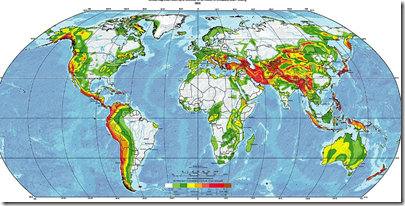
Seismically active areas of the world


# 8064


In 2005, we very nearly lost a large American city when Hurricane Katrina breeched the levees that protect New Orleans, and flooded that historic town. I was there six weeks after the storm had passed to help my brother retrieve what he could from his French Quarter apartment, and even then, having electricity and running water was the exception – not the rule.


He, along with hundreds of thousands, were forced to abandon their homes, jobs, doctors, and neighbors - with many unable or unwilling to return (see Five years after Hurricane Katrina, 100,000 New Orleanians have yet to return). 


Although the city is recovering, the physical, economic, and emotional scars are still there 8 years later. 


While it may seem like a one-off event, the reality is there are many heavily populated areas around the world that are at risk of catastrophic, long-lasting damage from either a natural or manmade disaster. 


The Chernobyl Exclusion Zone, a 1,000 square mile `dead zone’ around that stricken nuclear plant is a prime example.  Another is the (smaller) region near the damaged Fukushima Nuclear plant in Japan.  And Port-au-Prince, Haiti remains in shambles more than 3 years after that city’s 7.0 quake.


Nuclear accidents, Cat 4 or 5 hurricanes, tsunamis, and earthquakes all have the potential to cause either permanent or long-lasting damage to urban areas.  And with more and more of the worlds population congregating in cities, the impact of a major disaster to people’s lives, and the global economy, grows greater.


In December of 2011, in WHO e-Atlas Of Natural Disaster Risks To Europe, we looked at some of the seismic risks to Europe. And in April of 2011 (see UNDP: Supercities At Seismic Risk) we saw a report that stated that half of the world’s supercities (urban areas with 2 million – 15 million inhabitants) are at high risk for seismic activity. And more recently, in January of this 2012 (see UN Agency Warns On Global Seismic Risks), the United Nations International Strategy For Disaster Reduction (UNIDSR.Org) issued a cautionary warning about ignoring seismic threats.


And as Seismologist Dr. Lucy Jones reminded her audience over the weekend at the annual meeting of the American Geophysical Union (held this year in San Francisco),  should the `big one’ hit Southern California, we could literally `lose’ Los Angeles. 


Not for weeks, or months.  But perhaps, for years.


Her talk was called `Imagine America Without Los Angeles’ and she warned that the damage could be far greater, and last much longer, than most people believe.  While 99 out of 100 modern buildings might remain standing, the (often buried) infrastructure needed to provide water, electricity, internet connectivity, and natural gas – the lifeblood -  to the region could be devastated (see CBS News report).


If that sounds like hyperbole, the USGS Los Angeles Shakeout Scenario Report envisions that a highly plausible (M) 7.8 earthquake on the southern San Andreas Fault could produce the following types of infrastructure damage.


Utilities, Lifelines, and Infrastructure


Significant vulnerabilities remain in the water conveyance system and in the lifelines that cross the San Andreas Fault. Pipes of concrete and iron are brittle and break in many places in an earthquake. The number of pipe breaks will be large enough that recreating the water system will be necessary in the hardest hit areas. Because this earthquake affects such a large area, there will not be enough pipe and connectors or trained manpower to repair all the breaks quickly. The worst hit areas may not have water in the taps for 6 months. This damage to the water system will also greatly increase the problems in fighting the fires that will follow the earthquake. The cost to repair water and sewer lines will be $1 billion.


The lifelines that cross the fault will all break when the fault moves. This will disrupt the movement of water, petroleum products, telecommunications, and general transportation. Repair of the lifelines will be slowed because the lifelines all cross the fault at just a few passes in the mountains and therefore interact with each other. For instance, repairing pipelines broken at Cajon Pass will require access that depends upon repair to Interstate 15. That in turn could be delayed if a wildfire starts after damage to the electric lines in the same location.


Many roads and highways will be impassable in the first few days after the earthquake because of debris on the roads, damage to bridges, and lack of power for the traffic signals. This will have a significant negative impact on the emergency response. Because of the major highway bridge retrofit program of the last 20 years, highway bridges are not expected to completely collapse, but some will not be passable. Many bridges on local roads have not been retrofitted and more damage is expected on those.  The continuing impairment of the roads for months after the earthquake until everything can be repaired has a significant economic cost, estimated at $5 billion over one year.


In other words, for many in the region, staying after an earthquake may not be an option.  And it could be weeks, months, or even years before the city could be made whole again.  To illustrate the point, below you’ll find a video that depicts a 7.8 San Andreas earthquake in Southern California.


In 2010 (see Revised Risk Of `The Big One’ Along San Andreas Fault) we looked at a study that suggested that Southern California may be more overdue for another major quake than previously thought, and in the following year (see Estimating The Economic Impact Of A San Andreas Quake) we looked at a report from the U.S. Bureau of Labor Statistics that endeavored to gauge the crippling impact that a highly feasible (and long overdue) 7.8 magnitude Southern California earthquake would have on jobs and local businesses.

image

Download PDF file

A quake of this magnitude, they estimate, could affect  430,000 businesses and 4.5 million workers and deliver a devastating – and prolonged – blow to the local (and national) economy.


For a comprehensive guide on how you can prepare for `the big one’ (even if you live someplace other than Los Angeles), I would recommend you download, read, and implement the advice provided by the The L. A. County Emergency Survival Guide.   As you’ll notice, Los Angeles recommends more than just a 72 hour emergency kit.

image


And for some earlier blogs on the seismic hazards in the United States, and around the world, you may wish to revisit:

Just A Matter Of Time

Academics Debate Odds Of Tokyo Earthquake


While we can’t prevent natural disasters, we can prepare for them  You may not be able to do anything personally about the risks to local infrastructure, but you can ensure that you and your family have the supplies to survive for days (or better yet, a couple of weeks) if these vital services are cut or destroyed. 


For more information on emergency preparedness, I would invite you  to visit:

FEMA http://www.fema.gov/index.shtm

READY.GOV http://www.ready.gov/

AMERICAN RED CROSS http://www.redcross.org/


And some of my preparedness blogs, including:
When 72 Hours Isn’t Enough

The Gift Of Preparedness: 2013

In An Emergency, Who Has Your Back?